
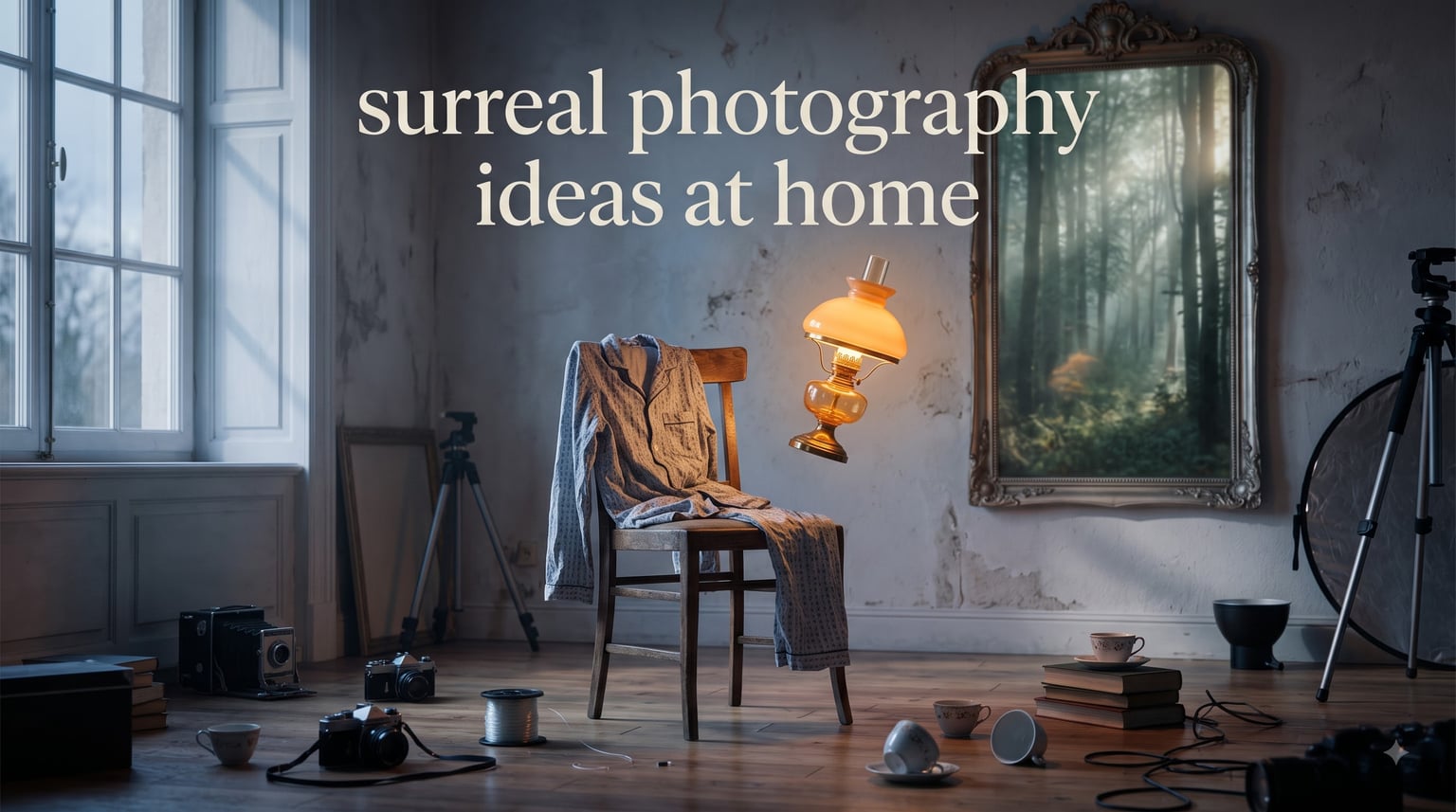
I spent three months photographing dreamlike scenes in my own living room before I realized surreal photography does not need a studio, a model, or a fat budget. It needs a question. What if reality behaved differently? That single question turned empty walls into floating hallways, ordinary fruit into portals, and a glass of water into a doorway. If you have ever wondered whether you can make genuinely surreal images at home, this guide is your permission slip.
Surreal photography is a genre that combines real-world elements with imaginative, dreamlike, or impossible scenarios to create images that feel believable yet defy reality. Rooted in the early 20th-century Surrealism art movement, it uses in-camera techniques, composition, and editing to challenge perception. Below I will walk you through what surrealism actually means, how to come up with ideas, and 20 concrete surreal photography ideas at home you can shoot this weekend.
Table of Contents
What Is Surreal Photography? A Quick Definition
Surreal photography is the visual cousin of the Surrealist movement that started in Paris in 1924, when poet Andre Breton published his first Surrealist Manifesto. Painters like Salvador Dali and Rene Magritte made the movement famous on canvas, but photographers like Man Ray, Dora Maar, and Hans Bellmer were doing the same thing with cameras almost immediately.
The genre has two flavors. Veristic surrealism tries to look like a normal photo with one impossible element – a floating chair, an oversized moth, a face that looks identical to the back of a head. Absolute surrealism leans into abstraction, dream logic, and visual puzzles. Most home shooters end up in the veristic camp because it reads instantly and you can pull it off with one prop and good light.
Concept First: The Method That Changes Everything
Most surreal photography tutorials jump straight to techniques. Double exposure, levitation, photomontage, blah blah. Those are tools, not ideas. The reason most beginners get stuck is they reach for a tool with nothing to say.
Here is the framework I use and teach. It takes 10 minutes and replaces creative block with a clear shot.
Step 1: Pick three mood words. Examples: floating, fading, glitchy, liquid, ritual, abandoned, overgrown, weightless. Write them down.
Step 2: Pick a single anchor subject. A person, a fruit bowl, your own face, a chair. One subject per shot keeps the eye from wandering.
Step 3: Pick one impossible element. A floating object, a giant version of a small thing, a shadow pointing the wrong way. This is the joke of the photo.
Step 4: Walk around your home and choose props. Match your mood words to what you already own. Bed sheets, mirrors, water glasses, lamps, fish tanks, scissors, kitchen foil, fishing line. Almost anything will do.
Step 5: Light it like a movie still. Surreal does not mean messy. The more unusual the idea, the more controlled the lighting should be. Window light, a single lamp, or a flashlight with a colored gel will carry the mood.
I have used this exact workflow to make surreal images in a 12 by 12 foot spare bedroom, a kitchen with the lights off, and a bathtub with a single sheet of black cardboard behind it. The room size never matters. The concept does.
20 Surreal Photography Ideas at Home You Can Try Today
Here is the core list. Every idea includes the concept, the props you probably own, the simplest technique, and a no-Photoshop alternative so you are not stuck if you do not edit.
1. Floating Objects (Levitation Photography) – Tie or tape a small object with thin fishing line, hang it from a ceiling hook or tape a clear thread across the frame. Shoot against a plain wall so the line almost disappears. A small stool or a hidden chair works as the support you later mask out, or you can leave the line visible for a more theatrical look.
2. Giant Hands Holding Tiny People – Photograph your own hand close to the lens, then shoot a small figure (a doll, a Lego, or a friend far away at the end of the room). Composite in any free app or print them as Polaroids stacked. No Photoshop needed if you simply hold a small toy against your real palm and shoot in macro.
3. Reflections That Tell a Different Story – Place a small mirror on the floor and reflect a sky poster, a window, or a lamp while the real scene is dark. The mirror becomes a portal to a second world inside your own room.
4. Underwater in a Bathtub – Drop fruit, flowers, fabric, or your own arm into a clear glass bowl or a bathtub full of water. Shoot through the side with a waterproof pouch or press your lens directly against the glass. Lighting from above the waterline creates a shadow layer that sells the dream.
5. Double Exposure Self-Portrait – Set your camera to multiple exposure mode (most mirrorless and DSLR bodies have it). Layer two shots of yourself – one in focus, one slightly moved or with a translucent fabric over your face. The result is a ghost-like, dreamlike portrait.
6. Forced Perspective Scale Play – Make a friend stand far away in your hallway while you hold a toy car or a thimble close to the lens. They look giant, the car looks like a monument. Telephoto lenses exaggerate this. Phones can do it too with a little zoom.
7. Shadows as Characters – Use a hard light source like a desk lamp or a flashlight to throw a sharp shadow on a wall. Pose so the shadow does something the body cannot – stretches, multiplies, points in a different direction. The shadow becomes the subject.
8. The Portal in a Mirror – Lean a tall mirror against a wall, then photograph the room with the mirror at a sharp angle so the reflection shows a totally different scene (a window with curtains drawn behind you, a lamp aimed at it). The mirror becomes a window to another version of your room.
9. Floating Fabric Like Water or Smoke – Throw a thin white sheet upward and shoot on a long exposure (1 second or more). Use a dark room with a single bright window or lamp. The fabric freezes mid-air as waves, ghosts, or water.
10. Food as Architecture – Build tiny towers of crackers, pasta, or bread. Photograph them up close with a wide aperture and place a person far behind. The pasta city becomes a skyline, the person becomes a giant.
11. Long Exposure Light Drawing – In a dark room, set a 10 to 30 second exposure on a tripod. Use a flashlight, a phone screen, or sparklers to draw shapes in the air while the camera is open. You become both the painter and the canvas.
12. Juxtaposition With Household Items – Put an object where it does not belong. A single shoe on a dinner plate. A fish bowl on a bed. A teacup balanced on a doorknob. Strong surreal images come from one absurd pairing, not five.
13. Multiple Faces, One Body – Wear the same outfit, shoot yourself in three positions on a tripod, and stack the frames in a free collage app. The result is a creature with three faces, a recurring nightmare theme used by painters for centuries.
14. Smoke and Colored Light – Light incense or burn a piece of paper under controlled conditions (a metal bowl, a window cracked open). Shine a colored gel or a flashlight through a colored plastic bag. You get swirling, painted smoke at the cost of a single match.
15. Doorway to Another Room – Hang a printed photo of a forest, ocean, or desert scene in a doorframe. Step back so the photo fills the door and a person stands in the foreground. The illusion reads instantly, no editing needed.
16. The World Inside a Glass – Photograph a small scene inside a wine glass, fishbowl, or jar. Stack books to hold the glass, place a tiny model inside, and shoot through the glass edge. The world inside the glass becomes a snow globe or a contained universe.
17. Fading Into the Wall – Dress in the same color and texture as your wall. With soft, even light, you appear to dissolve into the background. Paint a backdrop cloth in your wall color for a stronger effect.
18. A Room Overflowing With One Object – Fill a small room corner with one repeated object: apples, shoes, books, plastic cups. Shoot wide. The repetition reads as obsessive, dreamlike, and slightly unsettling.
Bonus idea 19. Sleepwalker Self-Portrait – Set a 10 second timer, lie in bed, eyes closed. Have a friend stand just out of frame holding a flashlight aimed at your face. The composition becomes a quiet, eerie dream scene.
Bonus idea 20. The Tiny Storm in a Teacup – Photograph swirling tea or coffee from above. Drop food coloring in for instant clouds. With a fast shutter, you freeze ripples that look like satellite images of storms.
In-Camera Techniques That Make Surreal Photos Easier
Techniques are the muscles. Concepts are the brain. Here are the five techniques I lean on most when shooting surreal photography at home.
Long exposure. Lets you paint with light, freeze motion in fabric, or blur a moving subject into a ghost. Most cameras handle 1 to 30 seconds on a tripod. If you do not have a tripod, balance the camera on a stack of books.
Multiple exposure / double exposure. Combines two or more frames into one in-camera image. Found on most mirrorless and DSLR bodies. Great for portraits where one frame is sharp and the other is a soft ghost or a totally different scene.
Levitation support. Fishing line, a clear plastic stand, or simply holding the object just out of frame. Shoot from a low angle so the line is hard to spot. Even leaving the line visible can feel deliberate and theatrical.
Forced perspective. Move closer or further to manipulate apparent size. A wide angle makes nearby objects look giant. A telephoto compresses a faraway friend into the palm of your hand.
Reflection tricks. Mirrors, water, glass, phone screens, polished metal. Anything shiny can become a portal, a second face, or a window into another version of your scene.
Camera Settings Cheat Sheet for Surreal Photography at Home
Here is the simplest starting point I give to anyone shooting at home. Adjust based on the light you actually have.
Window light, static subject: Aperture f/5.6 to f/8, shutter 1/60 to 1/125, ISO 100 to 400. Shoot in RAW so you have room to push shadows and pull highlights later.
Low light, moody: Aperture f/1.8 to f/2.8, shutter 1/30 (use a tripod below this), ISO 800 to 1600.
Long exposure light drawing: Aperture f/8 to f/11, shutter 10 to 30 seconds, ISO 100. Tripod mandatory.
Double exposure: Aperture f/4 to f/8, shutter 1/60 to 1/200, ISO 200 to 800. Bracket by stop so your two exposures blend cleanly.
Floating object shots: Aperture f/8 for edge-to-edge sharpness, shutter 1/125 to freeze any tiny sway, ISO 100.
Lighting Your Home Like a Surreal Set
Lighting is the secret sauce. A great concept with flat overhead lighting looks like a school photo. The same concept with one window, one lamp, and a piece of black cardboard to block spill looks like a gallery print.
Window light is your best free tool. Face the window for soft, even light. Turn 90 degrees to it for a dramatic shadow. Turn away from it for a silhouette. Cover half the window with a sheet to soften it further.
Desk lamps, phone flashlights, and Christmas string lights are your colored and hard light sources. Tape a piece of colored plastic or tissue over a flashlight for instant gels. Aim a bare bulb at a wall to bounce light softly without buying a softbox.
Use shadow deliberately. Turn off all lights, place one small lamp low and to the side, and let the shadows do the storytelling. Surreal photography has always used shadow as much as light.
Shooting Solo: Self-Portrait Tips for One-Person Surrealists
If you are alone, and most home surreal shooters are, here is how to make self-portraits without losing your mind. Use a 10-second timer, a phone app that triggers your camera remotely, or a cheap wireless remote. Mark the floor with tape so you can stand in the same spot every retry.
Frame wide, then crop later. You can always zoom in. You cannot add space you did not leave around yourself. Shoot a test frame of just the room before you start posing so you can check the lighting, the focus point, and the background.
Composition matters more than face. Most surreal self-portraits work because of the body language, the angle, or the prop. Your face can be soft focus, half turned, or even hidden. Many Brooke Shaden-style surreal portraits hide the face entirely behind fabric, hair, or a hand.
Common Beginner Mistakes and How to Fix Them
The photo looks fake instead of surreal. Usually the lighting does not match between the subject and the impossible element. Shoot the floating object and the room in the same session, ideally with the same light source. If the shadows point different ways, the brain screams fake.
The idea feels like every other surreal photo online. The fix is concept first. Pick a personal mood word from your own week – lonely, slow, electric, overgrown – and find a prop that matches that word for you. Personal ideas look fresh because they are.
The image is too busy. One impossible element per shot. Two at the very most. Surreal photography rewards restraint.
You can see the fishing line, the tape, the chair. Good. Keep it. Visible construction is a whole art style. Photographers like John Dykstra have built careers on clearly visible practical effects. The line becomes part of the joke.
You forgot to shoot in RAW. RAW files keep way more shadow and highlight detail. You can rescue an underexposed moody shot in a way JPEG simply cannot. Set RAW plus JPEG if storage is tight.
Surrealist Photographers Worth Following for Inspiration
If you want a steady drip of surreal photography ideas at home, follow these artists and study their portfolios. Brooke Shaden shoots elaborate surreal self-portraits in her home with practical effects and household props. Dina Belenko shares tricks that turn the ordinary into the impossible. Man Ray and Dora Maar are foundational reads from the original Surrealism movement. Rene Magritte and Salvador Dali are painters, but their visual logic is a free masterclass in surreal ideas.
Frequently Asked Questions
Can you give me some examples of surreal photography?
Classic examples include floating chairs inside ordinary rooms, oversized moths on faces, reflections showing impossible scenes, portraits where the body dissolves into a wall, and still-life setups where ordinary objects appear enormous next to tiny human figures. Look at the work of Man Ray, Brooke Shaden, and Dina Belenko for hundreds of visual references.
How can I create surreal photos at home?
Pick a mood word, choose one anchor subject, add one impossible element, then light the scene like a movie still. Use household props, window light, and simple techniques like levitation with fishing line, forced perspective, double exposure, and reflection mirrors. Most surreal photography at home uses no studio and no Photoshop.
What are some creative photography ideas I can do at home?
Try levitation with fishing line, double exposure self-portraits, bathtub underwater scenes, long exposure light drawing, forced perspective scale play, shadow characters on walls, mirror portals, smoke with colored gels, doorway portals using printed photos, and overflow rooms filled with one repeated object.
How do you make a photo look surreal?
Introduce one impossible element into an otherwise realistic scene. Match the lighting between the real and impossible parts, anchor the composition with one clear subject, and choose a mood word to guide your props and color palette. Strong surreal images feel dreamlike, symbolic, and slightly impossible, yet still visually believable.
How do surrealists come up with ideas?
Surrealists draw ideas from dreams, personal memory, philosophical questions, word games, and unlikely pairings of everyday objects. A practical method: pick three mood words, then find one anchor subject and one prop that does not belong. The friction between ordinary and impossible is where the idea lives.
What is a surreal photo?
A surreal photo is an image that feels believable yet defies reality. It uses real subjects, real light, and real composition but includes one impossible element such as a floating object, a mismatched shadow, a giant version of a small thing, or a reflection that shows a different world.
Final Thoughts: Your Home Is Already a Surreal Set
Surreal photography at home is one of the most freeing creative practices you can start this week. You do not need gear, money, a model, or a fancy room. You need a question, one anchor subject, one impossible element, and the discipline to light the scene like a movie still. Start with one of the 20 surreal photography ideas at home above and shoot it before you read another article. The strongest surreal images come from people who actually pressed the shutter, not from those who kept planning the perfect shot.
If you make anything from this guide, I would love to see it. The surrealist tradition was built on artists sharing their strangest dreams with the world. Yours is next.