
If you have ever scrolled Pinterest looking for surreal fashion aesthetic outfit ideas and felt like every result looked the same, you are not alone. The surrealist movement started in 1924 Paris with André Breton’s manifesto, and more than a century later it is having a genuine comeback in everyday wardrobes.
I have spent the past few months collecting surrealist outfit inspiration from runway archives, Etsy artists, and Reddit threads. This guide covers what surreal fashion actually is, where it came from, and eight concrete outfit ideas you can build today. We will also cover how to wear surrealist details without looking like you are heading to a costume party, plus the contemporary designers shaping the look right now.
Table of Contents
What Is Surreal Fashion Aesthetic?
Surreal fashion aesthetic is a style of dress that translates the dreamlike, irrational visual language of the Surrealist art movement into wearable clothing. It uses trompe-l’oeil prints, exaggerated silhouettes, unexpected juxtapositions, and recurring motifs like melting clocks, single eyes, disembodied lips, and lobsters printed across unexpected surfaces. The goal is not to dress up as a painting but to borrow the artist’s instinct for visual surprise and apply it to the body.
The easiest way to recognize surrealist fashion in the wild is to look for one detail that feels slightly off. A perfectly tailored blazer with an anatomical heart embroidered where a pocket should be. A simple slip dress printed with clouds that appear to be inside the fabric rather than on top of it. A pair of plain loafers with a tiny, sculptural heel shaped like a melting candle. That single moment of cognitive friction is the signature of the look.
Signature Elements at a Glance
- Trompe-l’oeil prints: fabric that tricks the eye into seeing depth, flesh, or objects that are not there.
- Exaggerated silhouettes: shoulders that extend past the natural line, hips padded into curves, hems dropped to theatrical lengths.
- Surreal motifs: eyes, lips, melting clocks, hands, lobsters, butterflies, and clouds repeated like symbols in a private language.
- Optical illusion: stripes that warp, patterns that shift as you walk, color blocks placed to confuse the eye.
- Unexpected juxtapositions: a business shirt paired with a sculptural skirt, evening gloves worn with daytime denim, pearls layered over a torn tee.
A Brief History of Surrealism in Fashion
The Surrealist movement was officially launched in 1924 when French poet André Breton published the first Surrealist Manifesto. The goal was to free creative thought from rational control and reach what Breton called “the absolute reality” of the unconscious mind. Within a decade, visual artists like Salvador Dalí, René Magritte, and Meret Oppenheim were producing paintings and objects that looked like scenes from dreams.
Fashion was one of the first industries to respond. Italian designer Elsa Schiaparelli opened her Paris couture house in 1927 and became the unofficial couturière of the Surrealist circle. Her 1937 collaboration with Dalí produced two of the most quoted pieces in fashion history: a white evening gown with a giant crimson lobster painted across the skirt, and a felt shoe repurposed as a hat, with its heel turned upward like a cut-out question mark. Both pieces were technically garments, but they read as jokes, puzzles, and small acts of rebellion all at once.
Through the 1940s and 1950s, surrealist fashion softened into wearable proportions, but the visual vocabulary kept resurfacing. Cristóbal Balenciaga sculpted silhouettes that bent the body’s natural line. Designers like Hubert de Givenchy and later Yves Saint Laurent referenced Magritte’s apples and bowler hats in editorial styling.
The 1980s and 1990s brought a louder chapter. Thierry Mugler and Jean Paul Gaultier turned the runway into theater with car-shaped dresses, conical bras, androgynous tailoring, and collections built around alien anatomy. Alexander McQueen in the late 1990s and 2000s pushed the surrealism toward darker emotional terrain, with skull motifs, feathered creatures, and the now-legendary Armadillo shoes.
Today, surrealist fashion is no longer the sole property of couture houses. Independent artists on Etsy, vintage sellers on Depop, and fast-fashion labels all trade in surrealist details. That accessibility is the biggest reason the look has crossed over into everyday style.
Signature Visual Elements of Surrealist Fashion
Before we get into the outfit ideas, it helps to have a shared vocabulary. These are the visual moves that show up most often in surrealist collections, vintage pieces, and modern street-style surrealism.
- Trompe-l’oeil: the French phrase for “deceives the eye.” In surrealist fashion this usually appears as prints that imitate skin, muscle, fabric folds, or absent body parts. A knit sweater printed to look like a muscled torso is a classic example.
- Exaggerated proportions: shoulder pads that double the natural shoulder, hips exaggerated with peplums, or trousers that pool several inches past the shoe. The body becomes a starting point, not a limit.
- Surreal motifs: the eye, the lip, the hand, the cloud, the melting clock, the lobster, and the bird. These function like recurring characters in a film.
- Warped prints: plaids that shift in scale, polka dots that fade into solid color, houndstooth that stretches. The pattern itself behaves strangely.
- Misplaced objects: jewelry shaped like everyday items (a bracelet that looks like a twisted paper clip, earrings that look like teacups) and accessories designed to be slightly confusing on first glance.
Surreal Fashion Aesthetic Outfit Ideas: 8 Looks to Try
This is the section most surrealist guides skip entirely. Below are eight concrete outfit formulas built from real pieces you can source from a mix of Etsy artists, vintage sellers, and contemporary labels. Each look pairs one surrealist statement with the simplest possible supporting cast.
1. Dopamine Surreal
Dopamine surrealism is the bright, candy-colored branch of the look. Start with a colorful knit dress or matching two-piece in saturated pink, orange, or electric blue. Add a single surrealist accessory: a handbag shaped like a melting ice cream, sculptural platform shoes in a contrasting color, or a pair of earrings shaped like hands holding tiny objects. Keep the hair and makeup simple so the color and shape do the work.
2. Y2K Surreal
Y2K surreal leans into the early 2000s mood: low-rise trousers, baby tees, butterfly clips, and tiny shoulder bags. The surrealist twist comes from choosing one piece with an oversized motif, like a tee printed with a giant mouth or a pair of jeans with a trompe-l’oeil belt buckle. Finish with tinted sunglasses and silver jewelry.
3. Gothic Surreal
Gothic surrealism borrows from romantic gothic literature as much as from Dalí. Black velvet, deep burgundy, antique silver jewelry, and lace are the building blocks. The surrealist detail is a piece that feels slightly unsettling: a choker with a tiny anatomical heart, a black dress with white eyeball embroidery at the cuff, or velvet gloves with bone-shaped rings stacked over the fabric.
4. Soft Surrealist
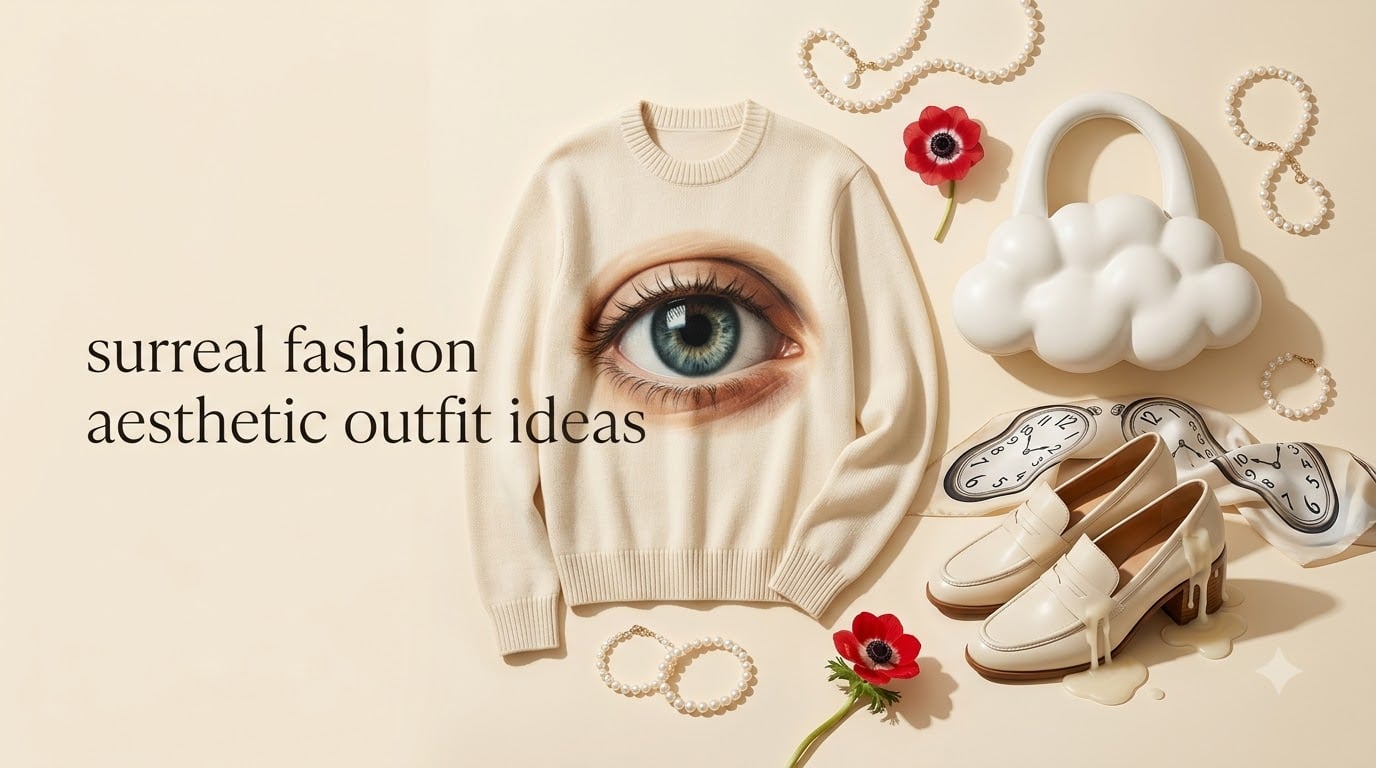
Soft surrealism is the most wearable version of the look and a good starting point if you are curious but cautious. Pastel knit sets, slip dresses in dusty rose, cream trousers, and cream knitwear form the base. Add one surrealist element in a similar palette, like a handbag shaped like a cloud, pearl jewelry arranged in unusual clusters, or a pair of loafers with sculptural curved heels.
5. Statement Surreal (for a surrealist party or gallery opening)
When the occasion actually calls for surrealist dress, build the outfit around one hero piece. A sculptural jacket with exaggerated shoulders, a gown with a trompe-l’oeil print, or a dress with a giant 3D appliqué of an eye, flower, or hand. Let everything else recede: simple shoes, clean hair, minimal jewelry. This is the rule the stylists I spoke with kept repeating.
6. Vintage Mugler-Inspired
Thierry Mugler’s 1980s and 1990s collections are the closest mainstream fashion ever came to literal wearable sculpture. You can echo the look without buying vintage couture: a sharply cut blazer with strong shoulders, a high-waisted skirt with an exaggerated hip, and one accessory in metallic or animal-print leather. Vintage markets, Etsy, and curated resale platforms are the best sources for original pieces.
7. Etsy Artist Surreal
Independent makers have built an entire cottage industry around surrealist clothing, from hand-painted denim jackets to knitwear featuring melting clocks and disembodied eyes. Pair one of these pieces with everyday basics, like straight-leg jeans, a simple tee, and white sneakers. The independent artist element gives the look its story without forcing you into a costume.
8. Minimalist Surreal
Minimalist surrealism proves the look does not require color, print, or volume. Take a perfectly tailored black suit or a column dress in a neutral tone. Add one sculptural accessory in an unexpected material, like brushed steel, smoke-colored resin, or raw concrete. This is the version of surrealism most often seen on contemporary fashion editors, and it travels beautifully into office and evening settings.
How to Wear Surreal Fashion in Everyday Life
The single biggest mistake people make when they try surrealist style is doing too much at once. Below are the rules I keep coming back to when I am building an outfit with surrealist elements.
- Let one piece do the heavy lifting. Pick a single surrealist statement, whether that is the dress, the bag, or the shoe, and build everything else around basics. Head-to-toe surrealism reads as costume.
- Anchor with neutral basics. Black trousers, white tees, denim, and cream knitwear are the quiet foundation that lets a surrealist detail shine.
- Balance volume. If the top is exaggerated, keep the bottom streamlined. If the silhouette is wide, choose a closer-fitting bag and shoe.
- Match surrealism to the occasion. Save the loudest pieces for art openings, parties, and creative offices. Keep daytime surrealism to a single accessory or motif.
- Use vintage and thrifted pieces strategically. A vintage 1980s blazer or a thrifted scarf with a surrealist print can carry an entire outfit that would otherwise feel ordinary.
- Build by budget tier. Start with Etsy, Depop, and thrift for the surrealist details. Add one mid-tier investment piece a season if you love the look. Save designer surrealism (Schiaparelli, Iris van Herpen) for the pieces you will wear for years.
- Wear surrealism at any size. Surrealist style is about proportion and detail, not body shape. Look for pieces that fit your frame and skip anything that fights your comfort.
Contemporary Designers Defining Surreal Fashion Today
The surrealist tradition is alive and well on the runway. Daniel Roseberry, the creative director of the house Schiaparelli since 2019, has rebuilt the brand’s surrealist legacy around anatomical gold jewelry, sculptural busts, and gowns that look like classical sculpture meeting cartoon logic. His viral gold-tooth and gold-lung pieces have appeared on the red carpet on Beyoncé, Cardi B, and Doja Cat.
Iris van Herpen continues to lead the technical end of surrealist fashion, blending 3D printing, laser cutting, and bioluminescent materials into dresses that look more like sea creatures than clothing. Alexander McQueen’s legacy is carried forward by Sarah Burton and the current creative team, who keep the house’s surrealist vocabulary of dramatic tailoring and anatomical references alive.
Jonathan Anderson at Loewe has quietly built a softer surrealist vocabulary: surrealist-shaped bags (the Puzzle bag, the egg-shaped clutch), dresses printed with hyperrealistic anemones, and shoes that look like they were molded from clay. Thom Browne, Viktor & Rolf, Collina Strada, and Comme des Garçons all work in adjacent territory, building on the surrealist tradition with their own signatures.
Frequently Asked Questions
What are examples of surreal fashion?
Surreal fashion examples include Elsa Schiaparelli and Salvador Dali’s 1937 Lobster Dress, a white evening gown with a giant crimson lobster painted across the skirt, and the matching Shoe Hat. Other canonical examples include Iris van Herpen’s 3D-printed dresses, Alexander McQueen’s Armadillo shoes, Thierry Mugler’s car-shaped gowns, and modern trompe-l’oeil knitwear that imitates skin or muscle.
What do you wear to a surrealist party?
Pick one surrealist hero piece and let everything else stay simple. A sculptural jacket with exaggerated shoulders, a gown printed with a trompe-l’oeil pattern, or a dress with a 3D motif like an eye, flower, or hand works well. Pair it with simple shoes, clean hair, and minimal jewelry so the statement piece reads as fashion rather than costume.
What are some tips for styling a surrealism outfit?
Let one piece carry the surrealist detail while the rest of the outfit stays in basics. Anchor with neutral pieces like black trousers, white tees, denim, or cream knitwear. Match the occasion by saving loud pieces for parties and creative settings, and keep daytime surrealism to a single accessory or motif.
How to wear aesthetic clothes?
To wear aesthetic clothes well, choose one clear theme per outfit, balance a single statement piece with quiet basics, and keep proportions intentional so volume on top pairs with streamlined bottoms. Mood-board your look on Pinterest or a saved folder first so the details feel cohesive rather than random.
Is surrealism making a comeback in fashion?
Yes. Surrealism is having a clear comeback in fashion in 2026, with runway houses like Schiaparelli, Loewe, and Iris van Herpen leaning into surrealist motifs and independent artists on Etsy and Depop making surrealist pieces accessible for everyday wear. The look has also spread through TikTok and Pinterest, where sub-styles like dopamine surreal, Y2K surreal, and gothic surreal are widely shared.
Final Thoughts
Surreal fashion aesthetic outfit ideas work because the look is built around personal expression, not conformity. Whether you start with a single surrealist accessory or rebuild your whole wardrobe around the look, the rule is the same: one statement piece, simple supporting cast, and a willingness to let your clothes tell a small story.
If you only try one look from this guide, start with Soft Surrealist or Minimalist Surreal. Both are wearable, both translate easily into everyday settings, and both leave room to grow into louder versions of the aesthetic as you get comfortable. Surrealist fashion rewards experimentation, and the best surreal fashion aesthetic outfit ideas are the ones that feel most like you.