
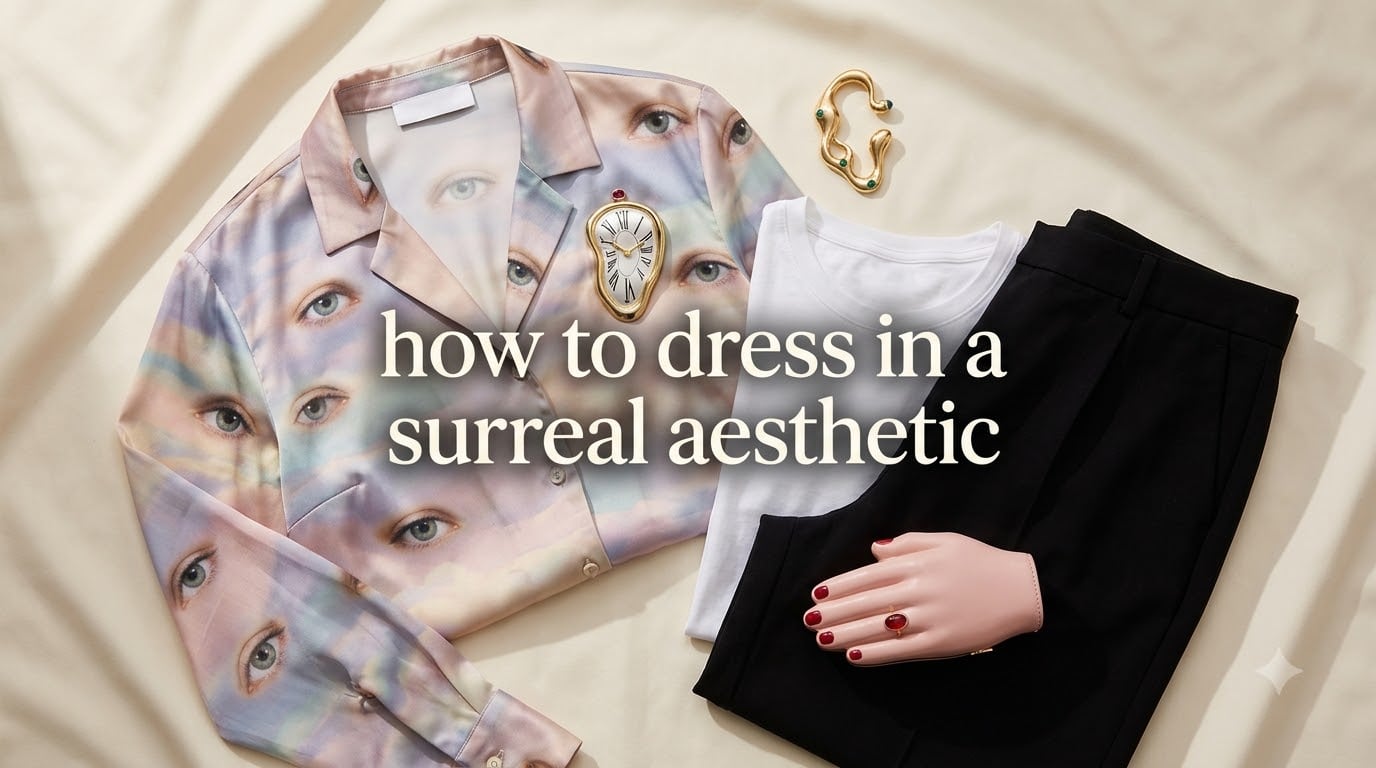
Learning how to dress in a surreal aesthetic is easier than the runway photos make it look. Surrealist fashion is simply clothing that behaves like a dream — distorted proportions, optical-illusion prints, sculptural accessories, and motifs borrowed straight from Salvador Dalí, Elsa Schiaparelli, and Iris van Herpen.
In this guide, I’ll walk you through the visual cues that signal “surreal,” a beginner-friendly 7-step method to build a wearable surreal outfit, palette and occasion breakdowns, plus DIY tricks that keep the look budget-friendly.
By the end, you’ll have a clear plan for surreal dressing — from everyday basics to a fully-costumed festival look — without ever feeling like you’re wearing a Halloween costume.
Table of Contents
What Is the Surreal Aesthetic in Fashion?
The surreal aesthetic in fashion is a style built on dreamlike, distorted, or visually impossible elements — the kind of details that make someone stop and ask, “How is that even real?” It comes from the Surrealism art movement of the 1920s, which Salvador Dalí, René Magritte, and Man Ray founded on the idea of releasing the unconscious mind. Fashion took those ideas and translated them into fabric: melting clocks, oversized eyes, trompe l’oeil prints, exaggerated shoulders, shoes shaped like lips, and garments that look half-finished on purpose.
Surreal fashion is not the same as avant-garde fashion, though they overlap. Avant-garde means experimental or boundary-pushing; surreal specifically leans into dreamlike, illusionary, or psychologically charged imagery. A plain deconstructed blazer is avant-garde. A blazer printed with floating eyeballs over a desert is surreal.
What makes the surreal aesthetic recognizable on the street is a small set of visual signatures. If a look has at least two or three of these, it reads as surreal:
- Illusion or trompe l’oeil prints (fabric that looks like skin, sky, liquid, or another garment)
- Exaggerated or impossible proportions (shoulders past the ears, sleeves past the fingertips, hats wider than the shoulders)
- Sculptural, three-dimensional accessories (clock brooches, ear cuffs that climb past the jawline, necklaces shaped like hands)
- Iconic Surrealist motifs: melting clocks, single large eyes, lobsters, birds, apples, mannequins, lips, hands, hourglasses
- Bold or “wrong” color blocking that doesn’t quite match reality
- A single focal piece that looks like it walked out of a painting
A Brief History of Surrealist Fashion
Surrealist fashion began as a private conversation between two artists in 1930s Paris. Elsa Schiaparelli, an Italian designer known for treating clothes like jokes and puzzles, began collaborating with Salvador Dalí in 1937. The first result was the famous “Lobster Dress” — a white evening gown printed with a giant red lobster across the front. Schiaparelli and Dalí also made a hat shaped like an upside-down shoe (the “Shoe Hat”) and a suit covered in drawer prints (“Skeleton Dress”).
Magritte entered fashion through his paintings of bowler hats, floating apples, and faceless figures. René Magritte’s “The Son of Man” — a man in a bowler hat with a green apple over his face — became one of the most quoted images in modern surrealist design.
The movement faded from couture after World War II and lived mostly in editorial photography until the 1990s, when Alexander McQueen revived the dreamlike silhouette on the runway. McQueen’s “Voss” show (2001), with its padded cell set and Shalom Harlow sprayed by robots, brought surrealist theatre back to fashion.
Today, the surreal aesthetic is carried by Dutch designer Iris van Herpen (known for 3D-printed gowns that look like water, smoke, or bone), Viktor & Rolf’s sculptural collections, and indie labels that remix old surrealist motifs into wearable streetwear.
Core Visual Elements That Define the Surreal Aesthetic
Surreal dressing lives or dies on a small toolkit of visual cues. You don’t need every element at once — one or two well-chosen signatures will read as surreal almost anywhere. These are the building blocks I’d recommend knowing:
- Illusion prints. Trompe l’oeil fabric that looks like skin, marble, sky, water, or a second layer of clothing. The eye doesn’t know where to land, which is the whole point.
- Exaggerated proportions. Shoulders past the ears, sleeves past the fingertips, hats wider than the body, shoes with platforms so tall they shift the walk. Surreal clothing often ignores “flattering” on purpose.
- Sculptural accessories. Three-dimensional pieces that behave like wearable sculptures — clock brooches with hands that move, ear cuffs that climb toward the temple, rings shaped like tiny hands or eyes.
- Iconic motifs. Melting clocks (Dalí’s “The Persistence of Memory”), single large eyes, lobsters, birds, apples, mannequins, hourglasses, lips, hands. One clear motif is usually enough.
- “Wrong” color blocking. Combinations that feel slightly off — pastel pink with deep forest green, mustard with lavender, monochrome black broken by a single shock of red. The eye reads it as a dream.
- Statement headwear. Wide-brim hats, sculptural veils, headpieces that look like clouds, feathers, or architecture. Schiaparelli used the head as a canvas; so do modern surrealists.
- One focal piece that looks “impossible.” A bag shaped like a book, gloves that look like hands, shoes that look like hooves. One strong focal piece anchors the whole outfit.
How to Dress in a Surreal Aesthetic – Step by Step
The fastest path into surreal dressing is the 3-3-3 starter rule: pick one statement piece, three surreal details, and three grounded basics. From there, you scale up or down depending on the occasion. Here’s the full 7-step method I use when I build a surreal look from scratch:
Step 1 – Pick one focal surreal piece. Start with the strongest item you own or can find. This could be an illusion-print blouse, a sculptural earring, a melted-clock brooch, a dress printed with giant eyes, or shoes shaped like something they shouldn’t be. Everything else in the outfit supports this one piece.
Step 2 – Build a neutral base around it. Surreal pieces need quiet companions. Black trousers, a simple white tee, a long black slip dress, plain denim, a clean trench — anything that lets the focal piece speak without competing. A common mistake is layering two surreal items at once; it muddies the message.
Step 3 – Add one surreal accessory on top. Pair your focal piece with one supporting surreal detail: a clock brooch on a black lapel, an eye-motif ring, an ear cuff that climbs the ear, a hand-shaped bag. Two surreal touches is a surreal outfit; five is a costume.
Step 4 – Choose a palette and stay inside it. Pick one of the palettes below (pastel dreamscape, monochrome illusion, or jewel-tone surrealism) and let every piece respect it. Surreal works best when the color story is tight.
Step 5 – Style the hair and makeup to match. A simple surreal outfit gets a 30% visual boost from one unusual beauty choice — graphic eyeliner, a painted face motif, a slicked-back avant-garde updo, or a single red lip. I’ll cover specific looks in the makeup section below.
Step 6 – Test the outfit in a mirror from 3 feet away. Step back and squint. You should still see one clear surreal focal point. If everything is loud, dial back the loudest item.
Step 7 – Decide the occasion and adjust intensity. A surreal outfit for a Tuesday coffee run should have one surreal detail. A surreal outfit for a gallery opening can carry three. The 3-3-3 framework scales with the event.
Surreal Color Palettes to Build Your Outfit Around
Surrealism has three signature color worlds. Pick one and let the rest of the outfit stay inside it.
- Pastel dreamscape. Soft sky blue, powder pink, butter yellow, mint, cream, and dusty lavender. This is the “dreamcore” surreal palette — Magritte skies, Dali clouds, candy-bright illusion prints. Best for spring, festival, date night, and softer surreal looks.
- Monochrome illusion. All black, all white, or all cream with one surreal texture or print breaking the surface. Black with a single red lip. Cream with a melting-clock handbag. This is the most wearable surreal palette and works at the office or any daytime event.
- Jewel-tone surrealism. Deep emerald, sapphire, ruby, plum, mustard, oxblood. Inspired by Van Herpen, McQueen, and Viktor & Rolf’s evening surrealism. Best for parties, theatre, and full-on dramatic surreal outfits.
Surreal vs Whimsical vs Dreamcore vs Dark Academia
Surrealism is often confused with three adjacent aesthetics. Here’s a clear comparison so you can pick the look that matches your mood — or mix them without losing the surreal thread.
| Aesthetic | Mood | Palette | Key Motifs | Signature Silhouette |
|---|---|---|---|---|
| Surreal | Dreamlike, psychologically charged | Any palette, often monochrome or pastel | Melting clocks, eyes, lobsters, trompe l’oeil prints | Exaggerated proportions, sculptural accessories |
| Whimsical | Playful, storybook, nostalgic | Soft pastels, florals, candy colors | Fairy wings, ribbons, embroidery, mushrooms, stars | Puff sleeves, Peter Pan collars, tulle, lace |
| Dreamcore | Hazy, liminal, nostalgic-fantasy | Faded pastels, washed-out neutrals | Empty rooms, clouds, VHS textures, soft focus | Soft oversized layers, vintage basics |
| Dark Academia | Scholarly, moody, classical | Brown, oxblood, charcoal, cream | Books, statues, candlelight, plaid, tweed | Tailored blazers, long skirts, layered knitwear |
The clearest line: surreal uses imagery that feels impossible or psychologically strange; whimsical uses imagery that feels cute or fantasy-sweet; dreamcore uses imagery that feels faded or liminal; dark academia uses imagery that feels classical and literary.
Surreal-Inspired Makeup and Hair
Surrealist fashion was always about the face as much as the body. Man Ray photographed faces painted with white streaks; Magritte painted floating apples over bowler hats; modern surrealists treat the face as another canvas. None of these looks take more than 10 minutes.
- Graphic eyeliner. A thick, floating line drawn above the crease, geometric shapes past the outer corner, or a single line that extends past the temple. Anything that breaks “normal” eyeliner reads as surreal instantly.
- Painted face motif. A single small eye painted on the cheek, a tiny clock hand at the corner of the mouth, a teardrop in an unexpected color. One motif is plenty.
- Avant-garde updo. A slicked-back bun wrapped with a single black ribbon, hair sculpted into a low wave with gel, or a ponytail that ends in a sculptural clip. The hair is a shape, not a flow.
- Single-shade skin. Either very matte and pale or very monochromatic (full face of one unusual color, like lavender or green) is the classic surrealist move. Skincare stays simple; the face does the talking.
- The “one red detail” rule. Red lips, red blush dot, red eyeliner, or a single painted-red finger. One concentrated red detail pulls focus in a way that reads as Dalí.
Outfit Ideas by Occasion
The surreal aesthetic scales with the event. Here’s what works for everyday surreal dressing, parties, festivals, dates, and work.
- Everyday surreal. A plain white tee, plain black trousers, and one sculptural surreal earring or a single clock brooch. Quiet, but unmistakably surreal.
- Party surreal. A monochrome illusion dress (all black or all cream) with one focal surreal accessory — a hand-shaped bag, eye-motif clutch, or sculptural gold headpiece. Add the red-lip detail.
- Festival surreal. Layer a pastel-dreamscape palette: tulle skirt, illusion-print top, sculptural platform boots, oversized headwear. This is where full surreal dressing shines.
- Date night surreal. A slip dress in jewel tone with one strong surreal accessory (a clock brooch, an ear cuff, an eye-motif ring). Keep the silhouette soft and let the detail lead.
- Work / office surreal. Tailored basics in monochrome illusion (black blazer, black trousers, black loafers) with one subtle surreal detail — a hand-shaped cufflink, an eye-motif scarf tucked in, or sculptural earrings.
- Themed event surreal. Go full surreal with three strong signatures at once: illusion-print garment, sculptural accessory, and statement headwear. Save this for the gallery opening or surrealist-themed party.
DIY Surreal Accessories on a Budget
Most surreal accessories are surprisingly easy to make at home. On r/AestheticWiki and r/femalefashionadvice, the recurring pain point is that surrealist designer pieces cost a fortune. DIY fixes that completely.
- Melted-clock brooch. Glue a small working clock face to a thrift-store brooch back, then “melt” it slightly with a hair dryer on low. Pin to a black lapel or tote bag.
- Eye-motif earrings. Cut eye shapes from printed paper or thin plastic, seal with clear resin or Mod Podge, and attach to earring posts. Cheap, light, and unmistakably surreal.
- Sculptural ear cuff. Shape thin craft wire into a hand, branch, or abstract curve, then paint matte black or gold. Slides up the ear and reads as high-end surreal jewelry.
- “Impossible” bag charm. Glue a tiny plastic lobster, eye, or hand to a keychain ring. Attach to any plain bag and you have an instant surreal accent.
- Trompe l’oeil socks or tights. Look for illusion-print hosiery online — hands printed on a stocking, eyes running down the leg, or a “skin over fabric” print. Pairs with any plain outfit.
Common Mistakes to Avoid
The fastest way to look like you’re wearing a costume instead of an outfit is to make one of these classic surreal-dressing errors.
- Layering five surreal pieces at once. One strong surreal focal piece + one supporting detail is enough. More, and it becomes a Halloween costume.
- Mixing unrelated motifs. Clocks, eyes, lobsters, and birds each have their own surreal logic. Stacking all of them in one outfit looks chaotic, not curated.
- Wearing the wrong shoes. Plain sneakers or basic heels can flatten a surreal outfit. Either commit to a surreal shoe (platform boots, sculptural heels) or choose the cleanest possible minimalist shoe.
- Skipping the palette. Surrealism needs color discipline. If everything is bright, the surreal details disappear.
- Forgetting to ground the look. Surreal dressing needs at least one “real-world” piece — a plain tee, a basic coat, classic denim — to keep the outfit wearable.
Frequently Asked Questions
What are some tips for styling a surrealism outfit?
Start with one focal surreal piece, build a neutral base around it, add one supporting surreal accessory, choose a tight palette, and finish with one unusual makeup or hair detail. Two surreal touches is an outfit; five is a costume.
What are some popular surrealism outfit ideas?
A monochrome black outfit with one sculptural surreal accessory, a pastel dreamscape layered look with tulle and illusion prints, a slip dress with a clock brooch, or tailored office basics with one eye-motif scarf tucked in. Each combines one strong surreal signature with grounded basics.
What are examples of surreal fashion?
Elsa Schiaparelli and Salvador Dali’s 1937 Lobster Dress, Dali’s Shoe Hat, Alexander McQueen’s Voss collection (2001), Iris van Herpen’s 3D-printed water and smoke gowns, and Viktor and Rolf’s sculptural eveningwear. Each uses impossible proportions, illusion prints, or motifs borrowed from famous Surrealist paintings.
Is the surreal aesthetic the same as the whimsical aesthetic?
No. Surreal uses dreamlike, psychologically charged imagery like melting clocks, eyes, and trompe l’oeil prints. Whimsical uses playful, storybook imagery like ribbons, mushrooms, puff sleeves, and fairy wings. Surreal is uncanny; whimsical is cute.
How can I wear surreal pieces without looking like I’m wearing a costume?
Pick one strong surreal focal piece, pair it with neutral basics, limit yourself to one or two surreal details in total, and stick to a tight color palette. If you can still see one clear surreal signature from three feet away in a mirror, the outfit is wearable rather than costumed.
Conclusion
How to dress in a surreal aesthetic comes down to a small set of habits: pick one focal surreal piece, ground it with neutral basics, add one supporting surreal detail, and respect a tight palette. The rest is personal taste — which Dalí motif you love, which silhouette you enjoy, how far you push the look on a given day.
Start with one DIY accessory this week — a clock brooch, an eye-motif earring, a hand-shaped charm — and build from there. Surreal dressing is a slow craft, and the most interesting outfits come from pieces you genuinely love. Once you’ve worn surreal details in public, you’ll find the aesthetic clicks fast: people notice, they ask questions, and the look becomes unmistakably yours.