
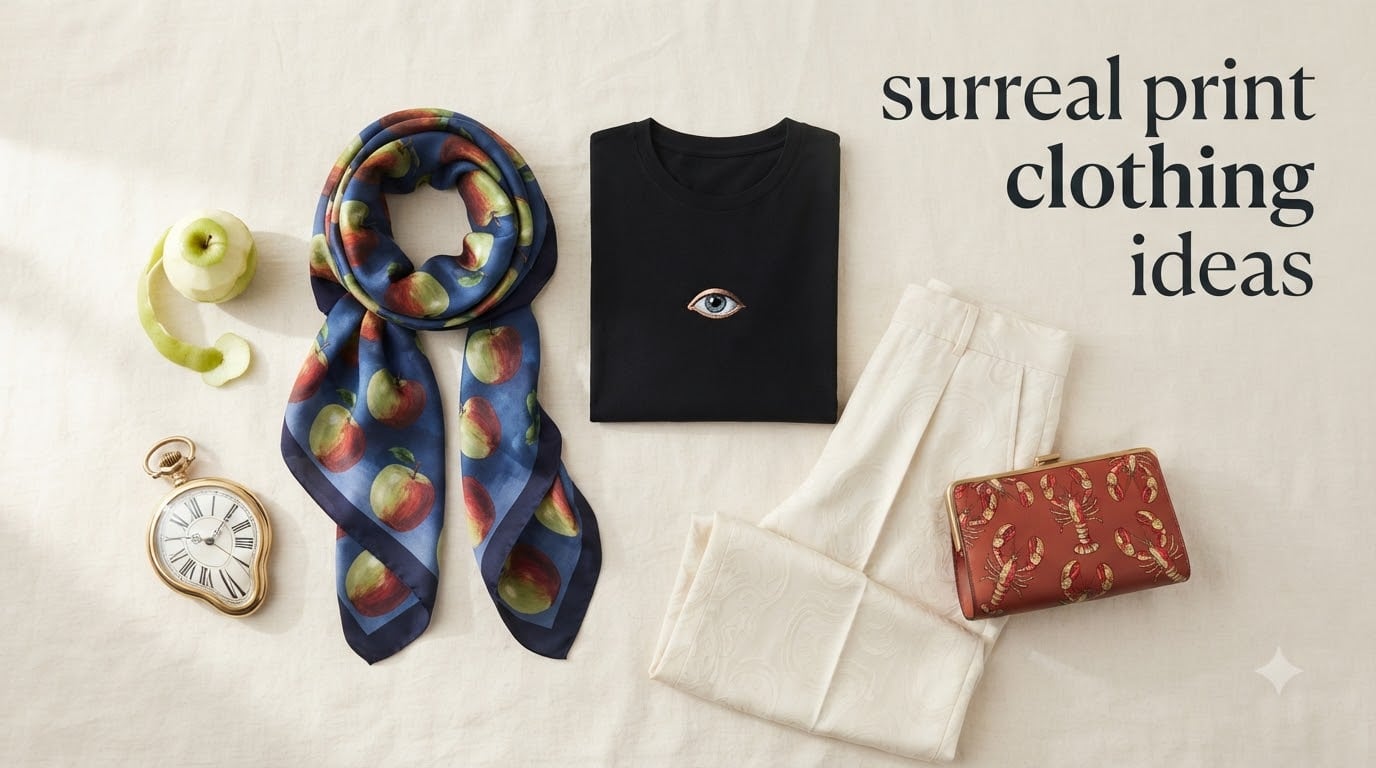
Surreal print clothing is having a real moment, and not the costume-party kind. On the fall runways, on Etsy storefronts, and across Instagram style feeds, dreamlike prints – melting clocks, floating eyes, Magritte apples – are showing up on tees, dresses, hoodies, and scarves you can actually wear to brunch. I pulled together this guide after weeks of scrolling, sketching, and trying on the trend myself, because the gap between “surrealist couture” and “surreal print clothing ideas for real life” is bigger than most guides admit.
Here you’ll find what surreal print clothing actually is, the signature motifs to know, ideas organized by garment type, styling rules that keep you out of costume territory, and the designers, indie shops, and vintage sources where the best pieces live. Save this page – it doubles as a shopping shortlist.
Table of Contents
What Is Surreal Print Clothing?
Surreal print clothing is apparel featuring bold, dreamlike imagery drawn from the surrealist art movement – melting clocks, floating eyes, oversized butterflies, Dalí lobster motifs, Magritte-style apples, and optical-illusion patterns that turn everyday garments into wearable art.
What separates a surreal print from a generic abstract or psychedelic pattern is its source vocabulary. The imagery borrows directly from 1920s surrealist painters – Salvador Dalí, René Magritte, Leonora Carrington, Remedios Varo – and from later photographers like Man Ray. A swirling teal blob is just abstract art. A melting clock draped over a tree branch is surrealist. That storytelling difference is what makes the print feel intentional instead of decorative.
Surreal prints can land anywhere on the spectrum from subtle to statement:
- Subtle surreal prints: A single repeated motif in tonal colors – one melting clock on a cream tee, or small eyes scattered across a black button-down.
- Bold surreal prints: Full all-over prints with multiple motifs, oversized graphics, or photographic surrealist scenes covering the entire garment.
- Hybrid surreal prints: One classic surrealist element paired with otherwise conventional styling – a lobster appliqué on a plain white dress, for example.
Inside the surrealist movement, clothing was treated as another canvas for the unconscious mind. Today, surreal print clothing takes that same impulse and makes it shoppable – without losing the artistic thread.
A Brief History of Surrealism in Fashion
The surrealism-fashion conversation really begins in 1936, when Elsa Schiaparelli walked into her Paris atelier with a Salvador Dalí sketch and the line “Why not a dress with a lobster on it?” That collaboration produced the now-legendary Lobster Dress, worn by Wallis Simpson in a Vogue portrait by Cecil Beaton. It was the first time a fashion garment openly quoted a surrealist painting, and it scandalized the industry.
For the next two decades, Schiaparelli kept the conversation going – Dalí designed a skeleton suit for her 1938 collection, Jean Cocteau drew embroidery for her, and Meret Oppenheim contributed fur-lined bracelets that read like wearable readymades. Across the Atlantic, Coco Chanel dismissed it as “art for art’s sake,” which only sharpened the contrast.
Then surrealist fashion went quiet for about 40 years. It came back loudly in 1988, when Yves Saint Laurent showed a collection built around Picassian cubism and surrealist portraiture. Thierry Mugler pushed further in the 1990s with insect-bodied corsets and alien proportions. Martin Margiela wrapped wigs around shoulders in 2009. By the 2010s, McQueen, Dior, and Christopher Kane were placing lobster prints, eye motifs, and Dalí references directly onto runway textiles.
What’s different now is reach. In 2026, surreal prints aren’t reserved for couture clients. Digital fabric printing, Etsy indie makers, and viral mood boards mean a $40 surreal-print tee can reference the same Dalí lobster that once cost $4,000 to embroider by hand. The history is the same. The price of entry has changed.
Signature Surreal Prints to Look For
This is the heart of any good surreal print clothing search, because the prints themselves are what carry the meaning. When I shop, I look for these eight motifs first – they read as “surreal” instantly, even when everything else about the garment is plain.
- The eye motif. Single floating eyes, eye-and-eyelash surrealism à la Magritte’s The False Mirror, or rows of mismatched eyes across an all-over print. Easiest surrealist motif to wear because it reads graphic, not costume-y.
- Melting clocks. Straight Dalí reference from The Persistence of Memory. Works best as a single hero placement on a tee or as a tonal repeating pattern on trousers.
- The lobster. Dalí’s phone-lobster from 1936, repurposed onto dresses, tees, and scarves. Schiaparelli still reissues lobster knits every season, and indie makers on Etsy riff on the same image constantly.
- Magritte apples. The floating green apple from The Son of Man (the bowler-hat man) – quiet, painterly, very wearable. Often appears on button-downs and silk scarves.
- Butterflies and moths. Oversized, photorealistic, often paired with skulls or hourglasses (memento mori symbolism). Strong on dresses and scarves.
- Floating objects. Levitating books, hats, telephones, or umbrellas that ignore gravity. A surrealist signature because it visualizes the dream state.
- Clouds and ladders. Both reference Magritte’s ladder-into-clouds paintings. Appear most often on knitwear and wide-leg trousers.
- Lips and mouths. Dalí’s Mae West lips sofa, Man Ray’s lips photographs. Loud, playful, and best on a single hero piece.
- Surreal landscapes. Dreamy desert horizons, impossible architecture, hand-painted celestial scenes. Common on indie brand dresses and on silk slip dresses.
- Optical illusions. Escher-style impossible staircases, op-art stripes that warp depth, hand-drawn anamorphic shapes. Reads more “wearable art” than “surreal” but lives in the same visual family.
If you’re building a surrealist wardrobe from scratch, my suggestion: pick one motif you genuinely love, then find three pieces built around it in different silhouettes. That’s how you get surrealist energy without looking like you’re wearing the same costume twice.
Surreal Print Clothing Ideas by Garment
Organizing surreal print ideas by garment works better than browsing by motif, because fit and scale matter as much as the imagery. A melting clock looks artful on a silk slip and chaotic on a heavy wool coat. Here is how I think about the strongest garment-motif pairings.
Surreal Print T-Shirts
Tees are the easiest entry point. Look for a single hero graphic on the chest – one eye, one clock, one lobster – printed on heavyweight cotton. Indie shops on Etsy specialize in this exact format, and the silhouette is forgiving enough to pair with jeans, trousers, or a slip skirt without going full art piece.
Avoid tees with more than two surrealist motifs competing for attention. One clear image is the difference between “wearing art” and “wearing a poster.”
Surreal Print Hoodies
Hoodies carry all-over prints well because the silhouette is loose and the fabric is opaque. Look for butterfly-and-skull pairings, floating-object scatter prints, or a giant single eye across the back. Pair with solid trousers so the print can breathe.
Surreal Print Dresses
Slip dresses and shirt dresses are where surreal prints feel most editorial. Photographic surrealist landscapes, painterly clouds-and-ladders, and oversized butterfly motifs translate beautifully onto a long line. Indie brands like Magda Butrym-adjacent labels and Etsy surrealist studios lean heavily on slip dresses and wrap dresses in their surreal drops.
Surreal Print Button-Down Shirts
A button-down in a tonal surreal print reads like officewear from another dimension. Small eyes on a navy ground, micro-lobsters on cream, scattered apples on oxford cloth – all of these work under a blazer without breaking dress code. Schiaparelli’s surrealist button-downs for pre-fall seasons are the gold standard reference.
Surreal Print Trousers and Skirts
Tonal prints work best here. A muted melting-clock pattern on pleated wool trousers, or a faint Magritte-apple repeat on a midi skirt, lets you wear surrealism below the waist while keeping the top half neutral. Loud full-saturation prints on bottoms can overpower an outfit quickly.
Surreal Print Scarves
If you only want one surrealist item in your wardrobe, make it a silk scarf. Small surreal motifs – lips, eyes, butterflies – read beautifully at scarf scale, and a printed silk square tied at the neck or wrist is the smallest possible commitment to the trend. Vintage Hermès surrealist scarves from the 1990s are collector favorites.
Surreal Print Accessories
Tote bags, socks, hats, and pins are the lowest-risk way in. A surrealist enamel pin on a plain jacket, or a tote printed with one Dalí reference, can carry a whole outfit without committing to a printed garment.
How to Style Surreal Prints Without Looking Like a Costume
This is the question I get most often, and it’s a fair one. Surreal prints are inherently dramatic, so the styling rules are about pulling focus back toward yourself.
- One hero piece per outfit. If your tee is the surreal print, your trousers should be solid. If your dress carries the motif, keep shoes and bag neutral. Two competing surreal prints in one look is where “fashion” tips into “costume.”
- Anchor with basics. Plain denim, black trousers, white sneakers, a clean leather jacket – these are the grounding pieces that let the surreal print do its work without overpowering you.
- Color-coordinate, don’t color-match. Pick one color from inside the surreal print and repeat it on a solid piece elsewhere in the outfit. If your lobster tee has rust orange in it, add a rust bag or rust shoe. It ties the look together without making it busy.
- Use the 3-3-3 rule as a guardrail. The 3-3-3 rule – three colors, three fabrics, three layers – is a good sanity check for surreal outfits specifically because surreal prints already bring visual chaos. Sticking to three of each keeps you balanced.
- Match the formality of the print to the occasion. Loud lobster-on-silk belongs at an art opening or a surrealist ball. A tonal Magritte-apple button-down works at a gallery lunch. Reserve full-saturation all-over prints for festivals, parties, and creative workplaces.
- Mix surreal prints with classic patterns, but carefully. Stripes pair better than florals. Tonal surreal prints pair better than saturated ones. If the surreal print is busy, the second pattern should be small, sparse, and in a shared color family.
- Let makeup stay simple. A bold surreal outfit is already a statement. Heavy makeup on top of it reads as theatrical. Clean skin, a defined brow, and one tinted lip is usually enough.
Modern Surrealist Designers to Know
If you want to anchor a surrealist wardrobe in real references rather than mood-board vibes, these four designers cover the spectrum from runway to accessible indie.
Schiaparelli, under Daniel Roseberry since 2019, has rebuilt the house as the reference point for surrealist couture. The faux-taxidermy animal heads, the gold-button trompe-l’oeil, and the recurring lobster motifs are direct quotations of the 1936 Schiaparelli-Dalí collaboration. Pieces are expensive but show up on every red carpet, which means the visual vocabulary is now familiar to a wide audience.
Iris van Herpen brings the sculptural side of surrealism – 3D-printed gowns, water-inspired ripple dresses, magnetic-levitation fabrics. If surrealism had a tech-fashion arm, this would be it. Look to van Herpen for the rules-bending silhouette side of the trend.
Loewe, under Jonathan Anderson, has quietly built the most commercially successful surrealist wardrobe of the decade. Anagram-laden knitwear, surrealist ceramic charms, and trompe-l’oeil leather goods. Many Loewe pieces read “surreal” without announcing it, which makes them easier to wear into a normal week.
Collina Strada, Hillary Taymour’s NYC-based indie label, is where surreal print clothing shows up at indie-brand prices. Painterly prints, dreamlike colorways, and recurring motifs (eyes, hands, celestial bodies) on actual everyday garments. This is the closest the market has to a surrealist uniform that doesn’t require a couture budget.
Runway references aside, indie makers on Etsy and Instagram handle most of the surreal print market in 2026. A quick scroll of Etsy surrealist shops, or a search of hashtags like #surrealistfashion and #wearableart on Instagram, surfaces hundreds of small studios doing surrealist prints in the $30-$80 range. Those are the actual places most surrealist wardrobes get built.
Where to Find Surreal Print Clothing
The discovery problem is real – surreal prints are scattered across small shops rather than concentrated in one big retailer. These are the realistic entry points, ranked by accessibility.
- Etsy surrealist shops. The widest selection, the broadest price range, and the strongest handmade signal. Search “surrealist tee,” “Dalí print,” “surreal dress,” or “Magritte clothing” and filter by handmade.
- Redbubble and Society6. Art-first marketplaces where independent illustrators upload surrealist prints onto demand-printed apparel. Good for graphic-led pieces and graphic-led accessories.
- Vintage and resale. 1990s Helmut Lang, Margiela-era pieces, and Schiaparelli reissues show up on 1stDibs, The RealReal, and Vestiaire Collective. Vintage surrealism often carries more edge than new pieces because the silhouettes are less tailored.
- Indie Instagram shops. Many surrealist studios launch through Instagram first. Hashtags like #surrealistfashion, #surrealcouture, and #wearableart lead to small labels selling direct. The discovery curve is steeper but the pieces are unique.
- Runway look-for-less. Schiaparelli and Loewe surrealist pieces get knocked off at accessible prices by ASOS, H&M’s designer drops, and Zara within a season. They lack the craftsmanship but capture the visual reference.
- DIY custom prints. Transfer paper on plain tees, fabric paint on thrifted button-downs, or AI-generated surrealist art printed through services like Printful – all viable for a single statement piece that no one else will own.
The honest truth is that most surrealist wardrobes are built from a mix of indie Etsy, vintage, and one or two “real” pieces. That mix is more interesting than a head-to-toe designer look anyway.
Frequently Asked Questions
What is surreal print clothing?
Surreal print clothing is apparel featuring bold, dreamlike imagery drawn from the surrealist art movement – melting clocks, floating eyes, Magritte apples, Dalí lobster motifs, butterflies, and optical-illusion patterns that turn everyday garments into wearable art. The prints borrow directly from 1920s surrealist painters rather than being purely abstract or psychedelic decoration.
What are examples of surreal fashion?
Classic examples of surreal fashion include Schiaparelli’s 1936 Lobster Dress designed with Salvador Dalí, Jean Cocteau’s hand-embroidered evening jackets, Thierry Mugler’s 1997 insect corsetry, Maison Margiela’s wig-as-shoulder-pad pieces, Iris van Herpen’s 3D-printed gowns, and Loewe’s trompe-l’oeil leather goods. At indie price points, surreal fashion shows up as Dalí-melting-clock tees, Magritte-apple button-downs, and butterfly-and-skull scarves from Etsy surrealist shops.
How do I style surreal prints without looking like a costume?
Anchor one hero piece per outfit with solid basics like denim or black trousers, repeat one color from the print on a neutral accessory, stick to three colors and three fabrics, keep makeup simple, and match the formality of the print to the occasion. Two competing surreal prints in one look is where fashion tips into costume – keep the second piece neutral.
Where can I buy surreal print clothing?
Etsy surrealist shops are the widest source for handmade surrealist tees, dresses, and scarves at indie prices. Redbubble and Society6 sell demand-printed apparel from independent surrealist illustrators. Vintage and resale platforms carry 1990s surrealist designer pieces. Runway-adjacent surrealist prints from Schiaparelli and Loewe get reproduced at accessible prices through ASOS, Zara, and Hu0026amp;M designer drops.
Conclusion
Surreal print clothing works because it turns the everyday act of getting dressed into a small piece of art history. Pick one motif you love, find three pieces built around it, anchor each look with solid basics, and let the print do the talking.
For more surrealist inspiration, browsing, and outfit ideas, keep exploring our art and style guides – the surrealist wardrobe is one piece at a time.