
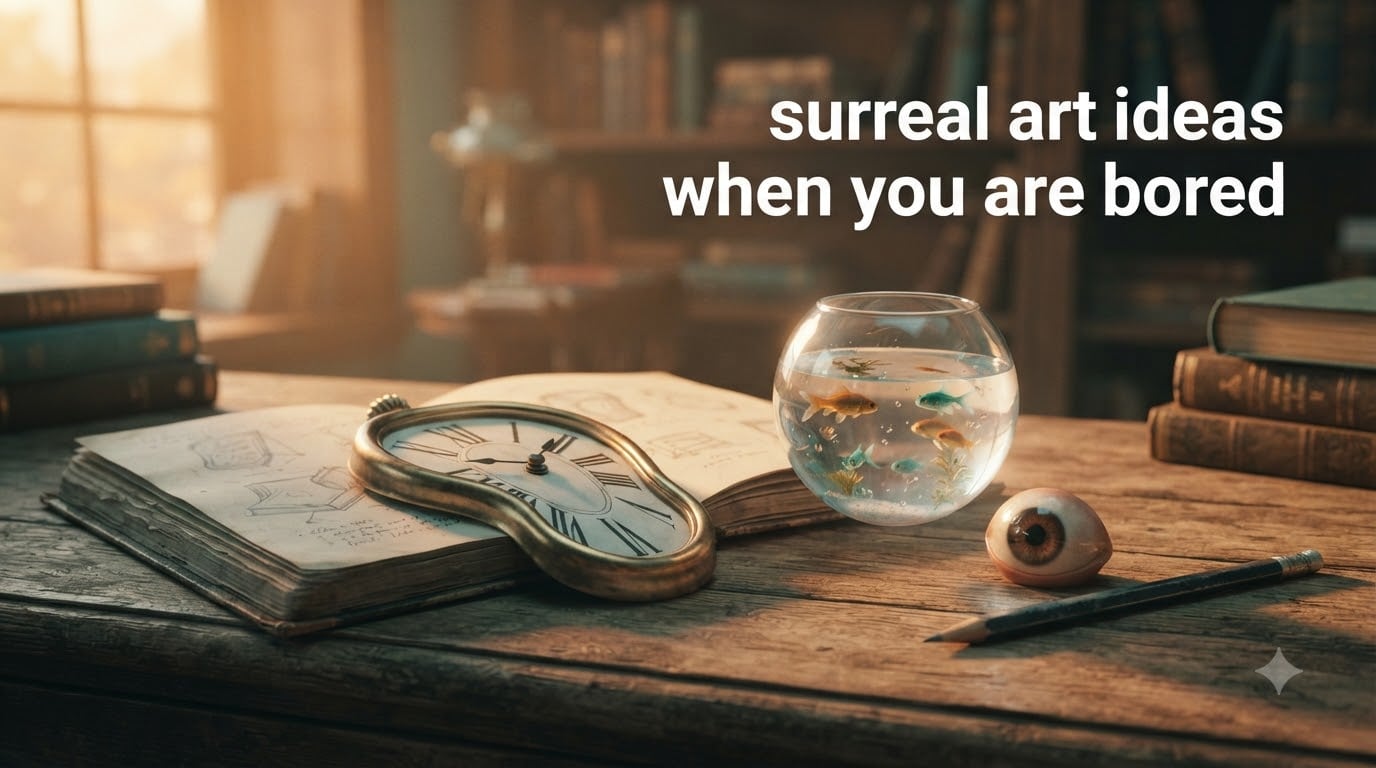
Staring at a blank page with nothing to do? That restless, bored feeling is actually one of the best launchpads for making surreal art. Surrealism thrives on the unexpected, the dreamlike, and the bizarre — and boredom strips away the overthinking that usually holds creativity back.
In this guide, I’ll walk you through 20 surreal art ideas you can try right now, beginner-friendly techniques straight from the surrealist playbook, and a daily challenge framework to keep the momentum going. Whether you’re picking up a pencil for the first time or you’re an experienced artist stuck in a rut, these surreal art ideas when you are bored will give you something genuinely exciting to work on.
Table of Contents
Quick Answer: What Are the Best Surreal Art Ideas When You Are Bored?
The best surreal art ideas when you are bored combine two unrelated objects — like a fish wearing headphones or a staircase melting into water — and draw them in a single, coherent scene. Other easy wins include melting clocks, floating furniture, hybrid animals, impossible architecture, and surreal self-portraits. You need nothing more than a pencil and paper to start.
Below you’ll find 20 specific ideas, followed by step-by-step projects, techniques, and a daily challenge to turn boredom into a creative habit.
20 Surreal Art Ideas to Try Right Now
Each idea below includes a bold title and a one-line prompt to get you started. Pick one that grabs you, grab a pencil or open your drawing app, and start sketching — perfection is not the point.
1. Melting Clock. Draw a realistic clock draped over a table edge or tree branch like wet fabric. Salvador Dalí made this iconic — now make it yours.
2. Floating Furniture. Sketch a room where every chair, table, and lamp hovers above the floor. Add a figure sitting calmly as if nothing is unusual.
3. Fish With Human Legs. Combine a fish body with human legs walking down a city street. The more realistic the legs, the more surreal it feels.
4. Staircase to Nowhere. Draw a staircase that loops back to its own beginning, defies gravity, or leads into the sky. Think M.C. Escher meets a dream.
5. Hybrid Animal. Merge two animals — a giraffe with butterfly wings, a cat with antlers. Draw it with natural anatomy so it looks biologically plausible.
6. Surreal Self-Portrait. Draw your own face but replace one feature with something impossible: eyes that are windows, a mouth that’s a doorway, hair made of vines.
7. Eyes Everywhere. Fill a landscape, object, or face with eyes. Eyes on walls, eyes on trees, eyes in the sky. This taps into the paranoia-meets-wonder feeling of dreams.
8. Giant Object in a Tiny World. Place a massive everyday object — a rubber duck, a teacup, a pencil — in a miniature cityscape or landscape.
9. Object Made of Wrong Material. Draw a waterfall made of glass, a cloud made of stone, or a tree with metal leaves. The trick is rendering the material convincingly.
10. Upside-Down Landscape. Draw a scene, then flip the ground and sky. Trees grow downward, rain falls upward, fish swim through clouds.
11. Human Body Metamorphosis. Start with a person and gradually transform one body part into something else — an arm becomes a tree trunk, fingers become candles.
12. Two-in-One Image. Create a double image where one picture hides another — a face that’s also a cityscape, a vase that’s also two people in profile.
13. Impossible Hands. Draw hands in the style of Escher’s “Drawing Hands” — two hands sketching each other into existence, or fingers that loop infinitely.
14. Dripping World. Imagine everything in a scene is slowly melting or dripping: buildings, people, mountains. Like Dalí’s persistence-of-memory paintings.
15. Miniature People on Everyday Objects. Draw tiny figures walking across a pencil, fishing in a coffee cup, or camping on a smartphone. The scale contrast creates instant surrealism.
16. Mirror With a Different Reflection. Draw someone looking in a mirror, but the reflection shows a different person, a different place, or a different era.
17. Clouds as Objects. Replace every cloud in a sky scene with something specific — shoes, fish, hands, musical instruments — while keeping the soft, fluffy texture.
18. Mechanical Nature. Draw a bird, flower, or tree that’s made of gears, pistons, and clockwork. The organic-meets-mechanical contrast is pure surrealism.
19. Shadow That Doesn’t Match. Draw a person or object, but make the shadow a completely different shape — a person’s shadow is a monster, a cat’s shadow is a lion.
20. Room Inside a Room. Open a door in a normal room to reveal an impossible second space — an ocean, a forest, outer space, or another era entirely.
Step-by-Step Surreal Art Projects for Beginners
If you want more guidance than a one-line prompt, these three projects walk you through the process from start to finish. Each one takes 30-60 minutes and works with basic materials.
Project 1: The Impossible Object Drawing
What you need: Pencil, paper, eraser.
Step 1: Choose two unrelated objects — say, a shoe and a fishbowl. Sketch each one separately in your notebook for 2-3 minutes to get familiar with the shapes.
Step 2: Decide how to merge them. A shoe with a fishbowl heel? A fishbowl shaped like a shoe? A fish wearing a shoe? Pick the combination that makes you laugh or feel uneasy — that’s your surreal instinct working.
Step 3: Lightly sketch the combined object. Focus on making the proportions feel realistic even though the combination is impossible. This “realistic impossibility” is the heart of surrealism.
Step 4: Add details and shading. The more real it looks, the more disturbing and powerful it becomes. Use cross-hatching or blending for depth.
Project 2: The Surreal Landscape
What you need: Pencil, paper, colored pencils or markers (optional).
Step 1: Draw a simple horizon line and a basic landscape — flat ground, a few hills, a sky.
Step 2: Now break reality. Decide on ONE rule to violate: gravity, scale, time, or materials. For example, gravity: everything floats. Scale: a giant flower towers over mountains. Materials: the ground is made of fabric.
Step 3: Fill the landscape with elements that follow your broken rule. If gravity is gone, draw trees floating, a river suspended in mid-air, a house drifting like a balloon.
Step 4: Add a small, calm figure somewhere in the scene. The contrast between a relaxed person and an impossible world creates a powerful surreal mood.
Project 3: The Surrealist Self-Portrait
What you need: Pencil, paper, a mirror (or a photo of yourself).
Step 1: Sketch your face accurately from the mirror or photo. Don’t worry about perfection — aim for recognizable.
Step 2: Choose ONE feature to transform. Eyes become clocks, hair becomes tree roots, skin becomes a map, ears become doors. The rest of the face stays realistic.
Step 3: Render the transformed feature with as much detail as the realistic parts. The tension between real and surreal is what makes it compelling.
Step 4: Consider adding a background that reflects your internal state — a storm behind one shoulder, a garden behind the other. Surrealist self-portraits are about inner worlds, not just outer appearances.
5 Surrealist Techniques Every Beginner Should Know
The surrealists didn’t just have ideas — they invented specific methods for generating them. These five techniques are the creative engines behind the art movement, and every single one works for beginners.
Exquisite Corpse
This is the surrealist parlor game that produces the wildest results. Fold a piece of paper into three or four sections. One person draws a head and extends the neck lines slightly past the fold. The next person draws a torso without seeing the head. The last person draws legs. Unfold the paper to reveal a bizarre hybrid creature. You can play this alone by folding, drawing one section, forgetting what you drew, and continuing. It’s the most fun surrealist technique for groups.
Automatic Drawing
Set a timer for five minutes. Close your eyes or stare at a fixed point. Move your pencil across the paper without planning, judging, or correcting. Let your hand follow impulse, not intention. When the timer ends, look at what you created and find images in the abstract marks — a face in a swirl, a creature in a scribble. Outline and develop what you see.
Frottage
Place your paper over a textured surface — wood grain, a coin, a leaf, crumpled foil. Rub a pencil or crayon over it to capture the texture. Max Ernst invented this technique and used the random textures as starting points for imaginary landscapes and creatures. The texture becomes your unconscious collaborator.
Juxtaposition
This is the simplest and most powerful surrealist technique: put two things together that don’t belong. A burning piano in a library. A whale in a bathtub. A soldier holding a bouquet of flowers in a battlefield. The more emotionally distant the two objects are, the more surreal the result.
Dream Journaling
Keep a notebook by your bed. The moment you wake up, write down everything you remember about your dreams — no matter how fragmented or absurd. These dream fragments become raw material for surreal art. A staircase that turned into a snake, a conversation with a fish, your childhood home with too many rooms — draw what you wrote.
Famous Surrealist Artists Who Inspire These Ideas
Understanding the artists behind surrealism gives you a deeper well to draw from. These three masters defined the movement and continue to influence artists today.
Salvador Dalí (1904-1989) is the name most people think of first. His melting clocks, elongated elephants, and burning giraffes established the visual vocabulary of surrealism. Dalí called his method “paranoiac-critical” — he would induce a semi-hallucinatory state and paint what he saw. His technical skill was extraordinary, which made his impossible images feel disturbingly real. Study his work for how to render the unreal with photorealistic precision.
René Magritte (1898-1967) took a cooler, more intellectual approach. His paintings of bowler-hatted men, floating rocks, and pipes that aren’t pipes (“The Treachery of Images”) ask questions about perception and reality. Magritte’s style is clean and accessible — simple compositions with profound dislocations. If you want surrealism that makes people think rather than shudder, Magritte is your guide.
Max Ernst (1891-1976) invented techniques like frottage and grattage (scraping paint) that embraced randomness and chance. Ernst’s work ranges from haunting forests to playful collages, and his methods are some of the most beginner-friendly in all of art history. You don’t need drawing skill to try frottage — you just need curiosity.
Digital Surrealism: Surreal Art Ideas for Your Computer and Phone
You don’t need a canvas to make surreal art. Digital tools have lowered the barrier dramatically, and some of the most compelling contemporary surrealism lives on screens.
Photo manipulation is the easiest entry point. Apps like PicsArt (free, mobile), GIMP (free, desktop), or Photoshop let you combine photographs into impossible scenes. Take a photo of your desk, cut out a section of sky from another photo, and place it where the drawer should be. Swap a friend’s eyes with flowers. Replace a door with an ocean view. The technique is simple — the results can be stunning.
AI image generators like Midjourney, DALL-E, and Stable Diffusion respond brilliantly to surrealist prompts. Try prompts like “a melting staircase in a desert, photorealistic” or “a cat made of clockwork sitting in a field of flowers.” AI excels at the “realistic impossibility” that defines surrealism. Use the generated images as references for hand-drawn work, or refine them digitally as standalone pieces.
Digital painting apps like Procreate (iPad), Krita (free desktop), or even the basic drawing tools on your phone let you apply surrealist techniques digitally. Automatic drawing works beautifully on a tablet — use a large brush, close your eyes, and let your finger trace paths on the screen. Layer multiple automatic drawings and see what emerges.
Surreal Collage and Mixed Media Ideas
Collage is one of the original surrealist techniques, and it requires zero drawing skill. Cut images from old magazines, print photos, or use junk mail and packaging. The surrealist principle is simple: combine images from completely different contexts.
Magazine cutout surrealism — Cut out a human body from one page and an animal head from another. Place architectural elements in natural landscapes. Combine food photography with fashion shoots. The more unrelated the source images, the more surreal the result.
Found-object assemblage — Glue real objects onto a surface in impossible combinations. A fork growing out of a photograph. Buttons arranged as eyes on a painted face. Scraps of fabric as a landscape. Max Ernst and Joseph Cornell made this approach famous.
Digital collage — Use layers in any image editor to stack and blend photographs. Create double exposures by combining a portrait with a forest. Place objects in impossible scales — a tiny elephant standing on a real person’s palm. Digital collage gives you unlimited undo, which makes experimentation completely risk-free.
Surrealism for Stress Relief and Mindfulness
Here’s something most art idea lists won’t tell you: making surreal art when you’re bored is also one of the most effective stress-relief practices you can do. The reason is psychological — surrealism removes the pressure of “getting it right.”
When you draw a realistic portrait, you measure and compare and judge every line. When you draw a fish with human hands, there’s no “correct” version. The freedom from correctness puts you into a flow state — that focused, time-disappearing mental zone that psychologists associate with well-being and reduced anxiety.
Many artists describe surrealist practice as meditative. Automatic drawing, in particular, quiets the inner critic because you’re not making conscious decisions. You’re just letting your hand move. Dream journaling connects you to your unconscious mind. Even the silly techniques — like exquisite corpse — produce genuine laughter, which is its own form of stress relief.
If you’re bored and stressed at the same time, try this: set a 15-minute timer, do an automatic drawing, then spend 15 minutes developing whatever creatures or shapes you find in the marks. By the end, you’ll have made something unique and forgotten what you were stressed about.
Try the Daily Surrealist Challenge
The best way to turn boredom into a creative habit is to commit to a daily practice. Here’s a one-week challenge you can start today — each day has a different surrealist prompt and technique.
Day 1 — Juxtaposition: Draw two unrelated objects combined into one. Spend 20 minutes maximum.
Day 2 — Automatic Drawing: Close your eyes, draw for five minutes, then develop one image you find in the marks.
Day 3 — Dream Journal: Write down a dream from last night (or invent one), then draw the most vivid scene from it.
Day 4 — Surreal Self-Portrait: Draw your face with one impossible feature. Keep the rest realistic.
Day 5 — Frottage: Rub three different textures, then turn each one into a creature or landscape.
Day 6 — Exquisite Corpse: Fold paper into three sections. Draw one section now, another at lunch, the last before bed. Unfold and see what you made.
Day 7 — Your Choice: Revisit whichever technique you enjoyed most, or combine two of them into one piece.
After one week, you’ll have seven surreal artworks and a much clearer sense of which techniques suit your personality. Many artists who start this challenge find they keep going — one surrealist artwork a day becomes a creative anchor that makes boredom impossible.
Frequently Asked Questions
What is surrealism in art?
Surrealism is an early 20th-century art movement that explores the unconscious mind through dreamlike, unexpected imagery. Founded by André Breton in 1924, it combines realistic technique with impossible subjects — melting clocks, floating objects, hybrid creatures — to challenge how we perceive reality. Salvador Dalí and René Magritte are its most famous practitioners.
How do you draw surreal art for beginners?
Start by choosing two unrelated objects and merging them into one drawing — like a fish wearing boots or a house with wings. Keep the rendering realistic even when the subject is impossible. Use basic pencil and paper, focus on one surreal element per drawing, and don’t judge the result. Surrealism has no wrong answers.
What are some surrealism ideas?
Classic surrealism ideas include melting clocks, floating furniture, hybrid animals, impossible architecture, surreal self-portraits with transformed features, eyes placed in unexpected locations, giant objects in miniature worlds, and scenes where shadows don’t match their objects. Combining two unrelated items is the simplest starting point.
What should I draw when I’m bored?
When you’re bored, try drawing a melting version of a nearby object, create a hybrid of two animals, sketch your room with one impossible element (like a tree growing through the floor), or do a five-minute automatic drawing with your eyes closed. Surreal art is ideal for boredom because there’s no pressure to be accurate.
How do you make surreal art?
You make surreal art by combining realistic technique with impossible subjects. Choose a technique — juxtaposition (two unrelated objects), metamorphosis (one thing transforming into another), dream imagery (scenes from dreams), or automatic drawing (unconscious mark-making). Then render it with as much detail and realism as you can manage.
What are 5 surrealist techniques?
Five surrealist techniques are: 1) Exquisite Corpse — a collaborative game where different people draw different body parts without seeing each other’s work. 2) Automatic Drawing — drawing without conscious planning. 3) Frottage — rubbing pencil over textured surfaces. 4) Juxtaposition — placing unrelated objects together. 5) Dream Journaling — drawing scenes from remembered dreams.
Who is the most famous surrealist artist?
Salvador Dalí is the most famous surrealist artist, known for melting clocks, elongated elephants, and his distinctive upturned mustache. René Magritte, known for The Son of Man and Ceci n’est pas une pipe, is a close second. Max Ernst, Frida Kahlo, and Remedios Varo are also widely celebrated surrealists.
What are common surreal art subjects?
Common surreal art subjects include melting or distorted clocks, floating or levitating objects, hybrid creatures (combinations of different animals), impossible architecture, dreamlike landscapes, body metamorphosis, double images, eyes in unexpected places, and miniature people interacting with oversized everyday objects.
What is the easiest surrealist technique?
Juxtaposition is the easiest surrealist technique — simply draw two unrelated objects in the same scene or merged into one. No special skills, materials, or setup required. Exquisite Corpse is the easiest group technique, and automatic drawing is the easiest technique that requires zero drawing ability.
Can surreal art be made digitally?
Yes, surreal art translates extremely well to digital media. Photo manipulation apps like PicsArt, Photoshop, and GIMP let you combine and distort photographs. AI image generators respond powerfully to surrealist prompts. Digital painting apps like Procreate support automatic drawing and layered compositions. Digital tools actually lower the skill barrier for beginners.
Conclusion
Boredom isn’t a problem to solve — it’s a signal that your creativity wants a channel. Surreal art ideas when you are bored give you that channel without the pressure of realism, perfection, or skill requirements. You can start with a pencil and paper right now, or open your phone and start manipulating photos. The surrealist techniques from Dalí, Magritte, and Ernst are as accessible today as they were a century ago, and the daily challenge framework turns a one-time boredom fix into a lasting creative practice. Pick one idea from this list, set a timer, and start drawing. You’ll be surprised how fast boredom disappears when your unconscious takes the lead.