
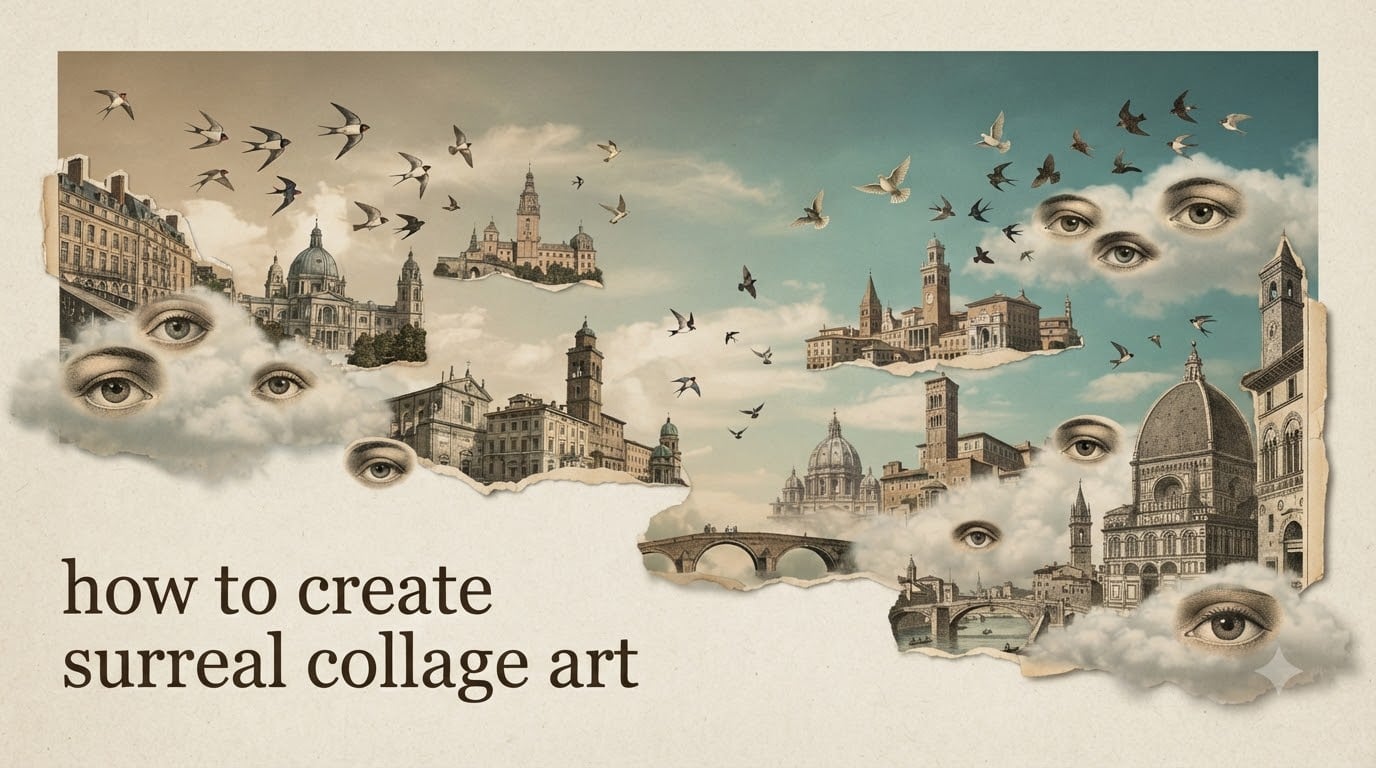
If you’ve ever wanted to create art that feels like it was pulled straight from a dream, learning how to create surreal collage art is one of the most rewarding creative paths you can take in 2026. Surreal collage combines the tactile joy of cutting and pasting with the boundless freedom of the subconscious mind, letting you build impossible scenes from ordinary images.
Whether you’re a complete beginner or an experienced artist looking to explore a new medium, this guide covers everything you need to know. We’ll walk through the essential materials, proven techniques, and the creative mindset that transforms simple magazine clippings into mind-bending works of art.
By the end, you’ll have the knowledge and confidence to create surreal collage art that’s genuinely your own — no art degree required.
Table of Contents
What Is Surreal Collage Art?
Surreal collage art is a creative technique that combines disparate images, textures, and materials to create dreamlike, fantastical compositions inspired by the surrealist art movement. It borrows from the Surrealism philosophy of accessing the subconscious mind, arranging unexpected visual elements together to challenge rational perception and evoke emotional responses.
What makes a collage “surreal” rather than simply decorative is the intent behind the composition. Surreal collage deliberately juxtaposes unrelated objects — a clock melting into a landscape, a human figure replaced by clouds, a birdcage containing a cityscape — to create imagery that couldn’t exist in reality but feels emotionally true.
The practice draws heavily from the original Surrealist movement of the 1920s, when artists like André Breton, Salvador Dalí, and Max Ernst sought to unlock creativity through automatic techniques, dream analysis, and the irrational combination of everyday objects.
The History and Origins of Surrealism in Collage
Collage as an art form exploded onto the scene in the early 20th century when Cubist artists like Pablo Picasso and Georges Braque began incorporating newspaper clippings, wallpaper, and fabric into their paintings. But it was the Surrealists who recognized collage’s true potential for accessing the unconscious mind.
Max Ernst became one of the most influential figures in surreal collage during the 1920s and 1930s. His “collage novels” like Une Semaine de Bonté (1934) combined Victorian engravings into bizarre, dreamlike narratives that had never been seen before. Ernst treated existing images as raw material for the subconscious, cutting and reassembling them into configurations that defied logic.
Meanwhile, Hannah Höch was pioneering photomontage in Berlin’s Dada movement, creating sharp social commentary through surreal combinations of mass-media images. Her work proved that collage could be both intellectually rigorous and visually stunning.
Joseph Cornell took a different approach with his shadow box assemblages, creating miniature surreal worlds from found objects, old photographs, and vintage ephemera. His work bridged the gap between collage and sculpture, demonstrating that surreal collage doesn’t have to be flat.
Today, surreal collage continues to evolve through both traditional hand-cut methods and digital techniques, with artists like John Stezaker and Wangechi Mutu pushing the medium into new territory.
Essential Materials and Tools for Traditional Collage
Before you start creating surreal collage art the traditional way, you’ll need to gather some basic supplies. The beauty of collage is that the barrier to entry is remarkably low — you probably already have several of these items at home.
Cutting Tools:
- Sharp scissors (both large and small precision scissors)
- Craft knife or X-Acto knife with extra blades
- Cutting mat to protect your work surface
- Rotary cutter for clean straight edges
Adhesives:
- Glue stick (acid-free for archival work)
- Mod Podge for sealing and decoupage
- Rubber cement for repositionable adhesion
- Double-sided tape for clean, wrinkle-free application
- Gel medium for mixed-media layering
Surfaces:
- Heavy cardstock or watercolor paper (140 lb minimum)
- Canvas boards or stretched canvas
- Mixed-media sketchbooks
- Wood panels for a rigid working surface
Source Materials:
- Old magazines (National Geographic, vintage LIFE, fashion catalogs)
- Postcards, stamps, and vintage ephemera
- Maps, sheet music, and book pages
- Photographs (your own or copyright-free sources)
- Fabric scraps, ribbon, and textured papers
- Natural elements like pressed flowers, leaves, or feathers
Essential Materials and Tools for Digital Collage
Digital surreal collage opens up a world of possibilities that traditional methods can’t match. You can work with unlimited layers, instantly undo mistakes, blend images seamlessly, and access millions of source images without ever picking up scissors.
Software Options:
- Adobe Photoshop — The industry standard for professional digital collage. Offers advanced layer masking, blending modes, and precise selection tools. Monthly subscription required.
- GIMP — A powerful free alternative to Photoshop. Has most of the features you need for surreal collage, though the interface takes some getting used to.
- Canva — Browser-based and beginner-friendly. Great for simpler compositions, though it lacks advanced blending capabilities.
- Adobe Express — A simplified version of Adobe tools that works well for quick collage projects on mobile and desktop.
- Procreate — iPad-only but excellent for combining hand-drawn elements with photographic collage.
Hardware:
- A computer with at least 8GB of RAM (16GB recommended)
- A graphics tablet or iPad for precise selections and painting
- A high-resolution display for accurate color work
Source Image Libraries:
- Unsplash and Pexels (free, high-resolution stock photos)
- The Met Open Access and Rijksmuseum (public domain artworks)
- Rawpixel (vintage illustrations and ephemera)
- Your own photography and scanned textures
How to Create Surreal Collage Art: Traditional Method Step by Step
This step-by-step guide walks you through the entire process of creating a traditional hand-cut surreal collage from concept to finished piece. Set aside two to four hours for your first attempt.
Step 1: Gather Your Source Images
Flip through magazines, books, and printed photographs without a specific plan. Tear out or cut out anything that catches your eye — faces, landscapes, animals, objects, textures, patterns. For surreal collage, the more unrelated the images are to each other, the better. You want raw material for your subconscious to work with.
Step 2: Let Your Subconscious Lead
Spread all your cut-out images on a table and start arranging them without overthinking. This is where the surrealist principle of automatism comes in. Place a human hand next to a fish. Put a building inside a flower. Let your instinct guide the combinations rather than logic. The most powerful surreal imagery comes from these unexpected pairings.
Step 3: Experiment with Scale and Proportion
One of the most effective surreal collage techniques is playing with scale. Make an eye larger than the landscape it’s looking at. Place a tiny person inside a normal-sized teacup. These impossible proportions immediately signal to the viewer that they’re entering a dreamlike space rather than reality.
Step 4: Cut and Trim Your Elements
Once you’ve found combinations that resonate, carefully cut out each element. For a clean, deliberate look, use scissors or a craft knife to follow the exact contours. For a more organic, dreamlike quality, tear the edges by hand — the rough edges create a softer, more ethereal transition between elements.
Step 5: Build Your Composition on the Surface
Arrange your cut pieces on your chosen surface (cardstock, canvas, or board) before gluing anything down. Move things around. Overlap elements. Try different backgrounds. Take a photo of each arrangement you like so you can compare options. The composition should feel balanced but not symmetrical — surreal art thrives on controlled chaos.
Step 6: Layer and Adhere
Start gluing from the background layer forward. Apply adhesive to the back of each piece and press it firmly onto the surface. Use a brayer or the back of a spoon to smooth out air bubbles and wrinkles. For a raised, three-dimensional effect, use foam adhesive squares to lift certain elements above others.
Step 7: Add Finishing Details
Once the main composition is complete, consider adding hand-drawn elements with colored pencils, markers, or paint. Draw connecting lines between unrelated objects. Add small patterns or textures in empty spaces. These finishing touches unify the composition and add your personal artistic voice to the piece.
Step 8: Seal Your Work
Apply a coat of Mod Podge or gel medium over the entire collage to seal and protect it. This also helps unify the different paper textures and gives the piece a cohesive, finished appearance. Let it dry completely before framing or displaying.
How to Create Surreal Collage Art: Digital Method Step by Step
Digital surreal collage offers incredible flexibility and precision. Here’s how to create striking surreal compositions using software like Photoshop or GIMP.
Step 1: Build Your Image Library
Download high-resolution source images from copyright-free libraries. Focus on collecting a variety of categories: human figures and body parts, animals, landscapes, architectural elements, textures, and objects. Save them in an organized folder system so you can find what you need quickly.
Step 2: Create a New Document
Open your chosen software and create a new document. For web use, 3000 x 3000 pixels at 72 DPI works well. For print, go with at least 4000 x 4000 pixels at 300 DPI. Set the background to a neutral color or a textured paper scan for an organic feel.
Step 3: Make Precise Selections
Use the Pen Tool, Quick Selection Tool, or Select Subject feature to isolate the elements you want from your source images. For surreal collage, clean selections are important — rough edges can make the composition look amateurish rather than intentionally surreal. Spend time getting this step right.
Step 4: Place and Arrange Elements
Drag your selected elements onto the canvas as separate layers. Use the Transform tool (Ctrl/Cmd + T) to resize, rotate, and position each piece. Remember the surrealist principle of unexpected combinations — don’t arrange elements the way they’d naturally appear.
Step 5: Use Blending Modes for Surreal Effects
This is where digital collage really shines. Experiment with layer blending modes like Multiply, Screen, Overlay, and Soft Light to create seamless transitions between elements. A cloud layer set to Screen mode can make objects appear to dissolve into sky. A texture layer set to Multiply adds instant grunge and depth.
Step 6: Apply Layer Masks for Smooth Transitions
Instead of hard-cutting edges, use layer masks with soft brushes to fade one element into another. This creates the ethereal, dreamlike blending that defines surreal collage. A human figure can gradually dissolve into a landscape. An animal can emerge from a pattern. The key is making the impossible look natural.
Step 7: Adjust Color and Tone
Use Curves, Hue/Saturation, and Color Balance adjustments to unify the color palette across all elements. Even if your source images have wildly different lighting and color temperatures, you can bring them together with consistent color grading. Many surreal collages use muted, vintage tones or vivid, saturated colors for a dreamlike effect.
Step 8: Add Final Touches
Paint in additional details using a soft brush — atmospheric fog, light rays, shadows, or connecting elements that tie the composition together. Add a subtle texture overlay (paper grain, noise, or film grain) to give the piece an analog feel. Flatten the image and apply final sharpening before exporting.
Key Surrealist Techniques for Collage Art
Understanding these core surrealist techniques will transform your collage work from simple cut-and-paste into genuine surreal art. Each technique offers a different way to access creative imagery from the subconscious mind.
Juxtaposition
Juxtaposition is the foundation of surreal collage — placing two or more unrelated objects side by side to create new meaning. A birdcage containing an ocean, a clock melting into a human face, a staircase leading into a cloud. The more unrelated the elements are, the more powerful the surreal effect becomes.
Automatism
Automatism means creating without conscious thought or planning. In collage, this translates to grabbing images instinctively, arranging them without analysis, and allowing your subconscious to make decisions your rational mind would reject. Set a timer for 15 minutes and create a composition without stopping to evaluate. The results are often surprisingly powerful.
Frottage and Grattage
Max Ernst pioneered these techniques — frottage involves rubbing a pencil over textured surfaces placed beneath your paper, while grattage involves scraping paint across textured objects. In collage, you can incorporate frottage textures as background layers or use them to create organic patterns that connect disparate elements.
Decalcomania
This technique involves pressing paint between two surfaces and pulling them apart to create organic, Rorschach-like patterns. These accidental forms can suggest faces, creatures, and landscapes that become starting points for surreal collage compositions. Scan or photograph your decalcomania results and use them as digital collage elements.
Exquisite Corpse
Borrowed from the Surrealist parlor game, this technique involves creating a collage in sections without seeing the whole. Fold your paper into thirds. Create the top section (head), then fold it away and create the middle section (torso), then fold that away and create the bottom section (legs). The result is a figure that no single rational mind would have designed — pure surrealist gold.
Scale Displacement
Take an object and place it in a context where its scale is completely wrong. A massive flower towering over a city. A tiny elephant sitting on a fingertake. A house-sized butterfly resting on a branch. Scale displacement immediately disrupts reality and creates that unmistakable surreal feeling.
Finding and Sourcing Images for Surreal Collage
One of the biggest challenges in surreal collage is finding the right source material. Here are the best approaches for both traditional and digital artists.
For Traditional Collage:
- Thrift stores and flea markets for vintage magazines, postcards, and photographs
- Estate sales for old books, maps, and ephemera
- Your own photographs printed on regular paper
- Old textbooks and encyclopedias (especially pre-1970s editions with detailed illustrations)
- National Geographic magazines — a treasure trove of landscapes, animals, and cultures
For Digital Collage:
- Unsplash, Pexels, and Pixabay for high-quality stock photos (free for commercial use)
- The Metropolitan Museum’s Open Access collection for classical art elements
- Rawpixel for vintage illustrations and public domain ephemera
- Flickr Commons for historical photographs
- Wikimedia Commons for a massive range of copyright-free images
Many artists find that keeping a running “image collection” — a box of torn-out magazine pages or a digital folder of saved images — helps them build a rich library of source material over time. When inspiration strikes, you’ll already have raw materials ready.
Composition and Layout Principles for Surreal Collage
Even though surreal collage deliberately breaks many rules of realistic art, strong composition is still what separates a powerful piece from a random collection of cut-outs. Here are the principles that matter most.
Visual Flow: Guide the viewer’s eye through the composition using directional elements — pointed objects, lines of sight, implied movement. Even in chaos, there should be a path the eye follows naturally.
Balance Without Symmetry: Surreal collage works best with asymmetric balance. A large, dark element on one side can be balanced by several smaller, lighter elements on the other. The composition should feel weighted but not lopsided.
Focal Point: Every surreal collage needs something that anchors the viewer’s attention — usually the most unexpected or emotionally charged element in the composition. Build the rest of the piece around this focal point.
Negative Space: Don’t fill every inch of the canvas. Empty space gives the viewer’s eye a place to rest and makes the surreal elements more impactful. Some of the most powerful surreal collages use generous negative space.
Connecting Elements: Use color, texture, or visual echoes to connect unrelated elements. If you’ve placed a fish in a desert, add small water-like textures elsewhere in the composition to create subconscious visual links between the elements.
From Dream Journal to Collage Art: A Creative Pipeline
One of the most uniquely surreal approaches to collage is drawing directly from your dreams. The Surrealists were obsessed with dream imagery, and for good reason — dreams produce the kind of impossible, emotionally charged combinations that surreal art thrives on.
Step 1: Keep a Dream Journal
Place a notebook and pen beside your bed. The moment you wake up, write down everything you remember about your dreams — objects, feelings, impossible scenes, strange juxtapositions. Don’t try to interpret or organize the material. Just capture it raw.
Step 2: Extract Visual Elements
Read through your dream journal and highlight specific visual elements: “a red door in the middle of the ocean,” “my childhood bedroom but the ceiling was the sky,” “a cat made of clock parts.” These become your collage brief.
Step 3: Find Matching Source Images
Search your image library for elements that approximate your dream imagery. They don’t need to be exact matches — in fact, the gap between your dream and the available images creates interesting creative tension. A dream about “melting buildings” might inspire you to combine architecture photos with paint drip textures.
Step 4: Preserve the Dream Logic
When assembling your collage, resist the urge to make things “make sense.” Dreams have their own internal logic — emotions determine spatial relationships, not physics. A feeling of being trapped might mean placing a figure inside a tiny box. A sense of freedom might mean giving someone wings made of newspaper. Trust the emotional logic of the dream over rational composition rules.
Famous Surrealist Collage Artists to Study
Studying the masters of surreal collage will deepen your understanding of what’s possible in this medium. Each of these artists brought a unique approach that you can learn from and adapt for your own work.
Max Ernst (1891–1976) is widely considered the father of surreal collage. His book Une Semaine de Bonté remains one of the most important collage works ever created. Ernst combined Victorian engravings into dreamlike narratives, proving that existing images could be transformed into something completely new through recombination.
Hannah Höch (1889–1978) was a pioneer of photomontage who used mass-media images to create sharp social commentary. Her work demonstrated that surreal collage could address real-world issues while maintaining its dreamlike quality. Her piece Cut with the Kitchen Knife Dada Through the Last Weimar Beer-Belly Cultural Epoch of Germany is a masterclass in large-scale collage composition.
Joseph Cornell (1903–1972) took collage into three dimensions with his shadow box assemblages. He collected vintage photographs, maps, marbles, and other ephemera to create miniature surreal worlds in wooden boxes. His work proves that surreal collage doesn’t have to be flat or two-dimensional.
Kurt Schwitters (1887–1948) created what he called “Merz” art — compositions made from everyday refuse like bus tickets, candy wrappers, and broken objects. His approach elevated found materials to fine art and showed that anything could be collage material.
John Stezaker (born 1949) continues the surrealist collage tradition today, creating haunting works by combining vintage postcards and film stills. His simple but powerful compositions — often just two images combined with precise cuts — demonstrate that surreal collage doesn’t need to be complex to be effective.
Wangechi Mutu (born 1972) creates surreal collage works that combine fashion magazine imagery with painted elements, addressing themes of identity, gender, and cultural representation. Her work shows how surreal collage can be both personally meaningful and visually stunning.
Common Mistakes and How to Avoid Them
Even experienced artists fall into these traps when creating surreal collage. Knowing what to watch out for will help you create stronger work from the start.
Mistake 1: Too Many Elements
Beginners often feel the need to use every interesting image they’ve collected. But overcrowded compositions overwhelm the viewer and dilute the surreal impact. Start with three to five key elements and build around them. You can always add more, but it’s hard to take away once things are glued down.
Mistake 2: Ignoring Color Harmony
When combining images from different sources, clashing color temperatures can make the collage look disjointed rather than intentionally surreal. Unify the palette through color overlays, desaturation, or consistent tonal adjustments. Even a subtle color wash can bring disparate elements together.
Mistake 3: No Focal Point
If every element in your collage demands equal attention, the viewer’s eye wanders aimlessly. Create a clear focal point — the element that draws the eye first — and let other elements support and enhance it through scale, contrast, and positioning.
Mistake 4: Flat Composition
Arranging all elements on a single plane creates a static, uninteresting result. Use overlapping, scale variation, and (in traditional collage) physical layering to create a sense of depth. Elements should feel like they exist in different spatial planes, even in a flat collage.
Mistake 5: Overthinking the Concept
Surreal art is supposed to come from the subconscious. If you spend more time planning than creating, you’re probably censoring your most interesting instincts. Set a timer, work fast, and save the analysis for after the piece is finished. The best surreal collage often comes from the ideas your rational mind would reject.
Mistake 6: Poor Craftsmanship
While the concept matters most, sloppy execution undermines even the best ideas. Take the time to make clean cuts, apply adhesive evenly, and avoid visible glue marks or air bubbles. If you’re working digitally, spend the extra time on clean selections and smooth blending. Professional-looking technique lets the surreal concept take center stage.
Frequently Asked Questions
What materials do I need for surreal collage art?
For traditional surreal collage, you need scissors, a craft knife, glue (acid-free sticks or gel medium), heavy paper or canvas, and source materials like magazines, photographs, and vintage ephemera. For digital collage, you need a computer with photo editing software (Photoshop, GIMP, or Canva) and a library of high-resolution source images.
How do I start a surreal collage?
Start by gathering a collection of unrelated images that catch your eye — faces, landscapes, objects, textures, animals. Then arrange them intuitively without overthinking, letting your subconscious guide the combinations. The most powerful surreal collages come from unexpected pairings that your rational mind would normally reject.
What makes a collage surreal?
A collage becomes surreal when it deliberately combines unrelated or impossible elements to create dreamlike imagery that challenges rational perception. Unlike decorative collage, surreal collage uses techniques like scale displacement, juxtaposition, and automatism to access the subconscious mind and evoke emotional responses.
Can I make surreal collage art digitally?
Yes, digital surreal collage is a thriving art form. Software like Photoshop and GIMP offer layer masking, blending modes, and precise selection tools that enable seamless image combinations impossible in traditional collage. Many professional surreal collage artists work entirely digitally or combine both methods.
What software is best for digital collage?
Adobe Photoshop is the industry standard for professional digital collage, offering advanced layer masking, blending modes, and selection tools. GIMP is a powerful free alternative with similar capabilities. For beginners, Canva and Adobe Express offer simpler interfaces. Procreate on iPad is excellent for combining hand-drawn elements with photographic collage.
How do I find images for surreal collage?
For traditional collage, source images from thrift store magazines, vintage postcards, estate sale ephemera, and your own photographs. For digital collage, use copyright-free image libraries like Unsplash, Pexels, Rawpixel, The Met Open Access collection, and Wikimedia Commons. Many artists keep running collections of interesting images for future projects.
Who are famous surreal collage artists?
Key artists to study include Max Ernst (collage novels), Hannah Höch (photomontage), Joseph Cornell (shadow box assemblages), Kurt Schwitters (Merz art from found materials), John Stezaker (vintage postcard combinations), and Wangechi Mutu (mixed-media surreal collage addressing identity and culture).
Is collage art easy for beginners?
Collage is one of the most accessible art forms for beginners because it requires no drawing skills and uses readily available materials. The barrier to entry is remarkably low — scissors, glue, and old magazines are all you need to start. Surreal collage adds a conceptual layer, but the techniques themselves are approachable for artists at any skill level.
Conclusion
Learning how to create surreal collage art is a journey into your own subconscious — a way to express feelings, dreams, and ideas that words alone can’t capture. Whether you choose the tactile satisfaction of cutting and pasting by hand or the infinite flexibility of digital tools, the core principles remain the same: let your instinct guide you, combine the unexpected, and trust the emotional logic of your compositions over rational rules.
Start with a small collection of images, set aside a few hours, and give yourself permission to create without judgment. The techniques in this guide — from automatism and juxtaposition to dream journal workflows and composition principles — give you a solid foundation to build on. But the real magic of surreal collage happens when you stop following instructions and start following your own subconscious.
The best surreal collage art doesn’t come from technical skill alone. It comes from the courage to combine things that “shouldn’t” go together and discovering that the impossible feels more real than reality ever could.