
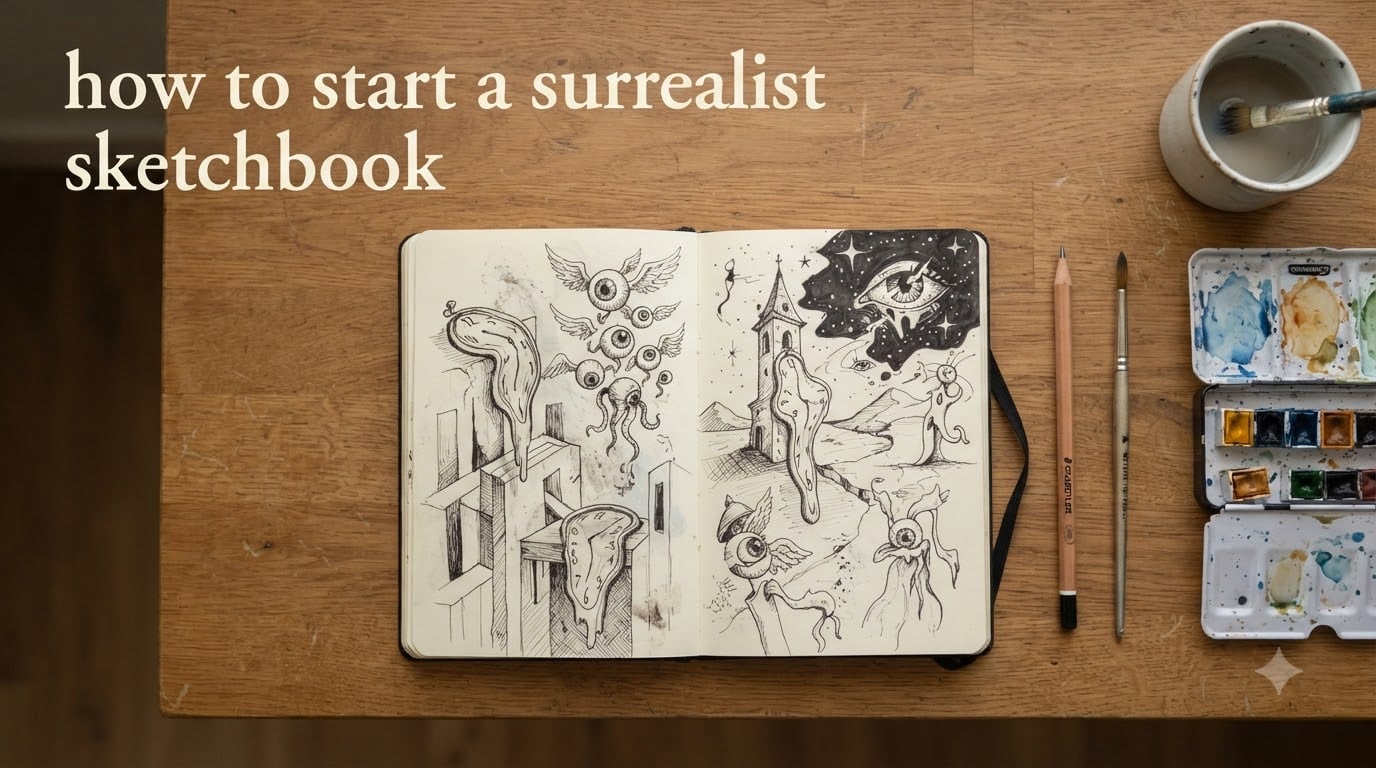
You’ve seen those hauntingly beautiful surrealist paintings — melting clocks, floating elephants, eyes sprouting from unexpected places — and thought, “I want to make something like that.” Here’s the good news: you don’t need art school, fancy training, or even the ability to draw a straight line. A surrealist sketchbook is your personal playground for exploring the unconscious mind through images, and starting one is easier than you think.
In this guide, I’ll walk you through exactly how to start a surrealist sketchbook, from choosing materials to mastering the core techniques that André Breton, Salvador Dalí, and Leonora Carrington used to create their most iconic work. You’ll get a step-by-step starter routine, 30 drawing prompts to banish creative block forever, and answers to every beginner question you’re too embarrassed to ask.
By the end, you’ll have everything you need to open your sketchbook tonight and start creating dreamlike imagery that’s entirely your own.
Table of Contents
What Is a Surrealist Sketchbook?
A surrealist sketchbook is a personal visual journal used to explore surrealism — the 20th-century art movement that draws on the unconscious mind, dreams, and unexpected juxtapositions. Founded by André Breton in 1924, surrealism uses techniques like automatic drawing, the exquisite-corpse game, and dream transcription to bypass conscious control and generate strange, dreamlike imagery.
Unlike a traditional sketchbook where you practice realistic drawing skills, a surrealist sketchbook is about loosening your grip on “what the drawing should look like.” You deliberately short-circuit your planning brain and let images emerge from the unconscious. Over time, recurring symbols and motifs surface — these become your personal surrealist vocabulary.
Every great surrealist kept sketchbooks full of ideas, experiments, and obsessions. Dalí’s notebooks are crammed with paranoid-critical method studies. Carrington’s journals overflow with mythological creatures. Ernst’s pages drip with frottage textures. The sketchbook is where surrealism lives and breathes before it becomes a finished painting.
What You Need to Get Started
You don’t need much to start a surrealist sketchbook, and that’s part of the beauty. Here’s what I recommend keeping on your desk:
A sketchbook. Any size works, but I prefer A5 or A4 with thick paper (at least 120gsm) so ink and light watercolor don’t bleed through. Hardbound books feel more permanent, which helps you commit to filling them. Don’t agonize over this — the best sketchbook is the one you’ll actually use.
Drawing tools. A soft graphite pencil (2B or 4B), a fine liner pen (0.3mm or 0.5mm), and a basic set of colored pencils or watercolors. You don’t need expensive supplies to make surrealist art. The weirdness comes from your mind, not your materials.
Collage supplies. A glue stick, a pair of scissors, and a folder of found imagery. Tear pages from old magazines, collect vintage photographs, print interesting textures from the internet. Collage mixed with drawing is one of the easiest surrealist “wins” for beginners — you start with someone else’s image and transform it into something strange.
A dream journal. Keep a notebook by your bed. When you wake up, write down whatever you remember — even fragments. Those half-remembered dreams become raw material for your sketchbook pages.
Core Surrealist Techniques Every Beginner Should Know
Surrealism isn’t just one technique — it’s a toolkit. Here are the seven core methods that surrealist artists have used for a century, explained so you can try each one tonight.
Automatic Drawing
Automatic drawing is the foundation of surrealist practice. Put pen to paper and draw without planning. Don’t think about what you’re drawing. Don’t judge. Let your hand move across the page the way it wants to move. The goal is psychic automatism — Breton’s term for creating directly from the unconscious without conscious interference.
Start by closing your eyes for thirty seconds. Then open them and draw continuously for two to three minutes without lifting your pen. What emerges might look like abstract scribbles at first. That’s perfect. Over time, recognizable forms start appearing — faces, hands, animals — and those are windows into your unconscious imagery.
Exquisite Corpse (Cadavre Exquis)
This classic surrealist game works beautifully solo or with friends. Fold your paper into three or four sections. Draw a head in the top section, fold it hidden, pass it along (or set it aside and work on the middle section separately), then draw a torso, fold, and draw legs. Unfold to reveal a strange composite figure.
The beauty of exquisite corpse is that it produces juxtapositions you’d never consciously plan — a fish head on a human torso with octopus legs. You can adapt this technique to any subject: landscapes, buildings, creatures. The constraint creates the surrealist magic.
Dream Transcription
Wake up, grab your dream journal, and illustrate whatever you remember. Don’t try to make it “make sense.” Dream imagery is naturally surreal — time collapses, spaces merge, people transform. Your job is to capture the feeling, not recreate reality.
Write the dream first, then draw. Let the words guide the image. A dream about flying through a kitchen becomes a surrealist landscape. A nightmare about a talking mirror becomes a portrait study. The specificity of your dreams makes your sketchbook uniquely yours.
Juxtaposition
Surrealism thrives on placing objects together that don’t logically belong. A telephone in a birdcage. A dresser drawer in a human torso (like Dalí’s famous Venus de Milo). A fish wearing a top hat. Juxtaposition is the technique of unexpected combinations — the stranger the pairing, the more surrealist the result.
Try this: pick two random objects from your room. Now draw them interacting. How does a coffee mug relate to a shoe? Where do they overlap? What story do they tell together that neither tells alone?
Decalcomania
This technique involves pressing wet paint or ink between two surfaces and pulling them apart to create organic, biomorphic textures. Apply ink or watercolor to one page, press another page on top, and peel them apart. The resulting blotch becomes a starting point — look for faces, creatures, or landscapes in the random patterns and develop them with pen and detail.
Decalcomania was used by Max Ernst and Oscar Domínguez to generate dreamlike textures that suggest rather than define. It’s perfect when you don’t know what to draw — the technique gives you something to respond to.
Fumage and Frottage
Fumage means holding your paper over a candle flame or soot source to create smoky, atmospheric textures. Frottage (invented by Ernst) means placing paper over a textured surface — wood grain, leaves, fabric — and rubbing with pencil or crayon to transfer the pattern. Both techniques generate automatic textures that your unconscious mind can then interpret and develop.
These are low-effort, high-reward methods. A wood-grain rubbing becomes a forest. A soot-covered page becomes a night sky filled with floating objects. Let the texture suggest the image rather than forcing a subject.
Collage and Photomontage
Cut, tear, and rearrange found images — magazine pages, vintage photographs, postcards, illustrations. A woman’s face from a 1950s advertisement becomes surreal when you replace her eyes with clock faces. A landscape photograph transforms when you paste a door into the middle of a field.
Collage is the most accessible surrealist technique because you don’t need to draw at all. You’re remixing existing imagery into new, impossible combinations. Many beginners find this the easiest entry point and keep it as a permanent part of their practice alongside drawing.
Your First Surrealist Sketchbook Routine
Here’s a simple starter routine you can do every day in ten to fifteen minutes. I recommend doing it at the same time each morning or evening — consistency matters more than duration.
Step 1: Warm up with automatic drawing (2 minutes). Close your eyes, open them, and draw without stopping. Don’t look at the page. Let your hand wander.
Step 2: Check your dream journal (1 minute). Reread last night’s dream. Pick one image or feeling that stands out.
Step 3: Draw or collage that image (5-7 minutes). Illustrate the dream fragment using any technique — pencil, ink, collage, or a mix. Don’t aim for perfection. Aim for strange.
Step 4: Add a juxtaposition element (2 minutes). Introduce one object that doesn’t belong in the scene. A fish in the sky. A door in the ocean. A clock melting off a tree branch.
Step 5: Write a one-line caption (30 seconds). Something poetic, nonsensical, or dreamlike. “The room remembered itself differently.” “She carried the weather in her pocket.” This trains your brain to think in surrealist language.
Do this routine for 30 days and you’ll have a sketchbook full of raw surrealist material. After that, you can expand sessions, try more complex techniques, and start developing finished pieces from your best pages.
30 Surrealist Drawing Prompts to Get You Started
When you sit down to draw and your mind goes blank, these prompts will jumpstart your imagination. Work through them in order, pick randomly, or use them as daily warm-ups.
Dream and memory prompts:
1. Draw a recurring dream you’ve had, but change the ending.
2. Illustrate a childhood memory as if it happened underwater.
3. Draw the room you’re sitting in, but everything is melting.
4. Create a portrait of someone from a dream you can only half-remember.
5. Draw a landscape that exists only in a feeling you can’t name.
Juxtaposition prompts:
6. Combine a kitchen appliance with a wild animal.
7. Draw a city where all the buildings are made of food.
8. Create a creature that is half insect, half musical instrument.
9. Draw a human figure with furniture instead of body parts.
10. Illustrate a conversation between a tree and a telephone.
Transformation and metamorphosis prompts:
11. Draw a face that is transforming into a landscape.
12. Illustrate a hand growing flowers instead of fingers.
13. Create a fish with a human face swimming through a living room.
14. Draw an eye that contains an entire city inside its iris.
15. Illustrate a book whose pages are turning into birds and flying away.
Automatic drawing prompts:
16. Close your eyes and draw for two minutes. Then develop three details you see in the result.
17. Use your non-dominant hand to draw a self-portrait.
18. Draw a continuous line without lifting your pen for a full page. Then find a figure inside it.
19. Make a decalcomania blot and turn it into a creature.
20. Scribble aggressively, then find and refine the images hiding in the chaos.
Space and scale prompts:
21. Draw a tiny person standing inside a giant teacup.
22. Illustrate a door that opens into a completely different world.
23. Create a room where gravity works sideways.
24. Draw a staircase that leads nowhere and everywhere.
25. Illustrate the inside of a clock, but instead of gears, there’s a garden.
Emotion and concept prompts:
26. Draw what anxiety looks like as a landscape.
27. Illustrate the feeling of déjà vu.
28. Create a portrait of silence.
29. Draw a memory that hasn’t happened yet.
30. Illustrate your personal symbol for freedom.
Surrealist Artists to Study for Inspiration
Studying how the masters approached surrealism will deepen your own practice. You don’t need to copy their style — you need to understand their thinking. Here are seven artists whose work directly informs sketchbook practice.
Salvador Dalí perfected the paranoiac-critical method — a way of seeing multiple images in a single form. Study his melting clocks in The Persistence of Memory and his meticulous technique for painting dreams with photographic precision. His sketchbooks reveal obsessive studies of his recurring obsessions.
René Magritte painted quiet impossibilities — a pipe that isn’t a pipe, a night sky that’s also daytime. His work teaches juxtaposition through restraint. Study how he uses familiar objects in unfamiliar contexts to create cognitive dissonance.
Leonora Carrington built a personal mythology from Celtic folklore, alchemy, and dream imagery. Her paintings overflow with hybrid creatures and ritualistic scenes. Her sketchbooks are especially valuable for studying how to develop a consistent symbolic vocabulary over time.
Max Ernst invented frottage and pioneered collage techniques in surrealist art. His visual novels — Une Semaine de Bonté and La Femme 100 Têtes — are masterclasses in collage narrative. Study them for composition ideas and found-image transformation.
Frida Kahlo turned personal pain into surreal self-portraits. Her work demonstrates how autobiography and surrealism overlap — you don’t need to paint melting clocks when your own body and experience contain surreal imagery worth exploring.
Joan Miró created a personal language of biomorphic forms — playful, childlike shapes that feel both abstract and figurative. His work shows that surrealism doesn’t have to be dark or disturbing. Study his use of line, color, and simplified forms for inspiration when your own imagery feels too literal.
Yves Tanguy painted vast, empty landscapes populated by strange bone-like objects. His work demonstrates how environment and atmosphere create surrealist impact — sometimes the setting is more surreal than any creature within it.
5 Common Beginner Mistakes and How to Fix Them
I’ve seen these pitfalls trap nearly every beginner. Recognizing them early saves you weeks of frustration.
Mistake 1: Trying to make every page “good.” Your sketchbook is not a gallery. It’s a laboratory. Give yourself explicit permission to make ugly, messy, failed pages. The more “bad” pages you make, the faster you’ll discover what works. Forum discussions consistently reveal that the perfectionism trap is the number one reason people abandon their sketchbooks within the first two weeks.
Mistake 2: Copying Dalí and calling it surrealism. It’s tempting to reproduce famous surrealist paintings, but that’s study, not practice. Use Dalí’s techniques, not his images. Your sketchbook should contain your dreams, your symbols, your obsessions — not echoes of someone else’s.
Mistake 3: Waiting for inspiration. Surrealism doesn’t work on inspiration — it works on technique. Automatic drawing, exquisite corpse, and dream transcription generate imagery whether you “feel inspired” or not. Show up and do the routine. The surrealism follows.
Mistake 4: Overthinking before drawing. The moment you plan a surrealist drawing in detail, it stops being surrealist. Start with the technique — the automatic line, the collage element, the dream fragment — and let the image develop through response, not planning. Your conscious mind is the editor, not the author.
Mistake 5: Keeping the sketchbook hidden in a drawer. If your sketchbook is out of sight, it’s out of mind. Leave it on your desk, open to the last page you worked on. Many artists report that visibility alone doubles their consistency. Make the sketchbook impossible to ignore.
Building Your Personal Symbol Library
After a few weeks of regular practice, you’ll notice certain images repeating — a specific animal, a recurring object, a color that keeps appearing. These aren’t random. They’re your personal symbols, and they’re the most valuable thing a surrealist sketchbook produces.
Start collecting them. Dedicate a few pages at the back of your sketchbook to a “symbol library” — sketches of your recurring motifs with notes about what they might mean to you. Over months, this library becomes your artistic vocabulary. When you eventually move from sketchbook to finished pieces, you’ll draw from this personal mythology rather than relying on borrowed imagery.
Carrington built an entire cosmology from her symbols — hyenas, birds, rocking horses, eggs. Dalí’s ants, elephants, and melting clocks became his visual signature. Your sketchbook is where you discover what yours will be. Trust the process. The symbols emerge when you stop trying to invent them.
Frequently Asked Questions
What is a surrealist sketchbook?
A surrealist sketchbook is a personal visual journal used to explore surrealism through techniques like automatic drawing, dream transcription, collage, and juxtaposition. It’s a space to create imagery directly from the unconscious mind without the pressure of finished art.
Do you have to be good at drawing to start a surrealist sketchbook?
No. Surrealist sketchbooking is deliberately accessible to all skill levels. Automatic drawing — the core surrealist technique — requires zero drawing ability because you draw with your eyes closed or without conscious planning. Many of the most powerful surrealist images come from beginners who embrace the technique without overthinking.
What kind of sketchbook is best for surrealism?
Any sketchbook with paper thick enough to handle ink and light watercolor (120gsm or heavier) works well. A5 or A4 sizes give you enough space for detailed pages. Hardbound books encourage commitment. Don’t spend weeks choosing — the best sketchbook is the one you actually open and use daily.
What do surrealists draw?
Surrealists draw dream imagery, impossible juxtapositions, metamorphosing forms, biomorphic shapes, floating objects, and recurring personal symbols. Common subjects include melting or distorted bodies, hybrid creatures, impossible architecture, eyes, clocks, drawers in human torsos, and landscapes that violate physics.
How often should I draw in my surrealist sketchbook?
Daily practice for ten to fifteen minutes builds the habit faster than longer, less frequent sessions. Many artists find that after 30 to 60 days of consistent daily pages, a personal symbol language begins to emerge naturally. Start with the starter routine outlined in this guide and expand from there.
How do you come up with surrealist ideas?
You don’t wait for ideas — you use techniques that generate them automatically. Automatic drawing lets your hand create without planning. Dream transcription turns last night’s sleep imagery into art. Exquisite corpse produces unexpected juxtapositions. Juxtaposition exercises combine unrelated objects. The ideas emerge from the process, not from conscious brainstorming.
How do you draw surrealist dreams?
Write the dream first in your dream journal while memories are fresh. Then illustrate the most vivid image or feeling — not the whole narrative, just one fragment. Don’t try to recreate the dream literally; capture the emotional quality and the strangeness. Let dream logic guide your composition rather than real-world physics.
How do I find my own surrealist style?
Your style emerges from consistent practice, not conscious decision. Keep your sketchbook daily, try every technique, study multiple artists, and pay attention to which images and motifs keep recurring in your work. After several months, patterns will surface — certain colors, forms, subjects, and textures that feel distinctly yours. That’s your style developing.
conclusion
Now you know exactly how to start a surrealist sketchbook. You have the techniques, the prompts, the routine, and the artists to study. The only thing left is to open your sketchbook and begin. Start with tonight’s dream, tomorrow morning’s automatic drawing, or one of the thirty prompts above. Surrealism doesn’t require perfection — it requires willingness. Your unconscious mind has been waiting to draw. Let it.