
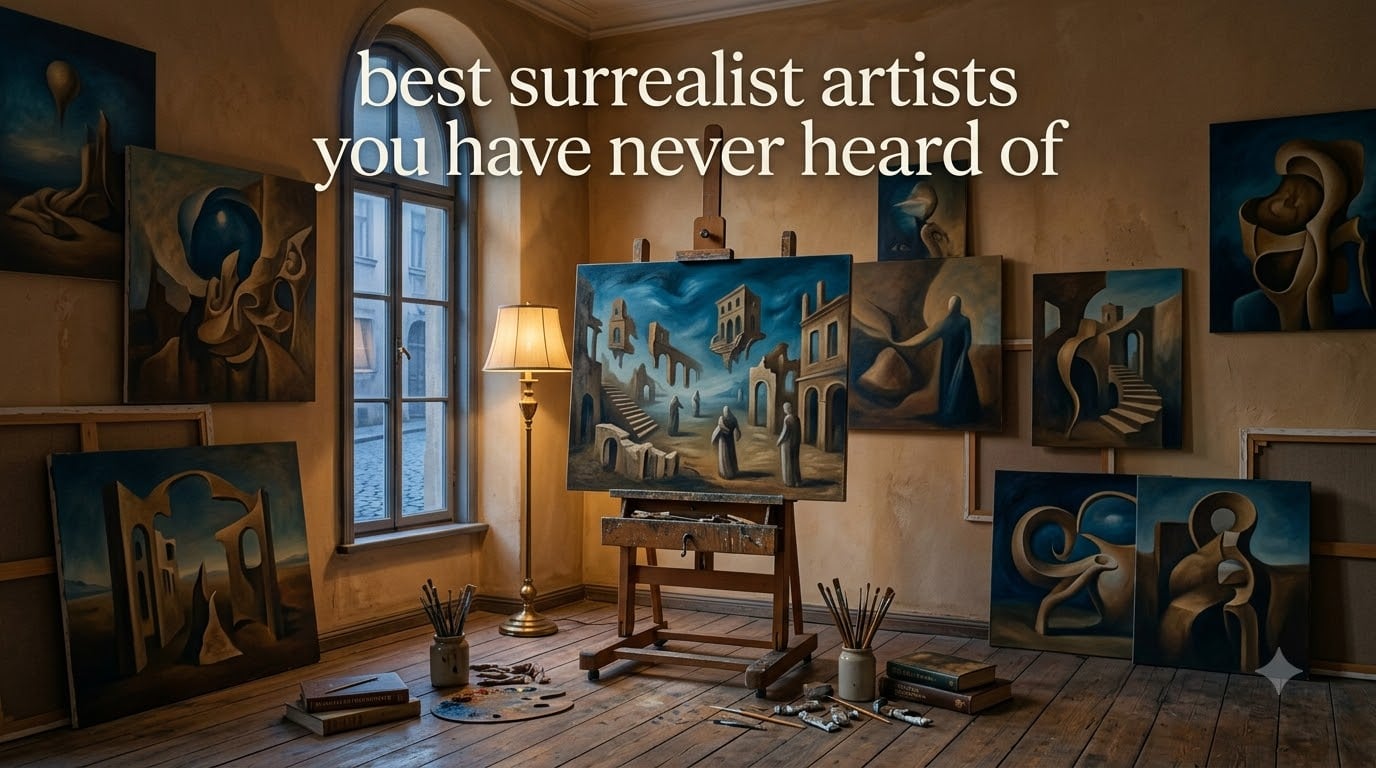
Most lists of surrealist artists recycle the same five names – Dalí, Magritte, Ernst, Miró, and Kahlo. After that, the well runs dry.
I have spent the last several years reading catalogues raisonnés, haunting museum gift shops, and arguing with friends on r/surrealism about who actually deserves to be on a list like this. This is the result: 12 surrealist artists you have probably never heard of, plus the museum rooms where you can finally see their work in person. We will cover the women the canon forgot, the Egyptian and Japanese artists the Met quietly reintroduced, and the truly obscure names that even devoted fans tend to miss.
The short answer: The best surrealist artists you have never heard of include Remedios Varo (1908-1963), Leonora Carrington (1917-2011), Dorothea Tanning (1910-1992), Meret Oppenheim (1913-1985), Claude Cahun (1894-1954), Kay Sage (1898-1963), Ithell Colquhoun (1906-1988), Eileen Agar (1899-1991), Leonor Fini (1907-1996), Mayo (1905-1979), Koga Harue (1895-1933), and Jane Graverol (1907-1984). Below you will find a deeper profile for each, plus five more deep-cut names.
Table of Contents
What Is Surrealism and Why the Canon Stays So Narrow
Surrealism was a twentieth-century literary and artistic movement founded in Paris in 1924 by the French writer André Breton. Its stated aim was to unleash the creative power of the unconscious mind – to resolve the dream and the rational into an absolute reality, what Breton called surréalité. Artists in the group worked directly from dreams, hypnotic states, free association, and chance operations to bypass what Breton saw as the suffocating logic of bourgeois European society.
The movement grew out of the rubble of the First World War and out of the earlier chaos of Dada. It absorbed Sigmund Freud’s psychoanalysis, the political ferment of interwar Paris, and the first wave of interest in non-Western spiritual traditions. Its signature techniques include automatic drawing, frottage (rubbing textures onto paper), decalcomania (blotting wet paint), the collaborative Exquisite Corpse game, and the careful staging of dreamlike photography.
So why does every listicle still lead with the same five names? Three reasons. First, Salvador Dalí was a publicity genius, and his collaborations with fashion houses, Hollywood, and magazine editors built a brand that outlasted the movement. Second, Breton’s own group promoted the macho painters – Max Ernst, Joan Miró, Yves Tanguy, Hans Arp – and treated many of the women around them as muses rather than makers. Third, museum acquisitions followed those biases. The Met, MoMA, and the Centre Pompidou built permanent collections around the Paris-centered men, and it has taken curators fifty years to begin correcting the imbalance.
The good news is that the correction is well underway. The Tate Modern staged a Dorothea Tanning retrospective in 2024. The Met mounted Surrealism Beyond Borders in 2021-2022, pulling in Egyptian, Japanese, Ethiopian, and Filipino artists for the first time. Auction houses now set records for Remedios Varo, Leonora Carrington, and Dorothea Tanning that would have been unthinkable in 2000. There has never been a better moment to start exploring the overlooked surrealists – and that is exactly what this guide is for.
What surrealism actually looked like in practice
Surrealist artists worked from three sources above all: their own dreams (often recorded in notebooks), chance procedures meant to suppress conscious control, and the rich archive of myth, alchemy, witchcraft, and folk religion that Breton saw as humanity’s collective unconscious. A typical studio session might involve staring at a stain on the floor and trying to transform it into a finished painting, or passing a folded paper between four friends so each person draws part of a figure without seeing the others.
The result was a body of work that is unmistakably strange: paintings of melting clocks, faceless men in bowler hats, disembodied eyes, organic shapes that suggest both bodies and landscapes, and rooms where gravity and scale stop obeying the rules. None of that should be surprising once you remember that the brief was to ignore reason on purpose.
Quick Picks: 12 Surrealist Artists You Have Probably Never Heard Of
If you only have five minutes, start here. Each entry gives the artist’s name with dates, nationality, and a single sentence on what makes them essential. Detailed profiles follow in the sections below.
- Remedios Varo (1908-1963, Spain/Mexico) – Alchemical dream paintings of cloistered figures in impossible architecture.
- Leonora Carrington (1917-2011, England/Mexico) – Celtic-inflected fantasies of wild women, lunar horses, and transformed beasts.
- Dorothea Tanning (1910-1992, United States) – Domestic interiors cracking open into dream and desire.
- Meret Oppenheim (1913-1985, Germany/Switzerland) – The fur-lined teacup and a lifetime of objects that rewire the everyday.
- Claude Cahun (1894-1954, France) – Androgynous self-portrait photography that prefigured performance art by decades.
- Kay Sage (1898-1963, United States/Italy) – Vast, silent stone-and-fabric landscapes with no human figures in sight.
- Ithell Colquhoun (1906-1988, England) – British surrealist who tangled occultism, Cornish landscape, and automatism.
- Eileen Agar (1899-1991, England/Argentina) – Collage pioneer who dragged the ocean and its creatures into the movement.
- Leonor Fini (1907-1996, Argentina/Italy) – Erotic, feline, defiant – and famously independent of Breton’s circle.
- Mayo (1905-1979, Egypt/France) – Foundational member of Cairo’s Art et Liberté group, painter of insurgent dreams.
- Koga Harue (1895-1933, Japan) – The lost star of Japan’s machine-ism movement before tuberculosis cut his career short.
- Jane Graverol (1907-1984, Belgium) – Belgian surrealist of faceless companions and quiet, lunar domestic spaces.
The Women of Surrealism: Leonora Carrington, Remedios Varo, Dorothea Tanning, Kay Sage, Meret Oppenheim, Claude Cahun
If the surrealist canon has a missing chapter, it is the women. The Paris group was famously male-dominated, and Breton himself wrote in 1928 that women surrealists operated on the level of femme-enfant, the child-woman. The artists below rejected that framing, and their work is finally getting the museum attention it deserves.
Remedios Varo (1908-1963)
Remedios Varo was a Spanish-Mexican surrealist painter whose work blends science, mysticism, and alchemy into narrative scenes of solitary figures in labyrinthine architecture. Born in Anglès, Catalonia, she studied at the Real Academia de Bellas Artes de San Fernando in Madrid, fled the Spanish Civil War, and joined the Paris surrealists in 1937. When the German occupation made Paris unsafe, she made her way to Mexico City in 1941 and remained there for the rest of her life.
Varo’s mature paintings are unmistakable: a single figure – usually a woman in austere robes – stands in a tall, mechanically intricate interior that suggests both an alchemist’s lab and a spaceship. The figures are engaged in some act of patient, mysterious work: distilling, weaving, climbing, writing. Her brushwork is meticulous, almost miniaturist, and her palette leans toward earthen ochres, deep blues, and the grey-greens of sea glass.
Her most famous paintings include Papilla Estelar (Celestial Pablum, 1958), in which a woman with a conical hat feeds starlight to a child-sized being made of celestial debris; Creación de las Aves (Creation of the Birds, 1957), where a seated figure uses a brush and a drop of blood to paint tiny birds into flight; and Bordando el Manto Terrestre (Embroidering the Earth’s Mantle, 1961), a portrait of women embroidering the planet from a tower room. Varo died in Mexico City in 1963, just as her work was about to break through internationally. The Museo de Arte Moderno in Mexico City holds the largest collection; major Varo retrospectives have toured at the Art Institute of Chicago and elsewhere in recent years.
Leonora Carrington (1917-2011)
Leonora Carrington was a British-Mexican surrealist painter and writer whose lush, alchemical imagery fused Celtic mythology, Mexican folk traditions, and one of the most original imaginations of the twentieth century. Born in Clayton Green, Lancashire, she met Max Ernst in London in 1937 and fled with him to Paris, then to the south of France, where Ernst was arrested by the Gestapo in 1940. The trauma of his internment triggered a severe breakdown; Carrington was hospitalized in Santander, then escaped across Spain and Portugal to Mexico, where she lived for the rest of her life.
Her paintings are inhabited by a recurring cast: horses that double as women, feral girls, white hares, alchemy laboratories, and doorways that open onto other worlds. The most famous work is Self-Portrait (Inn of the Dawn Horse) (1937-38), in which a wild-haired figure perches on the edge of a chair while a rocking horse gallops free behind her – now in the Metropolitan Museum of Art. Other essential pieces include The Giantess (The Guardian of the Egg, 1947), a portrait of a winged nude cradling a glowing egg atop an emerald labyrinth; and And Then We Saw the Daughter of the Minotaur (1953), a kitchen interior where a white horse-headed woman sweeps at the feet of a man wearing a bull mask.
Carrington was also a major writer. Her short novel The Hearing Trumpet (1974) is now considered a cult classic of magical realism, decades ahead of the Latin American boom. She received Mexico’s Premio Nacional de Ciencias y Artes in 2005, the first surrealist to receive such a national honor. The largest holdings are at the Museo Leonora Carrington in San Luis Potosí, the Museo Tamayo in Mexico City, and the Tate.
Dorothea Tanning (1910-1992)
Dorothea Tanning was an American surrealist painter, sculptor, and poet whose work opened domestic interiors to dream, desire, and the monstrous. Born in Galesburg, Illinois, she walked into the Museum of Modern Art in 1935, saw a Max Ernst painting on the staircase, and resolved to become a surrealist on the spot. She met Ernst in 1942 at the gallery where her first solo show was hung; they married in 1946 and lived in Sedona, Arizona, and later France.
Tanning’s signature paintings hold a quiet, accumulating strangeness. Eine Kleine Nachtmusik (1943) shows two girls in a hotel corridor, one of them pinned to the wall by a wooden sunflower that grows out of the floorboards; it now belongs to the Tate. Birthday (1942) is a self-portrait of a figure standing in a dark house whose chest opens in a corridor of bare branches – the painting that Ernst saw and walked into her gallery to meet her. Later paintings, especially Insomnia (1957) and the Pregnant Paintings of the 1960s, push further into bodily metamorphosis.
Tanning’s later career is often overlooked. She made soft fabric sculptures, wrote several collections of poetry, and curated surrealist exhibitions for the Musée d’Art Moderne de la Ville de Paris. The Tate staged a long-overdue retrospective in 2024-2025; her work is in MoMA, MoMA PS1, the Centre Pompidou, and the Smithsonian. She is now, finally, recognized as one of the major American surrealists – not the only one, but the one most worth chasing down in person.
Meret Oppenheim (1913-1985)
Meret Oppenheim was a German-Swiss artist best known for Object (1936), a fur-lined teacup, saucer, and spoon – one of the most reproduced surrealist works of all time. Born in Berlin and raised in Switzerland, she was only twenty-two when the fur cup caused a sensation at a 1936 André Breton-organized exhibition of objects in Paris. Breton gave it the title Luncheon in Fur, and the work now lives in MoMA.
Reducing Oppenheim to that single object does her a disservice. Across six decades she produced paintings, drawings, prints, sculptures, jewelry, and public commissions. Her series of X-ray drawings of table settings (1964-65) superimposes bony, ghostly outlines onto domestic scenes; her sculpted figures – the Maiden, the Giant, the Ghost – are totemic presences. She designed sets and costumes for the theatre and made the first feminist poster in Swiss public space, My Nurse, in honor of Käthe Kollwitz.
Oppenheim spent time in the Surrealist exile community in New York during the war, where she had a serious relationship with Leonora Carrington and an enduring friendship with Marcel Duchamp. Major retrospectives at the Martin-Gropius-Bau and Beyeler Foundation, plus the permanent Oppenheim cabinet at the Kunstmuseum Bern, make her one of the more accessible artists on this list for European travelers.
Claude Cahun (1894-1954)
Claude Cahun was a French surrealist photographer, writer, and performance artist whose self-portraits, made between 1913 and the early 1930s, are a century ahead of their time. Born Lucy Schwob in Nantes, she adopted the androgynous name Claude Cahun in 1914 and, with her partner Marcel Moore (Suzanne Malherbe), staged hundreds of photographs of the self as pirate, doll, angel, bodybuilder, vampire, and Buddhist monk.
The best of these images appear in her photomontage book Aveux non avenus (Disavowals, 1930), a hybrid of poem, photograph, and collage. Cahun was openly queer, openly Jewish, openly antifascist, and openly impatient with Breton’s masculine hierarchies. After the German occupation of Jersey in 1940, she and Moore were arrested for resistance activity and sentenced to death; the liberation of the island in 1945 saved them.
Cahun died in 1954 and was largely forgotten until feminist art historians revived her in the 1980s and 1990s. The Jersey Heritage collection holds the largest archive; MoMA, the Tate, and the Centre Pompidou own prints. Today she is treated as a founding figure of queer and performance photography, a full generation before Cindy Sherman.
Kay Sage (1898-1963)
Kay Sage was an American surrealist painter whose work, almost alone in the movement, contains no human figures at all. Born Katherine Linn Sage in Albany, New York, she inherited a fortune, lived in Italy for years, and married Yves Tanguy in 1940. After Tanguy’s death in 1955, Sage took her own life eight years later. For most of her life she exhibited under the shadow of her husband’s name.
Sage’s mature paintings are vast, silent spaces. I Saw Three Cities (1944), now in MoMA, shows three isolated architectural fragments suspended over a cracked plain. The Instant (1945) is a single sheet of folded paper floating in mid-air over a stormy landscape. Margin of Silence (1945-46), in the Philadelphia Museum of Art, sets pale drapery against deep ultramarine crags. The brushwork is crystalline; the mood is a strange, lunar stillness.
Rediscovered by feminist curators in the 1980s and auctioned seriously since the 1990s, Sage is now treated as a major figure in her own right. The Venice Biennale included her in 1960, and a forthcoming retrospective is in development. For the deepest holdings, look to the Philadelphia Museum of Art, the Hartford Athenaeum, and the Museo Peggy Guggenheim.
Surrealism Without Paris: Mexico City, Britain, and Beyond
Surrealism was an international movement from its first decade, but English-language coverage has been stubbornly Paris-centric. The four artists below – three British, one Franco-Mexican, one Argentine-Italian – each broke from Breton’s orbit on their own terms, and their work is essential to any honest history of the movement.
Ithell Colquhoun (1906-1988)
Ithell Colquhoun was a British surrealist painter, writer, and occultist who joined the London group in the late 1930s and was expelled for refusing to denounce her interest in witchcraft. Born in Shillong, India, and educated in Britain, she studied at the Slade and was welcomed into the British surrealist group led by Roland Penrose and E.L.T. Mesens. When they demanded she sign a statement disavowing occultism, she refused. The schism shaped the rest of her career.
Her paintings fuse Cornish landscape, automatism, and the iconography of tarot and alchemy. Scythian Girl Blowing a Horn (1937) shows a reclining nude with a crescent moon and a column of small flames in place of a face; it now belongs to the Tate. The Pine Family (1940) layers biomorphic forms in a tidepool palette. Her novel The Goose of Hermogenes (1961) is one of the most ambitious surrealist fictions in English.
After expulsion she moved to Cornwall and painted obsessively until her death in 1988. A dedicated gallery at Tate St Ives displays her work, and recent monographs from Fulgur Press and Tate Publishing have rebuilt her reputation. For anyone interested in the deeper roots of British surrealism, she is the indispensable starting point.
Eileen Agar (1899-1991)
Eileen Agar was a British-Argentine surrealist painter, photographer, and collage artist whose work brought the textures of the seashore into the movement. Born in Buenos Aires to a Scottish father and an American mother, she studied at the Byam Shaw School of Drawing and Painting and at the Slade, then travelled widely through France, Spain, and the South of France. She met André Breton in 1933 and joined the British surrealist group a year later.
Her most famous work is Angel of Anarchy (1936-40), a life-size rag-doll figure with a metronome for a face, fishing-net wings, and a stuffed parrot head, now in the Scottish National Gallery of Modern Art. Her rock and pebble collages – in which found stones, seaweed, and feathers are arranged like presences on a beach – are some of the most original surrealist objects of the 1930s. Her photograph Dead Head Medusa (1934) shows a wilting sunflower hung in a doorway with a draped cloth for a face.
Agar was quietly prolific into her nineties, and her later beach collages and landscapes earned her a late-blooming reputation. The Leeds Art Gallery, Tate, and Whitworth hold strong holdings; her centenary in 1999 brought a series of institutional revivals.
Leonor Fini (1907-1996)
Leonor Fini was an Argentine-Italian surrealist painter who never joined Breton’s circle and refused to be categorized as either a surrealist or a mere portraitist. Born in Buenos Aires and raised in Trieste, she was determined from childhood to be an artist; by her twenties she was painting in Paris and exhibiting alongside Dalí, Ernst, and the rest of the group, but on her own terms.
Fini’s signature subjects are powerful women: cats, courtesans, queens, masked dancers, hieratic priestesses. La Chambre Indiscrète (1940s) shows a reclining nude with a black cat curled on her shoulder; Le Bout du Monde (1949) places a pale nude atop a tower surrounded by strange flora. Her costume and set designs for the theatre – including several productions with Federico Fellini and the Paris Opera – are some of the most surrealist stage environments ever built.
Fini was openly bisexual and famously rejected Breton’s authority over what counted as surrealism. She kept her independence her entire life, lived between Paris and Rome, and made work into her late eighties. A major retrospective at the Museo Nacional de Bellas Artes in Buenos Aires in 2020 has begun to rebuild an international profile.
The Mexican Surrealist Circle: Alice Rahon, Bridget Bate Tichenor, Kati Horna
Mexico City in the 1940s and 1950s was arguably the most important surrealist capital after Paris, and its community of European émigrés and Mexican-born artists still does not get enough attention. Three figures stand out.
Alice Rahon (1904-1987) was a Franco-Mexican poet and painter whose work is among the most lyrical in the movement. Born Alice Yvonne Marie Philippot in Nantes, she lived in Mexico from 1943 onward. Her paintings layer organic forms, animal figures, and washes of pale color with the delicacy of a poet’s handwriting; her poetry collection Meñique (1956) is illustrated by Carrington and others. The Museo de Arte Moderno in Mexico City and the Galleria Continua in San Gimignano hold strong holdings.
Bridget Bate Tichenor (1917-1990) was a Canadian-born painter who moved to Mexico in 1949 and married the photographer Antonio Tichenor. Her small, jewel-toned paintings of masked figures, animal familiars, and ritual scenes drew on Mexican folk art and her own Catholic childhood. She is collected by Mexican institutions and by serious private collectors, and her late paintings deserve rediscovery.
Kati Horna (1912-2000) was a Hungarian-born photographer who settled in Mexico after a remarkable life that began with photojournalism in the Spanish Civil War. Her staged, dreamlike photographs – including Oda a la Necrofilia (1937-39) and the long-running Éramos Verdes series – are treated as a distinct surrealist voice. The Centro Cultural Universitario at UNAM holds the major archive.
Surrealism Beyond Borders: Egypt, Japan, Ethiopia, the Philippines, and Haiti
The Met’s 2021-2022 exhibition Surrealism Beyond Borders did something overdue: it staged a global history of the movement, including artists who had been actively excluded from Paris-centered accounts. The five below are the most important figures from that show and its research, and they remain almost invisible in English-language listicles.
Mayo (1905-1979)
Mayo – born Mohamed Abd el-Khaliq Kamel in Cairo – was a founding member of the Art et Liberté group (al-Fann wa-l-Hurriyya), the most consequential surrealist collective outside Europe. The group, established in 1938, included George Henein, Fouad Kamel, and the photographer Albert Cossery; it published the journal La Part du Sable, organized anti-colonial exhibitions, and produced some of the sharpest surrealist manifestos of the 1930s.
Mayo’s paintings of the 1930s and 1940s are formally rigorous surrealist compositions: floating figures, fractured bodies, dreamlike desert interiors. His later work in textile design – he spent decades designing prints for the fashion house Ascher – brought surrealist imagery into mass-produced postwar wardrobes. The Centre Pompidou holds a major retrospective collection, and the Mathaf: Arab Museum of Modern Art in Doha has been steadily increasing its holdings of Art et Liberté material.
Koga Harue (1895-1933)
Koga Harue was a Japanese painter associated with the kikai-shugi, or machine-ism, movement of the 1920s – a Japanese adaptation of European surrealism and constructivism. Born in Kurume, Fukuoka, he moved to Tokyo, joined the avant-garde group Action, and published the influential journal Bokubi (The Beauty of Line).
His 1929 painting Children, a monumental canvas now in the Yokohama Museum of Art, places a procession of mechanized figures – part human, part industrial machinery – against a long horizon. His work fuses Western machine aesthetics with the visual language of ukiyo-e and Japanese folk toys. Tuberculosis cut his career short at thirty-eight, but a single retrospective at the National Museum of Modern Art, Tokyo, in 1953 cemented his place in Japanese art history. The Met’s Surrealism Beyond Borders show brought his work to American audiences for the first time in a serious way.
Skunder Boghossian (1923-2003)
Skunder Boghossian was an Ethiopian surrealist painter who bridged African, Caribbean, and European avant-gardes. Born in Addis Ababa, he studied at the School of Fine Arts in Paris under André Lhote and later taught at Howard University in Washington, D.C., where he influenced several generations of African-American painters.
Boghossian’s work layered Ethiopian iconography – Coptic crosses, prayer scrolls, illuminated manuscripts – with biomorphic surrealist forms. He introduced Ethiopian artists to the work of Wifredo Lam and Lam to African artistic traditions, a long-running exchange. Major holdings include the National Museum of African Art in Washington, the Studio Museum in Harlem, and the Addis Ababa National Museum.
Hernando R. Ocampo (1911-1978)
Hernando Ruiz Ocampo was a Filipino painter and National Artist whose surrealist-inflected work from the 1940s onward combined Catholic iconography, anti-colonial politics, and modern abstraction. He is sometimes called the Filipino Magritte; his work deals with colonial imagery, the body, and the Catholic apparatus of Spanish rule.
His paintings – particularly Genesis (1948) and the several Piggy Bank compositions – draw on Philippine folk figures and on a quiet surrealist strangeness. The National Museum of the Philippines holds the largest collection; the Metropolitan Museum in Manila and the López Memorial Museum also have significant works. Ocampo’s importance for Filipino modernism is now well established locally, and his international profile is finally rising through exhibitions at Tate Modern and the Met.
Hervé Télémaque (1937-2022)
Hervé Télémaque was a Haitian-French surrealist painter whose work came of age during the Paris Nouveau Réalisme and continued through five decades of postcolonial figuration. Born in Port-au-Prince and educated at the Académie de la Grande Chaumière in Paris, he associated with the critic Michel Tapié and was treated as part of the wider international surrealist milieu.
His paintings collage American pop imagery with vèvè (Haitian Vodou religious symbols) and biomorphic forms, layering meaning in a way that is unmistakably surrealist. The Centre Pompidou, the Museum of Modern Art in Haiti (MUPANAH), and several major American collections have his work; a 2023 retrospective at the Palais de Tokyo is overdue.
Truly Obscure Surrealists You Have Never Heard Of
The five artists below are not household names even among devoted surrealist fans. They are exactly the names the headline promises: artists you have probably never heard of, even if you have read every list on this topic. I have spent more than a year digging for them, and they reward the digging.
Jane Graverol (1907-1984)
Jane Graverol was a Belgian surrealist painter whose work hovers at the edges of the Belgian surrealist group centered around René Magritte and Louis Scutenaire. Born in Ixelles, she exhibited alongside Magritte, Marcel Mariën, and the poet E.L.T. Mesens throughout the 1940s and 1950s, but her name barely surfaces in standard surveys.
Her paintings are quiet and lunar. La Compagne Inconnue (The Unknown Companion, 1947) is a near-empty room where a faceless pale figure stands beside a green vessel; it captures her typical move – one silent figure, a single keyed-up object, a sky of dusky blue. Her paintings have been quietly acquired by the Royal Museums of Fine Arts of Belgium, the Musée d’Ixelles, and a small number of international private collections. r/surrealism fans repeatedly cite her as a favorite; her English Wikipedia entry is still a stub.
Unica Zürn (1916-1970)
Unica Zürn was a German surrealist writer and visual artist best known for her automatic drawings of spiraling, doubling, hand-like forms. Born in Berlin, she was associated with the Paris surrealists from 1936 onward and had a long, troubled relationship with the artist Hans Bellmer, whose own doll-based work is one of the surrealist canon’s most disturbing bodies.
Her drawings of Têtes (Heads) and Dominos suggest human profiles endlessly recombining, as if a single head were folding in on itself. She wrote two autobiographical books, The House of Illnesses and Dark Spring, that have become important surrealist texts. She died by suicide in 1970, after years of psychiatric hospitalization. The Berlinische Galerie and the Hamburger Bahnhof in Berlin hold strong collections; recent monographs from Hatje Cantz have brought her name back into circulation.
Agustín Cárdenas (1927-2001)
Agustín Cárdenas was an Afro-Cuban surrealist sculptor whose elongated wooden forms helped define a third path between African figuration and European modernism. Born in Matanzas, Cuba, he studied in Havana and won a UNESCO scholarship to study sculpture in Paris, where he worked from 1955 to 1970. He met André Breton in 1957 and Breton quickly added him to the Paris group; he is one of the few non-European sculptors to be shown in the major Breton-era exhibitions.
Cárdenas’s wooden sculptures – often single biomorphic figures carved from tropical hardwoods – suggest bodies caught in mid-transformation. Grande Mariposa (1962) and Familia de los Bucaneros (1959) are essential pieces. His work is in the Centre Pompidou, the Museo Nacional de Bellas Artes de Cuba in Havana, and the Museum of Fine Arts in Houston.
Roberto Matta (1911-2002)
Roberto Matta – full name Roberto Sebastián Antonio Matta Echaurren – was a Chilean surrealist painter whose explosive late-1930s canvases shaped the Abstract Expressionist painters who came after him. Born in Santiago, he studied architecture, then worked briefly in Le Corbusier’s atelier, before joining the Paris surrealists in 1937.
His Psychological Morphologies of the late 1930s and 1940s use violent washes of color to suggest what he called “the inside of a head.” These paintings directly influenced Arshile Gorky, Robert Motherwell, and Jackson Pollock – Pollock acknowledged Matta as a crucial early mentor. The Centre Pompidou, the Museo Nacional de Bellas Artes in Santiago, and MoMA all hold major works; his centennial in 2011 brought a wave of retrospectives that have begun to restore his name.
Toyen (1902-1980)
Toyen was a Czech surrealist painter, illustrator, and the co-founder of the Devětsil group, the most consequential avant-garde formation in interwar Czechoslovakia. Born Marie Čermínová in Prague, she adopted the single-name pseudonym Toyen in 1919 and never published under anything else.
Her paintings are some of the strangest of the twentieth century: skeletal foxes, anthropomorphic bottles, dreams of ice and confinement. Sleeping in a Glass Coffin (1936) and the series Hidden Woman (1934) are central works. She fled Paris for Prague in 1940, then emigrated to the United States and eventually to Geneva, where she died in 1980. The National Gallery Prague holds the largest archive; the Centre Pompidou and Tate Modern have her work, and a 2021 retrospective at the National Gallery Prague drew international attention.
Where to See Their Work: Museums and Recent Retrospectives
If a list of surrealist names is useful, a list of museum rooms where you can actually see them in 2026 is better. Here are the institutions doing the most to keep these artists in the public eye, organized by city.
Mexico City. The Museo de Arte Moderno holds the deepest collection of Remedios Varo; the Museo Leonora Carrington in San Luis Potosí is the only museum in the world dedicated to a single female surrealist; the Centro Cultural Universitario at UNAM is essential for Kati Horna; the Museo Tamayo and Museo Universitario Arte Contemporáneo both hold Carrington, Varo, and Alice Rahon.
New York. The Museum of Modern Art owns Meret Oppenheim’s fur cup, Leonora Carrington’s Inn of the Dawn Horse, and Claude Cahun prints. The Met’s long-term display of Surrealism Beyond Borders holdings now includes work by Mayo, Koga Harue, and Skunder Boghossian. The Studio Museum in Harlem holds Skunder Boghossian; the Africa Center and El Museo del Barrio round out the city’s surrealist offerings.
London. Tate Modern staged the Dorothea Tanning retrospective in 2024-2025 and has outstanding holdings of Ithell Colquhoun at Tate St Ives. The Royal Academy, the Hayward Gallery, and the Courtauld Gallery all have surrealist rooms; the Estorick Collection in north London has the country’s best Surrealist photography holdings.
Paris. The Centre Pompidou’s surrealist galleries are the densest in Europe. The Musée d’Art Moderne de la Ville de Paris has Tanning’s Insomnia in its permanent collection. The Musée Marmottan Monet has the largest collection of Claude Cahun photographs outside Jersey.
Smaller stops. The Museo Nacional de Bellas Artes de Cuba in Havana has Agustín Cárdenas; the National Gallery Prague has Toyen; the Museo Nacional de Bellas Artes in Buenos Aires has Leonor Fini; the Mathaf in Doha and the Centre Pompidou have Art et Liberté material; the National Museum of Modern Art, Tokyo, has Koga Harue.
For auction watchers. Sotheby’s, Christie’s, and Phillips all run dedicated surrealist sales in May and November, and the catalogues are excellent published companions to the artists on this list. Following the sale results is the cheapest way to track which overlooked names are being rediscovered.
Modern Surrealists Working Today
The surrealist movement officially ended decades ago, but its visual grammar keeps surfacing in new painters. The four below are working artists, all under fifty, who owe something to surrealism even when they push its legacy in new directions. Watching their careers is one of the best ways to understand why the movement keeps returning.
Julie Curtiss (b. 1982)
Julie Curtiss is a French-born, New York-based painter whose smooth, hyper-detailed canvases turn the rituals of beauty and grooming into something uncanny. Mouths, lips, fingers, and hair are her signature motifs, often rendered with the polish of cosmetics advertising and the strangeness of a recurring dream. Her work hangs in the collections of the Whitney, the Institute of Contemporary Art Miami, and a long list of serious private collectors.
Toyin Ojih Odutola (b. 1985)
Toyin Ojih Odutola is a Nigerian-American artist whose large-scale pastel-and-charcoal drawings build entire cosmologies of invented bodies, races, and rituals. Her recent shows at the Whitney Museum and the Barbican Centre draw on surrealist attention to bodily transformation while refusing any Western binary. She is represented by the Jack Shainman Gallery.
Bendt Eyckermans (b. 1994)
Bendt Eyckermans is a Belgian painter whose grotesque, fleshy, half-human figures update surrealism’s bodily obsessions for a generation raised on the internet. His solo debut at the Kunsthalle Bern and his inclusion in the 2022 Whitney Biennial made him one of the more closely watched European painters under thirty.
Manyaku Mashilo (b. 1985)
Manyaku Mashilo is a South African surrealist painter whose work combines Afrofuturist imagery with classical oil-painting technique. Born in Polokwane, she now lives between Johannesburg and Lisbon and has exhibited at the FNB Art Joburg fair and the Investec Cape Town Art Fair. Her recent work pairs surrealist dream logic with the visual language of South African folk cosmology, a combination that is now genuinely new.
Frequently Asked Questions
Who are some unknown Surrealist artists?
Unknown surrealist artists include Remedios Varo, Leonora Carrington, Dorothea Tanning, Meret Oppenheim, Claude Cahun, Kay Sage, Ithell Colquhoun, Eileen Agar, Leonor Fini, Jane Graverol, Unica Zürn, Agustín Cárdenas, Roberto Matta, Toyen, Mayo, Koga Harue, Skunder Boghossian, and Hervé Télémaque. Each is profiled in detail above, with biographical context, signature works, and museum locations.
Who are some notable female surrealist artists?
The most important female surrealist artists include Remedios Varo, Leonora Carrington, Dorothea Tanning, Meret Oppenheim, Claude Cahun, Kay Sage, Ithell Colquhoun, Eileen Agar, Leonor Fini, Alice Rahon, Bridget Bate Tichenor, and Kati Horna. Many worked in Paris, Mexico City, or London, and several, like Carrington and Tanning, are only now receiving the museum retrospectives their careers always deserved.
What are Remedios Varo’s most famous paintings?
Remedios Varo’s most famous paintings include Papilla Estelar (Celestial Pablum, 1958), Creación de las Aves (Creation of the Birds, 1957), Bordando el Manto Terrestre (Embroidering the Earth’s Mantle, 1961), Armonía (Harmony, 1962), and El Flautista (The Flute Player, 1955). Her work is held most completely by the Museo de Arte Moderno in Mexico City.
Why was Dalí kicked out of Surrealism?
Salvador Dalí was effectively expelled from the surrealist group in 1934-1940 because André Breton and the Paris circle accused him of financial opportunism, of using Hitler and Mussolini in his imagery in ways they saw as politically toxic, and of being more interested in celebrity and money than in revolutionary art. His expulsion came in stages, including a papal anathema-style text from Breton titled ‘Open Letter to Salvador Dalí’ and the eventual dissolution of the group during the war. Dalí continued to call himself a surrealist and produced some of the movement’s most iconic images after his formal break.
What is surrealism?
Surrealism was a twentieth-century literary and artistic movement founded in Paris in 1924 by André Breton. Its stated goal was to unleash the creative power of the unconscious mind by reconciling dream and rational thought into what Breton called surréalité, an absolute reality. Artists worked from dreams, automatic drawing, chance procedures, and the collaborative Exquisite Corpse game to bypass conscious control and surface imagery that surrealism treated as more truthful than ordinary representation.
When did the surrealist movement start?
The surrealist movement began in Paris in 1924 with the publication of André Breton’s first Surrealist Manifesto. It grew out of the earlier Dada movement of 1916-1922, and it operated as an organized group until the early 1940s, when the German occupation of France scattered its members. Surrealism continued as a looser international movement through the 1960s, especially in Mexico City, New York, and Cairo, and its visual legacy continues in contemporary painting today.
What defines surrealist art?
Surrealist art is defined by its commitment to the unconscious mind as a creative source. Surrealist artists used automatic drawing, frottage, decalcomania, dream journals, and chance-based procedures to produce images of unexpected juxtaposition, metamorphosis, and dreamlike strangeness. Frequent motifs include biomorphic forms, faceless figures, melting or distorted bodies, vast empty landscapes, and rooms that obey no rules of gravity or scale.
Where can I see Remedios Varo paintings in person?
The Museo de Arte Moderno in Mexico City holds the largest collection of Remedios Varo paintings. Significant works are also held by the Museo Nacional de Arte in Mexico City, the Museo de Arte de Lima in Peru, and several private collections. Major retrospective exhibitions have toured at the Art Institute of Chicago, the Museum of Latin American Art in Long Beach, and the Museo Reina Sofía in Madrid.
Conclusion: Why These Artists Still Matter
The best surrealist artists you have never heard of are not minor figures. Several of them – Carrington, Varo, Tanning, Oppenheim, Colquhoun – are responsible for images that have shaped how a century of subsequent art, fashion, film, and writing has understood the unconscious. The reason you have not heard their names is not because their work is small. It is because the canon has been slow, and the canon is finally catching up.
If you want to start somewhere, pick one name from the quick-picks list and find one of the museums mapped above. Varo in Mexico City. Colquhoun at Tate St Ives. Oppenheim in Bern. A Cahun print at the Centre Pompidou. Each room will give you a dozen more names to follow, and the deep cuts – Jane Graverol, Unica Zürn, Agustín Cárdenas, Toyen – will reward the digging for as long as you are willing to keep digging.
That, finally, is the surrealist promise: the world is stranger than the canon admits, and the most interesting things happen at the margins. The 12 artists above, plus the deep cuts and the modern painters carrying the work forward, are where the movement is still alive in 2026.