
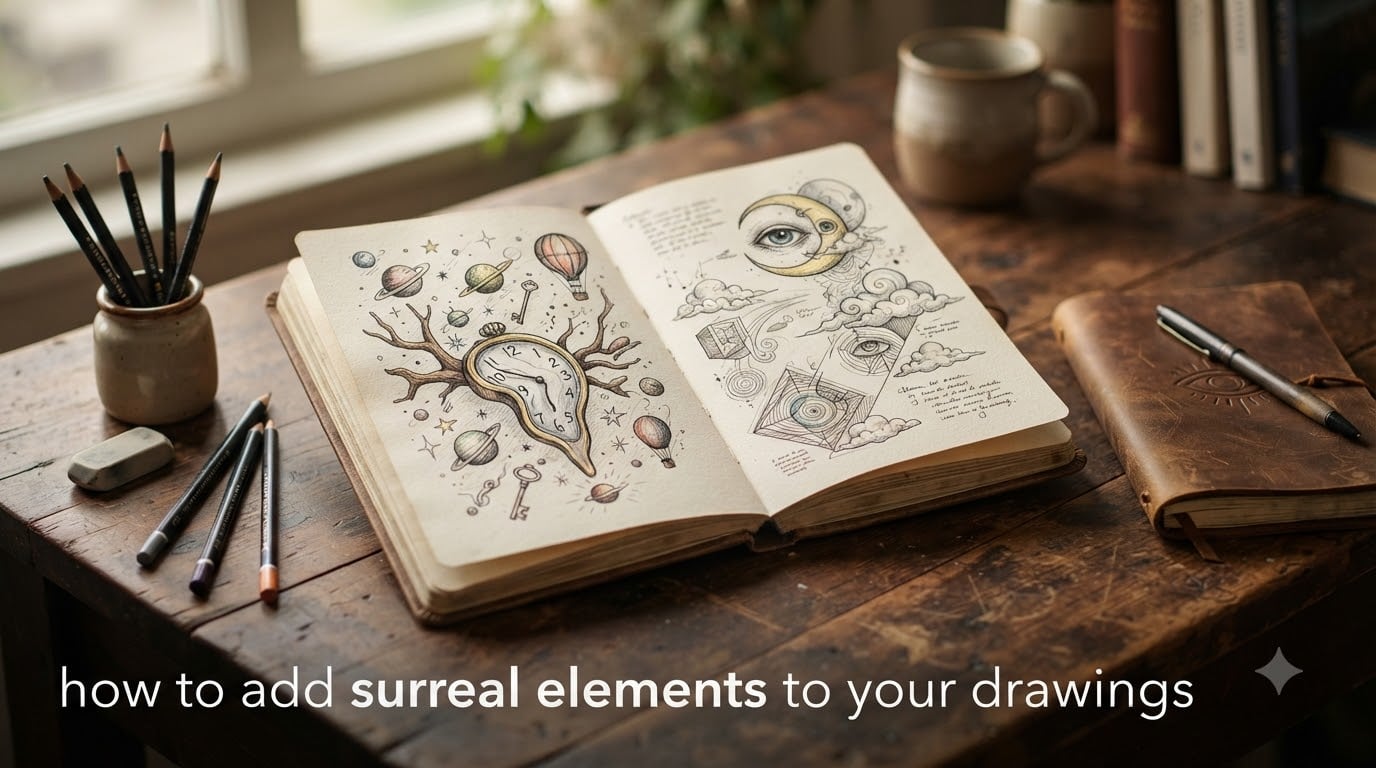
Surreal elements in drawings are unexpected, dreamlike combinations of objects, scales, or scenes that challenge everyday reality — built around juxtaposition, distortion, and imagery from the unconscious mind. In this guide, you’ll learn how to add surreal elements to your drawings using proven techniques from Dalí, Magritte, and other masters, plus practical exercises you can try in your sketchbook today.
Whether you’re a beginner looking to break free from literal representation or an experienced artist wanting to deepen your personal style, surrealism offers a toolkit for turning drawings into experiences. We’ll cover the core techniques, a symbol library to reference, dream journaling for idea generation, and the common mistakes that trip up new surrealist artists.
Table of Contents
How to Add Surreal Elements to Your Drawings
Adding surreal elements to your drawings starts with understanding what makes something feel surreal — the uncanny, the impossible, the dreamlike. The techniques below will help you develop a practice that taps into your unconscious mind and produces imagery that resonates on an emotional level. Let’s start with the foundational knowledge.
What Are Surreal Elements in Art?
Surreal elements are visual components that defy ordinary logic — objects placed where they don’t belong, impossible scales, melting or transforming forms, and imagery pulled directly from dreams or the unconscious mind. The goal is to create that uncanny feeling: “this could almost be real, but something is deeply strange.”
The movement began in the 1920s when André Breton published the Surrealist Manifesto, defining surrealism as “psychic automatism in its pure state.” Artists like Salvador Dalí, René Magritte, Max Ernst, Leonora Carrington, and Dorothea Tanning explored ways to bypass rational thought and tap directly into the subconscious.
Key characteristics of surreal art include:
- Unexpected juxtaposition — placing unrelated objects together
- Metamorphosis — objects transforming into something else
- Impossible scale or perspective — tiny objects made massive, or vice versa
- Dreamlike atmosphere — strange lighting, floating elements, distorted space
- Symbolic motifs — recurring images like eyes, clocks, doors, mannequins
The Surrealist Artists You Should Study First
Studying master surrealist artists is the fastest way to internalize what makes surrealism work. Here are the artists whose techniques are most useful for developing your own surreal drawing practice:
Salvador Dalí is the most recognizable name in surrealism, known for his hyper-realistic rendering of impossible scenes — melting clocks, elephants on spider legs, drawers emerging from human bodies. His technique of “paranoiac-critical method” involved deliberately inducing hallucinatory states to generate imagery. For beginners, his work teaches how realistic rendering makes surreal concepts more believable.
René Magritte took the opposite approach with clean, flat lines and simple compositions that hide philosophical puzzles. His paintings like “The Son of Man” (a man whose face is hidden by a floating apple) and “The Treachery of Images” (“This is not a pipe”) demonstrate how minimalism can amplify surreal impact. Practicing Magritte’s approach helps beginners more than trying to replicate Dalí’s photo-real melting forms.
Max Ernst invented techniques like frottage (rubbing pencil over textured surfaces) and grattage (scraping paint) to generate unexpected textures and forms. His collage novels cut Victorian engravings into new, disturbing compositions. Ernst’s methods are perfect for artists who struggle with “blank page anxiety” — the techniques themselves generate the imagery.
Leonora Carrington created richly detailed scenes filled with mythological creatures, alchemical symbols, and feminine archetypes. Her work demonstrates how personal mythology and recurring symbolic systems can give surreal drawings emotional depth beyond mere strangeness.
Dorothea Tanning moved from detailed surrealism to abstract, biomorphic forms that suggest bodies and spaces without defining them. Her work teaches how suggestion and ambiguity can be more powerful than explicit imagery.
Joan Miró used automatic drawing and biomorphic abstraction to create playful, childlike forms that feel both spontaneous and deeply considered. His loose, gestural approach is excellent for beginners who feel constrained by tight rendering.
Core Techniques for Adding Surreal Elements to Drawings
These four techniques form the foundation of surrealist drawing practice. Each one gives you a different way to bypass rational thinking and access unexpected imagery.
Juxtaposition: Combining Unexpected Objects
Juxtaposition is the most fundamental surreal technique — placing two or more objects together that have no logical relationship, creating a new meaning in the viewer’s mind. The key is choosing objects that create tension or resonance, not just randomness.
Try this exercise: pick two random objects from your room (a coffee mug and a bird, a shoe and a clock). Draw them interacting — the bird drinking from the mug, the clock wearing the shoe. The more specific and detailed your rendering, the more the absurd combination will feel “real” and unsettling.
Magritte mastered this technique. His painting “Time Transfixed” shows a locomotive emerging from a fireplace — two domestic objects (fireplace, train) that have nothing in common, yet the precise rendering makes the impossible feel inevitable. When combining objects, think about what relationship you want the viewer to sense, even if they can’t articulate it.
Automatic Drawing: Letting the Subconscious Lead
Automatic drawing (also called automatism or psychic automatism) is the practice of drawing without conscious planning — letting your hand move freely across the page while your rational mind stays quiet. André Breton called this “the real functioning of thought” in the Surrealist Manifesto.
To practice automatic drawing:
- Set a timer for 5-10 minutes
- Put pencil to paper and don’t lift it
- Move your hand continuously without planning what you’re drawing
- Don’t judge or correct — let the forms emerge
- After the timer ends, look for recognizable shapes and develop them
Many artists report that automatic drawing loosens up overly controlled habits. The forms that emerge often surprise you — creatures, faces, landscapes you didn’t consciously plan. These unconscious outputs are raw material for more developed surreal drawings.
Distortion, Scale Shifts, and Impossible Forms
Changing the scale, proportion, or physical logic of familiar objects instantly creates surreal impact. Make a tiny object enormous. Give a building human legs. Let a landscape curve like a ball. The technique works because your brain recognizes the object but can’t reconcile it with reality.
Salvador Dalí’s elephants on impossibly thin spider legs are a classic example — the contrast between the massive animal and the fragile legs creates visual tension that’s immediately striking. Try drawing a familiar object (your hand, a chair, a fruit) at ten times its normal size, surrounded by tiny normal-scale objects.
Impossible architecture is another powerful variant. M.C. Escher’s impossible staircases and Penrose triangles create spaces that can’t exist in three dimensions. You can apply this principle by drawing rooms where the floor becomes the ceiling, or doors that open into the same room from which you started.
Dream Imagery and Subconscious Prompts
Dreams are surrealism’s primary source material. The unconscious mind naturally creates the kind of impossible combinations, transformations, and emotional logic that surreal artists seek. The challenge is capturing dream imagery before it fades.
Keep a notebook by your bed. The moment you wake, write down everything you remember — even fragments, emotions, colors, textures. Don’t try to interpret; just record. Over time, patterns emerge: recurring objects, spaces, creatures that become your personal surreal vocabulary.
Many artists find that studying Magritte’s clean compositions helps them translate dream fragments into drawings more effectively than trying to replicate Dalí’s complex, photo-real scenes. Start with simple compositions and let the strangeness come from the subject matter, not from technical complexity.
Surrealist Symbol Library: Motifs and Meanings
Surrealist artists developed a vocabulary of recurring symbols. Using these motifs gives your work immediate resonance with viewers who recognize the tradition, while the symbols’ ambiguity lets each viewer project their own meaning.
Common surrealist motifs and how to draw them:
Melting clocks — symbolize the fluidity of time, memory, and consciousness. Draw a realistic clock, then let the face and hands droop and pool like wet fabric. Dalí’s “The Persistence of Memory” is the iconic reference.
Eyes — represent perception, the unconscious, and being watched. Draw eyes in unexpected places: on walls, on hands, floating in sky. Leonora Carrington frequently placed eyes within her mythological scenes.
Doors and archways — symbolize transitions, thresholds between conscious and unconscious. Draw doors that open into impossible spaces, or doors within doors. Magritte’s “The Victory” shows a door opening onto a vast landscape.
Floating objects — suggest detachment from normal physics and rationality. Draw everyday objects (chairs, books, fruit) hovering in space with shadows that don’t match their position. This is one of the easiest surreal effects to achieve.
Mannequins and empty figures — represent the absence of identity, automatons, the uncanny valley. Draw human forms without faces, or with blank masks. Ernst’s “The Elephant Celebes” features a mannequin-like figure.
Keys and locks — symbolize secrets, hidden knowledge, and access to the unconscious. Draw oversized keys opening tiny locks, or keys that are also other objects (a key that’s also a spine, a key shaped like a hand).
Stairs and ladders — represent ascent, descent, and impossible journeys. Draw stairs that go nowhere, spiral into the ground, or connect spaces that shouldn’t be adjacent.
Dream Journaling: Where Surreal Ideas Come From
Dream journaling is the single most useful habit for generating surreal drawing ideas. Most experienced surreal artists keep a dedicated notebook by their bed and write down dreams immediately upon waking, before rational thought edits the imagery.
Here’s how to start a dream journal for art:
Keep your journal within arm’s reach. The moment you wake, your rational mind starts explaining away the dream’s strange logic. You have about 30-60 seconds to capture the raw imagery before it transforms into a “normal” memory.
Record everything, not just the plot. Colors, textures, emotions, spatial relationships — these details are what make surreal drawings feel authentic. A dream where “the walls were breathing” is more useful than “I was in a room.”
Sketch fragments immediately. Even rough thumbnail sketches capture spatial relationships that words miss. A 30-second sketch of a dream’s layout often reveals compositional ideas you’d lose in a written description.
Look for recurring symbols. After two weeks of journaling, patterns emerge. Maybe you keep dreaming about flooded rooms, or birds that are too large, or doors that lead to gardens. These recurring motifs become your personal surrealist vocabulary — symbols with emotional weight that only you fully understand.
Use dream fragments as drawing prompts. Take one element from a dream and draw it in realistic detail, placed in an ordinary setting. The contrast between the strange element and the mundane context creates immediate surreal tension.
Composition and Lighting for Surreal Mood
Technical composition and lighting choices can make or break a surreal drawing. The subject matter might be strange, but if the lighting is flat and the composition is cluttered, the surreal impact is lost.
Use strong contrast. Surreal work needs dramatic light and shadow to create that “dreamlike” quality. Deep shadows suggest mystery and the unconscious; bright highlights draw the eye to the impossible element. Many beginners draw surreal subjects with even, flat lighting — this makes the work feel illustrative rather than surreal.
Simplify your composition. Magritte’s most effective paintings often have just one or two elements against a plain background. The surreal impact comes from the subject, not from busy compositions. When in doubt, remove elements until only the essential strangeness remains.
Use atmospheric perspective. Objects in the distance should be lighter, less detailed, and cooler in color. This creates depth that makes impossible objects feel like they exist in real space. Dalí’s desert landscapes use this technique masterfully — the melting clocks feel real because they sit in convincingly rendered space.
Consider your color palette. Many artists find that limiting the palette to 2-4 colors helps the surreal mood read more clearly. A restricted palette creates visual unity that makes even the strangest subject feel coherent. Warm earth tones suggest dreams and memories; cool blues and greens suggest mystery and the unconscious.
Common Mistakes Beginners Make with Surreal Art
From forum discussions and artist communities, these are the most frequent mistakes that hold beginners back from effective surreal drawings:
Mistake 1: Random for the sake of random. The most common complaint from experienced artists is that beginner surreal work feels like “random stuff thrown together.” Effective surrealism has intent — the juxtaposition creates meaning, not just confusion. Before combining objects, ask yourself what relationship you want the viewer to sense.
Mistake 2: Copying Dalí without understanding why. Many beginners try to replicate Dalí’s photo-realistic melting forms without understanding his paranoiac-critical method or the philosophical context. As multiple artists on r/learnart have noted, studying Magritte’s clean compositions helps beginners more than trying to imitate Dalí’s technical virtuosity. Start with simpler compositions and let the strangeness come from the concept.
Mistake 3: Neglecting technical fundamentals. Surreal drawings still need solid drawing fundamentals — proportion, perspective, shading. An impossible object drawn with poor anatomy reads as a mistake, not as surreal. Practice realistic drawing alongside surreal exploration.
Mistake 4: Flat lighting and composition. Surreal work needs dramatic lighting to read as “dreamlike.” Even, flat lighting makes surreal subjects feel like illustrations rather than experiences. Invest time in learning how light and shadow create mood.
Mistake 5: Trying to be “weird” instead of honest. The most powerful surreal work comes from genuine emotion and personal symbolism, not from trying to shock or confuse. Artists on conceptartempire.com consistently recommend developing personal symbols through dream journaling rather than relying on borrowed surrealist clichés.
Mistake 6: Overworking the drawing. Many beginners add more and more elements hoping to make the work “more surreal.” Often the opposite is needed — strip away until the core surreal concept is clear. One impossible element rendered well is more powerful than ten impossible elements competing for attention.
Frequently Asked Questions
What are surreal elements in art?
Surreal elements are visual components that defy ordinary logic — objects placed where they don’t belong, impossible scales, melting or transforming forms, and imagery pulled directly from dreams or the unconscious mind. The goal is to create that uncanny feeling where something looks almost real but deeply strange.
How do you draw surrealism for beginners?
Start by practicing automatic drawing (drawing without conscious planning for 5-10 minutes), then develop the forms that emerge. Study Magritte’s clean compositions rather than trying to copy Dalí’s complex rendering. Keep a dream journal for ideas, and practice combining two unrelated objects in detailed, realistic drawings.
How do surreal artists get ideas?
Most surreal artists keep dream journals, recording imagery immediately upon waking before rational thought edits it. Others use automatic drawing, collage techniques like frottage and grattage, or deliberately combine unrelated objects. The unconscious mind naturally creates surreal combinations — the artist’s job is to capture and develop them.
What techniques did Salvador Dalí use in his drawings?
Dalí used his ‘paranoiac-critical method’ — deliberately inducing hallucinatory states to generate imagery. He combined this with hyper-realistic rendering of impossible scenes, making melting clocks, elephants on spider legs, and drawers emerging from human bodies feel photographically real.
What is automatic drawing?
Automatic drawing (also called automatism or psychic automatism) is the practice of drawing without conscious planning, letting your hand move freely across the page while your rational mind stays quiet. André Breton defined it as ‘psychic automatism in its pure state’ in the Surrealist Manifesto. It’s used to bypass rational thinking and access unconscious imagery.
What are the most common surrealist motifs?
Common surrealist motifs include melting clocks (fluidity of time), eyes (perception and the unconscious), doors and archways (transitions between conscious and unconscious), floating objects (detachment from physics), mannequins (absence of identity), keys and locks (hidden knowledge), and stairs and ladders (impossible journeys).
How do I make my art more surreal?
Start by keeping a dream journal to capture unconscious imagery. Practice combining two unrelated objects in detailed drawings. Study how masters like Magritte and Carrington use composition and lighting. Use strong contrast and simplified compositions. Most importantly, develop personal symbols through dream journaling rather than relying on borrowed surrealist clichés.
Who are the most famous surrealist artists?
The most influential surrealist artists include Salvador Dalí (melting clocks, paranoiac-critical method), René Magritte (philosophical puzzles in clean compositions), Max Ernst (frottage, grattage, collage), Leonora Carrington (mythological creatures and feminine archetypes), Dorothea Tanning (biomorphic abstraction), and Joan Miró (automatic drawing and biomorphic forms).
What is the difference between fantasy art and surrealism?
Fantasy art depicts imaginary worlds and creatures with internal consistency — the impossible elements follow their own rules. Surrealism aims to disrupt logic itself, creating uncanny combinations that resist rational interpretation. Fantasy art asks you to believe in another world; surrealism asks you to question this one.
Conclusion
Learning how to add surreal elements to your drawings is less about mastering special techniques and more about learning to trust your unconscious mind. The core tools — juxtaposition, automatic drawing, distortion, and dream imagery — are all ways to bypass rational thinking and access the strange, emotionally resonant imagery that lives below conscious awareness.
Start with the simplest exercises: combine two unrelated objects in a detailed drawing, or set a timer and practice automatic drawing for ten minutes. Keep a dream journal for two weeks and watch patterns emerge. Study Magritte’s clean compositions before trying to replicate Dalí’s technical complexity.
The most important thing is to develop your own surrealist vocabulary rather than borrowing others’. Dream journaling, automatic drawing, and personal symbol exploration will give you imagery with emotional weight that no borrowed surrealist cliché can match. Your unconscious mind is already producing surreal material every night — the artist’s job is simply to capture it and give it form.