
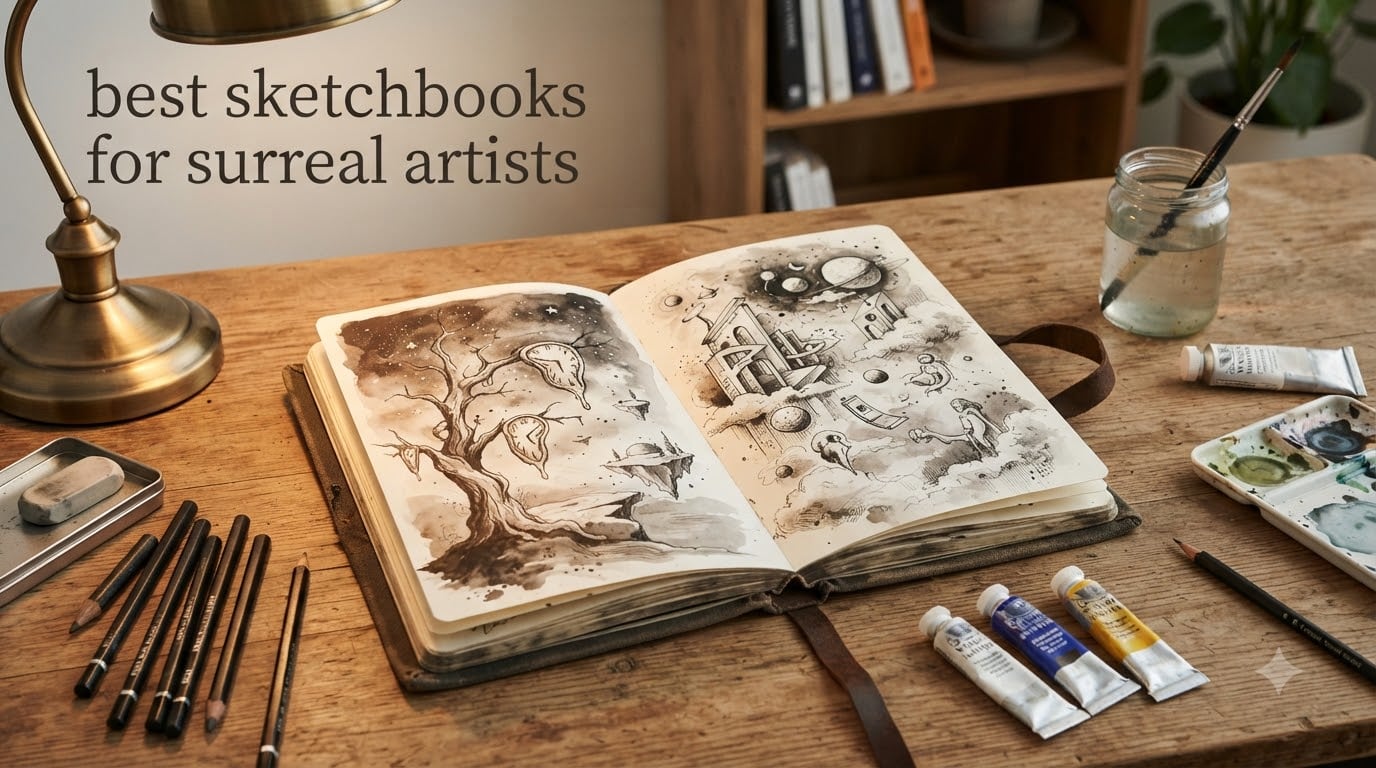
Salvador Dalí once said he did not understand why people found his work strange when the world itself was far stranger. That paradox sits at the heart of surrealism, and it explains why so many surrealist artists treat the sketchbook as their most essential tool. When Dalí painted The Persistence of Memory in 1931, the idea for those melting clocks began as a quick sketch in a notebook. René Magritte filled page after page with studies of bowler-hatted men and floating stones before committing to canvas. The sketchbook is where the subconscious first speaks.
Finding the best sketchbooks for surreal artists means thinking beyond the standard “good for any artist” advice you find elsewhere. Surrealism demands specific paper qualities: surfaces that accept layered ink washes without buckling, pages that hold charcoal for atmospheric shadow work, and formats that invite spontaneous automatic drawing. This guide walks you through every factor that matters, from paper weight and tooth to binding style and archival longevity, so you can choose a sketchbook that becomes a genuine creative laboratory.
Table of Contents
Why Paper Choice Matters for Surrealist Art
A sketchbook for surrealism is not interchangeable with one meant for casual doodling or even standard illustration work. Surrealist techniques push paper harder than most other styles. Ink washes for dreamlike skies need a surface that absorbs pigment without warping. Charcoal and soft graphite for shadowy, dream-logic scenes require enough tooth to grip the medium. Collage work with found materials, paint, and ink demands heavy mixed-media paper that will not delaminate.
Paper choice directly affects the quality of surrealist imagery you can produce. Thin, smooth sketch paper (60-90gsm) works for pencil outlines, but the moment you layer ink wash, gouache, or marker, it bleeds through and the page buckles. Artists who experiment with automatic drawing or dream journaling in their sketchbooks report that heavyweight, acid-free paper (160gsm and above) preserves the urgency of their first marks without the frustrating artifact of paper failure.
The archival dimension matters, too. Surrealist works are meant to endure, and many artists photograph or scan their sketchbook pages for gallery exhibitions or print-on-demand collections. Paper that yellows or becomes brittle within a few years undermines the entire purpose of the practice.
Paper Weight (GSM): Choosing the Right Thickness
GSM stands for grams per square meter, and it is the single most important number on any sketchbook label. Here is how the main weight tiers perform across the media surrealists use most:
70-100gsm (Lightweight sketch paper) suits pencil, ballpoint pen, and light fountain pen work. This is the weight you will find in cheap newsprint sketchbooks and pocket notebooks. It works for quick gestural studies and automatic drawing experiments, but it will not tolerate wet media of any kind.
100-150gsm (Medium weight drawing paper) handles pencil, charcoal, dry pastel, and light marker. Many popular sketchbooks from brands like Moleskine sit in this range. It is serviceable for dry-media surrealism, but ink wash and gouache will still bleed and wrinkle.
160-250gsm (Heavyweight mixed-media paper) is the sweet spot for surrealist work. Paper in this range supports ink wash, gouache, light watercolor, charcoal, marker, and collage without significant warping. This is where you should focus your search.
250-300gsm (Watercolor paper weight) handles everything from heavy washes to acrylic and multimedia collage. Pages become thick and stiff, which reduces the number of sheets per sketchbook but guarantees complete media freedom. For surrealists who build layered, atmospheric compositions, this weight tier offers maximum flexibility.
300gsm+ (Card weight) is for dedicated watercolor or mixed-media pads. Few standard sketchbooks come in this weight, but it is ideal for single-page surrealist paintings or cut-and-paste collage assemblies.
Paper Texture and Tooth: What Works for Your Medium
Paper tooth refers to the surface texture, and it determines how a medium interacts with the page. This is not an aesthetic preference—it is a technical factor that directly affects your results.
Hot-pressed (smooth) paper has been pressed under high heat during manufacturing, creating a fine, slick surface. It is ideal for detailed ink work, fine line illustration, and fountain pen sketches. Artists working in a meticulous surrealist style—think of the crisp detail in Magritte’s paintings—will find hot-pressed paper rewards careful line work.
Cold-pressed (not pressed) paper retains a natural, slightly bumpy tooth. This texture grabs charcoal, soft graphite, and dry pastel, making it the better choice for atmospheric, textural surrealist work. Ink wash also behaves beautifully on cold-pressed paper because the texture gives the pigment granulation patterns that add visual complexity.
Rough (textured) paper has pronounced tooth that creates dramatic effects with charcoal, pastel, and dry pigment. It is less suitable for precise ink work but produces stunning results for expressionistic or abstract surrealist pieces.
Most sketchbooks do not advertise their paper tooth, so you will need to test or read detailed reviews. Cold-pressed paper in the 180-250gsm range is the most versatile choice for surrealist artists because it balances tooth with enough smoothness for occasional fine-line work.
Paper Color and Tone for Surrealist Aesthetics
Paper color is one of the most overlooked factors when choosing a sketchbook, yet for surrealist artists, it can define the entire mood of a piece. This is an area where virtually no generic sketchbook guide goes into depth, so it is worth understanding properly.
White paper is the default and the most common. It provides maximum contrast for black ink and graphite, which suits detailed surrealist illustrations where sharp definition between light and shadow matters. White paper reads as clean and contemporary, and it reproduces well when scanned.
Ivory and off-white paper has a warm, slightly aged quality that evokes vintage surrealism. If your work references the early 20th-century roots of the movement, ivory paper adds an instant atmospheric cue. It is also easier on the eyes during long drawing sessions because it reflects less harsh light than bright white.
Toned paper (gray and tan) opens up a completely different working method. On toned paper, you draw or paint your shadows with dark media and add highlights with white chalk, ink, or gouache. This approach produces high-contrast imagery with less effort, and the mid-tone base gives your work a cohesive, atmospheric quality that suits dreamlike and atmospheric surrealist scenes.
Black paper is the most distinctly surrealist choice. Dark surrealism, a subgenre that emphasizes nightmarish imagery, monstrous forms, and the uncanny, thrives on black surfaces. Artists like Zdzisław Beksiński created haunting imagery that gains even more impact against a dark ground. White ink, metallic markers, and gouache applied over black paper produce striking, luminous effects that are impossible to achieve on white or toned surfaces.
Binding Styles and How They Shape Your Workflow
The binding of your sketchbook affects how you work at the desk, how you travel, and how your finished pages present when the book is open flat. For surrealist artists, whose techniques range from meticulous pencil studies to vigorous charcoal and mixed-media layering, binding choice has practical consequences.
Spiral-bound sketchbooks lay perfectly flat and allow pages to fold back completely. This makes them excellent for working at a desk or easel. The downside is that spiral coils can bend or snag, and the exposed page edges are less protected. Left-handed artists often struggle with spiral bindings because the coil digs into their wrist.
Hardbound (case-bound) sketchbooks have a rigid cover that protects pages during transport and gives the finished book an exhibition-quality feel. However, hardbound books do not lay flat unless the spine is broken in, which can take several weeks of use. Many surrealist artists prefer hardbound for finished work and dream journals because the binding communicates that the content matters.
Softcover sketchbooks are lighter and more flexible than hardbound, making them good travel companions. They tend to use glue binding, which can fail under heavy mixed-media use. Softcover books work best for lighter media like pencil, pen, and light marker.
Thread-bound (stitched) sketchbooks offer the best balance between durability and flexibility. Stitched bindings allow pages to lay reasonably flat once broken in, and they withstand heavy use better than glue-bound alternatives. Thread-bound books are common in Japanese and European sketchbook brands and are an excellent choice for serious surrealist practice.
Sketchbook Sizes: From Pocket to Studio
Size affects portability, the scale of your imagery, and how comfortable you feel working on a page. Surrealist artists often maintain more than one sketchbook for different contexts.
A5 (148 x 210mm / 5.8 x 8.3 inches) is the most popular sketchbook size globally, and for good reason. It fits in a bag, works on a lap, and provides enough surface area for detailed drawings without feeling intimidating. For dream journaling and automatic drawing practice, A5 is ideal because its compact size encourages speed and spontaneity.
B6 (125 x 176mm / 4.9 x 6.9 inches) is a pocket-sized format that works as a true carry-everywhere sketchbook. It is smaller than A5 but large enough for meaningful sketches. B6 books are perfect for capturing fleeting surrealist images on the move.
A4 (210 x 297mm / 8.3 x 11.7 inches) provides studio-scale working area. For surrealist compositions with multiple focal points or detailed ink-wash atmospheres, A4 gives you room to develop complex scenes without feeling cramped. This is the size to choose if your finished surrealist pieces are typically A3 or larger and you want to sketch at a meaningful scale.
B5 (176 x 250mm / 6.9 x 9.8 inches) splits the difference between A5 and A4. It is large enough for developed compositions but still portable enough for sketching sessions at a café or in the park. Many artists find B5 is the best single-sketchbook size for both travel and studio work.
Mixed-Media Sketchbooks for Surrealist Collage
Surrealism has deep roots in collage as a technique. Max Ernst pioneered frottage and grattage, combining rubbed textures with painted passages. The Dada artists who preceded surrealism used photomontage and found-object assemblage. Contemporary surrealist artists continue this tradition, and if you work with collage or mixed media, your sketchbook needs to accommodate it.
A mixed-media sketchbook should have paper heavy enough (180gsm minimum, ideally 250gsm+) to support adhesive, paint, and collaged materials without delamination. The binding must be sturdy enough to accommodate the added thickness of glued materials. Thread-bound or heavy spiral-bound books perform better than thin glue-bound softcovers for collage work.
Look for sketchbooks specifically labeled “mixed media” rather than “sketch” or “drawing.” Mixed-media sketchbooks use paper engineered for wet and dry media plus adhesive application. The surface has enough tooth to grab acrylic medium and enough weight to resist warping when wet glue is applied.
Some surrealist artists buy sketchbooks with perforated pages so they can remove individual sheets for scanning or collage assembly. If this matches your workflow, check for perforation as a feature. Just be aware that perforated pages can tear unintentionally under heavy media use.
Archival Quality: Preserving Your Surrealist Visions
Acid-free paper is not a luxury—it is a necessity for anyone who intends their sketchbook to last more than a few years. Paper that contains acid (lignin from wood pulp) yellows and becomes brittle over time. For surrealist artists who see their sketchbooks as art objects in their own right, acid degradation is unacceptable.
The term “acid-free” means the paper has a pH of 7.0 or slightly above (neutral to slightly alkaline). High-quality sketchbooks from brands like Strathmore, Stillman & Birn, and Canson explicitly state “acid-free” on their labels. If a sketchbook does not mention acid-free status, assume it is not.
Archival quality also depends on the paper’s lignin content. Even acid-free paper can degrade if it contains significant lignin. “Lignin-free” is the more rigorous standard. For sketchbooks you intend to keep as permanent records of your surrealist practice, look for both acid-free and lignin-free certifications.
One practical tip from forum discussions: even archival paper benefits from proper storage. Keep your sketchbook out of direct sunlight, in a dry environment, and away from extreme temperature fluctuations. Acid-free paper stored poorly will still outlast cheap paper stored well, but good storage practices extend the life of any sketchbook significantly.
How Surrealist Masters Used Their Sketchbooks
Looking at how famous surrealist artists approached their sketchbooks provides both inspiration and practical insight. Their choices reveal patterns worth emulating.
René Magritte used sketchbooks extensively for compositional planning. His notebooks reveal thumbnail studies of impossible scenes, word-image experiments, and preparatory drawings for major paintings. Magritte’s sketchbooks were typically small and portable—he worked in pencil and ink, making standard sketch paper (80-120gsm) perfectly adequate for his needs.
Salvador Dalí kept meticulous sketchbooks alongside his famous dream diaries. Dalí’s sketchbook practice included what he called “napping with a key”—holding a key over a metal plate while drifting off to sleep, capturing hypnagogic images the moment he woke. This required a sketchbook that was always accessible and comfortable to open quickly. Dalí also worked in ink and watercolor in his sketchbooks, which meant he needed heavier paper than Magritte did.
Leonora Carrington and Remedios Varo, two of surrealism’s most important women artists, both maintained active sketchbook practices. Carrington’s drawings often featured intricate, mythologically loaded imagery rendered in fine ink line. Varo’s notebooks contained engineering-like studies of her fantastical machines and interiors. Both artists used standard hardbound drawing books of the mid-20th century.
Zdzisław Beksiński, the Polish artist whose dark surrealist paintings are among the most disturbing and beautiful in the genre, was known for his prolific output across multiple media. His early work was in photography and sculpture before he moved to painting, but his sketchbooks reveal the consistent thread of dark, dreamlike imagery that unified everything he produced.
Frida Kahlo illustrated her diary with watercolor, ink, and gouache, mixing personal narrative with surrealist imagery. Her diary is a masterclass in mixed-media sketchbook work—it demonstrates what becomes possible when you treat a sketchbook as an art object rather than a disposable planning tool. Her diary pages used heavy paper capable of accepting watercolor and ink wash without deterioration.
The Sketchbook as Dream Journal: Automatic Drawing Techniques
Automatic drawing is one of surrealism’s foundational techniques. André Breton defined it as writing or drawing “as rapidly as possible, without any concern for aesthetics or morality, with the first sentence that comes to mind.” The goal is to bypass conscious control and access imagery from the subconscious.
For automatic drawing, your sketchbook should open flat and be immediately accessible. You need to be able to grab it and start drawing within seconds of waking or during any moment of subconscious availability. This argues for a lightweight, quickly opening binding—spiral-bound or softcover—rather than a stiff hardbound that requires both hands and a desk.
Paper weight matters less for automatic drawing because the focus is on speed and spontaneity rather than technical polish. A 100-120gsm sketchbook is adequate if you are working in pencil, pen, or light marker. If you want to add ink wash or paint to automatic drawings after the initial session, 160gsm+ gives you that flexibility without needing to transfer to a different surface.
The exquisite corpse technique, where different artists contribute to a single drawing without seeing each other’s contributions, requires a sketchbook with removable or easily visible pages. Spiral-bound sketchbooks with perforated pages are ideal for this collaborative surrealist technique.
Dream journaling pairs naturally with surrealism. Keeping a sketchbook by your bed and recording dream imagery immediately upon waking captures the fleeting visual impressions that the conscious mind quickly forgets. Many artists report that their strongest surrealist compositions originate in dreams, making the bedside sketchbook one of the most productive tools in the surrealist practice.
Frequently Asked Questions
What is the most famous surrealism art piece?
Salvador Dali’s The Persistence of Memory (1931) is widely considered the most iconic surrealist painting. It depicts melting clocks draped across a barren landscape, representing the fluidity and unreliability of time in dreams. The image began as a sketch in Dali’s notebook, illustrating how surrealism starts in the sketchbook.
What is the highest quality sketchbook?
The highest quality sketchbooks use acid-free, lignin-free paper at 160gsm or heavier, with thread-bound or heavy spiral binding that lays flat. Brands like Strathmore 400 Series, Stillman and Birn, and Canson are consistently rated among the best. For surrealist work, look for mixed-media paper that supports ink wash, gouache, charcoal, and collage without warping.
What are the 7 characteristics of surrealist art?
The seven key characteristics of surrealist art are: 1) Dreamlike imagery drawn from the subconscious, 2) Juxtaposition of unrelated objects and scenes, 3) Exploration of the subconscious mind, 4) Distortion of reality and scale, 5) Symbolic motifs like eyes, clocks, mirrors, and keys, 6) Use of found objects and collage techniques, and 7) Automatic drawing and writing as creative methods. Each of these characteristics influences what you need from a sketchbook.
What sketchbook do surreal artists use?
Most surreal artists use mixed-media sketchbooks with acid-free paper at 160gsm or heavier. Popular choices include Strathmore 400 Series, Stillman and Birn Alpha or Zeta series, and Canson XL Mixed Media. The specific choice depends on whether the artist works primarily in dry media like charcoal and pencil, wet media like ink wash and gouache, or mixed-media collage.
Is black paper good for surrealism?
Yes, black paper is excellent for dark surrealism and surreal work that emphasizes light emerging from darkness. White ink, metallic markers, and opaque gouache applied over black paper produce luminous effects that are impossible on white or toned surfaces. Artists working in the vein of Zdzislaw Beksinski or other dark surrealist styles find black paper amplifies the eerie, dreamlike quality of their work.
What kind of art is hot right now?
Dark surrealism, dreamcore aesthetics, and surrealist-inspired digital illustration are among the most popular art movements currently. These styles share a foundation in traditional surrealist techniques—dreamlike imagery, subconscious exploration, and unexpected juxtapositions—which means a solid sketchbook practice remains essential regardless of the medium you ultimately work in.
How do surrealists use sketchbooks?
Surrealists use sketchbooks for multiple purposes: automatic drawing to access subconscious imagery, dream journaling to capture fleeting visions upon waking, compositional planning for larger paintings, and mixed-media collage experimentation. Salvador Dali famously held a key over a metal plate while napping, sketching hypnagogic images the moment he woke. Many surrealist artists consider the sketchbook itself an art object, not just a planning tool.
What paper is best for surrealist ink wash?
Cold-pressed paper at 180gsm or heavier is ideal for surrealist ink wash work. The cold-pressed texture gives ink wash beautiful granulation patterns that add visual complexity to dreamlike atmospheres. Hot-pressed paper works for smooth, controlled washes but produces a flatter effect. Avoid lightweight sketch paper under 150gsm for ink wash, as it will buckle and bleed through.
Starting Your Surrealist Sketchbook Practice
Choosing the best sketchbook for surreal art comes down to matching paper qualities to your specific techniques. If you work primarily in ink and pencil, a 120-150gsm smooth paper in a spiral-bound A5 format will serve you well. If your practice involves ink wash, gouache, and collage, invest in a 250gsm+ mixed-media sketchbook with thread-bound or heavy spiral binding. If dark surrealism drives your work, try black paper and discover a completely different relationship between light and surface.
The most important step is simply to start. Dalí, Magritte, Carrington, and Beksiński all maintained prolific sketchbook practices, and each found that the act of regular drawing in a dedicated book accelerated their creative development more than any other single habit. Your sketchbook does not need to be perfect—it needs to be open, accessible, and ready for whatever imagery your subconscious delivers.
Begin with one sketchbook that matches your primary medium and commit to filling it. Keep it by your bed for dream journaling. Carry it with you for automatic drawing. Treat it as a laboratory for ideas that have no other home. The surrealists understood that the most extraordinary imagery lives just beneath the surface of ordinary perception, and the sketchbook is the tool that lets you reach it.