
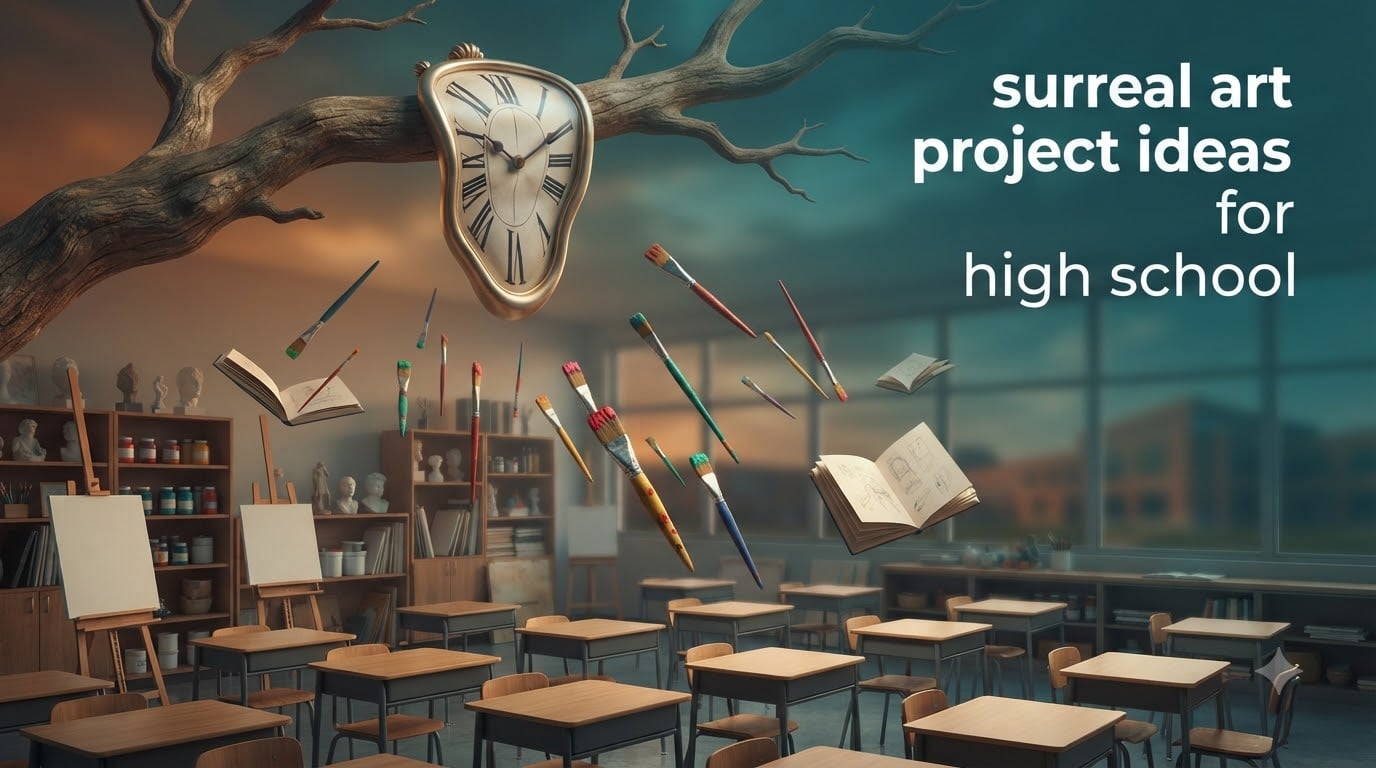
Surrealism is one of the most exciting art movements to bring into a high school classroom. It combines dreamlike imagery, unexpected juxtapositions, and personal symbolism to push students beyond literal representation. These surreal art project ideas for high school students are designed to spark creativity, build technical skills, and help young artists find their own visual voice.
Whether you are a teacher planning a surrealism unit or a student looking for inspiration, this guide covers everything from beginner-friendly projects to advanced techniques. You will find step-by-step ideas, famous artist references, materials lists, and practical tips for making surrealism come alive in the art room.
Table of Contents
Surreal Art Project Ideas for High School Students
Below are 15 surrealist project ideas ranging from beginner to advanced. Each one includes a brief description, suggested materials, and a famous artist to reference.
1. Surrealist Self-Portrait
Ask students to paint or draw a self-portrait that includes symbolic elements representing their emotions, memories, or dreams. Instead of a realistic likeness, encourage them to distort proportions, add floating objects, or replace facial features with meaningful imagery. Reference Frida Kahlo’s self-portraits, which are loaded with personal symbolism and dreamlike settings.
Materials: Acrylic paint, colored pencils, canvas or heavy paper. Best for: Beginners and intermediate students.
2. Exquisite Corpse Collaborative Drawing
This classic surrealist game has each student drawing one section of a figure (head, torso, legs) on a folded piece of paper without seeing the rest. When unfolded, the result is a bizarre, unexpected creature. It is a fantastic ice-breaker and teaches students how chance and collaboration create surprising imagery.
Materials: Drawing paper, pencils, markers. Best for: All skill levels. Great as a warm-up.
3. Dream Landscape Painting
Have students paint a landscape based on an actual dream or a recurring fantasy setting. Encourage impossible perspectives, floating islands, melting horizons, and unusual color palettes. Reference Salvador Dalí’s desert scenes and René Magritte’s cloud-filled skies for compositional ideas.
Materials: Acrylic or watercolor paints, canvas or paper, reference images. Best for: Intermediate painters.
4. Magritte-Style Juxtaposition Collage
Rene Magritte made a career out of placing ordinary objects in unexpected contexts — an apple covering a face, a train emerging from a fireplace. Challenge students to cut out magazine images and combine them in ways that defy logic. The goal is to make the viewer question what they are seeing.
Materials: Magazines, scissors, glue, cardstock, found images. Best for: Beginners and mixed-media artists.
5. Frottage Texture Art
Max Ernst invented frottage by placing paper over textured surfaces and rubbing with pencil or crayon. Students collect rubbings from wood grain, leaves, fabric, or brick, then transform the textures into surreal creatures, landscapes, or metamorphosing forms. This technique removes the pressure of drawing from scratch.
Materials: Thin paper, pencils, crayons, textured surfaces. Best for: Beginners and students who struggle with drawing.
6. Metamorphosis Series
Inspired by M.C. Escher and Dalí, this project asks students to create a series of 3 to 5 images showing one object gradually transforming into another. A human hand becomes a tree branch, a fish becomes a cloud. The series format teaches narrative thinking and visual storytelling.
Materials: Sketchbook, pencils, ink, or digital drawing tools. Best for: Intermediate to advanced students.
7. Surrealist Photography with a Smartphone
Students use their phones to create surreal images through forced perspective, double exposure apps, or creative editing. Hold a miniature world in your palm, place a friend’s head on a tiny body, or combine two photos into a dreamlike composite. This project is hugely popular with teens because it requires no traditional art supplies.
Materials: Smartphone, free editing apps (Snapseed, PicsArt, Photoshop Express). Best for: All levels, especially students who think they “can’t draw.”
8. Decalcomania Transfer Art
Apply thick paint to one surface, press another surface against it, and pull apart to reveal organic, unpredictable patterns. Students then look for shapes and images within the dried pattern and develop them into a full surrealist composition. Ernst and Oscar Dominguez popularized this technique.
Materials: Gouache or acrylic paint, paper or canvas, palette knife. Best for: Intermediate students comfortable with paint.
9. Found Object Assemblage Sculpture
Students collect everyday objects — keys, broken toys, kitchen utensils, fabric scraps — and assemble them into a three-dimensional surreal sculpture. Reference Meret Oppenheim’s fur-covered teacup (Object) for inspiration. This project removes the “I can’t draw” barrier and encourages creative problem-solving.
Materials: Found objects, hot glue gun, wire, paint, base board. Best for: All levels, especially tactile learners.
10. Automatic Drawing Composition
André Breton, the founder of Surrealism, championed automatic drawing as a way to access the unconscious mind. Students close their eyes or look away and let their hand move freely across the paper. They then develop the random marks into recognizable forms, creatures, or scenes. This exercise reduces anxiety about perfection.
Materials: Large paper, soft pencils, charcoal, ink. Best for: All levels. Works as a warm-up or full project.
11. Surrealist Poster Design
Students design a poster for an imaginary event — a surrealist art show, a dream theater performance, a subconscious music festival — using collage, typography, and surrealist imagery. This project bridges fine art and graphic design and works well for students interested in commercial art or illustration.
Materials: Mixed media (paper, paint, digital tools), access to a printer. Best for: Intermediate to advanced students.
12. Floating Objects Still Life
Arrange a still life where objects appear to float, defy gravity, or exist in impossible spaces. A coffee cup suspended in mid-air, fruit hovering above a table, books stacked in a gravity-defying tower. Students can paint, draw, or photograph this setup. Reference Dalí’s floating objects and Magritte’s impossible compositions.
Materials: Still life objects, fishing line or wire for suspension, camera or painting supplies. Best for: Intermediate students.
13. Digital Photo Manipulation
Using free digital tools, students combine multiple photographs into a single surrealist composition. A person walking on a ceiling, a city skyline underwater, a clock melting off a wall. This teaches digital literacy alongside surrealist principles and is perfect for students who prefer working on screens.
Materials: Computer or tablet, free software (GIMP, Canva, Photopea). Best for: All levels with basic tech skills.
14. Surrealist Comic Strip
Students create a 4 to 6 panel comic strip with a surrealist twist — dialogue that makes no sense, characters that morph between panels, or a story set inside a dream. This combines narrative writing with visual art and is especially engaging for students who love storytelling.
Materials: Paper, pencils, ink, markers, or digital drawing tools. Best for: All levels.
15. Surrealist Fashion Design
Design an outfit inspired by surrealist art — a dress made of eyes, shoes shaped like clouds, a hat that melts. Students sketch their designs and can even create small-scale paper or fabric mock-ups. This project connects surrealism to fashion and design, which resonates strongly with teens.
Materials: Sketching supplies, fabric scraps, paper, sewing supplies (optional). Best for: Students interested in fashion or design.
Essential Surrealist Techniques to Teach
Understanding surrealist techniques gives students the tools to create their own dreamlike imagery. These methods were developed by the original Surrealists and remain powerful creative exercises today.
Frottage
Frottage involves placing paper over a textured surface and rubbing with pencil, crayon, or charcoal to capture the texture. Max Ernst developed this technique in 1925 after noticing the grain of a wooden floor. Students collect multiple rubbings and transform them into surreal compositions by finding faces, creatures, or landscapes within the textures.
Decalcomania
Decalcomania is a paint-transfer technique. Apply thick paint to a surface, press paper or canvas against it, and pull apart to reveal organic, unpredictable patterns. The resulting textures resemble clouds, underwater scenes, or alien landscapes. Students develop these patterns into finished artworks by adding details and context.
Automatic Drawing
Automatic drawing is the practice of letting your hand move freely across the paper without conscious control. André Breton promoted this as a way to access the unconscious mind. Students draw with their eyes closed or while looking away, then develop the random marks into recognizable forms. It is one of the best warm-up exercises for reducing student anxiety.
Exquisite Corpse
Exquisite corpse (cadavre exquis) is a collaborative drawing game. Each participant draws a section of a figure — head, torso, or legs — on a folded piece of paper, hiding their work before passing it along. The unfolded result is always surprising and often hilarious. It teaches students that chance and collaboration can produce powerful imagery.
Grattage
Grattage is the technique of scraping away layers of wet paint to reveal colors and textures underneath. Max Ernst and Joan Miro used this method to create layered, complex surfaces. Students apply multiple paint layers, then use a palette knife, comb, or credit card to scrape through and reveal hidden patterns.
Juxtaposition
Juxtaposition is the core principle of Surrealism — placing two unrelated objects together to create new meaning. A fish wearing a business suit, a telephone with lobster claws (as Dalí created), a cloud inside a room. Students practice this by listing random objects and pairing them in unexpected combinations.
Famous Surrealist Artists Every Student Should Know
Showing students the work of master Surrealists provides context, inspiration, and a shared visual vocabulary. Here are the artists that resonate most with high school students.
Salvador Dali
The most recognizable Surrealist, Dalí is famous for his melting clocks, dreamlike desert landscapes, and hyper-detailed technique. His painting The Persistence of Memory is the single most iconic surrealist image. Show students his technical skill alongside his wild imagination — it demonstrates that surrealism requires craft, not just randomness.
Rene Magritte
Magritte’s clean, realistic style makes his surrealism feel accessible and intellectual rather than chaotic. His paintings ask questions: The Treachery of Images (a pipe that is not a pipe), The Son of Man (a man with an apple covering his face). Magritte is especially useful for teaching juxtaposition and conceptual thinking.
Max Ernst
Ernst invented several key surrealist techniques including frottage, grattage, and decalcomania. His paintings combine dreamlike imagery with experimental processes. He is a great artist to teach alongside technique-focused projects because students can see the methods in action.
Frida Kahlo
Kahlo’s self-portraits are deeply personal, emotionally intense, and loaded with symbolism. Her work is particularly relevant for surrealist self-portrait projects because she used her own body and face as a canvas for expressing pain, identity, and cultural heritage. Students connect with her vulnerability and honesty.
Meret Oppenheim
Oppenheim’s Object (a fur-covered teacup, saucer, and spoon) is one of the most famous surrealist objects ever made. She proves that surrealism can be sculpture and that a single unexpected texture change can transform the familiar into the strange. Her work is perfect for assemblage and found-object projects.
Materials and Supplies You’ll Need
Surrealism projects work across every medium, so the supply list depends on the specific projects you choose. Here is a categorized breakdown of common materials for a surrealism unit.
Drawing and Painting: Acrylic paint, watercolor, gouache, colored pencils, charcoal, soft pencils (4B to 8B), ink pens, sketchbooks, canvas paper, and heavy mixed-media paper.
Collage and Mixed Media: Magazines, newspapers, old books, scissors, glue sticks, gel medium, cardstock, washi tape, and found images from printed sources.
Photography and Digital: Smartphone or tablet, free editing apps (Snapseed, PicsArt, Canva, Photopea), and a printer for final output. No expensive software is needed.
Sculpture and Assemblage: Found objects, hot glue gun, wire, paint, small wooden bases, and fabric scraps. Encourage students to bring objects from home to reduce costs.
Technique-Specific: Thin paper for frottage, palette knives for grattage, large newsprint for automatic drawing, and foldable paper strips for exquisite corpse.
How to Teach Surrealism to High School Students
Teaching surrealism effectively requires balancing art history, technique instruction, and creative freedom. Here are strategies that work well in a high school art classroom.
Start with Context, Not Technique
Begin the unit by showing famous surrealist artwork and asking students what they notice. Let them describe the strangeness before you explain the movement’s history. When students discover surrealism for themselves — rather than being lectured about it — they engage more deeply with the projects that follow.
Use Warm-Up Games First
Jump straight into projects and many students freeze up. Warm-up activities like exquisite corpse and automatic drawing remove the pressure of creating a “finished” piece. These games teach surrealist principles through play and build the confidence students need for longer projects.
Provide a Clear Project Brief
Surrealism can feel directionless without structure. For each project, give students a specific brief: the technique, the materials, a reference artist, and a clear deadline. This balances creative freedom with enough structure to keep students on track.
Encourage Personal Symbolism
The strongest surrealist student work comes from personal meaning. Ask students to brainstorm symbols, memories, dreams, and emotions before they start. A surrealist self-portrait about their fears or hopes will always be more powerful than one that simply copies Dalí’s melting clocks.
Assess Process, Not Just Product
Surrealism is inherently subjective, so grading it can feel unfair. Consider assessing brainstorming sketches, technique experiments, artist statements, and creative risk-taking alongside the finished piece. A student who tried something bold and failed deserves recognition alongside one who produced a polished but safe piece.
Surrealist Warm-Up Games and Activities
These activities make excellent ice-breakers at the start of a surrealism unit or quick warm-ups before longer projects. They lower anxiety and teach core surrealist principles through play.
Exquisite Corpse Drawing
Fold a sheet of paper into three or four sections. The first person draws a head in the top section, folds it to hide their work, and passes it along. The next person draws the torso, the next draws the legs, and so on. Unfold to reveal a collaborative surrealist figure. This game is consistently the most engaging way to introduce surrealism — art teachers report that students love the unpredictability.
Automatic Drawing Challenge
Set a timer for 3 minutes. Students draw with their non-dominant hand, eyes closed, or while looking in the opposite direction. After the timer, they look at their marks and find images within them, developing the random lines into recognizable forms. This exercise reduces anxiety about “getting it right” and teaches students that the unconscious mind can produce compelling imagery.
Surrealist Word Association
Write 20 random nouns on slips of paper (clock, fish, staircase, cloud, eye, shoe, etc.). Students draw two slips and must create a single image combining both objects in a surreal way. This teaches juxtaposition — the core surrealist principle — in a fast, low-pressure format.
One-Minute Metamorphosis
Students start with a simple object drawing (a cup, a hand, a shoe). At one-minute intervals, they transform the drawing — the cup sprouts wings, the hand becomes a tree, the shoe melts into a puddle. After 5 minutes, they have a metamorphosis sequence. This builds confidence in drawing and shows how small changes create surreal effects.
Frequently Asked Questions
What is surrealism in art for students?
Surrealism is a 20th-century art movement that combines dreamlike, unexpected, and unconscious imagery to challenge reality. For high school students, it is one of the most accessible ways to explore creativity, symbolism, and personal voice in a low-stakes, imaginative framework.
What are some good surrealism art project ideas for beginners?
Beginner-friendly surrealist projects include exquisite corpse collaborative drawings, frottage texture art, surrealist self-portraits, Magritte-style juxtaposition collages, and automatic drawing exercises. These projects use simple materials and focus on imagination over technical skill.
How do you teach surrealism to high school students?
Start by showing famous surrealist artwork and letting students describe what they see. Use warm-up games like exquisite corpse and automatic drawing before longer projects. Provide clear project briefs with specific techniques, materials, and reference artists. Encourage personal symbolism and assess process alongside the finished piece.
What materials do you need for a surrealism art project?
Basic surrealist materials include acrylic or watercolor paint, colored pencils, charcoal, magazines for collage, scissors, glue, heavy paper, and found objects. For digital projects, a smartphone with free editing apps like Snapseed or PicsArt is sufficient.
What techniques do surrealist artists use?
The main surrealist techniques are frottage (rubbing over textured surfaces), decalcomania (paint transfer), automatic drawing (drawing without conscious control), exquisite corpse (collaborative folded drawing), grattage (scraping through paint layers), and juxtaposition (combining unrelated objects).
How do you make a surrealist self-portrait?
Start by brainstorming personal symbols, memories, and emotions. Instead of a realistic likeness, distort proportions, replace facial features with meaningful objects, or set yourself in a dreamlike environment. Reference Frida Kahlo’s self-portraits, which are loaded with personal symbolism and surreal elements.
What is the difference between surrealism and magical realism in art?
Surrealism emphasizes dreams, the unconscious mind, and illogical juxtapositions, often drawing directly from Freudian psychology. Magical realism depicts fantastical elements within an otherwise realistic, everyday setting without the psychological framework. Surrealism is wild and dreamlike; magical realism is subtle and matter-of-fact.
How do you create surrealist collage art?
Gather images from magazines, newspapers, and printed sources. Cut out objects, people, and backgrounds that seem unrelated. Combine them on a surface in unexpected ways — a fish in a living room, a tree growing from a shoe, a face made of clouds. Focus on surprising juxtapositions rather than logical compositions.
What are surrealist games and how do they work?
The most popular surrealist games are exquisite corpse (collaborative folded drawing), automatic drawing (drawing with eyes closed or without conscious control), and word association (combining random nouns into a single image). These games teach surrealist principles through play and are excellent ice-breakers for starting a surrealism unit.
Who are the most famous surrealist artists to reference?
The most influential surrealist artists include Salvador Dali (melting clocks, dreamlike landscapes), Rene Magritte (juxtaposition, conceptual paintings), Max Ernst (frottage and decalcomania techniques), Frida Kahlo (symbolic self-portraits), and Meret Oppenheim (surrealist objects and sculpture).
Final Thoughts
Surrealism offers high school art students something few other movements can: complete creative freedom within a supportive framework. These surreal art project ideas for high school give students permission to be weird, personal, and experimental without the pressure of realism. Whether you start with a simple exquisite corpse game or dive into a surrealist self-portrait unit, the key is creating a space where imagination is valued over technical perfection.
The projects in this guide work across every skill level and budget. A student with nothing but a pencil and paper can create powerful surrealist art through automatic drawing and juxtaposition. A student with access to a smartphone can produce striking surrealist photography. The movement itself was born from the idea that art should access the unconscious mind — and that does not require expensive supplies or years of training.