
There’s something magnetic about surreal paintings. They pull you into impossible worlds where clocks melt across barren landscapes and eyes float through starry skies. If you’ve been curious about easy surreal painting ideas on canvas, you’re in the right place. Surrealism doesn’t require advanced drawing skills or years of art school—it requires imagination and a willingness to break a few rules.
What I love about surrealist art is how forgiving it is. Unlike hyper-realistic painting, where every brushstroke must be precise, surrealism gives you permission to embrace the unexpected. A slightly “off” proportion becomes intentional. An unusual color choice becomes a feature. This guide will walk you through 15 concrete easy surreal painting ideas on canvas, the techniques to bring them to life, and the color palettes that make dreamlike scenes pop.
Table of Contents
15 Easy Surreal Painting Ideas on Canvas
Here are 15 concrete surreal painting ideas you can start today. Each one uses simple shapes and beginner-friendly techniques while delivering that unmistakable dreamlike quality.
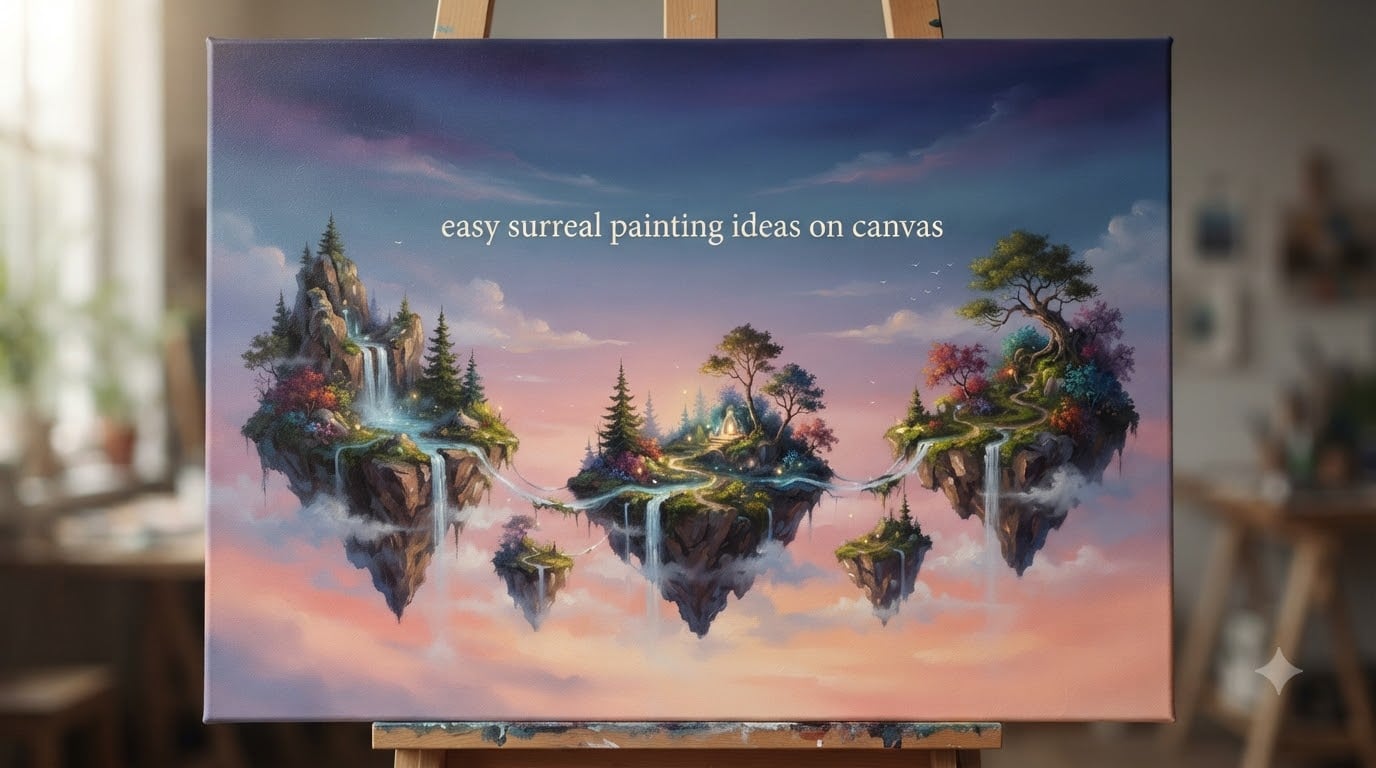
Floating Islands in a Gradient Sky — Paint small landmasses with grass, waterfalls, and tiny trees suspended in a twilight gradient. The contrast between detailed islands and vast empty sky creates instant surreal drama.
Melting Clocks Over a Desert Horizon — Inspired by Salvador Dali’s iconic “The Persistence of Memory,” draped clocks melting over simple desert shapes are surprisingly easy to execute with soft blending.
A Giant Eye Reflecting a Landscape — Paint a large, realistic eye with an entire miniature landscape—mountains, lakes, sunset—reflected in the iris. The scale contrast alone makes this striking.
Staircases Leading to Nowhere — Impossible architecture inspired by M.C. Escher. Geometric staircases that loop, float, or climb into the sky work beautifully with acrylics on canvas.
Fish Swimming Through Clouds — Marine life drifting through a fluffy daytime sky. The juxtaposition of underwater creatures in an aerial setting is classic surrealism made simple.
A Door Standing Alone in a Field — A freestanding door slightly ajar, revealing a completely different world—perhaps a starry cosmos or an underwater reef—on the other side.
Trees with Colorful Geometric Foliage — Realistic tree trunks topped with impossible neon or pastel geometric shapes instead of normal leaves. Simple to paint, visually arresting on a wall.
A Human Silhouette Filled with Stars — The outline of a person filled with a galaxy or night sky, symbolizing the universe within. Easy to execute with sponging and splattering techniques.
Butterflies Emerging from an Open Book — Pages of an old book transforming into colorful butterflies that drift upward. Warm tones for the book, cool pastels for the butterflies.
An Upside-Down City Reflected in Water — A simple cityscape flipped in a still lake, but the reflection shows a completely different, more fantastical version of the city.
A Cat with a Galaxy Fur Pattern — A realistic cat silhouette with its fur painted as a starry night sky or nebula. Popular with animal lovers and surprisingly straightforward.
Rain Falling Upward into a Sun — Rain droplets rising toward a glowing sun instead of falling down. A simple inversion that completely changes the emotional tone.
A Keyhole Opening to Another World — A large ornate keyhole on a plain wall, with a vivid, colorful surreal landscape visible through the opening.
Hands Releasing Birds That Become Clouds — Open hands with small birds flying upward, gradually transforming into cloud shapes. Symbolism meets simplicity.
A Moonlit Ocean with Oversized Flowers — Giant flowers growing directly out of dark ocean waves under a massive moon. The scale distortion makes the familiar feel alien.
Each of these ideas works because surrealism thrives on combining realistic elements in impossible arrangements. You don’t need to invent an entire fantasy world from scratch—just take familiar objects and change their context, scale, or behavior.
Understanding Surrealism: A Brief History
Surrealism began in the 1920s as an artistic and literary movement that sought to unlock the creative potential of the unconscious mind. Founded by poet Andre Breton, the movement drew heavily on Sigmund Freud’s theories of dreams and automatic thought. For painters, this meant exploring imagery that defied logical explanation.
Salvador Dali became the most recognized surrealist painter, famous for his melting clocks, elephants on spindly legs, and meticulously rendered dreamscapes. Rene Magritte created intellectual puzzles through paintings like “The Son of Man” (a man whose face is hidden by a floating apple) and “The Treachery of Images” (a pipe labeled “this is not a pipe”). Max Ernst pioneered techniques like frottage and grattage, while Frida Kahlo brought deeply personal surrealist symbolism to self-portraiture.
What makes surrealism especially relevant for 2026 painters is that the movement was never about technical perfection. It was about vision. Many surrealist techniques—collage, automatism, unexpected combinations—are inherently beginner-friendly. You’re not trying to replicate reality. You’re building something that could only exist on your canvas.
Soft Surrealism vs Classic Surrealism
A distinction that most guides skip—and one that matters for beginners—is the difference between soft surrealism and classic surrealism. Understanding which style appeals to you will shape your palette, subject matter, and approach.
Classic surrealism follows the Dali/Magritte tradition: bold contrasts, intellectual symbolism, often darker or more unsettling imagery. Think melting objects, impossible geometry, and confrontational compositions. The palette tends toward earth tones with dramatic pops of color.
Soft surrealism is the modern, Instagram-friendly evolution. It uses pastel palettes, gentle gradients, ethereal lighting, and dreamy atmospheres. The imagery is whimsical rather than disturbing—floating islands, gentle celestial scenes, and nature with magical elements. This style has exploded in popularity for bedroom and living room wall art because it feels inviting rather than jarring.
If you’re creating art for your home, soft surrealism tends to be the more versatile choice. It complements modern decor, pairs well with neutral furniture, and creates a calming focal point. Classic surrealism makes a bolder statement and works better in dedicated art spaces or studios.
Surrealist Techniques for Beginners
You don’t need to master every technique below to start painting surrealism. Pick one or two that excite you and build from there.
Juxtaposition
Juxtaposition is placing two unrelated objects together in the same scene. A fish in a birdcage. A teacup filled with an ocean. A clock growing from a tree branch like fruit. This is the backbone of surrealism and the easiest technique to start with because it only requires you to ask: “What two things don’t belong together?”
Scale Distortion
Take something familiar and make it enormous—or tiny. A massive flower towering over a house. A miniature elephant sitting on a fingertip. Scale distortion instantly signals to the viewer that they’re looking at a dream world, not reality. It’s surprisingly easy to paint because you’re still painting realistic objects—just at unexpected sizes.
Dream Imagery
Paint scenes that feel like they came from a dream: endless staircases, floating objects defying gravity, doorways opening to impossible landscapes. The key is to render these impossible elements with realistic shading and detail. The more “real” the impossible thing looks, the more surreal it feels.
Symbolism
Surrealist artists embed personal meaning into their work through symbols. Keys represent knowledge or opportunity. Eyes represent awareness or perception. Clocks represent time, mortality, or memory. You don’t have to explain your symbolism—surrealism is intentionally open to interpretation.
Automatism
Let your hand move freely across the canvas without planning. Start with random brushstrokes or shapes, then find images within them and develop those. This technique was championed by surrealists who believed the unconscious mind creates more interesting art than deliberate planning.
Color Palette Guidance for Dreamlike Scenes
Color choice makes or breaks a surrealist painting. The wrong palette can make a dreamlike scene feel flat or chaotic.
Cool palettes (blues, purples, teals) create calm, mysterious, moonlit dreamscapes. Use these for nighttime scenes, underwater imagery, and ethereal atmospheres. A gradient from deep indigo to soft lavender is one of the most reliable backgrounds for surrealist art.
Warm palettes (gold, coral, burnt orange) produce whimsical, sunset-toned surrealism. These work beautifully for desert scenes (Dali-style), golden-hour landscapes, and warm, inviting compositions.
Pastel palettes (soft pink, mint, powder blue) are the hallmark of soft surrealism. They create gentle, approachable dreamscapes perfect for bedroom wall art and modern home decor.
High contrast palettes (deep black with vivid reds or golds) create dramatic, classic surrealist works with strong emotional impact. Think Magritte’s dark skies against bright green apples.
A practical tip from forum discussions: start with a gradient underpainting for your background. Paint a smooth transition from one color to another before adding any elements. This immediately sets the dreamlike mood and makes everything you layer on top feel more cohesive.
Supplies You Need for Surreal Painting
One of the best things about surrealist canvas painting is that the supply list is short and affordable.
Canvas: Stretched canvas or canvas panels in your preferred size. Beginners often start with 11×14 or 16×20 inches—large enough to add detail, small enough to finish in one or two sessions.
Acrylic paints: Acrylics dry fast, blend easily, and are forgiving for beginners. A basic set of 12-24 colors is plenty. You can always mix custom shades.
Brushes: A flat wash brush (for backgrounds and gradients), a medium round brush (for general painting), and a fine detail brush (for small elements). Three brushes is genuinely enough to start.
Gesso: A white primer that prepares your canvas surface. Most pre-stretched canvases come pre-gessoed, but adding one extra coat improves paint adhesion and vibrancy.
Palette and water cup: A simple plastic palette or even a paper plate. Two water cups—one for rinsing, one for clean water to thin paint.
Pencil and eraser: For sketching your composition lightly onto the canvas before painting. Use a soft pencil (2B or 4B) and erase heavily before you start painting so graphite doesn’t muddy your colors.
Acrylics are overwhelmingly preferred by beginner surrealist painters because they dry quickly (allowing fast layering), clean up with water, and cost less than oils. If you’re wondering whether to invest in oils: save that for after you’ve completed five or ten acrylic surrealist paintings and know you love the process.
Step-by-Step: Painting a Floating Islands Scene
Floating islands are the most recommended first project for beginner surrealist painters. The shapes are simple, the results are stunning, and the technique teaches you gradients, scale, and atmospheric perspective. Here’s how to paint one from start to finish.
Step 1: Sketch Your Composition
Lightly pencil two or three islands at different heights on your canvas. Keep the shapes simple—rounded masses with flat tops. Leave most of the canvas empty for the sky. Add tiny details like a small waterfall line off one edge and a few simple tree shapes on top.
Step 2: Paint the Sky Gradient
Using a flat wash brush, start at the top with a deep blue or purple. Work your way down, gradually blending in lighter blues, then pinks or warm tones near the horizon. Keep the paint wet as you blend. This is the most important step—a smooth gradient sets the entire dreamlike tone.
Step 3: Add the Islands’ Base Color
Once the sky is dry, paint your islands with an earthy base—dark brown or muted green for the sides, a richer green or textured brown for the tops. Don’t worry about detail yet. Get the solid shapes down.
Step 4: Paint the Underside of the Islands
This is what makes floating islands look surreal. The underside should have visible rock, roots, or dangling earth. Use darker browns and grays, adding rough texture with a dry brush technique—load paint on your brush, wipe most of it off on a paper towel, then drag it across the surface.
Step 5: Add Details to the Island Tops
Paint simple trees (triangle or round shapes on thin trunks), small patches of grass, a tiny waterfall spilling off an edge (a thin white or light blue line). Keep details simple. The contrast between detailed islands and the vast empty sky is what creates the surreal effect.
Step 6: Add Atmosphere and Light
Add a glow around your light source (usually the sun or moon). Thin your paint with water and use a soft dry brush to create a haze around the edges of the islands, making them feel suspended in mist. This atmospheric perspective is what separates surreal paintings from simple illustrations.
Step 7: Final Touches
Add birds or floating particles in the sky for scale. Darken the shadows under each island. If you want extra magic, add tiny glowing elements—fireflies, small stars, or a faint aurora effect in the upper sky. Sign your work and let it dry completely before hanging.
This entire painting can be completed in two to four hours. Multiple art community members report that floating islands were their first surrealist project because the shapes are forgiving and the gradient background technique transfers to dozens of other surreal painting ideas.
Tips for Beginner Surrealist Painters
These tips come directly from art communities and experienced painters who’ve walked this path before you.
Start with simple shapes. Floating islands, circles, basic silhouettes. Surrealism is about context, not complexity. A simple shape in an impossible situation reads as more surreal than a complex shape painted perfectly.
Use reference photos for realistic elements. If you’re painting a cat, use a photo of a cat. If you’re painting clouds, photograph the sky. The surreal effect comes from combining realistic elements in impossible ways—not from painting everything from imagination.
Master the gradient background first. Nearly every surrealist painting benefits from a smooth gradient sky or atmospheric background. Practice blending two colors smoothly before attempting your first full composition.
Don’t over-detail. This is the most common beginner mistake in surrealism. Leaving negative space and soft edges makes your painting feel dreamlike. Every extra detail you add risks pulling the viewer out of the dream and into illustration territory.
Work from back to front. Paint the background first, then the middle ground, then foreground elements. This layering approach prevents muddy overlapping and creates natural depth.
Embrace imperfection. A slightly wobbly line in surrealism doesn’t look like a mistake—it looks intentional. This is the most forgiving genre of painting for beginners.
Common Beginner Mistakes to Avoid
I see the same mistakes repeated in art forums and beginner surrealist communities. Knowing these in advance will save you frustration.
Over-detailing the entire painting. The temptation is to render every leaf, every cloud, every feather in hyper-detail. In surrealism, selective detail is your friend. Paint the focal point in detail and leave the background soft and suggestive. This creates depth and maintains the dreamlike quality.
Muddy colors from over-blending. When you blend acrylics too much—especially complementary colors like blue and orange—you get brown mud. Let adjacent colors sit side by side rather than mixing them into each other. If your gradient looks muddy, let it dry completely, then glaze a clean color over it.
Forgetting the rule of thirds. Surrealism doesn’t mean random placement. Using the rule of thirds to position your focal elements creates a balanced composition that holds the viewer’s eye, even when the content itself is impossible.
Using too many bright colors. A surrealist painting with every color in the rainbow looks chaotic, not dreamlike. Choose a limited palette of three to five colors and stick to it. The constraint creates harmony.
Rushing the background. The gradient sky or atmospheric backdrop is the foundation of most surrealist paintings. Beginners often rush through it to get to the “interesting” elements. Take your time here. A beautiful background makes everything else look better.
Frequently Asked Questions
What is surrealism in painting?
Surrealism in painting is an artistic movement that combines realistic techniques with dreamlike, impossible, or symbolic imagery to express the unconscious mind. It was popularized by artists like Salvador Dali and Rene Magritte in the 1920s and emphasizes imagination over technical perfection.
What are easy surreal painting ideas for beginners?
Easy surreal painting ideas for beginners include floating islands in a gradient sky, melting clocks over a desert, a giant eye reflecting a landscape, fish swimming through clouds, a door opening to another world, and butterflies emerging from an open book. All of these use simple shapes and forgiving techniques.
What supplies do I need for surrealist painting?
You need a stretched canvas (11×14 or 16×20 inches to start), a set of acrylic paints (12-24 colors), three brushes (flat wash, medium round, and fine detail), gesso for priming, a palette, water cups, and a soft pencil for sketching. Acrylics are the best paint choice for beginners because they dry fast and clean up with water.
What colors are best for surrealist art?
Cool palettes (blues, purples, teals) create mysterious moonlit scenes. Warm palettes (gold, coral, orange) produce sunset-toned surrealism. Pastel palettes (soft pink, mint, powder blue) are ideal for soft surrealism and modern home decor. Choose three to five colors for a cohesive look.
Do I need to be good at drawing to paint surrealism?
No. Surrealism is one of the most beginner-friendly art styles because the imagery is intentionally unrealistic. Slightly off proportions look intentional rather than incorrect. Many surrealist painters use reference photos for realistic elements and simple shapes for everything else. You can create striking surrealist art without advanced drawing skills.
How do I make my painting look dreamlike?
To create a dreamlike quality: use a smooth gradient background, keep edges soft rather than sharp, limit your color palette, leave negative space, avoid over-detailing, and add atmospheric effects like mist or glow around light sources. Soft surrealism palettes (pastels and muted tones) also help create a gentle, dreamy mood.
What is the difference between surrealism and abstract art?
Surrealism uses recognizable objects arranged in impossible or dreamlike ways—a clock melting, a fish in the sky. Abstract art uses shapes, colors, and forms without representing real objects. In surrealism, you can identify what you’re looking at; the impossibility is in the arrangement, not the object itself.
Conclusion
Easy surreal painting ideas on canvas open a door to a style of art that is as forgiving as it is visually striking. You don’t need advanced skills to start—you need a canvas, some acrylics, and the willingness to combine familiar things in unfamiliar ways. Whether you start with floating islands, melting clocks, or a giant eye filled with stars, the key is to begin. Pick one idea from this list, set up your canvas this weekend, and let your imagination do the rest. Surrealism has always been about what happens when you stop trying to paint reality and start painting the world inside your head.