
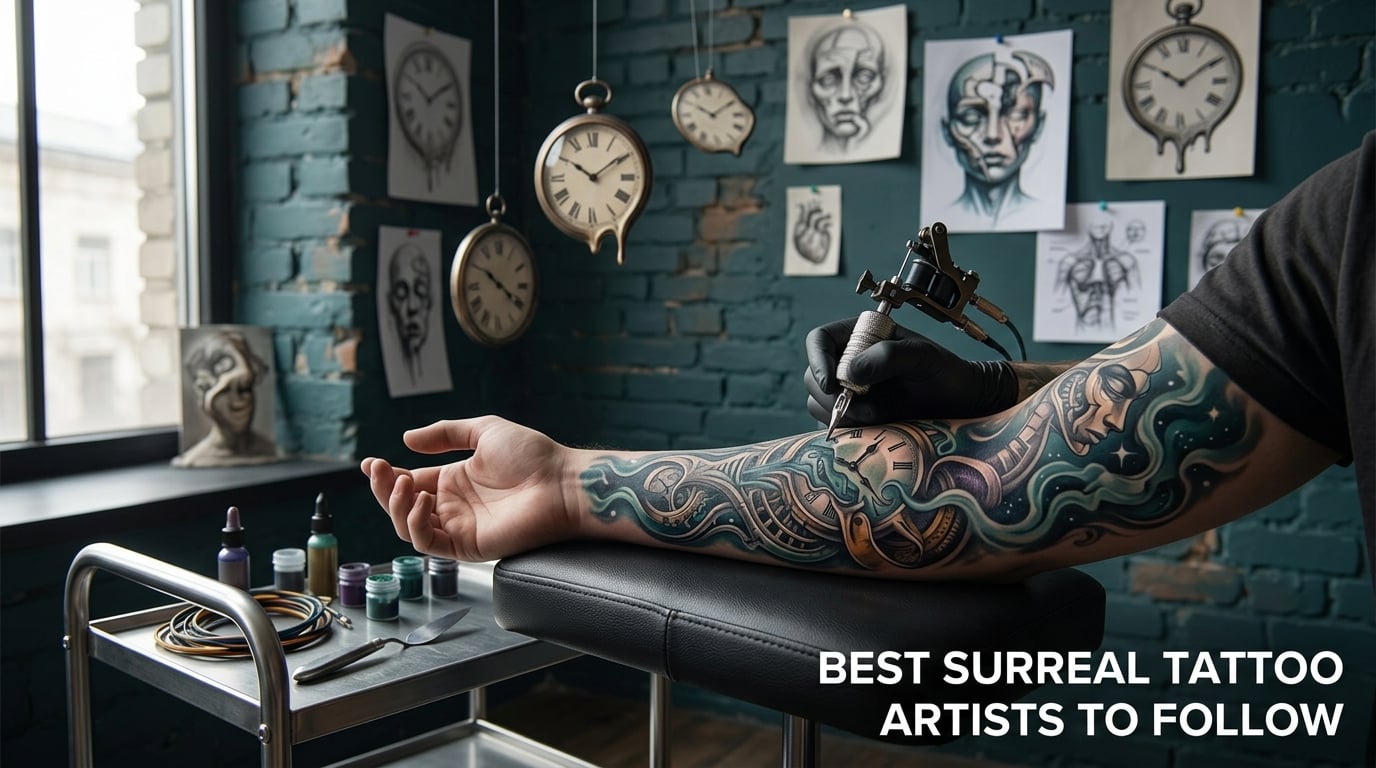
If you’ve ever scrolled Instagram at 2 a.m. and stopped dead on a tattoo that looked like a Magritte painting come to life, you’ve already felt the pull of surrealism tattoo art. This is the style that turns skin into a dreamscape, where clocks melt down arms, portraits split into impossible halves, and ordinary objects quietly morph into something stranger the longer you stare.
Finding the best surreal tattoo artists to follow in 2026 is harder than it should be. The top names live across continents, speak different languages, and most post only on Instagram where their work sits alongside thousands of other ink posts. We did the deep scroll for you. Our team spent weeks tracking surrealists from Los Angeles to Seoul, Bristol to Buenos Aires, and curated a global list of fifteen artists whose feeds are worth bookmarking.
Before we get into the list, a quick TL;DR for the impatient. Three names dominate every serious surrealism tattoo conversation: Expanded Eye (the Bristol duo behind some of the most viral surrealism tattoos of the past decade), Pietro Sedda (an Italian illustrator-tattooist whose dreamlike figures blur the line between art book and skin), and Kelly Doty (a Sacramento favorite whose color surrealism pops up on magazine covers and Ink Master reruns alike). If you only follow three accounts after this article, follow those three.
This guide covers what surrealism tattoo art actually is, where it came from, which artists are pushing it forward in 2026, how to follow and book them, and answers to the questions our readers ask us most. Whether you’re a collector planning your next sleeve, a tattoo-curious art lover, or a working artist looking for inspiration, there’s something here.
Table of Contents
What Is Surrealism Tattoo Art?
Surrealism tattoo art is a style of ink that translates the dreamlike, irrational logic of the 20th-century surrealist art movement into permanent body art. It borrows visual vocabulary from Salvador Dalí, René Magritte, Max Ernst, and André Breton, then renders it convincingly enough that the impossible part sneaks up on the viewer.
The movement started in 1924 when Breton published the first Surrealist Manifesto, building on the dream studies of Sigmund Freud and the weird fiction of the late 1800s. Dalí’s melting clocks, Magritte’s bowler hats and floating apples, Ernst’s collage creatures, and Leonora Carrington’s mystical beasts all fed the same well: the unconscious mind, irrational juxtaposition, and hidden symbolism. Tattoo artists in the 2000s and 2010s realized the same visual language translated beautifully into skin, and surrealism tattooing was born as a distinct movement.
What separates surrealism from regular realism tattooing is intent. A realism tattooist might ink a portrait of your grandmother that looks so real you expect her to blink. A surrealism tattooist will ink a portrait of your grandmother where half her face is melting into a clock, or her eyes are windows opening onto a different scene. The skill level is similar. The imaginative leap is the point.
Surrealism tattoos also lean on specific visual devices you can spot instantly once you know them. Impossible compositions place objects in scenes where gravity, scale, or perspective doesn’t add up. Fragmented portraits split a face into halves or slices that each show a different identity, era, or element. Dreamscapes blend multiple settings into one continuous landscape. Role-reversal concepts put animals in human clothing, humans in animal roles, or objects doing the work of living things. Hidden symbolism hides a second image inside the first – a key, a face, a clock, a number – that you only see once the tattoo heals.
The style works on nearly any body placement, but it really sings on larger canvases. Sleeves, back pieces, chest pieces, and full thigh pieces give surrealists room to layer multiple impossible elements into a coherent scene. Smaller placements work too, but expect the artist to simplify the concept rather than try to cram five dream layers onto a wrist.
How We Curated This List
We did not pull this list from a single source. We cross-checked three places: Instagram art communities with active surrealism hashtags, working artists’ guest-spot calendars, and the tattoo magazines and conventions that consistently name the same people as genre leaders. We also read every public Reddit thread on r/tattoos, r/tattoo, and city-specific subreddits where collectors swap surrealism recommendations.
Five filters shaped our final fifteen. Style specialization – does this artist lean surrealism-first, or surrealism-among-many-styles? We want artists whose surrealism portfolio is deep enough to define the style. Geographic diversity – we deliberately avoided LA-only or US-only lists. Surrealism is global; the list reflects that. Active Instagram presence – the keyword is “follow,” so every artist here has a working Instagram handle with consistent posting. Portfolio depth – at least 30 surrealism pieces publicly visible. Peer recognition – named by other artists, featured in magazines, or consistently recommended by collectors in forums.
We made a few deliberate exclusions. We left out pure fine-line artists who dabble in surrealism but lean minimalist. We left out realism-only tattooists whose “surreal” pieces are really just stylized portraits. We left out painters and illustrators who don’t tattoo. The list is fifteen working tattoo artists whose primary identity is surrealism.
Top 15 Surrealism Tattoo Artists To Follow
Here are fifteen surrealism tattoo artists our team considers essential follows in 2026. Each entry includes the artist’s location, primary style sub-specialty, Instagram handle, and a quick description of the work that earned them a spot. We’ve also flagged a few with a signature piece we keep coming back to.
1. Expanded Eye (Jade Tomlinson and Keva Richardson) – Bristol, UK. @expanded_eye on Instagram. The two-piece Bristol studio is probably the single most influential surrealism tattoo shop in the world right now. They invented a recognizable house style of dotwork, fine line, and full-color dreamscapes that reads instantly even on a thumbnail. Their signature move is hiding small, often disturbing imagery – skulls, insects, micro-portraits – inside larger pastoral or floral compositions. Follow them for the daily art-class quality of their grid alone.
2. Pietro Sedda – Cagliari, Italy (works internationally). @pietrosedda on Instagram. Sedda is technically an illustrator who tattoos, not the other way around, and that lineage shows. His pieces look lifted from an art book. Thin lines, washed color palettes, and figures that feel halfway between Hieronymus Bosch and a Studio Ghibli character sheet. He travels extensively for guest spots across Europe, North America, and Asia. Follow him for the cleanest linework in the genre and a feed that doubles as a visual essay.
3. Kelly Doty – Sacramento, California, USA. @kellydotytattoo on Instagram. Doty brings a heavy color palette and a heavy concept load. Her surrealism sits closer to pop surrealism than to Dalí – cartoon-derived forms with bright color blocking, often with a slightly menacing edge. Famous from her time on Ink Master, but the celebrity is incidental to the work; she’s been at this for over a decade. Follow for the color saturation and the character design chops.
4. La Malcontenta (Soledad Arias) – Buenos Aires, Argentina. @la_malcontenta on Instagram. La Malcontenta works in fine black and grey with a botanical-surrealism edge. Her pieces often combine skulls, bones, flowers, and insects into symmetrical dreamlike compositions that read almost like Victorian illustrations reimagined by Ernst. She works primarily from her Buenos Aires studio with limited international guest spots. Follow for the linework discipline and the consistent aesthetic.
5. Bongkee (Hongdam) – Seoul, South Korea. @hongdam on Instagram. Hongdam, known professionally as Bongkee, blends Korean folk imagery with Western surrealism in a way no one else quite manages. Color-heavy, often featuring tigers, cranes, snakes, and traditional Korean motifs rendered with impossible perspective shifts and dreamlike color washes. Based in Seoul but a frequent guest in LA, NYC, and European conventions. Follow for the cross-cultural surrealism you won’t see anywhere else.
6. Samantha Wilks – Los Angeles, California, USA. @samanthawilks on Instagram. Wilks does cosmic and architectural surrealism in fine black and grey. Her pieces often feature buildings bending into impossible geometries, figures floating through starfields, and architectural interiors that turn into outer space. Downtown LA studio, occasional guest spots. Follow for the most ambitious large-scale back pieces on this list.
7. Waler Montero – Cuba / international. @walermontero on Instagram. Montero is the artist who shows up most often in “mind-blowing surrealism tattoos” reels on Instagram, and for good reason. He blends color surrealism with conceptual portrait work, often hiding second and third images inside larger compositions. His work went heavily viral in 2024-2025 and the waitlist reflects that. Follow for the visual puzzles.
8. TheDavidCote – Montreal, Canada. @thedavidcote on Instagram. Cote works in fine line black and grey with a heavy illustrative surrealism influence. His pieces often feel like pen-and-ink book illustrations reimagined onto skin. Mountains dissolving into faces, eyes opening onto different landscapes, geometric forms hidden inside organic shapes. Montreal-based with regular Canadian and US guest spots. Follow for the illustrative precision.
9. Blaabad – Netherlands. @blaabad on Instagram. A studio rather than a single artist, Blaabad is known for its rotation of guest artists who work in geometric surrealism and dotwork. If you like mathematically clean impossible shapes, hidden linework, and Escher-like architectural pieces, this is the feed for you. Based in the Netherlands with frequent European guest rotations.
10. TenderBrusselsSprout (Arlene) – Brussels, Belgium. @tenderbrusselssprout on Instagram. Arlene’s work is softer surrealism – pastel color palettes, dreamy figure compositions, and a heavy illustrative influence. Pieces that feel like stills from a Hayao Miyazaki film. Brussels-based with limited European travel. Follow for the gentler end of surrealism tattoo art.
11. Jacob Sheffield – USA (traveling). @jacobsheffield on Instagram. Sheffield travels more than most artists on this list – he works primarily out of conventions and guest spots across the US, Europe, and Asia. His style is micro-realism surrealism: small, often single-needle pieces that hide whole dreamlike compositions inside portraits, animals, or objects. Follow for the “wait, there’s a whole scene inside that” effect.
12. Sandi Callistro – Denver, Colorado, USA. @callistro on Instagram. Callistro is the most-recommended surrealism artist on Denver-area Reddit threads, and the recommendation pattern holds up. Color-heavy surrealism with strong figurative work and a slightly nostalgic, almost vintage-pop sensibility. Worth the drive if you’re anywhere in the mountain west. Follow for the consistent concept work and the genuine community following.
13. Eric Solis – Austin, Texas, USA. @ericsolis_tattoo on Instagram. Solis works in color surrealism with a heavy conceptual edge – pieces that read like album covers or indie film posters. Recurring themes of cosmic loneliness, animal-human hybrids, and strange weather. Austin-based with Texas-wide guest spots. Follow for the album-cover quality of his feed.
14. Maksim Mel – New York City, USA. @maksimmel on Instagram. Mel works in a fine black and grey surrealism that leans architectural and conceptual. His pieces often feature buildings, interiors, and figure compositions that turn inside out on closer inspection. NYC studio with a long waitlist. Follow for the architectural dreamscapes.
15. Evan Summers at Bang Bang NYC – New York City, USA. @bangbangnyc on Instagram (collective account) and @evansummers on his personal handle. Summers is one of the surrealism-leaning artists at the famous Bang Bang NYC studio, which has housed names like Keith McCurdy, Dr. Woo, and others. His personal feed is the surrealism work; the studio feed is everything. NYC-based, long waitlist, premium pricing. Follow for the surrealism-meets-NYC-street-art edge.
That’s the main list. A few notes on who didn’t make the fifteen but are worth a follow: Filip Leu in Lausanne, Switzerland, for legacy surrealism that goes back to the 1990s; Vladimir Kozachenko in LA for architectural skulls; Shelby Bianco in LA for dreamlike compositions; Annettakras in Hungary for color surrealism; Chris Mata’afa in New Zealand for Pacific-inflected surrealism. Each could have made the top fifteen with a different curatorial lens.
Female Surrealist Tattoo Artists To Follow
Most public lists of surrealism tattoo artists skew heavily male. That’s not because the women in the style aren’t there – they absolutely are. It’s because the men tend to post more frequently and run louder studios. We pulled together a spotlight section for the female surrealists whose work we think deserves equal follow count.
Kelly Doty (covered above) leads this list. She’s been at the top of the color surrealism conversation for a decade and runs her own private studio in Sacramento. La Malcontenta (Soledad Arias, covered above) in Buenos Aires is one of the finest black-and-grey surrealists working today, period. Samantha Wilks (covered above) in LA works in cosmic architectural surrealism at a scale few artists match. Shelby Bianco in Los Angeles does dreamlike compositions with a heavy illustrative bent; she tattoos at a private LA studio and takes limited guest spots. Marija Tiurina, originally known as a London-based illustrator, has begun taking tattoo clients at private events – watch her feed for irregular booking announcements. Anna Bravo Bravo works in fine line surrealism out of a Brooklyn studio and posts some of the cleanest linework on Instagram. Adrienn Kern in Hungary does color surrealism with a heavy folk-tale influence. Loren Fetterman in California works in pop surrealism at the Mark Ryden-influenced end of the spectrum.
The pattern we noticed across these artists: they tend to post more concept development, more process shots, and more finished healed work than the average male-led studio feed. If you’re a collector planning a sleeve, following these accounts gives you a clearer window into how a piece actually heals over months.
Surrealism Tattoo Styles Explained
Surrealism isn’t one style – it’s a family of related visual approaches. Here’s how the main sub-styles differ, what each one does best, and how to choose between them.
Color surrealism uses saturated, often high-contrast color palettes to sell impossible compositions. Best on larger canvases where the color work has room to breathe. Most common on full sleeves and back pieces. Black and grey surrealism relies entirely on tonal range, often with stippling, halftone, or fine line work to suggest texture. More forgiving on smaller placements because the lack of color means the composition can read at any size. Fine line surrealism uses single-needle or small-needle configurations to render small, intricate impossible compositions. Perfect for forearms, ribs, and back-of-arm pieces where detail matters more than scale. Micro-realism surrealism pushes fine line further, hiding whole dreamlike scenes inside otherwise ordinary objects, animals, or portraits. Geometric surrealism builds impossible scenes out of mathematically clean shapes – perfect symmetry, hidden geometry, optical-illusion-like patterns. Pop surrealism / lowbrow surrealism borrows the visual language of Mark Ryden, Camille Rose Garcia, and other lowbrow painters – cartoon-derived forms, bright colors, slightly menacing or ironic imagery. Illustrative surrealism leans into the art-book look: thin lines, washed color, figures that feel like book illustration.
Here’s a quick reference to help you match style to placement and budget:
- Color surrealism – best on full sleeve, back, or thigh. Heaviest cost due to color session time. Healing time longest.
- Black and grey surrealism – works on most placements, including forearm and chest. Moderate cost. Mid-range healing.
- Fine line surrealism – ideal for forearm, ribs, neck. Lower cost per piece, but the detail means a longer design phase.
- Micro-realism surrealism – perfect for small hidden placements behind the ear, on fingers, on the wrist. Lower cost but high design fee.
- Geometric surrealism – strong on back, chest, and full leg. Moderate to high cost depending on density.
- Pop surrealism – works on most placements. Color saturation means medium-to-high cost.
- Illustrative surrealism – best on flat canvases where linework reads clean: outer arm, thigh, back.
If you’re planning your first surrealism tattoo, black and grey or fine line on a forearm is the safest entry point. The cost is lower, the healing time is shorter, and you can test the artist’s working relationship before committing to a sleeve.
How To Follow And Book A Surrealism Tattoo Artist
Following is easy. Booking is harder. Surrealism tattoo artists are almost universally appointment-only, often with months-long waitlists, and almost always require a deposit before they’ll start designing. Here’s how the process actually works in 2026.
Step 1: Build a real Instagram following habit. Don’t just hit follow and move on. Save the artist’s posts that resonate. Leave thoughtful comments – not just fire emojis. DM etiquette matters: most surrealism artists prefer that you do not slide into their DMs with a full booking request on first contact. Follow for a few weeks, engage with their posts, and let them see your face in their notifications.
Step 2: Build a project folder of references. Before you ever reach out, spend two to four weeks collecting references. Save the artist’s own past work you like. Save surrealist paintings that match your aesthetic (Magritte if you want minimalism, Dalí if you want drama, Ernst if you want collage texture). Save symbols and objects that matter to you. Surrealism is concept-led, not reference-led, so the artist needs your symbolic vocabulary to build a concept around.
Step 3: Send a concept-led brief, not a reference photo. When you do reach out, send the artist a short paragraph describing the concept you want. “I want a fragmented portrait of my grandmother where half her face is a forest” works better than “Can you copy this photo I found on Pinterest?” The best surrealism artists will decline work if you only bring a reference photo. They want to build something new with you.
Step 4: Expect a deposit and a long wait. Deposits for top surrealism artists typically run 30-50% of the estimated session cost. Waitlists for names like Expanded Eye, Pietro Sedda, or Kelly Doty run six months to two years. If your timeline is tight, look at guest spots: most touring surrealists publish their schedules on Instagram and book their guest city appointments months in advance.
Step 5: Plan for the consultation phase. Most surrealism artists schedule a paid consultation (sometimes $50-$200, sometimes waived against the final piece) before drawing anything. They’ll want to talk through the concept, the symbolism, the placement, the size, and the long-term plan if it’s a sleeve. Bring your reference folder. Bring questions. Bring patience.
Step 6: Respect the artist’s design timeline. A custom surrealism design can take 4-12 weeks to develop. Don’t ping the artist every week for updates. They’ll send it when it’s ready.
Step 7: Think about aftercare. Surrealism tattoos often have very fine detail. That detail needs careful aftercare to heal clean. Follow your artist’s aftercare instructions exactly. Sleep on a fresh sheet. Avoid sun for the first month. Use the recommended moisturizer, not whatever random lotion you have at home.
Frequently Asked Questions
Who are some famous surreal tattoo artists to follow?
Expanded Eye (Bristol, UK), Pietro Sedda (Italy), Kelly Doty (Sacramento), La Malcontenta (Argentina), Bongkee (Seoul), Samantha Wilks (Los Angeles), and Waler Montero (Cuba) are the names that come up most consistently across Instagram, Reddit, and tattoo magazines in 2026. Each brings a distinct sub-style of surrealism to the genre.
What defines a surrealism tattoo?
A surrealism tattoo translates the visual logic of the 20th-century surrealist art movement into ink – distorted perspectives, impossible juxtapositions, dreamlike imagery, hidden symbols, and bizarre creatures rendered convincingly enough that the impossible part sneaks up on the viewer. The defining feature is concept over reference: the piece starts as an idea, not a photograph.
How much does a surrealism tattoo cost?
Pricing varies by region, but expect $150-$300 per hour for a top surrealism artist in major US cities in 2026. A small fine-line surrealism piece on a forearm might run $400-$900 total. A full color surrealism sleeve can run $4,000-$10,000+ depending on the artist’s waitlist, the density of the design, and the number of sessions required. UK and European pricing is broadly similar, often slightly lower.
How do I design a surrealism tattoo?
Start with a concept, not an image. Write a short paragraph describing the impossible scene you want to live with on your skin. Collect references of surrealist painters whose work resonates (Dalí, Magritte, Ernst, Carrington, Ryden). Save symbols and objects that carry personal meaning. Then bring that folder to a surrealism tattoo artist for a paid consultation. They’ll build a custom design around your concept.
What is the difference between surrealism and realism tattoos?
Realism tattoos aim to reproduce a reference – usually a person, animal, or object – with photographic accuracy. Surrealism tattoos aim to create an image that couldn’t exist in the real world. Many surrealism artists use realism techniques (fine line, stippling, color realism) to render their impossible scenes convincingly. The skill overlap is significant; the imaginative intent is the differentiator.
Which surreal tattoo artists take international clients?
Most touring surrealism artists accept international bookings through guest spots at studios worldwide. Pietro Sedda, Bongkee (Hongdam), Jacob Sheffield, and several others post guest-spot calendars on their Instagram feeds. For a custom piece, expect to combine a guest-spot session with travel planning. Some artists also accept private international bookings through their studios – check each artist’s Instagram bio for the official contact method.
Final Thoughts
The best surreal tattoo artists to follow in 2026 are the ones whose feeds make you see differently. Expanded Eye, Pietro Sedda, and Kelly Doty are the three names we’ll keep naming. The full list of fifteen covers every major sub-style from color surrealism to fine line, micro-realism to geometric, across the USA, UK, Europe, Asia, and Latin America. Pick the artists whose work stops your scroll. Follow them. Build a real relationship with their feeds. Save the pieces you keep coming back to. When you’re ready to wear surrealism on your own skin, you’ll already know exactly who to book.