
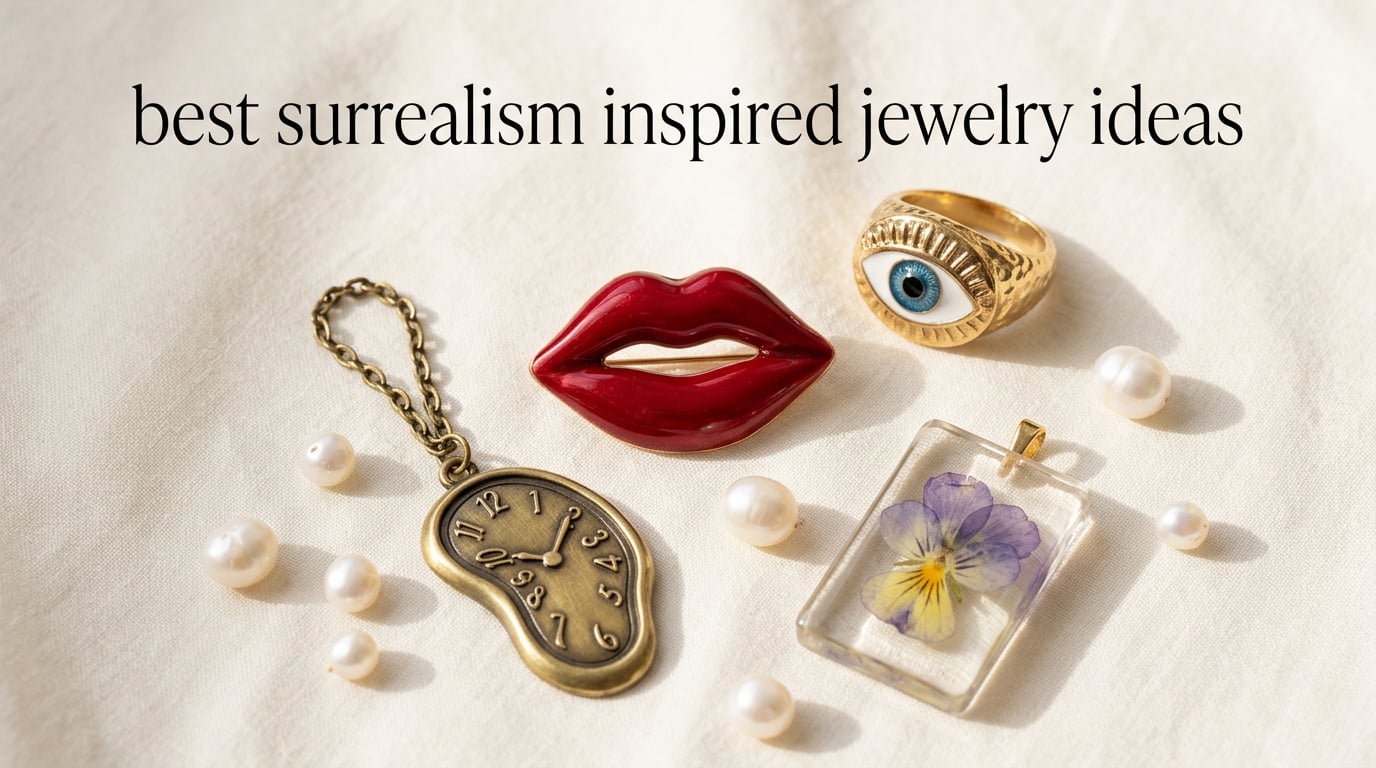
If you’ve ever stared at a melting clock and thought “I want to wear that,” you’re in the right place. Surrealism has slipped off the gallery wall and onto our collarbones, earlobes, and fingertips, and the best surrealism inspired jewelry ideas are more wearable than you might expect. In 2026, the trend is everywhere from red carpet looks to Etsy storefronts.
I pulled together this guide after months of scrolling museum archives, vintage auctions, and indie maker shops. You’ll find a quick history lesson, twelve concrete ideas you can actually buy or make, and honest styling advice so your surrealist jewelry looks intentional, not costume-y.
Table of Contents
A Brief History of Surrealism and Its Jewelry Roots
Surrealism officially began in 1924 when André Breton published his first manifesto, but its roots stretch back to the Dada movement’s rejection of logic after World War I. Breton defined surrealism as psychic automatism, a stream-of-consciousness way of making art that bypasses reason. Two key techniques shaped everything that came after: automatism (letting the hand move without control) and the paranoiac-critical method (interpreting reality through obsessive, irrational associations).
The five common themes of surrealism are dreams, the unconscious, juxtaposition of unexpected objects, transformation of the body, and the absurd. Jewelers, perhaps more than any other artists, found those themes irresistible. A ring is intimate, worn on the body, and already a small sculpture. Add a melting clock or a fur-lined cup, and suddenly the wearer becomes a walking poem.
Elsa Schiaparelli was the first to bring surrealism into high fashion. She collaborated with Salvador Dali and Man Ray in the 1930s, producing trompe-l’oeil buttons, the famous shoe hat, and a gold-plated metal bracelet shaped like a hand. That set the template: surrealism in jewelry means wearable strangeness with intent.
Salvador Dali: The Father of Surrealist Jewelry
Salvador Dali started making jewelry in earnest in the 1940s, working with goldsmith Carlos Alemany. He would sketch a design, Alemany would translate it into wax, and the two would cast it in yellow gold, often accented with rubies, cultured pearls, lapis lazuli, or natural diamonds. Dali personally supervised every piece, and he treated each jewel as a miniature sculpture with a punchline.
The most iconic Dali jewelry motifs are the Ruby Lips, a pair of lips set with rubies and pearls; the Royal Heart, a pulsating heart set with a hidden mechanical movement that beats when worn; the Eye of Time, a watch set into a teary eye carved from platinum and decorated with a diamond; the Étoile de Mer, a starfish brooch with moving arms; and the Medusa brooch, a face framed by serpents in cabochon sapphires and rubies.
Dali also designed the Dalinian Ghost, a gold brooch with a tongue that licks forward when the wearer tilts it. These pieces weren’t just pretty. They were visual jokes about time slipping, hearts racing, and eyes watching. In 2026, original Dali jewels still surface at auction houses like Sotheby’s and Christie’s, often for six-figure sums, but the motifs he invented are now everywhere from mass-market earrings to high jewelry collections.
Iconic Body-Part Motifs in Surrealist Jewelry
If surrealism has a visual vocabulary, body parts are its alphabet. Eyes, lips, hands, teeth, ears, and faces dominate the genre because they make us confront our own bodies in unfamiliar ways. Meret Oppenheim’s fur-covered teacup and Déjeuner en fourrure started it all, but jewelry took the idea even further: a fur bangle, a sugar-cube ring, and a bone necklace she made in the 1930s are still referenced by designers today.
Hands appear as gold fingertips that wrap around the finger like a glove. Lips show up as brooches, rings, and now earring shapes. Teeth, particularly gold or enameled teeth, hang from chokers. Ears are replicated as earrings so accurate you almost expect them to hear you. Faces, often half-hidden or distorted, become pendants that stare back at the wearer.
The reason these motifs endure is psychological. Surrealism is about making the familiar strange, and what is more familiar than your own body? A well-made surrealist piece makes you pause, and that pause is the whole point.
Modern Designers Bringing Surrealism to Life
Daniel Roseberry is the current creative director of Schiaparelli, and he has turned the house into a surrealist powerhouse. His golden anatomical heart gowns, prosthetic-nose earrings, and dripping-paint cuffs have been worn by Doja Cat, Beyoncé, and Cardi B. Roseberry’s work is loud, expensive, and instantly recognizable. If you want haute couture surrealism, his name is the one to know.
Delfina Delettrez Fendi takes a quieter, biological approach. Her piercings of flesh collection features tiny gold tongues, lips, teeth, and eyes set as earrings and rings. Solange Azagury-Partridge, who designed for the house of Boucheron before launching her own line, makes Hotlips rings and tongue studs that feel like Pop Art meets psychoanalysis. Pamela Love, an American designer based in New York, builds talismanic pieces with raw crystals and dark symbolism.
Other names worth knowing are Ileana Makri (Greek designer famous for eye motif rings), Dauphinette (which dresses fruit and other oddities in fine jewelry), Lady Grey, and Judi McCormick Studios for handmade statement brooches. Smaller indie labels like Joidart specifically riff on Dali’s catalog, while Etsy makers adapt the same vocabulary in resin, polymer clay, and recycled metals.
12 Surrealism Inspired Jewelry Ideas to Wear Now
Here are twelve concrete surrealism inspired jewelry ideas you can actually try. Some are haute, some are handmade, all of them carry that unsettling beauty the movement is famous for.
Idea 1: The Ruby Lips Brooch
Dali’s 1949 Ruby Lips is the original. Today you can find faithful reinterpretations in gold-tone metal from Etsy indie sellers, or the high jewelry version in rubies and pearls from Schiaparelli. Wear it pinned to a black blazer lapel for instant surrealist energy.
Idea 2: Melting Watch Pendant
The Persistence of Memory melted clock is Dali’s signature image. A melting watch pendant, in brass or antiqued silver, makes a strong necklace. Pair with a plain white shirt and let the pendant do the storytelling.
Idea 3: The Pulsating Heart Brooch
Inspired by Dali’s Royal Heart, modern versions use a hidden quartz movement so the heart actually beats. These work beautifully on a structured coat or dress at chest height.
Idea 4: Eye Motif Ring
The evil eye, the Eye of Time, the all-seeing eye. A single sculpted eye set as a ring (Ileana Makri’s Eye ring is a classic) is wearable even in an office. Choose a smaller version for daytime and save the dramatic lapis-and-diamond version for evening.
Idea 5: Gold Fingertips Ring or Cuff
Hand-shaped jewelry that extends your fingers has been a surrealist staple since Schiaparelli’s 1930s glove bracelet. A gold fingertips cuff transforms a simple manicure into a fashion statement.
Idea 6: Teeth Choker or Drop Earrings
Gold or enamel teeth as jewelry feels playful and faintly macabre. A teeth choker works best with a bare neckline, while teeth drop earrings add edge to a slicked-back hairstyle.
Idea 7: Fur or Feather Bangle
A direct nod to Meret Oppenheim’s fur bangle. Today versions use ethical faux fur, soft feathers, or velvet. Stack one or two over a long sleeve for a 1930s surrealist silhouette.
Idea 8: Nose or Lip Prosthetic Earring
Schiaparelli made these famous on the runway. A sculptural nose or lip hanging from one ear, asymmetric and slightly unsettling, is the easiest way to look fashion-editorial surrealist.
Idea 9: Butterfly Wing Ring with Moving Parts
A ring where the wings actually flutter when you move your hand. This borrows from Dali’s Étoile de Mer mechanical brooches and feels almost alive.
Idea 10: Face Pendant on a Long Chain
A pendant carved or molded into a partial face, sometimes half-hidden, sometimes split. Wear it over a plain sweater to let the face become the entire focal point.
Idea 11: Pearl Cluster in an Unusual Shape
Pearls clustered into a cloud, a tear, or a spider web. Cultured pearls, lapis lazuli, or malachite clusters that don’t follow traditional jewelry geometry are quietly surrealist.
Idea 12: Upcycled Object Charm Necklace
Take an old watch movement, a broken teacup fragment, or a vintage key, set it in resin, and hang it from a chain. This is the most DIY-friendly idea on the list and gives you a one-of-a-kind piece that no museum will have.
Materials and Symbolism in Surrealist Jewelry
The materials used in surrealist jewelry carry as much meaning as the shapes. Yellow gold and platinum suggest permanence and value, often used to elevate absurd objects into something precious. Cultured pearls, with their organic irregularities, feel dreamlike and faintly maternal. Rubies and cabochon sapphires add blood-like orbs that bring body symbolism alive. Lapis lazuli and malachite pull in the cosmic and the natural. Swarovski crystals, used heavily by Schiaparelli today, add theatrical sparkle without competing with the design itself.
The motifs themselves carry meaning. Melting clocks symbolize the slipperiness of time. Eyes mean watching, being watched, or hidden truths. Lips mean desire, speech, or secrets. Hearts, especially beating ones, mean life itself made mechanical. Hands and fingers mean touch, control, or surrender. When you choose a piece, knowing the symbolism helps you wear it with intent.
| Motif | Symbolic Meaning | Common Materials |
|---|---|---|
| Melting clock | Time slipping away | Brass, gold-tone metal, antiqued silver |
| Eye | Watching, hidden truth | Lapis lazuli, onyx, diamonds |
| Lips | Desire, secrets | Rubies, red enamel, pearls |
| Heart (beating) | Life, mechanical life | Gold, rubies, mechanical movement |
| Hand or fingertip | Touch, control | Yellow gold, sculpted brass |
| Teeth | Edge, mortality | Gold, white enamel, bone |
| Butterfly or starfish | Transformation | Platinum, diamonds, malachite |
How to Style Surrealist Jewelry Without Looking Costume-y
The biggest forum pain point I saw, especially on r/jewelry and r/femalefashionadvice, is that bold sculptural pieces can read as costume-y in everyday outfits. The trick is balance. Let one surrealist piece be the hero and keep everything else quiet. A ruby lips brooch with a plain white button-down works. The same brooch competing with statement earrings, a printed scarf, and stacked bracelets looks chaotic.
For daytime, smaller surrealist pieces (a single eye ring, a thin melting-clock pendant, an asymmetric nose earring) read as fashion-editorial without overwhelming. For special occasions, go larger: a beating heart brooch on a black tuxedo jacket, a teeth choker with a strapless gown, or a sculptural gold cuff with a simple slip dress.
Color matters too. Surrealist jewelry usually pops against solid colors. Black, cream, navy, and white backgrounds let the pieces shine. Busy prints fight with the sculptural shapes. If your outfit already has strong texture or print, choose a quieter surrealist piece and let the eye rest.
Where to Find Surrealist Jewelry at Every Budget
You don’t need a six-figure auction budget to wear surrealism. The trend has reached every price tier, and knowing where to look matters. At the high end, original Dali jewels appear at Sotheby’s, Christie’s, and Phillips; expect five- and six-figure prices for signed pieces. Schiaparelli’s current surrealist couture jewelry is sold through the house’s flagship locations and select luxury retailers.
The mid tier is where independent designers shine. Delfina Delettrez Fendi sells directly from her atelier in Rome. Solange Azagury-Partridge, Pamela Love, Ileana Makri, and Dauphinette all sell from their own websites. Joidart specializes in Dali-inspired gold pieces at accessible prices. The MoMA Design Store and similar museum shops carry curated indie makers with surrealist leanings.
For affordable surrealism, Etsy is your best friend. Search for ruby lips brooch, melting watch pendant, eye ring, or surrealist resin jewelry and you’ll find hundreds of handmade options. Punkyouth, Valley Rose, The Swaf, and Judi McCormick Studios all have Etsy storefronts. Resin-encased flower pieces, polymer clay eye rings, and upcycled watch-movement necklaces all live in this tier. Secondhand and vintage shops also surprise with mid-century Schiaparelli-adjacent finds.
DIY Surrealist Jewelry You Can Make at Home
If you want to wear surrealism without buying anything, DIY is a real option. Reddit’s r/jewelrymaking community regularly shares resin-encased real flower pieces inspired by surrealist photography. The technique is straightforward: arrange pressed flowers in a silicone mold, pour clear resin, cure, then add a bail and chain. The result looks like a tiny dream caught in amber.
Polymer clay is another easy medium. Roll out a flat circle, paint an eye motif, bake it, and turn it into a ring or pendant. For a more metal look, air-dry clay can mimic gold when painted with metallic acrylics. Upcycled charms are the most sustainable option: take an old watch movement, a broken teacup shard, or a vintage key, set it in resin, and hang it from a chain.
The point isn’t perfection. Surrealism prizes the strange and handmade over the polished and machine-made. A piece with a tiny imperfection reads as more authentic than a factory-perfect copy.
Frequently Asked Questions
What is surrealist jewelry?
Surrealist jewelry is wearable art that borrows from the Surrealism movement, which began in 1924 with Andre Breton’s first manifesto. It features dreamlike motifs like melting clocks, eyes, lips, hands, and teeth, often set in unexpected materials or proportions to create visual surprise. Designers from Salvador Dali and Elsa Schiaparelli in the 1930s to Daniel Roseberry and Delfina Delettrez today continue the tradition.
How do I wear surrealist jewelry without looking costume-y?
Treat one surrealist piece as the hero of your outfit and keep everything else minimal. Pair a ruby lips brooch with a plain white shirt, or wear sculptural earrings with a simple slip dress. Solid colors, clean lines, and quiet supporting pieces let the surrealist jewelry read as fashion-editorial rather than costume.
What materials are used in surrealist jewelry?
Traditional surrealist jewelry uses 18-karat gold, platinum, cultured pearls, natural diamonds, rubies, lapis lazuli, malachite, and cabochon sapphires. Contemporary and indie makers use Swarovski crystals, resin, polymer clay, air-dry clay, faux fur, and upcycled objects to capture the same dreamlike feeling at lower prices.
Where can I buy surrealist jewelry online?
High-end pieces are sold at Sotheby’s, Christie’s, and Schiaparelli flagship stores. Independent designers like Delfina Delettrez Fendi, Pamela Love, Solange Azagury-Partridge, and Ileana Makri sell directly from their websites. The MoMA Design Store and Joidart carry curated surrealist-leaning designs. For affordable handmade surrealism, Etsy shops like Punkyouth, Valley Rose, The Swaf, and Judi McCormick Studios offer handmade surrealism jewelry.
Who are the most famous surrealist jewelry designers?
Salvador Dali is the original surrealist jewelry designer, working with goldsmith Carlos Alemany from the 1940s. Elsa Schiaparelli collaborated with Dali and Man Ray in the 1930s. Modern designers continuing the tradition include Daniel Roseberry at Schiaparelli, Delfina Delettrez Fendi, Solange Azagury-Partridge, Pamela Love, Ileana Makri, and Dauphinette. Meret Oppenheim’s fur bangle and surrealist accessories remain iconic references.
Bringing Surrealism Into Your Jewelry Box
Surrealism inspired jewelry ideas aren’t just museum pieces anymore. They’re pieces you can wear to brunch, to a meeting, or to a wedding, and each one carries a story about time, the body, and the unexpected. Start with one piece that genuinely moves you, whether that’s a ruby lips brooch, a melting clock pendant, or a DIY resin-and-flower necklace you made yourself. The best surrealist jewelry doesn’t shout. It makes you look twice.