
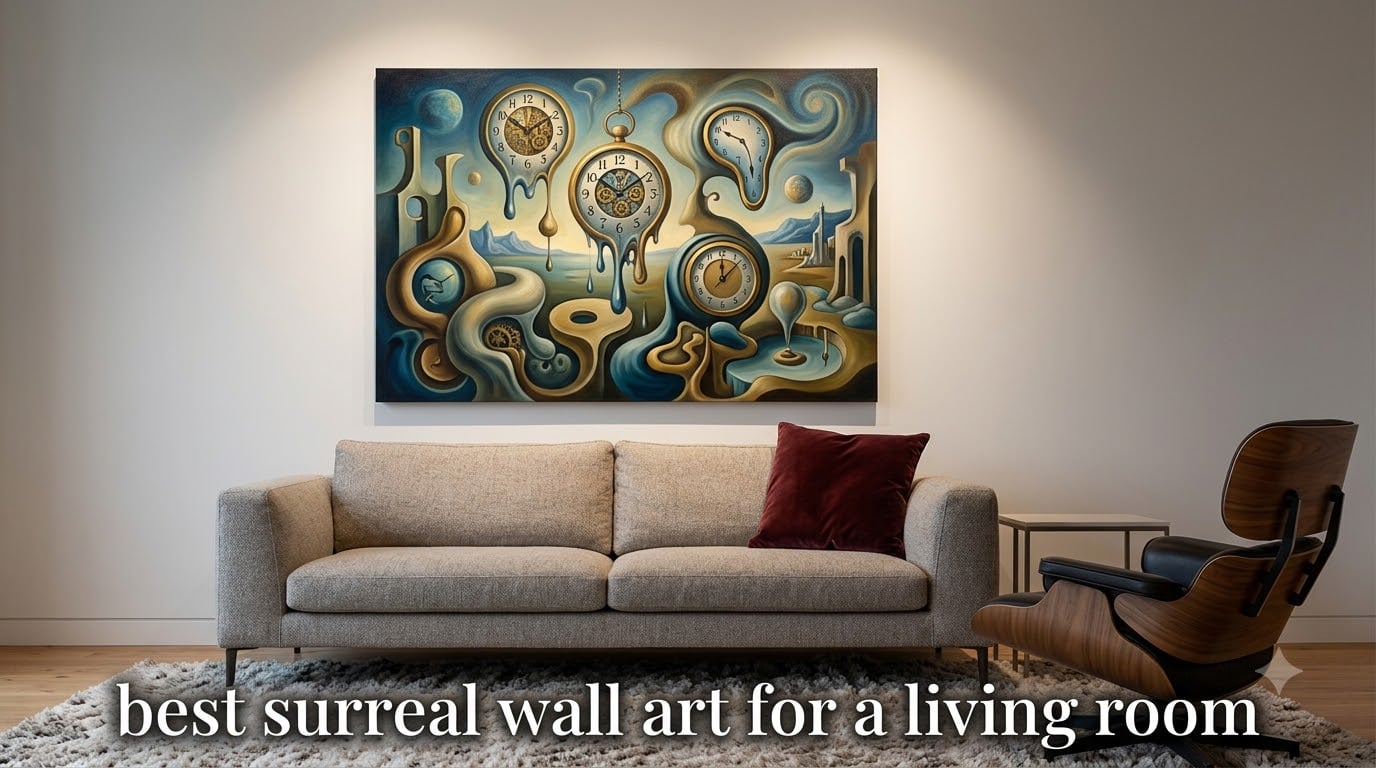
Surrealism is the art of the half-closed eye: clocks that puddle, apples that hide inside faces, doors that open onto deserts. If you have been searching for the best surreal wall art for a living room, you are really looking for a single image that can hold a whole room’s attention — something dreamlike enough to feel personal, but considered enough to survive a remodel. I have spent the last few months collecting prints, haunting museum shops and watching how people actually hang them above their sofas. This guide distills that work into a numbered list of ten pieces I would buy again, plus the rules that make any of them look right on your wall.
Table of Contents
What Is Surrealism, and Why Does It Work on a Living-Room Wall?
Surrealism is an avant-garde art movement that the French writer André Breton launched in 1924 with his Manifesto of Surrealism. Its aim was to express the workings of the unconscious mind by any means available — collage, dream-logic narrative, photorealistic hallucination, even chance. Surrealist art pairs familiar objects in impossible ways so the rational brain steps aside and the dreamer steps forward. That is exactly why it reads so well on a living-room wall: a single image can quietly rearrange how an entire room feels.
There are two main types of surrealist art most collectors will encounter:
- Veristic surrealism — hyper-real, painted like a photograph. Think Salvador Dalí’s melting clocks in The Persistence of Memory (1931) or René Magritte’s bowler-hatted men. The illusion of reality is the point.
- Automatic surrealism — loose, spontaneous, hand-led by the unconscious. Think Joan Miró’s playful biomorphic shapes or André Masson’s ink drawings.
Six techniques show up again and again across both branches:
- Automatism (drawing without conscious control, what Breton called psychic automatism)
- Frottage (Max Ernst’s method of rubbing pencil over textured surfaces)
- Grattage (scraping wet paint to reveal what’s underneath)
- Decalcomania (pressing wet paint between surfaces for organic patterns)
- Paranoiac-critical method (Dalí’s disciplined self-induced hallucination)
- Collage and the exquisite corpse (assembling fragments, the way the Surrealist group passed folded paper around a table)
On a wall, the effect is the same: one image doing the work of an entire mood board.
7 Characteristics of Surrealist Art to Look For Before You Buy
Before you fall for a thumbnail, scan the image for these seven cues. If three or more show up, you are probably looking at genuine surrealist art rather than a generic “dreamy” print.
- Dreamlike imagery — soft edges, fog, tilted horizons, impossible shadows.
- Juxtaposition — two unrelated objects sharing one frame (a fish in a telephone, a face inside a wall).
- Melting or warped forms — Dalí’s signature, but also Carrington and Tanning.
- Floating objects — apples, doors, eyes, hands that ignore gravity.
- Unexpected scale — a tiny figure in a giant room, a giant insect on a tabletop.
- Symbolic imagery — eyes, eggs, clocks, birds, mirrors, mannequin windows.
- Biomorphic shapes — amoeba-like forms that hint at living things without naming them.
These traits are also a quick way to filter on Etsy and Society6, where “surreal” gets attached to almost anything.
Best Surreal Wall Art for a Living Room: 10 Curated Picks
This is the list I would send to a friend who wants one piece that changes the room. Each pick carries a mood tag so you can match it to your space, plus a source link to a reputable seller or museum archive.
- The Persistence of Memory, Salvador Dalí (1931) — Mood: dreamlike. The reference point for everything on this list. Soft Catalan cliffs and three melting pocket watches. Buy a museum-licensed giclée from MoMA Design Store or a Society6 reproduction for budget walls.
- The Treachery of Images, René Magritte (1928) — Mood: philosophical. A pipe above the words “Ceci n’est pas une pipe.” Perfect above a clean white sofa; works as a teaching moment for guests.
- The Son of Man, René Magritte (1964) — Mood: quiet mystery. A bowler-hatted man with an apple floating in front of his face. Reads as gentle, not weird, and is one of the most-searched surrealist paintings of the last decade.
- Harlequin’s Carnival, Joan Miró (1924–25) — Mood: playful. A burst of biomorphic shapes and primary colors. The right call for a maximalist or boho living room that needs warmth.
- Self-Portrait (Inn of the Dawn Horse), Leonora Carrington (1937–38) — Mood: dark romance. A rocking chair, a hyena, a white horse. Decisive color and quiet menace — a strong alternative to a black-and-white Dalí.
- Dream Caused by the Flight of a Bee Around a Pomegranate One Second Before Awakening, Salvador Dalí (1944) — Mood: dreamlike. A nude floating above rocks while a fish and a pomegranate tumble from her mouth. The long title is itself a conversation piece.
- The Elephant Celebes, Max Ernst (1921) — Mood: uncanny. A mechanical elephant in a landscape that also reads as a boiler. Anchor piece for an industrial or mid-century modern room.
- Celestial Pablum, Remedios Varo (1958) — Mood: cosmic. Concentric figures pouring starlight through funnels into a tower. Quiet, layered, and less ubiquitous than Dalí.
- The Song of Love, Giorgio de Chirico (1914) — Mood: melancholy. A mannequin head, a rubber glove, a green ball, a classical building. The earliest painting on this list and a useful “gateway surrealist” piece.
- Eine Kleine Nachtmusik, Dorothea Tanning (1943) — Mood: surreal domestic. A girl on a hotel landing, a sunflower-headed creature, two open doors. Surrealism as lived-in interior — perfect above a sofa in a soft-pastel scheme.
Six of these are at MoMA, the Met or the Tate in their originals; the other four live in private collections or smaller museums. All ten reproduce well as canvas prints or posters.
Surrealist Sub-Styles Matched to Living-Room Moods
Not every surrealist painting wants to live in the same room. I think of it as five sub-styles, each matched to an interior mood:
- Dreamlike / classical surrealism (Dalí, Ernst, de Chirico) — pairs with modern and minimalist living rooms that need a single quiet anchor.
- Dark romance (Carrington, Tanning, Varo) — pairs with maximalist spaces with deep greens, oxblood and brass.
- Cosmic / visionary (Varo, Sage, Tanguy) — pairs with boho rooms that already mix textiles and travel finds.
- Biomorphic / playful (Miró, modern prints on Etsy) — pairs with mid-century modern rooms built around warm woods and primary accents.
- Black-and-white philosophical (Magritte’s word-paintings, Ernst’s frottage) — pairs with Scandinavian and gallery-wall schemes where contrast does the work.
Choosing by mood first and artist second is the trick that keeps a single surrealist canvas from overwhelming a calm room.
Print Format Comparison: Canvas vs Framed vs Poster vs Digital
Format changes everything. A Dalí on unstretched poster paper feels different from the same image on a 1.5-inch deep canvas. Here is how the four main print formats compare.
| Format | Best for | Look and feel | Watch out for |
|---|---|---|---|
| Canvas wrap | Above a sofa; large walls | Gallery look, no frame needed, softens busy imagery | Lower-cost canvases can warp; museum prints are sharper but cost more |
| Framed print | Magritte, word-paintings, minimalist rooms | Crisp edges, formal, easy to swap | Frame style must match the room; large frames are heavy |
| Unframed poster | Gallery walls, rotating art, renters | Cheapest, most flexible | Needs a mat and frame to look intentional |
| Digital download | Trying a piece before committing, instant gratification | Print anywhere, any size | Color accuracy depends on your printer; licensing for resale is murky |
For most living rooms I would recommend a canvas wrap for the hero piece and framed prints for everything else.
How to Pick the Right Piece: Size, Color and the 2/3 Rule
A surrealist canvas can either float or crush a room depending on proportion. The most reliable shortcut is the 2/3 rule: the artwork should measure roughly two-thirds to three-quarters of the width of the sofa it hangs above, and the bottom edge should sit 6 to 10 inches above the backrest. Anything narrower and the piece looks tentative; anything wider and it begins to fight the architecture.
Eye level matters too. In a living room where most people sit, hang the center of the artwork at 57 to 60 inches from the floor, not from the sofa back. That is the standard museum hang.
A quick sizing cheat sheet:
| Sofa width | Artwork width (2/3 rule) | Gap above backrest |
|---|---|---|
| 60 inch (loveseat) | 40–45 inch | 6–10 inch |
| 84 inch (standard 3-seat) | 56–63 inch | 6–10 inch |
| 108 inch (large sectional) | 72–81 inch — consider a diptych or gallery wall | 6–10 inch |
For color, pick up one of the secondary hues in the painting and echo it in a cushion or a throw. That single move is what keeps a surrealist canvas looking intentional rather than imported.
One last tip from the interior designers I trust: keep surrealism to about 30 percent of a room’s visual weight. A bold canvas, a quirky cushion and a curved candlestick is plenty. Anything more and the room tips into “Salvador Dalí museum threw up on the wall,” which I have seen more than once on r/HomeDecorating.
Where to Buy Surreal Wall Art Online
Based on what keeps coming up in r/HomeDecorating threads and across the broader shopping results, these are the places I would start.
- Etsy independent artists — best for one-of-a-kind prints and reasonable museum-licensed work. Artists like bnVisions and ChaosandWonderDesign show up consistently in positive threads.
- Society6 — broad catalog of surrealist-style prints on canvas, framed and poster; reviewers say colors can vary, so order a swatch first.
- GreatBigCanvas — large-format stretched canvases, good for above-the-sofa hero pieces.
- iCanvas — quality museum reproductions including Dalí and Magritte.
- Andy okay — gallery-style prints with a surreal-leaning catalog.
- Local galleries and museum shops — Reddit’s r/femalelivingspace users consistently report this is the best value once you frame yourself.
Start with museum shops if you want a recognizable masterpiece, then move to Etsy if you want something no neighbor owns.
Frequently Asked Questions
What are the 7 characteristics of surrealist art?
The seven characteristics most collectors look for are: dreamlike imagery, juxtaposition of unrelated objects, melting or warped forms, floating objects, unexpected scale, symbolic imagery (eyes, eggs, clocks, birds), and biomorphic shapes. A piece with three or more of these is usually a genuine surrealist work rather than a generic dreamy print.
What are the two main types of surrealist art?
Veristic surrealism is photorealistic and illusionistic, built like a dream you could walk into. Salvador Dali and Rene Magritte are the clearest examples. Automatic surrealism is loose and spontaneous, driven by the unconscious; Joan Miro and Andre Masson are the clearest examples.
What is the 2/3 rule for wall art?
The 2/3 rule says the artwork above a sofa should measure roughly two-thirds to three-quarters of the sofa’s total width, with the bottom edge sitting 6 to 10 inches above the backrest and the center of the piece hung 57 to 60 inches from the floor. It is the simplest way to keep art in proportion with the furniture below it.
Where can I buy surreal art for my living room?
Start at museum shops and iCanvas for museum-licensed reproductions of Dali and Magritte, then move to Etsy independent artists, Society6 and GreatBigCanvas for original surrealist prints. Reddit users consistently say local galleries plus self-framing are the best value for original work.
What kind of art looks good in a living room?
Living rooms do best with one large statement piece hung at 57 to 60 inches from the floor, a coherent palette of two or three colors echoed from that piece, and a 70/30 ratio between calm backgrounds and bold focal art. Surrealist paintings work especially well because they give the eye a single place to land.
What are the trends in wall art for 2026?
In 2026, the big wall-art trends are modern surrealism, dark romance, cosmic and biomorphic palettes, oversized single canvases above the sofa, and printed-on-demand gallery walls that mix recognizable masterpieces with original work from independent artists on Etsy and Society6.
How do I start with surrealism on a budget?
Begin with a museum-licensed poster or digital download of one anchor piece, frame it yourself, and add one or two supporting surrealist-style prints from Etsy or a local gallery. Keep the rest of the room calm so the single surreal canvas can do the work.
Bring a Little Dream Logic Home
Choosing the best surreal wall art for a living room comes down to three decisions: pick one anchor piece from the list above, hang it at two-thirds of your sofa’s width with the center at 57 to 60 inches from the floor, and keep the rest of the room quiet enough that the painting can do the dreaming. If you want a starting point, a Magritte for the philosophy, a Dalí for the dream, and a Carrington for the mood are the three I keep recommending to friends. Once the piece is on the wall, the room starts doing the work for you.