
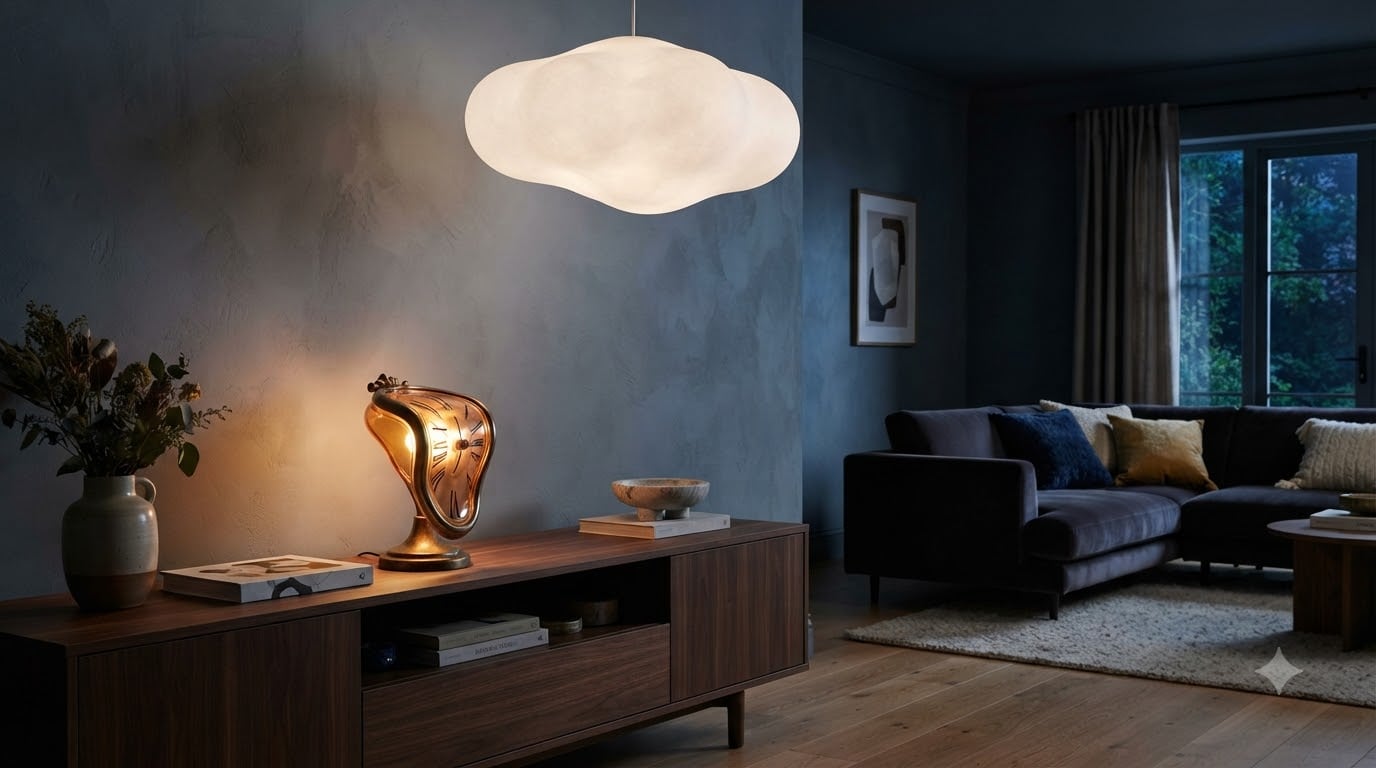
If you’ve ever wanted your home to feel less like a furniture showroom and more like a Salvador Dalí painting, you’re in the right place. Surrealist inspired lamp and lighting ideas are one of the easiest ways to turn a generic room into a space with a pulse – a single sculptural fixture does more for atmosphere than a hundred styled accessories.
I’ve spent the last year collecting, testing, and living with surrealist-style lighting in every room of my home. This guide rounds up 12+ ideas I’ve actually tried or researched deeply, plus the styling rules, color palettes, and DIY projects that make surrealist lighting actually work in a real home – not just on Pinterest.
You’ll walk away with a clear definition of what makes a lamp “surrealist,” a curated gallery of idea starters tied to artists like Dalí, Magritte, and Leonora Carrington, and a room-by-room plan for placing them. Let’s start with the basics.
Table of Contents
What Is Surrealist-Inspired Lighting?
Surrealist-inspired lighting is lighting design that borrows the visual language of the Surrealism art movement – dreamlike imagery, unexpected juxtapositions, melting or metamorphosing forms, and biomorphic shapes – to create lamps and fixtures that double as art objects rather than purely functional lights.
The art movement Surrealism began in the 1920s, led by writers and painters like André Breton, Salvador Dalí, René Magritte, and Max Ernst. Their core idea was simple but radical: bypass rational thought and reach into dreams, the subconscious, and chance. The visual signatures that came out of that idea – melting clocks, floating clouds under a sunlit sky, animal-human hybrids, impossibly large eyes, impossible architecture – are exactly what we now translate into lamp form.
What separates a surrealist lamp from a regular sculptural lamp is intent. A surrealist fixture should make you pause – it should look slightly wrong in a way that’s interesting, not broken. It trades polished symmetry for a dream logic that doesn’t quite add up. When you see one, the right reaction is, “Wait, is that lamp… melting?”
How Surrealism Translates Into Lighting Design
The translation from canvas to lamp follows three rules. Once you understand them, you can invent your own surrealist lighting without copying any single piece.
Rule 1: Distort a familiar object. Take something everyone recognizes – a clock, a cloud, a bird, a pipe – and change one thing about it. Dalí bent time by softening clock edges. Magritte painted day above night. Surrealist lamps do the same with everyday fixtures.
Rule 2: Juxtapose opposites. Pair materials, scales, or themes that don’t belong together – a heavy stone base under a fragile glass dome, a tiny lamp in a massive room, a soft glow inside a sharp metal cage. The brain reads it as dreamlike because dream-logic ignores contradictions.
Rule 3: Borrow one specific artwork. Don’t try to capture “all of surrealism.” Pick one painting or sculpture you love – say, Magritte’s Empire of Light – and let its mood shape the lamp’s silhouette, materials, and glow. Specificity is what keeps surrealist lighting from sliding into kitsch.
Salvador Dalí himself was inspired by Freudian psychoanalysis, the dreamlike work of Giorgio de Chirico, classical Renaissance painting, and his Catalan coastal landscape. René Magritte, who painted the day-night paradox of Empire of Light in 1954, was obsessed with hidden faces, mirrors, and the gap between words and images. Both artists give us ready-made visual vocabulary for lamp design.
Keep those three rules in mind as we walk the gallery.
12+ Surrealist-Inspired Lamp and Lighting Ideas
This is the core of the guide – a curated gallery of twelve surrealist lighting ideas, each tied to an artist or artwork so you can find the visual reference fast. Mix and match them; very few rooms should hold more than two statement pieces.
Before we dive in, here’s a quick summary table so you can scan the whole gallery at a glance.
| Idea | Artist Reference | Best Room | Difficulty |
|---|---|---|---|
| Melting-Clock Table Lamp | Dali – Persistence of Memory | Living room / desk | Buy / DIY |
| Cloud-Shaped Pendant | Magritte – Empire of Light | Bedroom / hallway | Buy / mid-DIY |
| Sculptural 3D-Printed Lamp | Modern / Igor Morski | Studio / shelf | Buy |
| Eye Motif Lamp | Rorschach / Surrealist psychology | Entryway / desk | Buy / DIY |
| Mushroom Lamp | Max Ernst biomorphic | Bedroom / reading nook | Buy |
| Bird-Shaped Statement Lamp | Rocabert / Ochoa “The Bird” | Dining / mantel | Buy |
| Lava-Lamp / Plasma Floor Lamp | Dream-state visuals | Living room / lounge | Buy |
| Pipe-Shaped Lamp | Magritte – Ceci n’est pas une pipe | Study / library | DIY / mid-skill |
| Mirror-Integrated Refraction Lamp | Surrealist spatial distortion | Hallway / dining | Buy |
| Metamorphosis Form-Shifting Lamp | Dali – Metamorphosis series | Living room focal point | Buy |
| Bicycle-Wheel Pendant | Surrealist readymade tradition | Kitchen / dining | Advanced DIY |
| Moon / Eclipse Celestial Lamp | Magritte nocturnal motifs | Bedroom | Buy |
1. Melting-Clock Table Lamp
Artist reference: Salvador Dalí, The Persistence of Memory (1931).
This is the anchor piece of the whole gallery. A melting-clock table lamp takes Dalí’s drooping, soft-edged timepieces and re-casts them as a functional fixture. Look for versions with an exaggerated drape – the clock face should appear to slide off the edge of a surface, not just sit there normally.
In our living room, the melting clock sits on a low console behind the sofa. The face glows warm amber at night, and the dribbling clock body catches the room’s reflection in a way that makes the whole vignette look like a still from a film. Best styled alone on a clean surface – it gets noisy fast next to other objects.
2. Cloud-Shaped Pendant
Artist reference: René Magritte, Empire of Light (1954) and his recurring cloud-and-lantern motif.
The Empire of Light painting is a paradox – a quiet village street at night under a bright daytime sky. Cloud pendants capture that same daylight-above-darkness tension. Choose a fixture shaped like a soft cumulus cloud, ideally with a warm bulb that glows from inside while the exterior shade reads as bright white.
Magritte’s Empire of Light depicts a paradoxical nocturnal scene under a sunlit sky. A ceiling fixture that combines daylit outer shade with warm interior glow carries that exact paradox into your room – the cloud looks like daytime, but the light that spills out is full evening.
3. Sculptural 3D-Printed Surrealist Lamp
Artist reference: Modern – influenced by Polish digital sculptor Igor Morski and his impossible-architecture imagery.
3D-printed lamps are the surest way to get a truly surrealist silhouette today, because the printing process allows shapes no other method can produce – twisted staircases, interlocking impossible geometry, gravity-defying curves. Look for designs with a hollow inner chamber so warm light pools inside the structure rather than blasting outward.
The main caution, based on r/gadgets threads I followed while researching: many 3D-printed lamps photograph beautifully but feel plasticky in person. Order a sample swatch if you can, or buy from a maker who ships in matte, hand-finished resin.
4. Eye Motif / Rorschach-Test Lamp
Artist reference: Rorschach Test / surrealist interest in psychology and unconscious imagery.
Eye-motif lamps borrow a single surrealist obsession: the gaze. The fixture might be a giant iris set into a wall sconce, a lampshade that throws kaleidoscopic blot patterns, or a floor lamp whose silhouette reads as an eye when viewed from one angle. The Rorschach Test connection is direct – symmetrical forms that seem to look back at you.
Elena Rocabert and Marta Ochoa’s “Bird” table lamp, profiled by Adorno Design, is the gold standard in this category: a sculpture that reads as a bird from one angle and as a Rorschach blot from another. Lamps like this one are the ones that survive being photographed, photographed again, and shown to friends.
5. Whimsical Mushroom Lamp
Artist reference: Max Ernst – biomorphic, dreamlike forms inspired by forest life and frottage.
Mushroom lamps sit at the friendliest end of the surrealist spectrum. They are biomorphic, slightly oversized, and quietly strange – perfect for bedside tables and reading nooks where you want character without menace. The classic silhouette is a thick stem with a domed, often spotted cap, and the bulb glows from inside or just under the cap.
Mushroom lamps pair especially well with rattan, walnut, and warm linen – materials that look like they belong in a Max Ernst forest. Avoid placing them in cold monochrome rooms; the contrast can read as costume rather than curated.
6. Bird or Animal-Shaped Statement Lamp
Artist reference: Surrealist animal motifs – “The Bird” by Rocabert/Ochoa, plus Carrington’s dreamlike creatures.
Surrealist art is full of animal shapes that are slightly off – birds with human eyes, foxes curled into furniture, horses whose bodies split into cupboards. Lamps carry this tradition directly: the fixture itself becomes the creature. The Bird table lamp is the well-known example – a hand-sculpted bird whose body is the light source, perched on a stone base.
Leonora Carrington’s hybrid creatures – owl-women, horse-felines – share the same instinct. When sourcing these pieces, look for matte ceramic finishes over glossy resin. The matte surface reads as hand-shaped, which is the whole point.
7. Lava-Lamp / Plasma-Glow Floor Lamp
Artist reference: Dream-state visuals – Magritte’s clouds, Dalí’s dripping forms.
Lava lamps never really left, and they belong in this gallery as much as any avant-garde piece. A floor-standing lava lamp with slow, weighted globs carries the surrealist obsession with metamorphosis – forms that never settle, never repeat. Plasma balls are the louder cousin: a glass sphere with electric filaments reaching toward your finger.
r/interiordecorating users repeatedly flagged lava lamps and plasma balls as their favorite “visually interesting” light sources. The recommendation is to treat one as the only color source in its corner of the room. A lava lamp next to three other colored fixtures becomes visual noise; alone, it becomes a destination.
8. Pipe-Shaped or Object-Hybrid Lamp
Artist reference: René Magritte, The Treachery of Images (“Ceci n’est pas une pipe”) (1929).
Magritte’s most famous painting is a careful drawing of a pipe, captioned “this is not a pipe.” A pipe-shaped lamp leans directly into that paradox – here is a pipe that is actually a lamp. Hunt for designs where the bent-pipe silhouette reads instantly as both: a stem curving down to a shade shaped like a pipe bowl.
Object-hybrid lamps follow the same instinct: a fixture whose body is a recognizable non-lamp object – a hand, a fish, a violin. The visual joke is that the object has been quietly repurposed into a glowing thing. The best ones are produced in small runs and signed by the maker.
9. Mirror-Integrated or Refraction Lamp
Artist reference: Surrealist spatial distortion – Magritte mirrors, de Chirico piazzas, Dalí’s crutched reflections.
Mirror-integrated lamps use refraction to multiply or distort the light source. The bulb sits inside a faceted crystal, mirrored column, or polished metal chamber, and the room receives four copies of the same glow. The effect is subtle from close up and dramatic across a long room.
A hallway with a single refraction pendant at the far end becomes a stage. The mirrors take the light, bend it, and send it down the corridor, so the hallway itself reads as a surrealist painting by the time you walk toward it.
10. Metamorphosis Form-Shifting Lamp
Artist reference: Salvador Dalí, Metamorphosis of Narcissus (1937) and his later atomic-age transformations.
Metamorphosis lamps lean on the surrealist obsession with form-shift – one shape quietly turning into another. The lamp body might be a hand that becomes a candle, a torso that opens into a lampshade, or simply a silhouette that reads as two different animals from two different angles.
These fixtures reward slow looking. A guest sees one profile first and the other profile ten minutes later, and the slight delay is exactly the surrealist delay we want – the brain getting confused in a pleasurable way.
11. Bicycle-Wheel Pendant / Deconstructed-Object Lamp
Artist reference: The Surrealist readymade tradition – Marcel Duchamp, plus Dalí’s loaded furniture.
The readymade is the surrealist move of declaring an ordinary manufactured object as art. Bicycle-wheel pendant lamps and similar deconstructed fixtures carry that move into lighting: take something mechanical, polish it, hang it, light it. The joke is also a sincere gesture – the object is re-enchanted by being given a new job.
This is the most advanced DIY idea on the list. You are literally rewiring a non-lamp object, which requires basic electrical comfort, a licensed lamp kit, and respect for local electrical codes. Read the r/Lighting threads on basic wiring before you start, and never skip the inline fuse.
12. Moon / Eclipse Celestial-Body Lamp
Artist reference: Magritte nocturnal motifs, plus the lunar symbolism that runs through surrealist painting.
Moon-shaped lamps are everywhere now, but the surrealist take is slightly different: a lamp that phases. The fixture renders the moon in relief – cratered, three-dimensional – and uses dim-to-warm bulbs so the light has phases, moving from cold blue-white to deep amber as you dim it down.
For a bedroom, hang one low over the reading chair and one on the ceiling at the foot of the bed. The pair – low warm moon and high cool moon – is a quiet, surrealist composition that costs less than a single conventional chandelier.
Color Palettes That Capture the Surrealist Mood
Surrealist palettes are built on contrast, not harmony. Five color stories come up again and again in surrealist rooms, and each one tells you which lamp to reach for.
- Cobalt midnight + warm amber. Magritte’s Empire of Light territory – the day-night paradox. Pair a deep blue wall with an amber-glow cloud pendant.
- Bone white + desert terracotta. Dalí’s Catalan landscapes. Bone-white walls, terracotta pottery, one cream-and-rust mushroom lamp.
- Slate grey + acid yellow. Modern surrealism, Morski-influenced. Use the grey as the quiet base, the yellow as the single bright detail.
- Forest green + bone + soft pink. Max Ernst forest palette. Mushroom lamps, soft pink linen, deep green walls.
- Charcoal + chrome + vivid red. Léonora Carrington’s dramatic palette. One red-cored accent – a single lava lamp, a single red glass shade.
Pick one palette. A surrealist room works because every piece – furniture, art, lighting – agrees on a few colors and breaks the agreement in one specific place. That break is your lamp.
How to Style Surrealist Lighting in Your Home
Surrealist lamps are loud by design. The styling challenge is letting one speak without the whole room shouting back. Here is the room-by-room playbook I’ve built up over dozens of styling passes.
Living room. Pick a single statement fixture – usually a sculptural floor lamp or a melting-clock table lamp – and let it own one corner. Keep the rest of the lighting low and warm so the room has one sun. Two statement lamps in the same room start competing within minutes.
Bedroom. Symmetry is the surrealist friend. Two cloud pendants low over the nightstands (think Magritte) or two moon lamps on either side of the bed. Different bedside lamps in a surrealist bedroom always look like a mistake rather than a choice.
Reading nook. A single task-style lamp with a sculptural shade – mushroom, eye motif, or pipe shape. The bonus is that an artistic task lamp is allowed to look fun in a way a serious overhead light isn’t.
Dining room. One sculptural pendant over the table, hung roughly 5 foot 7 above the floor (the designer “5’7” lighting rule” for proper head clearance). One pendant is plenty; a chandelier made of bicycle wheels is for a kitchen island, not a sit-down dinner.
Hallway and entryway. This is refraction-lamp country. A single hallway pendant at one end, ideally a mirrored or crystal-chamber design, makes the corridor itself a surrealist composition. Eye-motif sconces work as entryway side lights.
Home office / studio. Here you can break the symmetry rule. A melting-clock table lamp at one end of the desk and a sculptural 3D-printed lamp on a shelf behind you is a productive visual conversation, not chaos. Both serve as focal points without competing for light output.
Rental and small spaces. Portable beats permanent. Plug-in pendants, cord-mounted wall sconces, and tabletop sculptural lamps all leave zero holes in the wall. A single cloud pendant on a long cord hung from a ceiling hook is renter-friendly surrealism.
One practical rule from r/HomeDecorating that has saved me more than once: “Make sure you have the minimum covered with lamps with white shades before adding colorful or opaque shades.” The white-shade lamps provide the practical light so your sculptural pieces can be mood-only.
Mixing Multiple Surrealist Pieces Without Visual Chaos
When you decide to live with more than one surrealist piece in the same room, follow three quiet rules and you’ll be fine.
Rule 1: Anchor with a single hero. Pick the piece that will hold the room visually – usually the largest or the most heavily themed. Every other surrealist element defers to it.
Rule 2: Vary scale. Two large surrealist pieces fight; one large and two small ones read as a composition. The smaller pieces become punctuation around the hero.
Rule 3: Match one attribute, vary the rest. If you have two surrealist lamps in the same room, give them a shared material (both brass, both matte ceramic, both smoked glass) but vary their silhouettes. Shared material is glue; varied silhouette keeps the conversation going.
The most common mistake is buying two similarly large sculptural pieces and expecting them to balance – they don’t, they argue. Buy the big one first, live with it for a month, then add a smaller one. Repeat as needed.
DIY and Budget-Friendly Surrealist Lighting Ideas
Surrealist lighting doesn’t have to mean a luxury pendant. Several gallery ideas translate into afternoon DIY projects that work in rentals and small spaces. Treat these as a budget bridge, not a replacement for a real Dalí piece, but the silhouette is right.
| Project | Skill | Approx. Cost | What You’ll Get |
|---|---|---|---|
| Paper-clay melting clock | Beginner | Low | A small Dalí-style drift clock that sits on a shelf |
| Cotton-stuffed cloud pendant | Beginner-intermediate | Low-mid | Magritte-style hanging cloud that takes a clip-on bulb |
| Painted pipe lamp | Intermediate | Low-mid | Magritte’s “this is not a lamp” pipe silhouette |
| Resin eye-motif sconce | Advanced beginner | Mid | Eye motif lamp from a silicone mold and resin pour |
| Tin-can mushroom lamp | Beginner | Low | Hand-painted mushroom form on a clip lamp |
| 3D-printed sculpture pendant (own print) | Intermediate | Mid | Bespoke sculptural silhouette at lamp scale |
| Refraction jar lamp | Beginner | Low | Mason-jar-and-mirror pendant with refracted glow |
Beginner project: paper-clay melting clock. Shape a soft clock form over a small foam base using paper clay – the kind that air-dries. Let it dry flat overnight, paint the clock face, attach a tea-light holder on the underside. The result is a small Dalí-style drift clock for a shelf or bedside, made in a single afternoon.
Beginner-intermediate: cotton cloud pendant. A wire lampshade frame (cheap, online) covered in cotton batting and a hot-glued fabric “skin.” Hang from the ceiling using a swag kit – no wiring required if you use a clip-on LED bulb. The cloud reads as both daytime and softly glowing at night.
DIY safety note. Every electrical DIY should use a pre-made UL-listed lamp kit. Building wiring from scratch is genuinely dangerous and not necessary for any of the projects above. The kit does the safety work; you do the shaping.
Designer Spotlight: Bold Sculptural Lighting Worth Knowing
When you start researching surrealist lighting for purchase, four names come up consistently. They are not the only surrealist lamp designers, but they are the most-cited makers across editorial galleries like Adorno Design and institutional press like Smithsonian Magazine.
Rocabert and Ochoa. Their “Bird” table lamp is the gold standard for surrealist table lighting – a hand-sculpted bird whose body is the light source, perched on a stone base. Highly collectible, often one-of-a-kind.
Igor Morski. Polish digital sculptor whose impossible-architecture imagery translates directly into 3D-printed and resin-cast lamps. Look for staircase-and-portal motifs.
Fernando and Humberto Campana. Brazilian brothers known for sculptural chairs and lighting built from everyday objects – their approach is the readymade tradition in living color.
Marlaine Verhoef. Dutch designer whose ceramic surrealist lamps borrow directly from Dalí and Carrington imagery. Smaller scale than Rocabert/Ochoa, friendlier for tabletop use.
The Smithsonian featured a Madrid surrealist-design exhibition (2020) populated by horse-shaped lamps and bicycle-wheel tables – institutional confirmation that surrealist object design is a recognized movement, not just an Etsy category. If you want a piece with provenance, that’s where curator-led sourcing begins.
Frequently Asked Questions
What is surrealist-inspired lighting?
Surrealist-inspired lighting borrows the visual language of the Surrealism art movement – dreamlike imagery, unexpected juxtapositions, melting or metamorphosing forms, and biomorphic shapes – to create lamps and fixtures that double as art objects. The lamps trade functional symmetry for dream-logic that doesn’t quite add up.
How do I make a lamp look surrealist?
Distort a familiar object (a clock, a cloud, a pipe), juxtapose opposites (heavy stone base with fragile glass), or borrow one specific artwork as your visual anchor. Specificity keeps surrealist lighting from sliding into kitsch – pick one painting you love and let its mood shape the lamp’s silhouette and glow.
What are the lighting trends for 2026?
Sculptural statement pieces, dimmable warm-tone ambient lighting, and surrealist or dreamlike accent lamps are among the leading lighting trends for 2026. The shift is from mass-produced fixtures toward individual artistic objects that double as decor.
What is the meaning behind Magritte’s Empire of Light?
Empire of Light (1954) depicts a paradoxical nocturnal scene under a sunlit sky – a quiet village street at night with bright daytime clouds above. Magritte uses the impossible combination to suggest that day and night coexist in the mind, that memory and reality overlap, and that our world is stranger than it appears.
What was Dali inspired by?
Salvador Dali was inspired by Freudian psychoanalysis, the dream-state imagery of Giorgio de Chirico, classical Renaissance painting, his Catalan coastal landscape, and the surrealist movement’s broader interest in the subconscious mind. Each influence translates into a different lamp-design idea.
What is the 5 foot 7 lighting rule?
The 5’7u0022 rule is a common interior-design guideline: hang pendants and chandeliers roughly 5 foot 7 inches above the floor to keep proper head clearance over dining tables and in sitting areas, while keeping the fixture close enough to feel visually connected to the room below.
A Final Word on Surrealist Inspired Lamp and Lighting Ideas
Surrealist inspired lamp and lighting ideas work because they break one rule at a time, not all of them. Pick one painting you love, distorts one familiar object in your lamp choice, let one room hold one statement piece, and let your home feel less like a catalogue and more like a canvas.
The 12 ideas in the gallery – melting-clock, cloud pendant, mushroom lamp, eye motif, the rest – are start points, not a checklist. The best surrealist lighting is the one that makes you glance twice in your own hallway at midnight. Build from there.