
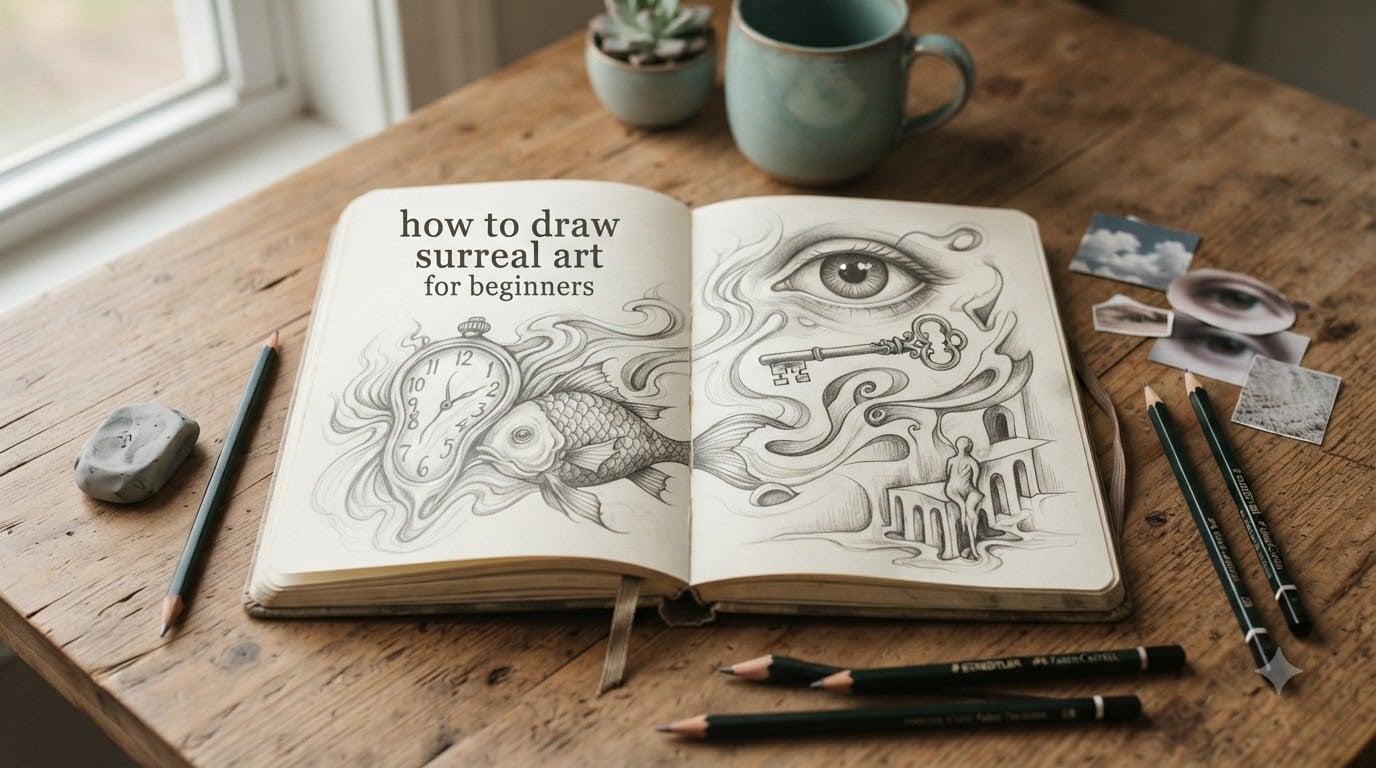
You can create surreal art as a beginner by combining two simple moves: pick two unrelated objects (a clock and an eye, a fish and a stairway), then draw them as if they belong together. The whole point of surrealism is to bypass “good drawing” rules. So a pencil, a piece of paper, and the willingness to let your hand wander are genuinely enough to start.
I know that sounds almost too easy, so let me back up. This guide walks you through how to draw surreal art for beginners in a way that skips the art-school detour. You will get the six core surrealist techniques, a full step-by-step drawing exercise, a budget-friendly supplies list, and answers to the questions beginners ask us most at One Surrealist A Day. No realism prerequisite. No fancy ink.
Table of Contents
What Is Surrealism and Why It Works for Beginners
Surrealism is a 20th-century art movement that puts the unconscious mind on paper. It started in 1924 when Andre Breton published the Surrealist Manifesto, building on Sigmund Freud’s ideas about dreams and the subconscious. Artists wanted to reach past rational thinking and pull up stranger, more honest images.
The reason this matters for you is simple. Breton and his circle built surrealism specifically to free people from the pressure of being “good” at drawing. Breton called it “psychic automatism” – letting the hand move without the brain editing. That is the entire origin story. If you have ever felt stuck drawing realistic still lifes, you are literally the kind of person this movement was made for.
7 Characteristics of Surrealist Art
Surrealist pieces tend to share seven recognizable traits. Use this checklist as a quick reference while you draw.
- Dreamlike imagery – scenes that feel like a half-remembered dream.
- Juxtaposition of unrelated objects – placing things side-by-side that do not normally meet.
- Distortion or metamorphosis – objects melting, growing, or fusing into other objects.
- Impossible scale or physics – oversized insects, floating stones, rooms that ignore gravity.
- Symbolic personal objects – items that mean something to the artist, not just a generic vase.
- An unsettling or uncanny mood – calm on the surface, weird underneath.
- Empty or absurd backgrounds – deserts, mirrors, infinite hallways, or featureless skies.
6 Surrealist Techniques Beginners Should Try
These are the six techniques we recommend every beginner practice first. You do not need all six in one drawing. Pick one, try it for a week, then layer in another.
- Automatism (automatic drawing). Set a 5-minute timer. Move your pencil without lifting it much. Do not plan the shape. Whatever comes out is the drawing. Andre Masson invented this and it is the bedrock of surrealism.
- Juxtaposition. Pick two unrelated objects from your room. Force them into one scene. A teacup growing out of a tree trunk. A telephone sitting at the bottom of the sea. The clash is the point.
- Morphing (metamorphosis). Draw object A on one side of the page and object B on the other. Gradually blend them in the middle so they fuse into one shape. Salvador Dali’s melting clocks are the classic example.
- Collage. Cut figures or textures from magazines and glue them together. Beginners on r/surrealism consistently call collage the lowest-friction way in because drawing skill barely matters.
- Frottage. Place a sheet of paper over a textured surface (wood grain, leaf, lace) and rub with the side of a pencil. Max Ernst invented this. The surprise texture becomes your starting shape.
- Exquisite corpse. Fold a paper into thirds. Person A draws the head, folds it over. Person B draws the torso without seeing the head. Person C draws the legs. Unfold for a wild collaborative drawing.
Supplies You Actually Need to Start
Here is the honest beginner supplies list. Anything beyond this is optional.
- Pencils: one HB for light lines, one 2B, one 4B or 6B for darks. A small set of three is fine.
- Kneaded eraser: lifts graphite cleanly and can smudge as a drawing tool itself.
- Sketchbook: 70 to 90 lb (100 to 120 gsm) paper so it does not buckle under ink or wash.
- Black ink pen: one fine liner (0.05 or 0.1) for final outlines.
- Old magazines: for collage. National Geographic, fashion mags, and old newspapers all work.
- Glue stick: for collage work.
That is the whole list. No special ink is required. Reddit beginners often stall here worrying about gear, but charcoal, alcohol markers, watercolor, or colored pencil all work too – whichever you already own.
How to Draw Surreal Art: Step-by-Step for Beginners
This is the exercise I wish someone had handed me on day one. It uses the first three techniques above (automatism, juxtaposition, morphing) so you get comfortable fast. Plan on 30 to 45 minutes.
- Step 1 – Run a 5-minute automatic warm-up. On any scrap paper, draw without lifting your pencil, without erasing, and without thinking. The goal is not a pretty drawing. The goal is to wake up your hand. I do this before every surrealist piece I make.
- Step 2 – Pick two objects. Look around your desk. Pick one object from the left side of your space and one from the right. They should feel unrelated. I once used a coffee mug and a moth. A student of mine used a house key and a whale.
- Step 3 – Sketch object A on the left third of your page. Draw it roughly but recognizably. No perfection needed – this is a sketch, not a finished drawing.
- Step 4 – Sketch object B on the right third. Same idea. Recognizable shape, loose lines.
- Step 5 – Fill the middle third with a morph. Slowly blend object A into object B across the middle of the page. Let parts of A become parts of B. This is where the surreal feeling lives.
- Step 6 – Add one impossible detail. Drop in a single physics-breaking element: an eye floating where it should not be, gravity going sideways, or a window opening into the wrong scene. One detail is plenty.
- Step 7 – Refine and darken. Trace your favorite lines with a darker pencil or fine liner. Leave the rest loose. The mix of crisp and soft lines is what makes a surrealist drawing feel alive.
Done. You now have a finished surrealist drawing. Pin it on your wall. Tomorrow, repeat with two new objects.
How to Come Up With Surreal Ideas When You Sit Down to Draw
“I sit down to draw and nothing comes out” is the number one complaint we hear from beginners. The fix is not talent. The fix is a warm-up habit.
Try the 10 ideas a day exercise. Open a notes file on your phone or a page in your sketchbook. Write down 10 surreal ideas as fast as you can. They can be one line each. “A clock melting into a piano.” “A door opening into the ocean.” “Shoes made of windows.” Do this every morning for three weeks. By week two, your idea muscle is noticeably stronger.
Another trick we use at One Surrealist A Day: pick one ordinary verb (running, sleeping, eating) and combine it with three random nouns from a book you open at random. Force the combinations onto paper, even when they feel silly. The weirdest prompt usually produces the strongest image.
Common Beginner Mistakes (and How to Let Go)
The most common trap is self-correcting back into realism mid-drawing. You start with a melting clock, then five minutes later you are shading it like a photograph. It happens to everyone.
There is a useful shorthand called the 70/30 rule. Spend about 70% of your drawing time on the surrealist element – the morph, the juxtaposition, the impossible detail – and only 30% on realistic rendering. Flip those numbers and you have made a normal still life. Comic and character artists on r/ArtistLounge say this single ratio unlocked their surrealist work.
Two other things to watch for. First, do not skip the warm-up. A 5-minute automatic drawing is the fastest way to silence your inner critic. Second, give yourself permission to make ugly work. Beginners on r/surrealism almost always say the same thing: their first ten drawings were rough, and the eleventh suddenly clicked.
4 Surrealist Artists Worth Studying for Inspiration
Looking at real surrealist work makes the style feel achievable. Spend 10 minutes scrolling through any of these artists and you will start seeing your own ideas show up.
- Salvador Dali – the master of melting clocks and hyper-real dream imagery. Study his persistence of memory if you want to learn how to render a surreal subject with extreme technical realism.
- Rene Magritte – perfect for beginners. His paintings use simple juxtaposition (a pipe that is “not a pipe,” an apple filling a room). His clean style is the easiest to imitate while you find your voice.
- Max Ernst – inventor of frottage and grattage. If you love texture and accidental marks, Ernst is your reference.
- Joan Miro – biomorphic shapes, childlike lines, bright colors. Miro is the proof that you do not need realism at all.
3 Surreal Drawing Projects to Try at Any Skill Level
Pick one project for this week and see how it feels.
- Beginner – 10-day sketchbook of morphed objects. One small surrealist drawing per day using only pencil. Pair objects from different rooms each day.
- Intermediate – Surrealist portrait collage. Cut a face from a magazine, then collage impossible elements (insect wings, second moon, cracked mirror) around it.
- Advanced – Mixed media one-piece. Combine charcoal, ink, and collage on heavyweight paper. Start with frottage, add a juxtaposed object, then morph the two together.
Frequently Asked Questions
How can I create surreal art as a beginner?
Start with two unrelated objects, sketch each on a different side of the page, and morph them together in the middle. Add one impossible detail (floating, melting, oversized) and finish with the 70/30 rule – 70% of your effort goes into the surreal element, 30% into realistic rendering. A pencil, paper, and a 5-minute automatic warm-up are all you need to begin.
What are 6 surrealist techniques?
The six core techniques are automatism (automatic drawing without planning), juxtaposition (placing unrelated objects together), morphing or metamorphosis (blending two objects into one), collage (cutting and recombining found imagery), frottage (rubbing over textures), and the exquisite corpse game (collaborative folded-paper drawing).
What are the 7 characteristics of surrealist art?
Surrealist art tends to be dreamlike, to juxtapose unrelated objects, to distort or morph objects, to break physics with impossible scale, to include personal symbolism, to feel uncanny or unsettling, and to use empty or absurd backgrounds like deserts or infinite hallways.
What is the 70/30 rule in drawing?
The 70/30 rule says to spend about 70% of your drawing time on the surrealist element – the morph, the impossible detail, or the juxtaposition – and only 30% on realistic rendering. Beginners often flip this and end up with a normal still life instead of surrealism.
Do I need to know how to draw realistically before learning surrealism?
No. Surrealism was specifically designed to free artists from realism. Andre Breton built the movement around psychic automatism, which means letting the hand move without realistic planning. Beginners can start with collage, frottage, or automatic drawing and produce strong surrealist work without advanced technical skill.
What supplies do I need to start drawing surrealism?
You need an HB pencil, a 2B or 4B pencil, a kneaded eraser, a sketchbook with 70 to 90 lb paper, a fine liner pen, and a few old magazines for collage. Anything beyond that is optional – charcoal, alcohol markers, and watercolor all work once you want to expand.
Start Drawing Surreal Art Today
You now have everything you need to learn how to draw surreal art for beginners: a definition, six techniques, a supplies list, a step-by-step exercise, and answers to the questions that trip most people up. The next move is small. Set a 5-minute timer, run one automatic warm-up on scrap paper, then pick two objects on your desk and morph them together. That single drawing is a complete surrealist piece.
Keep going. Pin your favorite drawings somewhere you will see them every morning. Share them with us at One Surrealist A Day – we love seeing what beginners make on day one. Surrealism is one of the few art styles that genuinely gets more interesting the looser you let it get, so the messier you allow yourself to be, the better your work will become.