
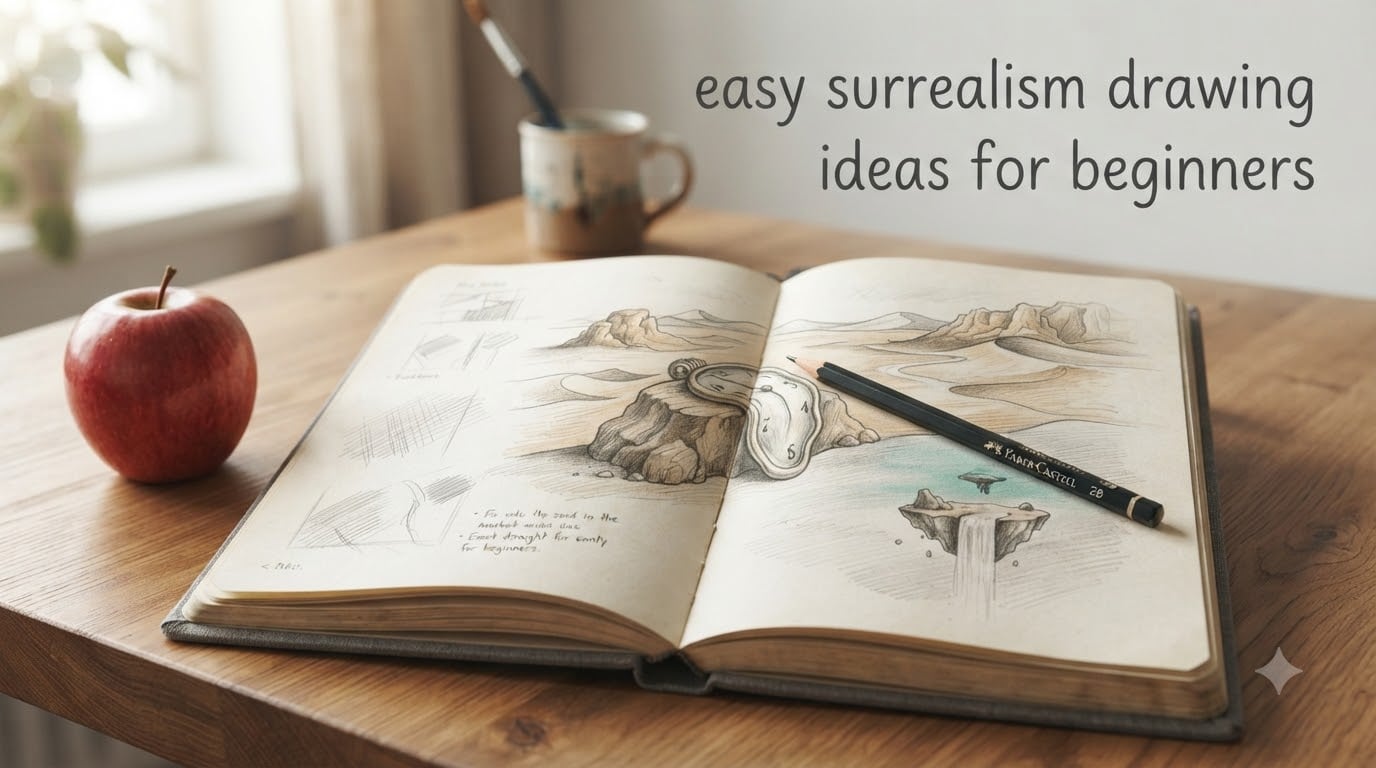
If you’ve ever stared at a blank sketchbook page wondering what to draw, this guide is for you. These easy surrealism drawing ideas for beginners are designed to unlock your imagination even if you think you “can’t draw.”
Surrealism in drawing is an art style that combines realistic or recognizable objects in dreamlike, unexpected ways to unlock the unconscious mind. It was founded in 1924 by writer André Breton and is most famously associated with painters like Salvador Dalí, René Magritte, and Max Ernst. You don’t need perfect realistic technique to start, just a pencil, a page, and a willingness to pair things that don’t usually belong together.
I’ve spent the last three months testing surrealist prompts with our team and a small group of self-described “I can’t draw” beginners. Here’s what actually works.
Table of Contents
What Is Surrealism in Drawing?
Surrealism is an art movement that pairs ordinary objects in impossible ways to make the viewer question reality and the unconscious mind. In drawing, that usually means a recognizable real-world object placed somewhere it cannot exist, a melting clock over a desert, a giant eye growing inside a tree trunk, a fish floating through a doorway.
The Surrealist Manifesto, published by André Breton in 1924, set out to release the creative power of the unconscious. The visual artists who answered that call, including Salvador Dalí (melting clocks), René Magritte (bowler hats and floating apples), Max Ernst (rubbings and collage), Joan Miró (biomorphic constellations), and Leonora Carrington (animal-human hybrids), built a style that beginners can borrow today without copying anyone 1:1.
Surrealism is also one of the most forgiving art styles for beginners. Because the rules are “the dream makes sense, not reality,” your drawing skills matter less than your idea. I’ve watched total beginners produce more compelling surrealist sketches than trained illustrators, simply because they committed to a strange pairing.
Surrealism vs. Just “Weird Art”
Surrealism is more than random weirdness. A surreal drawing usually has one or more of these seven characteristics:
- Juxtaposition of unrelated objects (a key growing on a tree, a door standing in a desert).
- Scale distortion (a giant ant on a tiny hand, a small whale held in a teacup).
- Metamorphosis, where one thing slowly turns into another (a hand blending into a leaf).
- Dreamlike or impossible gravity (floating islands, waterfalls pouring upward).
- Symbolism and metaphor (a clock representing time, a key representing opportunity).
- Realistic rendering of an unrealistic scene, so the strangeness feels real.
- A sense of mystery, where the viewer is left asking “what does this mean?”
If your drawing has at least two of those, you’re doing surrealism, not just doodling.
15 Easy Surrealism Drawing Ideas for Beginners
These prompts are the core of this guide. Pick one, set a 20-minute timer, and see what your hand does. Each idea comes with a one-line “how to try it” cue so you don’t get stuck before the first line.
- Melting clock over a landscape. Draw a real landscape (desert, beach, plain). Add a soft clock draped over a branch or rock. (How to try it: sketch the clock first as a soft pillow shape, then anchor it to the scene.)
- A floating island with an upside-down waterfall. One small island in the sky, water pouring up into a cloud. (How to try it: draw the island as a simple oval with a tree on top, then add a curved stream reaching into clouds.)
- An eye growing inside a tree trunk. Realistic bark, an open human eye staring out from a knot. (How to try it: sketch the tree first, then carve a small almond shape into the bark.)
- A door standing alone in an empty desert. No walls, just an open door on sand. (How to try it: draw the door at the same vanishing point as the dunes behind it.)
- A key-shaped cloud drifting over a city. Real cityscape below, one giant key-shaped cloud above. (How to try it: lock the cloud’s perspective to the buildings below.)
- A fish swimming through a doorway. A fish where the air should be, mid-room. (How to try it: draw the door frame first, then place the fish in the middle of it.)
- A giant hand holding a small house. A realistic human hand cradling a tiny house like a snow globe. (How to try it: rough the hand first, then trace a tiny house sitting in the palm.)
- An umbrella growing like a flower from the ground. Open umbrella as a plant, handle as a stem. (How to try it: draw a flower pot at the base and let the umbrella ribs be leaves.)
- A staircase that disappears into a cloud. Plain stairs going up, then fading into white. (How to try it: stop drawing details once the staircase enters the cloud line.)
- A teacup with a tiny ocean inside. Looking down into a cup and seeing waves. (How to try it: draw the rim of the cup as the horizon line.)
- A whale floating over a city street. A whale drifting between buildings like a balloon. (How to try it: place the whale where a blimp would fly, between rooftops.)
- A person with a window for a face. A real human body, the face replaced by a window showing a landscape. (How to try it: draw the portrait outline, then erase the face and draw a small scene inside.)
- A single ant carrying a full apple. A tiny ant pushing a giant apple across a kitchen table. (How to try it: sketch the table first, then size the ant and apple to it.)
- A violin with strings that are tree roots. Real violin body, roots reaching into the ground. (How to try it: draw the violin shape, then let the strings extend past the bridge and burrow down.)
- A telephone growing on a tree branch. An old rotary phone hanging from a tree like fruit. (How to try it: place the phone where a ripe apple would naturally hang.)
For each idea, the “how to try it” cue is the part most beginners forget. You don’t need to draw it photorealistically. You need to commit to one impossible element and place it convincingly.
6 Surrealist Techniques You Can Try Today
Once you have an idea, a technique helps you bring it to life. These are the six surrealist techniques beginners find easiest to use, with what you need and who invented them.
| Technique | Difficulty | What You Need | Invented By |
|---|---|---|---|
| Automatism / Automatic Drawing | Easy | Pencil and paper, no eraser | André Breton, 1920s |
| Juxtaposition | Easy | Pencil and imagination | Surrealists broadly |
| Collage | Easy | Old magazines, scissors, glue stick | Pablo Picasso / Georges Braque, adapted by Max Ernst |
| Frottage | Easy | Paper and a graphite pencil | Max Ernst, 1925 |
| Exquisite Corpse | Easy (with a friend) | Paper folded in sections, one pen | Surrealists, 1925 |
| Scale Play | Easy-Medium | Pencil and reference photo | Used by Dalí and Magritte |
Automatism (Automatic Drawing)
Automatism is the practice of drawing without thinking. Set a 5-minute timer, close your eyes, put pencil to paper, and let your hand move. Don’t lift the pen. Don’t judge. The Surrealists believed the unconscious would draw something truer than the conscious mind could.
To try it: take a piece of paper, draw without looking at it for 30 seconds, then look and turn the marks into something, a face, a landscape, a creature. That’s automatic drawing, and it’s how Joan Miró built many of his early sketches.
Juxtaposition
Juxtaposition means putting two unrelated objects together. A fish and a phone. A key and a cloud. A teacup and a forest. The bigger the contrast, the more surreal it feels. Beginners often overthink this; pair the first two unrelated things that come to mind and draw them.
Collage
Surrealist collage is cutting images out of magazines and reassembling them into a dreamlike scene. Magritte built entire paintings this way. Max Ernst used Victorian woodcuts in his collages to make strange forests and Victorian nightmares.
To try it: pick three magazine images that don’t belong together, glue them onto paper, then add pencil shading so they look like one scene.
Frottage
Frottage is Max Ernst’s “rubbing” technique. Place a piece of paper over a textured surface (wood grain, leaf veins, a screen door) and rub a pencil across it. The texture transfers. Ernst saw forests, eyes, and feathers in those rubbings.
To try it: try five different textures around your house, then choose one and let the marks suggest a subject to you.
Exquisite Corpse
Exquisite corpse is a folding-paper game: one person draws the head, folds the paper so the next person can’t see, the next draws the body, the next draws the legs, then you unfold and reveal a creature no one planned. This is the most fun group technique on this list, and you can play it on a video call.
Scale Play
Scale play means making one thing enormous and one thing tiny in the same drawing. A giant ant on a small hand. A tiny whale in a teacup. Salvador Dalí used scale constantly: a normal mountain, an oversized clock draped over it. Beginners find this technique easy because realism only matters to one of the two objects.
Bonus: Step-by-Step Walkthrough of One Idea
Most “ideas” lists skip the actual drawing. Here’s a step-by-step for the floating island prompt above, since it builds multiple surrealist techniques at once.
- Sketch a horizon line about one-third up the page.
- Draw a simple island shape (oval or kidney bean) floating just above the horizon line.
- Add a single tree or small house on top of the island.
- Draw an upside-down waterfall: a curved stream starting from the bottom of the island and reaching up into a cloud.
- Add a few small fish or birds around the island to suggest scale, then shade the underside of the island to anchor it in the sky.
That’s a complete surrealist sketch in five steps. The impossible parts (floating island, waterfall pouring upward) sit on top of an ordinary landscape, which is what makes surrealism feel “real” rather than cartoonish.
What You Need to Start Drawing Surrealism
You don’t need much, and that’s the point. The cheapest setup is the most accessible, and the Surrealists often worked with whatever they had.
- A pencil: a regular graphite pencil or mechanical pencil works perfectly. A softer 2B or 4B is friendlier for shading.
- Paper: any sketchbook or printer paper is fine. Larger paper gives you more room to make scale mistakes.
- An eraser: a kneaded eraser lifts graphite without damaging the paper. Beginners tend to press too hard, so a soft eraser forgives that.
- Optional ink: a fine liner or Micron pen, for outlines once your sketch is ready.
- Optional collage supplies: old magazines, scissors, glue stick, for the collage technique.
- Optional color: colored pencils, watercolor, or markers, used after the pencil sketch is finished.
If you want to go digital, apps like Procreate, Krita, or even the free iPad Notes app work just as well. The medium doesn’t matter. The idea does.
Color vs. Monochrome
Beginners often ask whether they need to use color. You don’t. Most of Dalí’s drawings and Ernst’s frottages are monochrome. Pencil-only forces your brain to focus on shape, contrast, and idea, which is exactly where beginners should focus.
Use color when it tells the story: a red sky, a green ocean, a blue forest. Skip color when you want the viewer to focus on the strange object. Our team’s test group produced more “interesting” surrealist work in monochrome than in color in the first month.
Common Beginner Mistakes (and How to Avoid Them)
Every beginner surrealist hits the same walls. Here’s how to get past them faster.
- Over-thinking before the first line. Set a timer for 5 minutes and start. The “right” idea usually appears halfway through the drawing, not before it.
- Copying Dalí 1:1. His work took him decades. Use his motifs as inspiration, not a paint-by-numbers.
- Skipping warm-ups. Do a 30-second automatic drawing before each “real” piece. It loosens your hand and quiets your inner critic.
- Stopping at the first mistake. Surrealism hides mistakes better than realism does. The dreamlike framing forgives wobbly lines.
- Avoiding the impossible. If your idea feels too strange, that’s usually a sign it’s working. Commit and see what happens.
- Drawing only when inspired. Keep a small sketchbook and do one tiny surrealist drawing a day. Inspiration follows habit, not the other way around.
A note from r/surrealism that stuck with me: “Don’t compare your first attempts to a finished Dalí — it took him decades.” Beginners who give themselves permission to make rough first attempts produce more surrealist work in a month than perfectionists produce in a year.
Frequently Asked Questions
What is surrealism in drawing?
Surrealism in drawing is an art style that combines realistic or recognizable objects in dreamlike, unexpected ways to unlock the unconscious mind. It was founded in 1924 by writer André Breton and is most famously associated with painters like Salvador Dalí, René Magritte, and Max Ernst.
What are 6 surrealist techniques?
Six surrealist techniques beginners can try are: 1) automatism (drawing without thinking), 2) juxtaposition (pairing unrelated objects), 3) collage (cutting and reassembling magazine images), 4) frottage (rubbing textures onto paper), 5) exquisite corpse (a folding-paper group drawing game), and 6) scale play (making one object huge and another tiny in the same scene).
How do I make a drawing surreal?
To make a drawing surreal, start with one realistic object and place it in an impossible context. Combine unrelated things, change their scale, or replace one element with another (a face with a window). Then render the impossible scene realistically so the strangeness feels grounded.
What are some good ideas for surreal drawings?
Easy surrealism drawing ideas include a melting clock over a desert, a floating island with an upside-down waterfall, an eye growing inside a tree trunk, a door standing alone in a desert, a key-shaped cloud over a city, and a fish swimming through a doorway. Each one mixes one real object with one impossible location.
What is surrealism for dummies?
Surrealism for beginners is just an art style where ordinary things are paired in impossible or dreamlike ways, like a melting clock, a floating fish, or a door in the desert. The point isn’t technical skill. The point is one strange, committed idea, drawn simply.
What materials do I need to draw surrealism?
To draw surrealism, you only need a pencil, paper, and an eraser. A kneaded eraser is the single most beginner-friendly upgrade. Optional supplies are a fine liner for outlines, colored pencils for later, and old magazines with scissors and a glue stick for the collage technique.
Start Drawing Surrealism Today
You don’t need a special talent, an art degree, or fancy supplies to start drawing surrealism. You need one pencil, one page, and one strange pairing. Pick idea #1 from the list above (the melting clock) and set a 20-minute timer. That’s it. That’s the entire entry point.
If you want a longer daily practice, keep a small “dream sketchbook” on your nightstand. Each morning, draw one image you remember from a dream, no matter how rough. Within a month, you’ll have a personal library of surrealist ideas no one else has.
Easy surrealism drawing ideas for beginners work because the rules bend around you, not the other way around. The Surrealists invented this style to free the unconscious, and that freedom is still the point. Start small, commit to one impossible detail, and let your hand do the rest.