
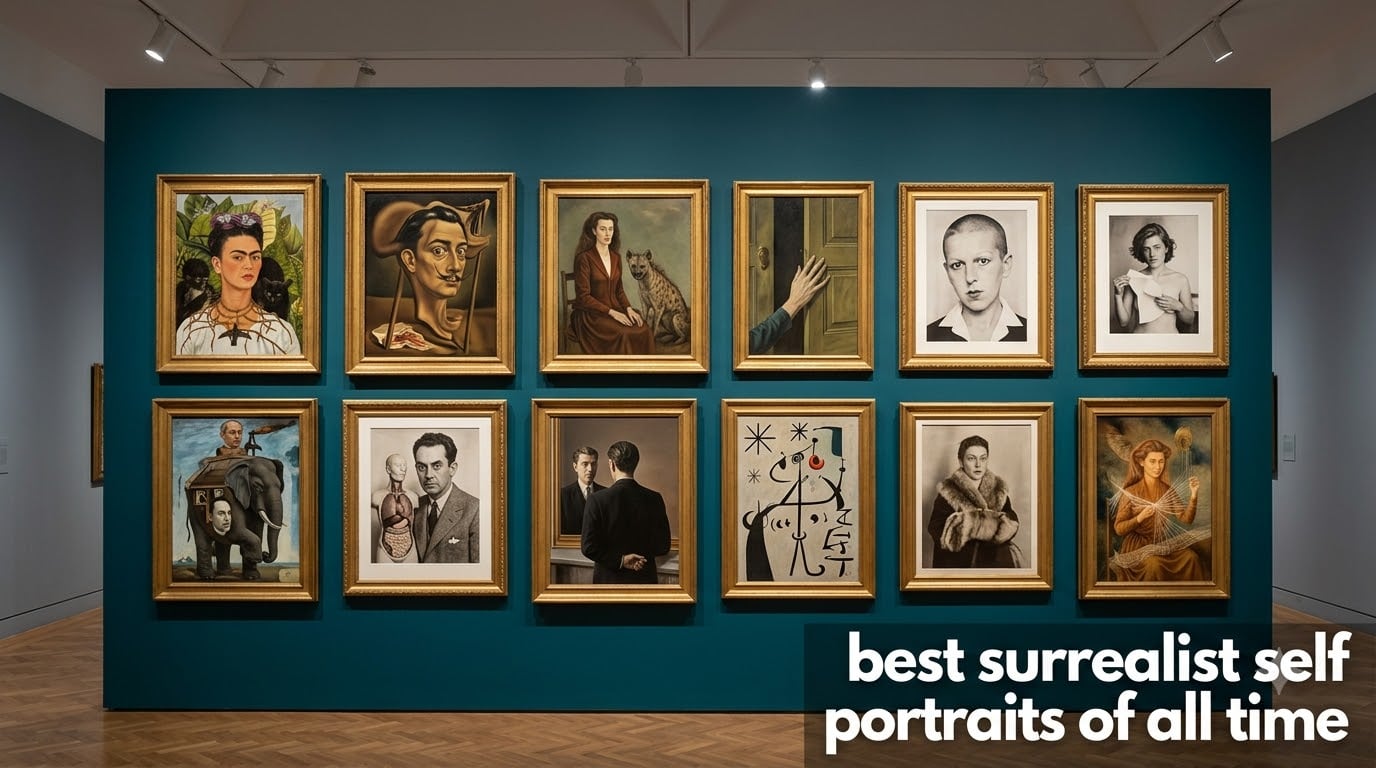
If you have ever stared at a self-portrait and felt like the artist was hiding a second self behind the canvas, you have already met the surrealist self-portrait. This guide curates the 12 best surrealist self-portraits of all time, explains what makes them surrealist, and shows you where to see each one in person. We lean into female surrealists (Carrington, Varo, Tanning, Cahun, Fini, Woodman) the way the canon should have from the start.
A surrealist self-portrait is not just a face on a canvas. It is a face that has been opened, doubled, or turned into something the mirror never gave permission to be. To collect the best surrealist self-portraits of all time, you have to know what surrealism actually demanded of its artists, and that story starts in a Paris bedroom in 1924.
Table of Contents
What Makes a Self-Portrait Surrealist?
A surrealist self-portrait is a self-depiction by an artist working inside the Surrealist movement, in which the artist intentionally merges the realistic face with dreamlike, symbolic, or psychologically charged imagery drawn from the subconscious mind. The portrait still has to look like the artist. What changes is the reality around the artist.
The Surrealist movement was launched by André Breton with his 1924 Surrealist Manifesto, which defined surrealism as “psychic automatism in its pure state.” In plain language, artists were told to bypass logic and let the unconscious mind speak. Self-portraiture, an old genre, was reborn inside that brief. Frida Kahlo, Salvador Dalí, Leonora Carrington, and Remedios Varo turned the mirror into a stage for metamorphosis, doubling, and animal transformation.
Three ingredients separate a surrealist self-portrait from an expressionist one. First, the artist keeps a recognizable face. Second, the symbols are drawn from Freudian psychoanalysis and dreams, not pure emotion. Third, the body often shifts – animals replace limbs, doubles appear, or the artist morphs into a room. That is the grammar we use to build our list.
12 Surrealist Self-Portraits at a Glance
This is the quick-look list version of the best surrealist self-portraits of all time. Use it to pick the next painting you want to study, then read the long-form section below for the symbolism and the museum.
- Frida Kahlo – Self-Portrait with Thorn Necklace and Hummingbird, 1940
- Salvador Dalí – Soft Self-Portrait with Fried Bacon, 1941
- Salvador Dalí – Mae West Lips Sofa, 1936-37 (meta-self-portrait)
- Leonora Carrington – Self-Portrait (Inn of the Dawn Horse), 1937-38
- Remedios Varo – Self-Portrait (looking at the mirror), c. 1960
- Dorothea Tanning – Eine Kleine Nachtmusik, 1943
- Claude Cahun – Self-Portrait (shaved head), 1920s photographic series
- Francesca Woodman – Self Deceit series, 1978-80
- Leonor Fini – Self-Portrait with Hands, c. 1950s
- Max Ernst – Self-Portrait with Plaster Head, c. 1935
- Victor Brauner – Self-Portrait with Enucleated Eye, 1931
- Frida Kahlo – The Two Fridas, 1939
Frida Kahlo: Self-Portrait with Thorn Necklace and Hummingbird (1940)
Frida Kahlo’s Self-Portrait with Thorn Necklace and Hummingbird is the painting most people picture when they think of a surrealist self-portrait. A dead hummingbird hangs from a thorn necklace, a black cat crouches on her shoulder, and a monkey pulls at the sheet behind her. The face is calm. The body is being eaten alive. That contrast is the entire surrealist gesture in one frame.
Kahlo famously said, “I never painted dreams. I painted my own reality.” That is why she also said she was not a surrealist. Breton disagreed and named her a surrealist in 1938. The thorns reference her chronic pain after a near-fatal bus crash, and the Tehuana dress signals her political embrace of Mexicanidad, the post-revolutionary cultural identity she championed.
Where to see it: Harry Ransom Center, University of Texas at Austin. The painting is one of the most reproduced surrealist self-portraits in the world, but the original lives in Austin, not Mexico City.
Salvador Dalí: Soft Self-Portrait with Fried Bacon and the Mae West Apartment
Salvador Dalí invented two surrealist self-portraits at once. In Soft Self-Portrait with Fried Bacon (1941) he paints his own head as a soft pillow supported by crutches, with fried bacon slabs dangling above. In Mae West Red Lips Apartment (1936-37), installed at the Dalí Theatre-Museum in Figueres, Spain, he makes the whole room a face and the face becomes a self-portrait of desire itself.
Dalí was eventually expelled from the official Surrealist group. Breton led the ouster in 1939 because of Dalí’s stated sympathy with Franco’s regime and his apparent hunger for fame and money. Dalí kept painting and kept saying, “I am surrealism,” which only made the dispute louder. By the 1940s his answer to his own self-portrait was to dissolve his head entirely, then later to become an entire apartment.
Where to see it: Soft Self-Portrait with Fried Bacon is at the Dalí Theatre-Museum in Figueres, Spain. The Mae West Lips Apartment is the centerpiece of the same museum and is one of the most visited surrealist rooms in the world.
Leonora Carrington: Self-Portrait (Inn of the Dawn Horse) (1937-38)
Leonora Carrington’s Self-Portrait (Inn of the Dawn Horse) is the surrealist self-portrait most often called “the one with the hyena.” Carrington sits in a chair while a hyena licks milk from a bowl in her lap and a rocking horse floats behind her. A white horse runs through the wall outside. Nothing here is decorative. Everything is a coded diary entry about her escape from a psychiatric clinic after her affair with Max Ernst collapsed.
On Reddit’s r/ArtHistory, the painting is consistently named one of the most powerful surrealist self-portraits ever made. The hyena is both her wild double and the figure that survives the breakdown. The rocking horse is her childhood. The mare galloping outside is the freedom her family denied her. Carrington, who grew up in an English Catholic family and later moved to Mexico, used the animal symbolism to speak what she could not say plainly.
Where to see it: Metropolitan Museum of Art, New York. The painting was gifted to the Met in 2018 after years of being held in private hands.
Remedios Varo: Alchemical Self-Portraits
Remedios Varo is the surrealist the canon left behind for too long. Born in Anglès, Spain in 1908 and forced into exile in Mexico after the Spanish Civil War, Varo painted women inside laboratories, towers, and alchemical kitchens. Her self-portraits rarely name themselves, but several – Papilla Estelar (Celestial Pablum), Bordando el Manto Terrestre (Embroidering the Earth’s Mantle) – stand in for her.
Varo’s symbolism is patient and slow. The figures are women alone, often suspended over vessels, distilling light or feeding stars. r/WitchesVsPatriarchy users frequently point to her as one of the great Spanish surrealists who deserves the same attention as Dalí. Her work treats the feminine subconscious not as a subject to be analyzed by male artists, but as a working laboratory.
Where to see it: Museo de Arte Moderno in Mexico City holds a major Varo collection. Several pieces also live at the Museo Reina Sofía in Madrid.
Dorothea Tanning: Eine Kleine Nachtmusik (1943)
Dorothea Tanning’s Eine Kleine Nachtmusik does not look like a self-portrait at first. Then you see the doorway. A small figure in a blue dress is reaching up to turn a doorknob in a hallway full of giant sunflowers, while a winged creature crouches on the floor. That figure is Tanning, and the painting is her surrealist self-portrait at age 33.
Tanning uses the title with a wink – Eine Kleine Nachtmusik is Mozart’s famous serenade. The pun tells you that the painting is about music, doors, thresholds, and the moment just before something arrives. It was exhibited at MoMA’s landmark 1946 Fourteen Americans show, and MoMA still owns it. Tanning later married Max Ernst and spent decades as a poet, sculptor, and painter working in Sedona, Arizona.
Where to see it: Museum of Modern Art (MoMA), New York.
Claude Cahun: The Androgynous Self-Portrait Photographs
Claude Cahun did not paint surrealist self-portraits. She photographed them. Starting in the early 1920s in Paris, Cahun shaved her head, bound her chest, and posed as a sailor, a doll, a dandy, and a ghost. Her most famous self-portrait is the shaved-head photograph in which she stares directly into the camera with the caption “I am not this, nor am I that.”
Cahun’s surrealism lives in performance and identity rather than paint. She was a member of the Paris Surrealists around the same time as André Breton, and her work influenced later photographic self-portraitists including Cindy Sherman, whose Untitled Film Stills (1977-80) is her most famous series. Where Sherman mimics Hollywood actresses, Cahun mimics herself out of existence.
Where to see it: Jersey Heritage Collection, Jersey, UK. A major retrospective of Cahun’s photographs toured the UK in 2019-20 and most major holdings now live at Jersey Heritage, where she spent the last years of her life during the German occupation.
Francesca Woodman: The Photographic Self That Bridges Surrealism to Now
Francesca Woodman is the bridge. Born in 1958, she made surrealist self-portraits on film in the late 1970s before her death at 22 in 1981. Her photographs – most of them black-and-white, many of them blurred, many of them showing a body merging with wallpaper or a fireplace – feel like the missing link between Breton’s 1924 brief and the contemporary “Instagram surrealism” aesthetic.
Woodman’s surrealism is quieter than Dalí’s and less coded than Carrington’s. She hides her face or blurs it. She photographs herself pressed against walls so that her body becomes architecture. Critics call this the “surrealist interior” – the idea that the artist’s body and the artist’s room are the same material. Today, contemporary artists on Instagram and TikTok regularly cite Woodman as a visual reference for the dreamy, mirror-surreal aesthetic.
Where to see it: Solomon R. Guggenheim Museum, New York, holds a major body of Woodman’s work. Additional prints are at MoMA and the Fondation Cartier in Paris.
Leonor Fini, Max Ernst, and Victor Brauner: Three More Surrealist Self-Portraits You Should Know
The list of best surrealist self-portraits of all time would be incomplete without three names that most roundups skip.
Leonor Fini. An Argentine-Italian painter based in Paris, Fini rejected Breton’s authority and built a self-portrait vocabulary around the sphinx, the cat-woman, and the masked aristocrat. Her self-portraits look like mythological beings wearing couture. She once said, “I am not interested in being a woman in the usual sense. I am interested in being a person.” That line is the entire surrealist self-portrait in one sentence.
Max Ernst. Ernst’s Self-Portrait with Plaster Head turns the artist into a sculpture, his real face replaced by a white plaster cast. Ernst was a co-founder of both Dada and Surrealism and was married at different times to Carrington, Tanning, and Peggy Guggenheim. His self-portraits often feature the bird persona Loplop – a magical stand-in for the artist as ornithological agent.
Victor Brauner. Brauner’s Self-Portrait with Enucleated Eye (1931) painted his injured eye years before he actually lost that eye in a 1938 fistfight with Oscar Domínguez. The painting predicted the wound. It is one of the most haunting examples of a surrealist self-portrait doubling as prophecy, and one of the clearest examples of what Breton meant by “psychic automatism in its pure state.”
How to Identify a Surrealist Self-Portrait: 6 Visual Clues
If you want to recognize a surrealist self-portrait the moment you see one in a museum or online, here is a six-cue visual checklist built from the best surrealist self-portraits of all time. Use it on Pinterest, in a gallery, or while scrolling for aesthetic inspiration.
- The face stays recognizable. The artist keeps a clear portrait of themselves. If you cannot tell who is in the painting, it is probably a symbolic painting, not a self-portrait.
- The body shifts. Animal heads, doubling, wings, or prosthetics appear on or near the body. This is the surrealist signature – the body does not obey its own anatomy.
- Symbols arrive from the unconscious. Thorns, mirrors, doors, hair, eggs, and stars appear as repeated motifs. They reference personal biography but read like dream imagery.
- Doubling shows up. Two selves, two faces, or two animals appear together. Carrington’s hyena and rocking horse, Kahlo’s Two Fridas, and Brauner’s mirror all share this trait.
- Time and gravity stop working. Floating objects, suspended figures, and impossible rooms (Dalí’s Mae West apartment) signal surrealist interior space.
- The medium itself is part of the message. Kahlo used blood, Cahun used photography, Woodman used long exposure. When the artist bends the medium, you are usually looking at surrealism.
Male vs Female Surrealist Self-Portraits: A Hidden Pattern
Once you line up the best surrealist self-portraits of all time and read them side by side, a quiet pattern shows up. The men tend to turn themselves into rooms, foods, and machines. Dalí becomes bacon. Ernst becomes plaster. Magritte becomes a bowler hat. The women tend to turn themselves into animals, doubles, and alchemists. Carrington becomes a hyena. Tanning becomes a small figure at a giant door. Varo becomes a woman distilling starlight.
This is not a hard rule, but it tracks a real art-historical difference. Male surrealists frequently used self-portraiture as a public stunt. Female surrealists used it as a coded private language about bodies, exile, and survival. The female surrealists were also systematically under-collected for most of the 20th century, which is why the Met’s 2018 gift of Carrington’s Inn of the Dawn Horse and the recent Varo exhibitions matter – they are part of a long-overdue rebalancing of the canon.
Where to See These Surrealist Self-Portraits Today
If you want to walk up to these paintings in person, here is where each one lives in the 2026 art world.
- Frida Kahlo, Self-Portrait with Thorn Necklace and Hummingbird – Harry Ransom Center, Austin, Texas.
- Salvador Dalí, Soft Self-Portrait with Fried Bacon – Dalí Theatre-Museum, Figueres, Spain.
- Salvador Dalí, Mae West Lips Apartment – Dalí Theatre-Museum, Figueres, Spain.
- Leonora Carrington, Self-Portrait (Inn of the Dawn Horse) – Metropolitan Museum of Art, New York.
- Dorothea Tanning, Eine Kleine Nachtmusik – MoMA, New York.
- Claude Cahun, photographs – Jersey Heritage Collection, Jersey, UK.
- Francesca Woodman, photographs – Solomon R. Guggenheim Museum, New York.
- Remedios Varo – Museo de Arte Moderno, Mexico City, and Museo Reina Sofía, Madrid.
- Victor Brauner – Centre Pompidou, Paris, and the Museum of Modern Art in Bucharest.
From Surrealist Self-Portraits to Instagram Surrealism
The best surrealist self-portraits of all time did not stop working in 1945. They moved into photography, then into fashion, then into the moody, dreamlike aesthetic now called Instagram surrealism. The fix of Frances Cahn’s shaved head, the rock-meets-paper interior of Woodman’s photographs, and Kahlo’s floral headpieces are now visual references for photographers, makeup artists, and decor brands that sit squarely inside the onesurrealistaday.com world.
When you pin a surrealist self-portrait to your mood board or recreate a Tehuana crown for a photoshoot, you are not just copying an image. You are joining a 100-year conversation about identity, the body, and the unconscious. That conversation is what surrealist self-portraiture is really for.
Frequently Asked Questions
Who is the most famous artist of Surrealism?
Salvador Dalí is the most famous surrealist artist by global name recognition, with paintings like The Persistence of Memory (1931) and Mae West Lips Apartment. Frida Kahlo is often ranked just behind him thanks to the cultural reach of her self-portraits, and André Breton is the most famous surrealist as the movement’s theorist and author of the 1924 Surrealist Manifesto.
What are some famous Surrealist portraits?
Famous surrealist portraits include Frida Kahlo’s Self-Portrait with Thorn Necklace and Hummingbird (1940), Salvador Dalí’s Soft Self-Portrait with Fried Bacon (1941), Leonora Carrington’s Self-Portrait (Inn of the Dawn Horse) (1937-38), Dorothea Tanning’s Eine Kleine Nachtmusik (1943), and Remedios Varo’s alchemical self-portraits such as Celestial Pablum (1958).
What is the meaning behind Frida Kahlo’s self-portraits?
Frida Kahlo’s self-portraits merge her physical pain from a near-fatal bus crash, her Mexicanidad politics, her Tehuana dress, and the symbols of Catholic iconography. Thorns reference suffering, monkeys and hummingbirds reference vulnerability, braided hair references indigenous identity, and doubling (as in The Two Fridas) references the split between her European heritage and her Mexican life.
Why was Dalí kicked out of Surrealism?
André Breton expelled Salvador Dalí from the Surrealist group in 1939, partly for Dalí’s public sympathy with Franco’s regime in the Spanish Civil War and partly for what Breton saw as Dalí’s hunger for fame and money. Dalí kept painting in his paranoiac-critical method and continued to call himself surrealism’s greatest export, even after the formal break.
Why did Frida Kahlo say she wasn’t a surrealist?
Frida Kahlo rejected the surrealist label because she felt she was painting her lived reality, not her dreams. Her exact words were, I never painted dreams. I painted my own reality. André Breton disagreed and declared her a surrealist in 1938, but Kahlo kept her distance from the Paris group for the rest of her career.
How do you tell a surrealist self-portrait from an expressionist one?
A surrealist self-portrait keeps a recognizable face and surrounds it with dreamlike symbols, animal doubles, or impossible rooms drawn from the unconscious. An expressionist self-portrait instead distorts the face itself for emotional effect, as in Munch’s The Scream or Schiele’s twisted self-portraits. If the symbols are doing the work, it is surrealist; if the brushwork is doing the work, it is expressionist.
Final Verdict
The best surrealist self-portraits of all time are not just beautiful paintings. They are documents of how artists, especially women, used the mirror to question identity, gender, and the body during the most artistically explosive hundred years in Western art. Kahlo’s thorns, Dalí’s bacon, Carrington’s hyena, Varo’s alchemy, Tanning’s door, Cahun’s shaved head, and Woodman’s blurred rooms each open a different door into the unconscious mind.
Start with whichever artist pulls you in. Read Frida Kahlo’s Self-Portrait with Thorn Necklace and Hummingbird if you want pain turned into myth. Read Carrington if you want a private language made visible. Read Woodman if you want the surrealist self-portrait to step out of the 20th century and into your own camera roll. The surrealist self-portrait is still alive, and it is still doing exactly what Breton asked of it in 1924: showing us the part of ourselves the mirror was afraid to show.