
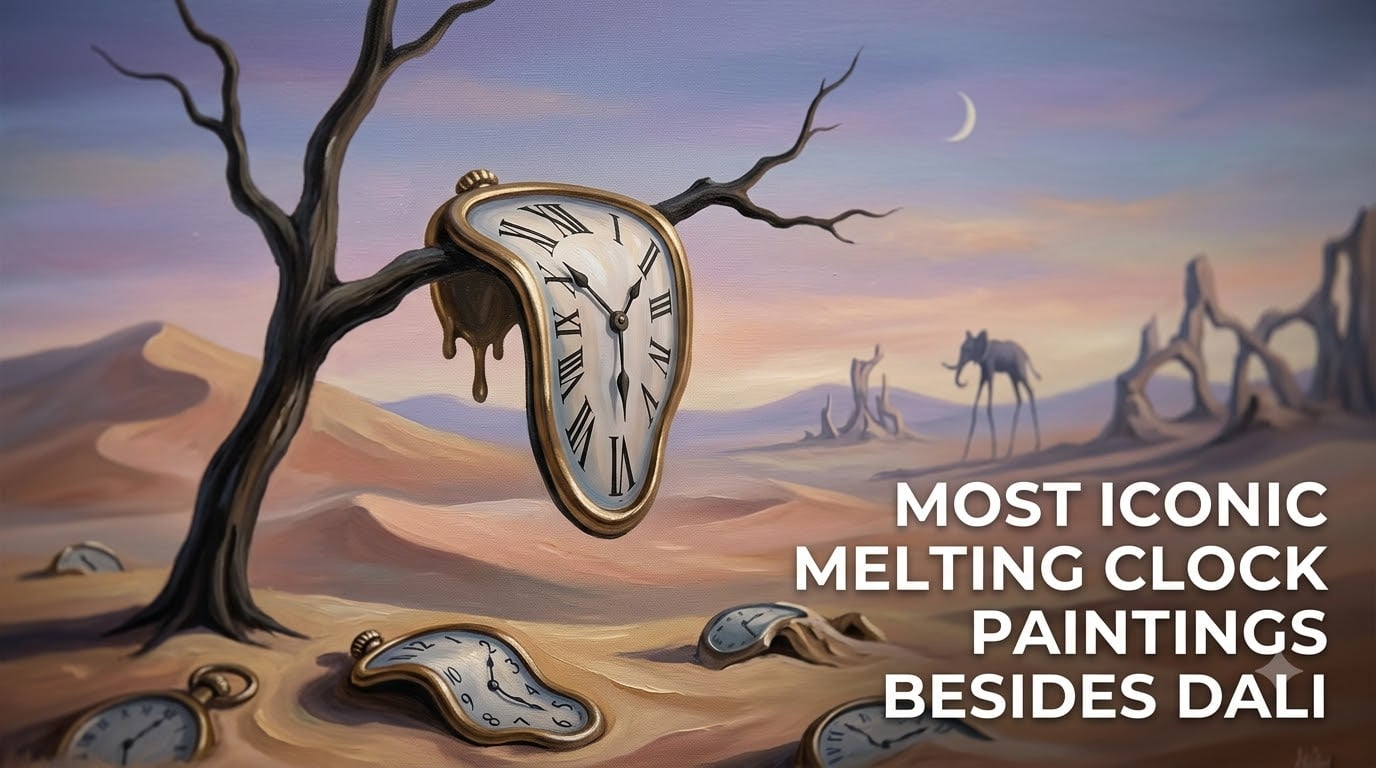
When people hear “melting clock painting,” one name immediately comes to mind: Salvador Dalí and his legendary The Persistence of Memory (1931). But here’s what most art lovers miss — Dalí wasn’t the only artist fascinated by time’s fluidity. Surrealists before, during, and after him explored melting, warping, and dripping clocks as a way to challenge our perception of reality.
In this guide, we’ll explore the most iconic melting clock paintings besides Dalí’s masterpiece. From Giorgio de Chirico’s metaphysical dreamscapes to contemporary artists pushing the motif into the 21st century, these works prove that the melting clock is far more than a one-painting wonder.
What is a melting clock painting? A melting clock painting is a surrealist or metaphysical artwork in which clocks, watches, or hourglasses appear soft, drooping, draped, or distorted — symbolizing the fluidity of time, memory, and the dream state. The motif was pioneered by Salvador Dalí in The Persistence of Memory (1931) and has since become the most recognizable visual symbol of Surrealism.
Table of Contents
Why Did Melting Clocks Become a Surrealist Symbol?
Before we explore specific paintings, it helps to understand why this image resonated so deeply with surrealists. Dalí himself offered conflicting explanations — once claiming he was inspired by melting Camembert cheese left on a table, another time referencing Einstein’s theory of relativity, which suggested time is not fixed.
The surrealist movement, founded by André Breton in 1924, drew heavily on Sigmund Freud’s theories of the unconscious mind. Dreams, repressed desires, and irrational juxtapositions were their raw material. A melting clock — a mechanical object that should be rigid and precise becoming soft and unreliable — perfectly captured this worldview.
Art historians also connect the motif to older traditions. The memento mori and vanitas still-life paintings of the 17th century used hourglasses, skulls, and extinguished candles to remind viewers of mortality. The melting clock is, in many ways, the surrealist evolution of that same impulse: time is an illusion, and it’s running out.
12 Most Iconic Melting Clock Paintings Besides Dalí’s Persistence of Memory
1. Salvador Dalí — The Disintegration of the Persistence of Memory (1954)
We’re starting with a Dalí painting — but it’s a different one. Twenty-three years after the original, Dalí revisited his melting clocks with a nuclear-age twist. The familiar landscape is now fragmented into rectangular blocks, with the soft watches suspended in mid-air over what appears to be a grid of water.
Painted during the atomic era, this work reflects Dalí’s obsession with nuclear physics and the idea that matter itself is disintegrating. The melting clocks persist, but everything around them is breaking apart. It’s housed at the Dalí Museum in St. Petersburg, Florida, alongside the original study sketches.
2. Giorgio de Chirico — The Melancholy of Departure (1914)
Giorgio de Chirico’s eerie townscapes predate Dalí’s melting clocks by nearly two decades. While de Chirico didn’t paint literal melting watches, his clocks and shadows are deliberately wrong — elongated, misplaced, frozen at impossible hours. The long shadows and empty piazzas create a dreamlike atmosphere that directly influenced the Surrealists.
De Chirico founded the pittura metafisica (metaphysical painting) movement, which Breton openly credited as a precursor to Surrealism. His clocks don’t melt — they haunt. This painting is in the Tate Modern, London.
3. Yves Tanguy — Indefinite Divisibility (1942)
Yves Tanguy’s paintings are populated by biomorphic, bone-like forms arranged in vast, empty landscapes. Indefinite Divisibility doesn’t feature a recognizable clock, but its organic shapes — drooping, stretching, dissolving — echo the same anxiety about time’s unreliability that Dalí explored.
Tanguy was self-taught and claimed he decided to become an artist after seeing a painting by de Chirico in a gallery window. His work influenced generations of surrealist painters exploring time and memory. This piece is at the Yale University Art Gallery.
4. Max Ernst — Ubu Imperator (1923)
Max Ernst’s towering, top-like figure appears to be spinning — or perhaps frozen mid-rotation. The title references Alfred Jarry’s absurdict play Ubu Roi, and the figure’s precarious balance suggests a world where the laws of physics (and time) are negotiable.
Ernst was a pioneer of frottage and grattage techniques, creating textures that made his surfaces feel almost tactile. While there’s no literal clock in this painting, the sense of temporal distortion — of a moment caught between movement and stillness — is pure melting-clock energy. It’s held at the Centre Pompidou in Paris.
5. René Magritte — Time Transfixed (1938)
Magritte takes a different approach: instead of melting, time is transfixed. A locomotive emerges from a fireplace, frozen in place, while a clock on the mantelpiece sits perfectly still. The title is a pun — “transfixed” means both “immobilized” and “pierced through.”
Magritte once said, “I have no interest in ‘melting clocks.’ I prefer the mystery of precise objects in impossible situations.” His version of temporal surrealism is cerebral rather than visceral. Time Transfixed is at the Art Institute of Chicago.
6. Leonora Carrington — The Inn of the Dawn Horse (Self-Portrait) (1939)
Leonora Carrington’s self-portrait is filled with symbolic objects, including a rocking horse that seems to exist outside normal time. Carrington, one of the last surviving original Surrealists, often depicted children’s toys and animals in states of temporal suspension — objects that should be in motion frozen or objects that should be still moving.
Carrington’s work has gained enormous recognition in recent years, particularly after her death in 2011. Her paintings are now in major museum collections worldwide, and she’s increasingly cited as one of the most important surrealist painters of the 20th century.
7. Remedios Varo — Celestial Pablum (1958)
Remedios Varo, a Spanish-Mexican surrealist, created Celestial Pablum as part of her mystical, science-infused body of work. The painting shows a woman feeding pablum (baby food) to the moon from a tower — a surreal act that collapses cosmic time into domestic time.
Varo’s work blends alchemy, astronomy, and feminine intuition. Reddit’s r/surrealism community frequently recommends her as “the most underappreciated surrealist,” and her paintings have seen a major resurgence in art-world attention. This piece is at the Museum of Modern Art in Mexico City.
8. Dorothea Tanning — Eine Kleine Nachtmusik (1943)
Dorothea Tanning’s painting features a young girl in a hallway where sunflowers seem to grow through the floor. The title, borrowed from Mozart, suggests a nocturnal serenade — but the scene is unsettling, with the sunflowers towering over the figure like creatures from a dream.
Tanning, who was married to Max Ernst, explored childhood, desire, and the uncanny throughout her seven-decade career. Her recent retrospective at Tate Modern brought her work to a new generation of viewers.
9. Kay Sage — I Saw Three Cities (1944)
Kay Sage’s architectural surrealism features towers, scaffolding, and impossible structures that seem to exist in a timeless void. I Saw Three Cities presents three cities in various states of construction or decay — time made visible through architecture rather than clocks.
Sage was one of the few American-born Surrealists and was married to fellow surrealist Yves Tanguy. Her work has been rediscovered in recent years, with major exhibitions at the Mint Museum and other institutions. Art forums note her as “essential viewing alongside Dalí and Tanguy.”
10. Vladimir Kush — Metamorphosis of Time (Contemporary)
Vladimir Kush, a Russian-American painter working today, is arguably the most prominent contemporary artist carrying forward the melting-clock tradition. His paintings transform everyday objects — watches, butterflies, ships — into dreamlike metamorphoses that feel directly descended from Dalí.
Kush’s work is widely available as prints and is a favorite among surrealism collectors. While art critics debate whether his style is homage or pastiche, there’s no denying his technical skill and his ability to make melting clocks feel fresh. His gallery in Maui, Hawaii, draws thousands of visitors annually.
11. Nobuya Hayashi — Time Keeper (Contemporary)
Nobuya Hayashi, a Japanese surrealist painter, creates intricate works where timepieces become organic, almost living entities. His Time Keeper series features clocks that sprout roots, grow branches, or dissolve into natural landscapes.
Hayashi represents the growing global influence of surrealism outside the traditional European and American centers. His work has been exhibited in Tokyo, Paris, and New York, and he’s frequently cited on surrealist forums as a modern artist worth watching.
12. Adam Caldwell — Surreal Clock Series (Contemporary)
Adam Caldwell, an American contemporary surrealist, has created a series of photorealistic paintings featuring melting and warped clocks in hyper-detailed environments. His work bridges classical technique with surrealist subject matter, creating images that feel both old and new.
Caldwell’s paintings have been exhibited in galleries across the United States, and his social media following has grown significantly as interest in contemporary surrealism increases.
Comparison Table: Melting Clock Paintings at a Glance
| Painting | Artist | Year | Medium | Current Location |
|---|---|---|---|---|
| The Disintegration of the Persistence of Memory | Salvador Dalí | 1954 | Oil on canvas | Dalí Museum, St. Petersburg, FL |
| The Melancholy of Departure | Giorgio de Chirico | 1914 | Oil on canvas | Tate Modern, London |
| Indefinite Divisibility | Yves Tanguy | 1942 | Oil on canvas | Yale University Art Gallery |
| Ubu Imperator | Max Ernst | 1923 | Oil on canvas | Centre Pompidou, Paris |
| Time Transfixed | René Magritte | 1938 | Oil on canvas | Art Institute of Chicago |
| The Inn of the Dawn Horse | Leonora Carrington | 1939 | Oil on canvas | Metropolitan Museum of Art, NYC |
| Celestial Pablum | Remedios Varo | 1958 | Oil on masonite | Museo de Arte Moderno, Mexico City |
| Eine Kleine Nachtmusik | Dorothea Tanning | 1943 | Oil on canvas | Tate Modern, London |
| I Saw Three Cities | Kay Sage | 1944 | Oil on canvas | Private collection |
| Metamorphosis of Time | Vladimir Kush | Contemporary | Oil on canvas | Kush Fine Art Gallery, Maui, HI |
| Time Keeper Series | Nobuya Hayashi | Contemporary | Oil on canvas | Various galleries |
| Surreal Clock Series | Adam Caldwell | Contemporary | Oil on canvas | Various US galleries |
Modern and Contemporary Melting Clock Art
While the classical Surrealists established the melting clock motif, contemporary artists have taken it in fascinating new directions. Vladimir Kush’s metamorphic paintings remain the most commercially successful, but the tradition is alive and well in galleries worldwide.
Japanese painter Nobuya Hayashi brings an Eastern sensibility to the melting clock, fusing it with natural imagery and Buddhist concepts of impermanence. His clocks don’t just melt — they grow, transform, and return to nature. Adam Caldwell’s photorealistic approach asks whether surrealism can exist in hyper-detailed realism.
The digital art world has also embraced the motif. Artists working in 3D rendering and AI-assisted creation are producing melting clock imagery that would have astonished Dalí — clocks that dissolve into pixels, melt into watercolor washes, or shatter into geometric fragments.
Where to See Melting Clock Paintings
If you want to experience these works in person, here’s a museum-by-museum guide:
United States: The Dalí Museum in St. Petersburg, Florida holds the largest collection of Dalí’s work outside Europe, including The Disintegration of the Persistence of Memory. The Art Institute of Chicago has Magritte’s Time Transfixed. The Metropolitan Museum of Art in New York displays Carrington’s The Inn of the Dawn Horse. Yale University Art Gallery in New Haven, Connecticut holds Tanguy’s Indefinite Divisibility.
Europe: The Tate Modern in London displays both de Chirico’s The Melancholy of Departure and Tanning’s Eine Kleine Nachtmusik. The Centre Pompidou in Paris holds Ernst’s Ubu Imperator. For the original Persistence of Memory, you’ll need to visit the Museum of Modern Art (MoMA) in New York — though it’s technically in the US collection, it’s one of the most visited paintings in the world.
Contemporary galleries: Vladimir Kush’s gallery in Maui, Hawaii is worth a visit if you’re in the area. For emerging contemporary surrealists, keep an eye on exhibitions at the Hirschl & Adler Gallery in New York and the Corey Helford Gallery in Los Angeles.
How to Recognize a Melting Clock Painting
Not sure if you’re looking at a melting clock painting? Here’s a quick visual checklist:
Look for these telltale signs:
- Soft watches: Clocks that droop over edges like fabric or cheese
- Dripping timepieces: Watches or clocks that appear to be melting downward
- Warped numbers: Clock faces where numerals stretch or dissolve
- Impossible placement: Clocks in strange locations — draped over trees, floating in air, resting on surreal landscapes
- Dreamlike landscapes: The clock exists in a barren, infinite, or impossible setting
- Organic mechanical objects: Timepieces that look alive, growing, or decaying
The key distinction from regular clock paintings: a melting clock painting distorts the clock itself. A traditional still life might show a beautiful clock; a melting clock painting makes the clock behave impossibly.
Frequently Asked Questions
Which artist is most famous for painting melting clocks?
Salvador Dalí is by far the most famous artist for melting clocks. His 1931 painting The Persistence of Memory, featuring soft watches draped over a barren landscape, became the defining image of Surrealism and one of the most recognized paintings in the world. It’s housed at the Museum of Modern Art in New York.
What does the melting clock symbolize in surrealism?
In surrealism, the melting clock symbolizes the fluidity and unreliability of time, the power of the unconscious mind, and the idea that mechanical precision is an illusion. It draws on older memento mori traditions (reminders of mortality) while expressing the surrealist fascination with dreams, Freudian psychology, and the irrational.
Where is the original Persistence of Memory painting?
The original Persistence of Memory by Salvador Dalí is at the Museum of Modern Art (MoMA) in New York City. It was donated anonymously in 1934 and has been one of the museum’s most popular works ever since. A companion piece, The Disintegration of the Persistence of Memory (1954), is at the Dalí Museum in St. Petersburg, Florida.
Why did Dalí paint melting clocks?
Dalí offered two explanations: he was inspired by watching Camembert cheese melt in the sun, and by Einstein’s theory of relativity, which suggested time is not fixed. Art historians believe the melting clocks also reflected Dalí’s interest in Freudian psychology — the soft watches represent the fluid, unreliable nature of dreams and the subconscious mind.
Who are artists similar to Salvador Dalí?
Artists similar to Dalí include René Magritte (Belgian surrealist known for witty, cerebral paintings), Max Ernst (German-French pioneer of frottage and collage), Yves Tanguy (French painter of biomorphic landscapes), Leonora Carrington (British-Mexican surrealist), Remedios Varo (Spanish-Mexican mystical surrealist), and contemporary painter Vladimir Kush, who works in a Dalí-adjacent style.
Are there modern artists who paint melting clocks?
Yes. Vladimir Kush is the most prominent contemporary artist working with melting clock imagery, creating metamorphic paintings that transform timepieces into natural forms. Japanese painter Nobuya Hayashi and American artist Adam Caldwell also explore the motif. The melting clock tradition continues in digital art and AI-assisted creation as well.
The Melting Clock Lives On
The melting clock painting is far more than a Salvador Dalí novelty. From de Chirico’s haunted piazzas to contemporary artists’ digital explorations, the motif has proven remarkably durable — adapting to new eras, new media, and new anxieties about time and mortality.
Whether you’re an art history student, a museum visitor planning your next trip, or simply someone who loves surrealism, these melting clock paintings besides Dalí’s masterpiece offer a rich, rewarding exploration of the surrealist imagination. Start with the Tate Modern or MoMA, and let time melt away.