
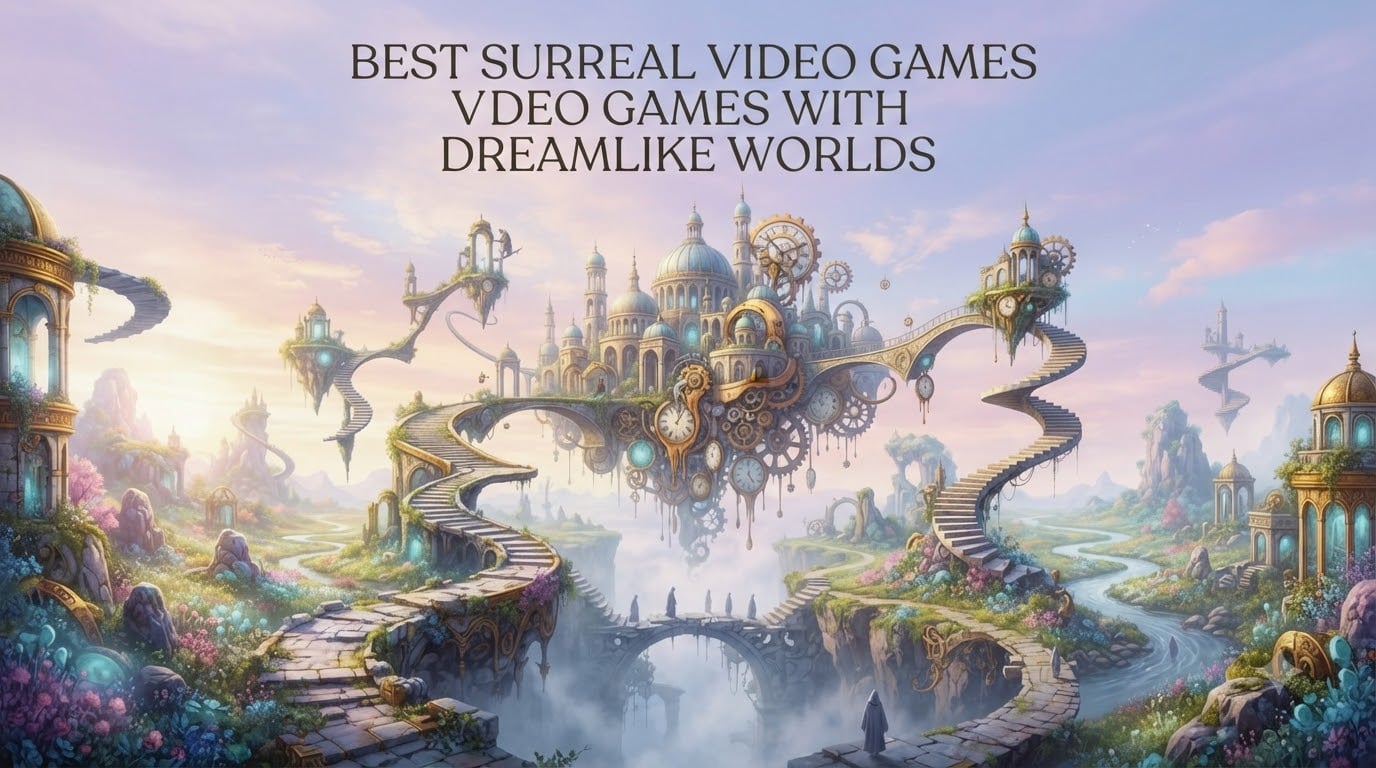
I remember the first time a game felt less like a product and more like a half-remembered dream. It was LSD: Dream Emulator on PlayStation, and nothing after it felt quite the same. That feeling is exactly what the best surreal video games with dreamlike worlds chase: a sense that the rules have quietly slipped, that the world is breathing on its own terms, and that meaning lives somewhere beneath the surface.
Surreal games are a small but stubborn corner of the medium. They refuse tidy explanations, they confuse as often as they delight, and they tend to divide players into camps of believers and skeptics. In this guide, I will walk you through what actually makes a game surreal, twelve standout titles that earn the label, the psychology behind why dreamlike worlds pull us back, and how to pick the right one for whatever mood you are in.
Table of Contents
What Makes a Video Game Surreal
A surreal video game is one that borrows the visual language of dreams: impossible architecture, shifting identities, and logic that refuses to behave. It uses symbolism over literal storytelling, atmosphere over exposition, and discomfort over closure. The best surreal video games with dreamlike worlds feel less like products and more like artifacts someone dreamed and somehow shipped.
Three elements tend to separate surreal from simply weird. First, visual rupture. Colors clash with no warning. A face morphs between cuts. Gravity reverses inside a hallway that should not exist. Second, narrative dislocation. A character knows things they should not. A setting contradicts its own history. Third, emotional residue. You finish the game, close the console, and a single image stays with you for days. That lingering image is the signature of a true surrealist game.
Surrealism in games draws directly from the 1920s art movement founded by Andre Breton. Where painting and film used juxtaposition and the uncanny to crack open the rational mind, games add something the original surrealists could not: agency. You do not just watch the dream. You walk through it, pick up objects in it, and sometimes break it. That interactivity is why video games have become one of the most fertile grounds for surrealist work in any medium.
The Best Surreal Video Games With Dreamlike Worlds
What follows is our team’s list of twelve games that genuinely earn the surreal label. Each one uses dreamlike imagery, broken logic, or unsettling atmosphere in a way that stays with you. We mixed classics with recent releases so you have options whether you own a modern PC or an older console gathering dust.
LSD: Dream Emulator
Developed by Osamu Sato and released in 1998 for the original PlayStation, LSD: Dream Emulator is the founding text of surreal video games. You wander ten linked environments pulled from a Japanese user’s dream journal, shifting between idyllic meadows and rotting, fleshy interiors. There is no score, no goal, only a texture counter that creeps toward a final, locked door. It is the most direct translation of dream logic into game form ever made.
Psychonauts 2
Double Fine’s 2021 sequel dives directly into people’s minds. Each level is a different character’s subconscious rendered as a theme park, a grocery store gone mad, or a paranoid library. The surrealism here is bright and acrobatic rather than disturbing. You jump inside thoughts, rearrange mental furniture, and fight the inner critics that have grown teeth. It is the rare surreal game that feels joyful rather than unsettling.
Pathologic 2
Ice-Pick Lodge’s 2019 survival horror RPG drops you into a plague-ravaged town where time loops, characters speak in riddles, and the rules of the world shift between days. Bodies speak after death. Children run a bone orchestra. The surrealism is grounded in Russian folklore and philosophy rather than dreamscape imagery, but the constant sense that reality is negotiating with you makes it one of the most disorienting games ever released.
Disco Elysium
ZA/UM’s 2019 detective RPG is surreal through pure language. Your detective wakes up in a trashed hotel room with no memory, no skills, and a chorus of competing voices in his head arguing about everything from politics to electrochemistry. The town of Martinaise is realistic on the surface, but every conversation branches into philosophy, dread, and strange poetry. It is the rare game where reading is the core mechanic and every paragraph is a dream fragment.
Superliminal
Pillow Castle’s 2019 puzzle game is built on a single surreal premise: objects you pick up change size based on where you hold them. A chess piece becomes a throne. A door becomes a hallway. The game teaches you to abandon assumptions about perspective and scale, and the further you go, the more the world itself starts questioning your sanity. It is short, clean, and finishes with one of the best surreal twists of the last decade.
Hylics
Mason Lindroth’s 2015 RPG looks like a claymation fever dream and plays like one too. Characters are blobs of color with mouths. Text is rendered in an alien alphabet. Combat is rhythmic and hypnotic. Released in 2020 as Hylics 2, the sequel expands the world into a soft, fleshy cosmology where you paddle through strange seas and talk to ghosts. It is the purest example of a small indie surreal game with a devoted following.
Darkwood
Acid Wizard Studio’s 2017 top-down survival horror is set in a Polish forest that fights back. By day you scavenge abandoned huts. By night you barricade doors and watch surreal things shuffle past your window. The forest is procedural but thematically rigid: half-buried houses, skinless cattle, and a single, unforgettable moral choice near the end. It is surrealist horror played at the pace of dread rather than jump scares.
Yume Nikki
Kikiyama’s 2004 free RPG maker game is the quiet ancestor of the dream diary genre. You play a girl named Madotsuki who never leaves her room, but a dream catcher on the wall opens a portal to dozens of linked dream worlds. Each world is a single, locked image: a snowy parking lot, a face with a traffic cone for a nose, a neon maze. There is no combat and almost no dialogue. It is the most patient surreal game ever made.
The Stanley Parable
Galactic Cafe’s 2013 walking simulator is a surrealist game about free will. A narrator describes everything you do, gets confused when you disobey, and eventually turns on you. The game’s branching paths collapse into a meditation on choice, obedience, and what games actually want from a player. It is funny, then unsettling, then quietly devastating. Few surreal games have reached the cultural reach of The Stanley Parable.
Outer Wilds
Mobius Digital’s 2019 space exploration game is surreal through scale and time. You pilot a tiny ship around a clockwork solar system that resets every 22 minutes. Each planet is a single, impossible idea: a world that is cracking apart, a planet covered in anglerfish fossils, a twin that has been crushed into a ball of ash by its own gravity. The time loop is the dream. Every reset is a waking.
Inscryption
Daniel Mullins’ 2021 card game wears many masks. It begins as a cabin horror deckbuilder, then becomes a meta-narrative about a man in a 1990s computer lab, then becomes something stranger still. Each layer peels back to reveal another puzzle box, and the final act moves into a surrealist gallery of ideas about games, creators, and players. It is the rare surreal game that respects you enough to keep moving the goalposts.
NieR: Automata
PlatinumGames’ 2017 action RPG, directed by Yoko Taro, is surrealist through absence. Androids fight machine lifeforms on a ruined earth, but the categories keep dissolving. Enemies beg for their lives. Companions go mad between routes. The game asks you to sacrifice your save data for a stranger, and the question gets harder every time it is asked. NieR: Automata is surreal because it pulls existential dread out of the player rather than the world.
The Psychology Behind Dreamlike Games
Surreal games stay with us because they mirror how the brain actually processes memory, fear, and identity. Dreams are the brain’s overnight filing system, sorting emotions and discarding what is not useful. Surreal game design borrows that filing system, layering symbols and contradictions that the conscious mind cannot quite file away. Players leave these games with a strange emotional residue that mainstream games rarely produce.
Players on r/patientgamers and ResetEra have long described surreal games as therapeutic in a way that traditional games cannot match. Someone processing grief can find a strange comfort in Disco Elysium’s broken detective. Someone dealing with dissociation can find Yume Nikki’s stillness genuinely restful. The dreamlike quality gives players permission to feel disoriented without needing to perform competence, which is a rare gift in any medium.
Visual uniqueness is often the primary draw, but the deeper hook is agency inside the strange. We cannot change our dreams, but we can walk these worlds. We can pick up objects, open doors, and make choices that the dream never asked for. That controlled surrender is what makes surreal games such a long-lasting genre. They give us the dream with the steering wheel still attached.
Choosing the Right Surreal Game for Your Mood
Not every surreal game fits every moment. I have watched friends bounce hard off Pathologic 2 when they wanted relaxation, and I have bounced off Hylics when I wanted something with a sharper edge. Matching the game to your current state matters more than matching it to your favorite genre.
For dark and unsettling moods, Pathologic 2, Darkwood, and NieR: Automata deliver existential dread without cheap horror tricks. The surrealism here is philosophical and heavy. Play these when you want to feel the weight of an idea.
For whimsical and playful moods, Psychonauts 2, Superliminal, and Hylics 2 offer surrealism that leans bright. The worlds are strange, but they invite laughter. These are the best surreal video games with dreamlike worlds for a weekend afternoon when you want delight more than dread.
For meditative and philosophical moods, Outer Wilds, Disco Elysium, and The Stanley Parable reward slow attention. The surrealism here is quiet, almost literary. They work best when you can give them uninterrupted hours and a notebook for the questions they will leave behind.
The Evolution of Surreal Game Design
Surreal games have existed almost as long as games themselves, though they only became a recognized genre in the last decade. LSD: Dream Emulator in 1998 and Yume Nikki in 2004 laid the template, but they lived in obscurity. The 2010s indie boom changed that, letting small teams ship strange, personal games that major publishers would never greenlight.
By the late 2010s, mainstream recognition arrived. Disco Elysium and Outer Wilds won major awards. Inscryption became a breakout hit on Twitch. Psychonauts 2, a sequel to a cult classic, sold millions. The surrealist indie game stopped being a curiosity and started being a category players actively hunt for.
Looking ahead to the rest of 2026 and beyond, the genre is healthy. Tools like RPG Maker, Godot, and Unity have lowered the barrier to entry. Younger developers grew up playing surreal games and now build their own. The dreamlike worlds of the next decade will be stranger, more personal, and more numerous than what came before. The genre that started as an underground quirk is now a permanent wing of the medium.
Frequently Asked Questions
What are some surreal video games?
Surreal video games include LSD: Dream Emulator, Psychonauts 2, Pathologic 2, Disco Elysium, Superliminal, Hylics, Darkwood, Yume Nikki, The Stanley Parable, Outer Wilds, Inscryption, and NieR: Automata. Each uses dreamlike visuals, broken logic, or unsettling atmosphere to create experiences that feel more like dreams than traditional games.
What are some good dream-based games?
Good dream-based games include Yume Nikki, a quiet RPG Maker exploration of dream worlds; LSD: Dream Emulator, which adapts a real Japanese dream journal into playable form; and Psychonauts 2, which sends players through character minds rendered as theme parks and grocery stores. Outer Wilds and Inscryption also use dreamlike structure through time loops and nested realities.
Which video games have the most beautiful worlds?
The most beautiful dreamlike worlds in surreal games include the shifting planets of Outer Wilds, the soft claymation cosmos of Hylics 2, the psychic landscapes of Psychonauts 2, and the broken town of Martinaise in Disco Elysium. Each combines strong art direction with rules that quietly slip, which is what makes them feel like dreams rather than screenshots.
What makes a game surreal versus just weird?
A surreal game uses visual rupture, narrative dislocation, and emotional residue to mirror how dreams actually feel. A weird game simply breaks rules for effect. Surreal design borrows from the 1920s art movement and uses symbolism and atmosphere to leave a single image with you for days after you stop playing.
Final Thoughts on Surreal Games Worth Your Time
Surreal games are not for everyone, and that is the point. They are built for the players who finish a mainstream blockbuster and feel a little hungry for something that does not behave. The best surreal video games with dreamlike worlds give that hunger a place to land.
If you are new to the genre, start with Superliminal or The Stanley Parable. Both are short, accessible, and will tell you quickly whether the dreamlike approach clicks for you. If it does, the rest of this list is waiting. Pick a mood, pick a game, and let it break the rules a little. The dream will be there when you wake up.