
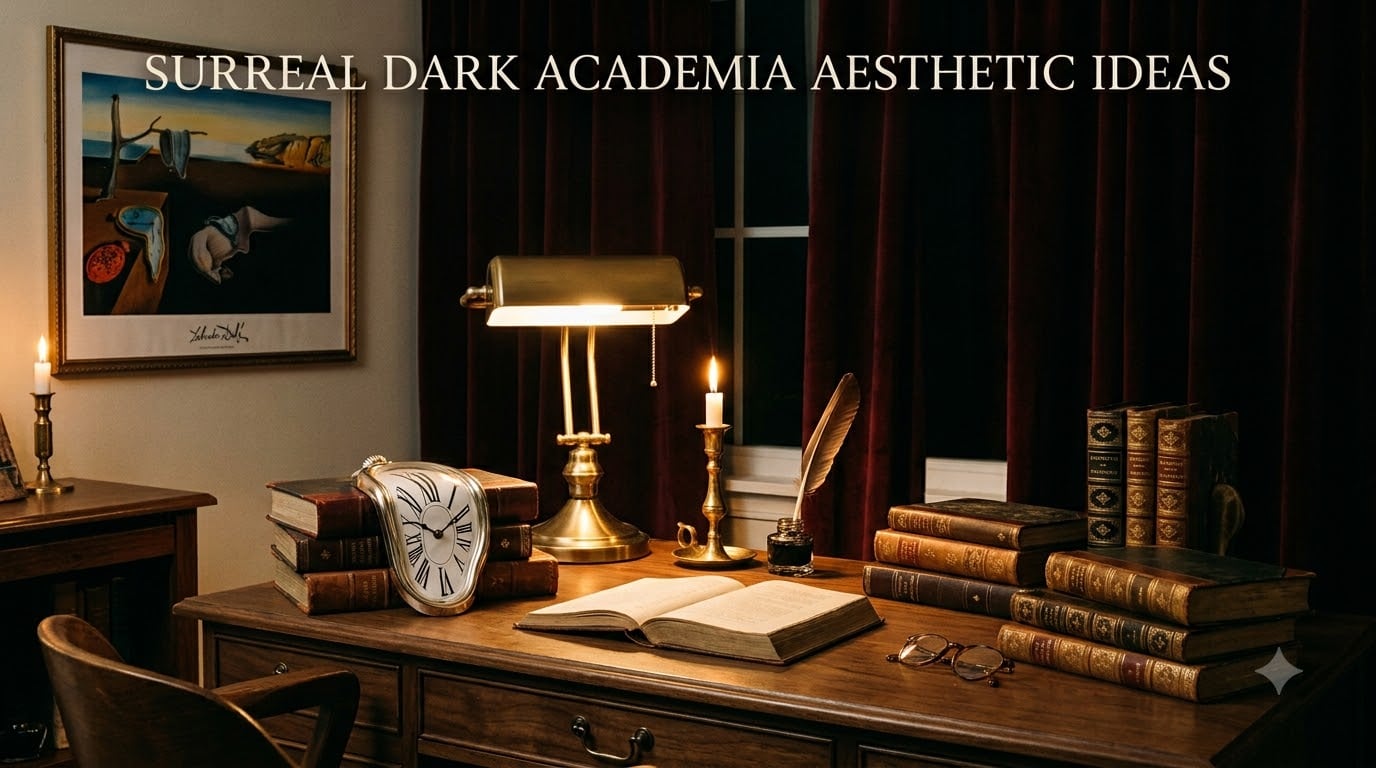
If you’ve ever wanted a room that feels like a candle-lit Oxford library had a dream about a Dalí painting, these surreal dark academia aesthetic ideas are for you. Surreal dark academia is the scholarly, tweed-and-oxblood world of dark academia crossed with the oneiric, uncanny imagery of Surrealism – melting clocks, floating books, optical illusions, and dreamlike backdrops. You keep the moody, lived-in base; you add surrealist visual cues until the room feels a little haunted by a painting.
I’ve spent the last few months testing this look in my own study, and the sweet spot is restraint. One surrealist piece in a curated dark-academia room reads as art. Five in a small room reads as a haunted escape room. Below is the full playbook: origins, palette, room-by-room ideas, art canon, wardrobe, DIY, and renter-friendly tips – all built around the surreal dark academia aesthetic ideas people actually search for in 2026.
Table of Contents
What Is Surreal Dark Academia?
Surreal dark academia is an aesthetic that fuses the scholarly, candlelit mood of dark academia – old libraries, tweed, oxblood, aged wood, leather-bound books, Donna Tartt novels – with the dreamlike, oneiric imagery of Surrealism, including melting clocks, floating books, optical illusions, and Dalí-meets-Dead-Poets-Society interiors. It keeps the warm, lived-in scholarly base and adds surrealist visual cues – distorted mirrors, vintage scientific illustrations, Dalí prints, melting-clock props, apothecary jars – until the room reads intellectual and slightly uncanny.
It’s not the same as classic dark academia, goth, whimsigoth, or dreamcore. Each shares a mood but a different source material. Here’s the quick map before we go deeper:
- Classic dark academia – tweed, ivy league, Donna Tartt, candlelit study. Sober and literary.
- Surreal dark academia – same scholarly base, plus Surrealist visual cues. Feels like the library had a dream.
- Goth – black clothing, Victorian mourning, romanticism, music scenes. Less scholarly, more subcultural.
- Whimsigoth – witchy, mystical, celestial. Stars, moons, crystals, deep purple.
- Dreamcore – liminal spaces, empty hallways, fuzzy VHS glow. Less objects, more atmosphere.
If a room feels like you could study a forgotten language in it, that’s surreal dark academia. If it feels like a coven, that’s whimsigoth. If it feels like a hotel hallway at 3 a.m., that’s dreamcore. Reddit’s r/DarkAcademia consistently lands on this distinction – surrealist accents are how the look stops feeling templated and starts feeling personal.
Origins and Influences
Surreal dark academia is a relatively young mash-up, but both halves have deep roots.
The Surrealist half begins in 1920s Paris with André Breton’s manifesto and the painters who exploded everyday objects into dream imagery: Salvador Dalí, René Magritte, Max Ernst, Giorgio de Chirico, Leonora Carrington. They were interested in the unconscious, dreams, optical tricks, and uncanny juxtapositions – a melting clock draped over a branch, a bowler-hatted man with an apple for a face, an empty piazza where the shadows don’t line up.
The dark academia half is a 2010s Tumblr aesthetic that drew on Donna Tartt’s The Secret History, Dead Poets Society, prep-school uniforms, Oxford and Cambridge, and the visual language of old university libraries. It went mainstream on TikTok, then Pinterest, then into dorm rooms and study nooks.
The fusion happened because the two share a mood. Both love shadows, weight, texture, age, and the romance of hidden knowledge. The aesthetic just asks: what if the library was haunted by a painting? What if the books floated? From there you get surreal dark academia aesthetic ideas like melting-clock props, painted portal backdrops, and Dalí prints leaning against a brass candlestick.
Classic vs. Surreal Dark Academia
The fastest way to feel the difference is to line the two side by side. This comparison also wins the table-snippet real estate in search.
| Element | Classic dark academia | Surreal dark academia |
|---|---|---|
| Palette | Oxblood, forest green, charcoal, navy, parchment | Same base + bruised purple, muted lavender, candle-flame gold |
| Core decor | Leather-bound books, brass lamp, antique globe, tweed throw | Same anchors plus apothecary jars, anatomical prints, optical-illusion objects |
| Wall art | Old oil portraits, framed antique maps, Greek busts | Same plus Dalí, Magritte, Ernst, de Chirico, Carrington prints |
| Lighting | Banker’s lamp, brass candlesticks, warm bulbs | Same plus LED candles in odd holders, fairy-light constellations |
| Surrealist cue | None – the look is sober and literary | One or two dreamlike accents: melting clock, floating books, distorted mirror |
| Mood | Scholarly, collected, melancholic | Scholarly and slightly uncanny, like a library dreaming |
The rule of thumb Reddit and Pinterest readers keep repeating: if you stripped out the surrealist accents, the room should still read dark academia. That’s how you know the surreal layer is a twist, not a costume.
Core Visual Pillars
Every solid dark academia room – surreal or not – rests on the same five pillars. Get these right first, then layer the surrealist touches.
Palette
Lean into deep, scholarly tones: oxblood, forest green, charcoal, ink blue, parchment, walnut brown. These read old-world, weighty, and library-like against natural wood. Surreal dark academia warms the palette up with bruised purple, muted lavender, and candle-flame gold, which I’ll cover in the color section below.
Books as primary decor
Books do the heaviest lifting. Real books, color-coordinated or stacked horizontally, on every horizontal surface. Fill shelves with books you actually read – r/DarkAcademia readers push back hard against decorative book boxes. A single antique hardback beats a stack of color-matched blank spines every time.
Brass and warm metals
Brass is the metal of the look. Banker’s lamps with green glass shades, brass candlesticks, brass picture lights, brass-bound bookends, an old brass microscope. Even one warm-metal piece anchors a corner.
Candlelight
Candlelight – real or LED – is non-negotiable. Cluster brass candlesticks at different heights, add an LED taper if you rent or live in a dorm, and let warm 2700K bulbs do the rest. The flicker is the whole point.
Aged wood and leather
Walnut, mahogany, oak – and leather chairs, leather satchels, leather-bound sketchbooks. Anything that patinas with use. Thrift stores and estate sales are where most of us find these; I’ll cover that in the DIY section.
Surrealist Signature Touches
Once the dark-academia base is solid, you add surrealist touches – sparingly. These are the visual cues that read “dream” without going kitsch.
- Melting clock prop – drape a clock face over a stack of books, a branch, or a candlestick. The most direct Dalí reference.
- Floating book illusion – mount books to clear fishing line so they hover at different heights above a desk or reading nook.
- Distorted mirror – a curved or funhouse mirror in a heavy vintage frame turns a corner into an art installation.
- Apothecary jars with odd contents – dried botanicals, anatomical models, fake specimens, old ink bottles. r/DarkAcademia loves these.
- Vintage scientific illustrations – botanical plates, anatomical drawings, astronomy charts. Frame them in dark wood.
- Painted portal backdrop – a faux archway, a painted window opening onto a courtyard, or a trompe-l’oeil bookshelf.
- Eye motif – a single framed eye, a Magritte bowler hat print, or a small sculpture. One eye per room.
- Brass orrery or astrolabe – a working astronomical model that looks like alchemy equipment.
The mistake people make is overdoing it. One or two surrealist anchors per room reads as curated. Five starts to feel like an escape room. The whole aesthetic collapses if you stop being able to read the room as a study first.
Surrealist Color Swaps
The surrealist layer mostly shows up in color shifts, not new objects. If you keep your dark-academia furniture and just nudge the palette, you can transform the entire mood.
- Bruise purple – replaces charcoal as the dominant dark. Adds an eerie, painterly quality.
- Muted lavender – softens oxblood into something dreamier. Works on velvet curtains or a single painted wall.
- Candle-flame gold – replaces brass. Reads warmer and more oneiric, especially in low light.
- Faded teal – sits next to oxblood like a Magritte sky. Use on a single throw or lampshade.
- Bone white and parchment – for sculptural objects and paper. The classic de Chirico plaza palette.
Forum users consistently say the palette swap is the cheapest way to get the surreal look. You don’t need new furniture – just swap a pillow, a curtain, a lampshade, and the room shifts.
Room-by-Room Surreal Dark Academia Ideas
These are the surreal dark academia aesthetic ideas that consistently test well in real rooms. Each one starts from a working dark-academia setup and adds a single surrealist twist.
- Study nook with floating books – brass banker’s lamp, walnut writing desk, leather chair. Add three hardbacks hanging on clear fishing line at staggered heights above the desk. One Dalí print above the chair.
- Reading corner with melting-clock vignette – tweed armchair, persian rug, brass floor lamp. Drape a working clock face over the arm of the chair or the spine of an open book on a side table.
- Bedroom with painted portal – oxblood or bruise-purple wall, velvet curtains, antique writing desk. Paint a trompe-l’oeil archway on one wall – a doorway opening onto a foggy courtyard. Etsy sells peel-and-stick versions.
- Living room with distorted mirror – leather club chairs, walnut bookshelves, Persian rug. A single funhouse mirror in a heavy vintage frame above the mantel flips the whole room.
- Dining room with apothecary still life – dark wood table, brass candelabra, parchment runner. Cluster apothecary jars of dried botanicals, anatomical models, and oddities down the table center.
- Bathroom with vintage scientific plates – clawfoot tub if you have one, deep greens and charcoals, brass fixtures. Frame a series of botanical or anatomical plates in dark wood above the towel rack.
- Hallway with painted windows – long dark corridor. Paint two or three trompe-l’oeil windows opening onto fog, stars, or a de Chirico plaza. Free downloadable templates exist online.
- Entryway with eye motif – dark console table, brass mirror, a single framed eye, a folded pair of kid gloves, an antique key in a dish.
The unifying principle: each room needs one focal surrealist piece and the rest of the room reads dark academia. That’s the recipe.
Surrealist Art Canon to Display
If you’re going to hang surrealist art – and you should – here are the five artists whose work most reliably pairs with dark academia rooms. Each is widely available as a print.
- Salvador Dalí – The Persistence of Memory (1931) is the obvious anchor. For something quieter, Sleep (1937) works in a bedroom. Pair with a melting-clock prop.
- René Magritte – The Son of Man (1964) for a study, The Human Condition for a reading nook. Bowler hats, apples, bow ties. Reads scholarly and uncanny.
- Max Ernst – The Elephant Celebes (1921) and the Europe After the Rain series. Forged, dreamlike textures that match aged-paper walls.
- Giorgio de Chirico – Mystery and Melancholy of a Street (1914), The Soothsayer’s Recompense. The deep plazas and long shadows are pure dark-academia material.
- Leonora Carrington – for the surrealist room with a witchier edge. Self-Portrait (Inn of the Dawn Horse), the Jauche de Lune works. Pairs with whimsigoth accents.
Aesthetikon is the only competitor that even names these artists, and it does so in passing. Most other guides never connect Dalí or Magritte to dark academia decor. That’s the gap this section fills.
Wardrobe Notes
The wardrobe follows the same logic as the room: classic dark-academia base, one or two surrealist accents.
The base is what you’d expect: tweed blazers, oxford shirts, plaid trousers, oxblood knits, leather satchels, lace blouses, wool overcoats, dark turtlenecks, penny loafers or oxfords. Stick to wool, leather, cotton, and linen. Avoid anything that screams logo.
The surrealist accents are small but powerful:
- Anatomical jewelry – a small brass heart pendant, an anatomical heart brooch, a brass key on a velvet ribbon.
- Eye motif – a single enamel eye pin, a Magritte-inspired bowler hat for a costume moment, or a printed silk scarf with surrealist imagery.
- Melting-print scarves or tees – one Dalí-printed silk scarf over an oxford shirt reads curated. Five reads costume.
- Unusual gloves – long leather gloves, lace gloves, or fingerless gloves in oxblood or charcoal.
- Antique-feel rings – a signet ring, a brass claw ring, an antique locket.
The genius of surrealist wardrobe accents is that they scale. You can do the whole look with one piece of jewelry and a good blazer, which keeps it wearable for class, the office, or a gallery opening.
DIY Surrealist Touches
You don’t need to buy surreal dark academia – most of the best pieces can be made in a weekend. These are the projects forum readers keep recommending.
Melting-clock prop
Buy a cheap wall clock, remove the mechanism, and drape the clock face over a stack of vintage hardbacks or a brass candlestick. Hot-glue the edges if you want it to hold a shape. Total cost is under fifteen dollars and it reads as a Dalí installation.
Floating-book illusion
Mount three to five hardbacks on clear fishing line from a ceiling hook above a desk or reading nook. Stagger the heights, let one book hang slightly open. Reads as magic from below.
Painted portal backdrop
Use a large canvas, a thrifted frame, or even a removable wallpaper panel. Paint an arched doorway opening onto a foggy courtyard, a starry sky, or a de Chirico plaza. Free templates exist on Etsy and Pinterest.
Distorted mirror DIY
Heat a cheap framed mirror with a heat gun (carefully, outdoors, with a respirator) until the glass curves slightly. Re-hang in a heavy vintage frame. This is one project to take slowly – hot glass is unforgiving.
Apothecary still life
Cluster thrifted glass jars on a tray. Fill with dried botanicals, fake anatomical models (Etsy is full of them), old keys, seashells, and brass weights. Label the jars with parchment tags tied in twine.
Renter and Dorm-Friendly Tips
The most common pain point on r/DarkAcademia and r/HomeDecorating is that renters and dorm-dwellers can’t paint, can’t drill, and can’t safely burn candles. Here’s how to get the look anyway.
- Skip paint, use peel-and-stick wallpaper – oxblood, deep green, and faux-aged-paper patterns all exist as renter-safe wallpaper. One accent wall is enough.
- LED candles everywhere – the modern LED taper with a flicker mode reads identical to real candlelight on camera and in person. Safe in dorms.
- Command strips for everything – hanging art, leaning frames, mounting ledges. No holes, no damage.
- Thrift and estate-sale hunt – r/DarkAcademia users consistently find their best pieces at thrift stores and estate sales, not big-box retailers.
- Print surrealist art at home or via Etsy – high-resolution public-domain Dalí, Magritte, and Ernst prints are downloadable for free. Etsy has curated sets from five to thirty dollars.
- Real books borrowed from the library – stack them horizontally as decor. You read them, you return them, your shelf stays full.
The big insight from forum threads: the aesthetic is about texture and age, not new purchases. Aged books, thrifted brass, a worn leather chair beat brand-new “dark academia” furniture every time.
Photography and Prompt Ideas
Surreal dark academia is one of the most photogenic aesthetics right now – which is why surreal dark academia photo prompts are everywhere on Pinterest and TikTok. A few I keep coming back to:
- The reading alchemist – a single figure at a candlelit desk, books floating on fishing line above, brass instruments catching the warm light.
- The library corridor – long dark hallway, painted trompe-l’oeil windows, single figure in a tweed coat walking away from camera.
- The melting study – a clock face draped over an open book, a candle guttering beside it, soft warm light.
- The Magritte portrait – figure in a bowler hat, apple or book obscuring the face, oxblood velvet backdrop.
- The still-life oddity – apothecary jars of dried flowers and anatomical models, lit from one side, deep shadow.
- The portal door – figure stepping through a painted archway into a foggy courtyard, brass key in hand.
For outfits, pair the look with a tweed blazer, oxblood knit, dark trousers, lace gloves, and one surrealist accent – a printed scarf or an eye pin. The contrast between the sober base and the dreamlike setting is what makes the image.
Frequently Asked Questions
What is surreal dark academia?
Surreal dark academia is an aesthetic that combines the scholarly, candlelit mood of dark academia – old libraries, tweed, oxblood, aged wood, leather-bound books – with the dreamlike imagery of Surrealism like melting clocks, floating books, optical illusions, and Dalí-meets-Dead-Poets-Society interiors. The room reads intellectual and slightly uncanny.
What is the dark academia aesthetic?
Dark academia is a romantic, scholarly aesthetic built around old libraries, tweed and oxblood palettes, leather-bound books, brass lamps, candlelight, and references to Donna Tartt, Dead Poets Society, and the visual culture of Oxford and Cambridge. It feels lived-in, literary, and melancholic.
How do I make a room look dark academia with surrealist touches?
Start with the five dark-academia pillars: a deep oxblood-and-forest-green palette, real books, brass and warm metals, candlelight, and aged wood and leather. Then add one or two surrealist anchors per room such as a melting-clock prop, floating books on clear line, a distorted mirror, a Dalí or Magritte print, or apothecary jars with odd contents. Keep surrealist accents sparse so the room still reads as a study first.
What colors are dark academia?
Classic dark academia uses oxblood, forest green, charcoal, ink blue, parchment, and walnut brown. Surreal dark academia keeps that base and adds bruised purple, muted lavender, candle-flame gold, and faded teal to give the room a dreamier, painterly quality.
What aesthetic is similar to dark academia?
Closely related aesthetics include light academia (same scholarly base in cream and beige), whimsigoth (witchy, mystical, celestial), dreamcore (liminal, empty, VHS-lit spaces), classic goth (Victorian mourning, subcultural), and surreal dark academia (dark academia plus Surrealist visual cues like melting clocks and Dalí prints).
Is dark academia expensive?
It does not have to be. Thrift stores, estate sales, used bookshops, and library-borrowed books do most of the heavy lifting. LED candles, peel-and-stick wallpaper, and printable surrealist art prints keep the cost low. Most readers on r/DarkAcademia build the look for a few hundred dollars rather than thousands.
Can I do dark academia in a dorm or rental?
Yes. Use peel-and-stick wallpaper for an accent wall, Command strips for hanging art and ledges, LED tapers for candlelight, thrifted brass and books, and printable surrealist art prints. None of this requires drilling, painting, or open flame, and the room still reads fully dark academia with a surrealist edge.
Would Harry Potter be considered dark academia?
Hogwarts overlaps heavily with dark academia: candlelit stone corridors, leather-bound textbooks, ivy-covered architecture, scholarly uniforms, candlelit feasts. Hogwarts leans more whimsical and magical than dark academia, but it shares the moody, scholarly, old-library visual language. Adding Surrealist accents to a Hogwarts-inspired room is a natural next step into surreal dark academia.
Conclusion
Surreal dark academia aesthetic ideas work because the two halves of the aesthetic already share a mood: shadows, age, weight, and the romance of hidden knowledge. The dark-academia side gives you the warm, lived-in scholarly base – oxblood, brass, tweed, candlelight, leather, real books. The Surrealist side gives you the visual twist – melting clocks, floating books, distorted mirrors, painted portals, Dalí and Magritte prints, apothecary jars of oddities. Keep the base, add one or two surrealist anchors per room, and the result reads as a private library that happened to dream.
The next step is yours. Pick one of the room ideas above, pick one surrealist anchor, and build from there. Start with the palette swap if you want the cheapest, fastest shift toward the surreal side. Add a single Dalí or Magritte print if you want the strongest visual upgrade. Build the floating-book illusion if you want the most photographic moment. Whatever you start with, the look rewards restraint – one surrealist piece in a curated dark-academia room always beats five surrealist pieces in a cluttered one.
Save this page as a mood-board prompt, screenshot the room ideas you want to try first, and start small. The library will dream itself into shape.