
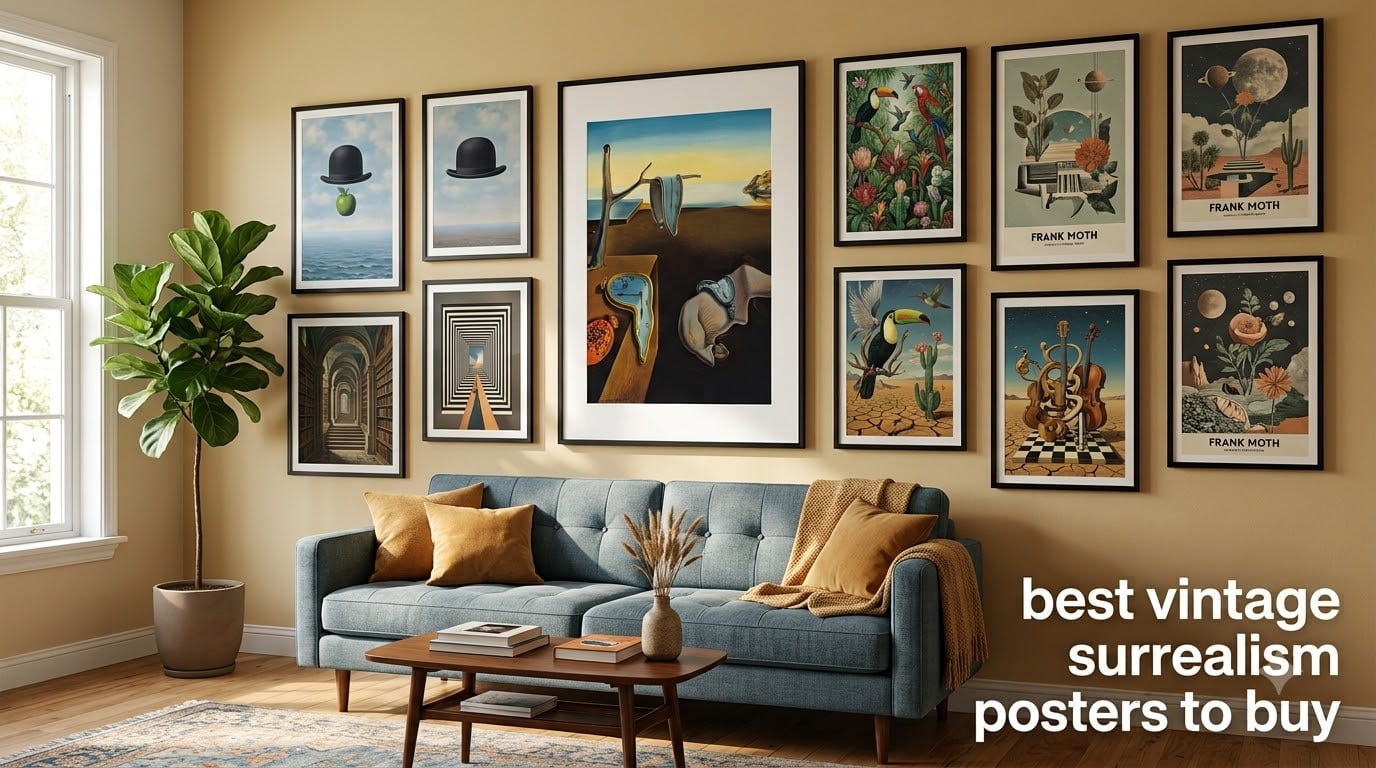
Looking for the best vintage surrealism posters to buy in 2026? I spent weeks combing through Etsy, eBay, specialist dealers, and museum print shops to put together a curated shortlist that actually delivers on that word “vintage” — without resorting to fuzzy modern knockoffs. Whether you want a museum-grade Dalí lithograph, an affordable Magritte reproduction for a gallery wall, or a contemporary Frank Moth print that feels period-authentic, this guide covers what to look for, where to buy, and how to avoid the reprints pretending to be originals.
Surrealism exploded out of 1920s Paris and reshaped how we depict the subconscious. Today, the movement’s dreamlike imagery — melting clocks, floating apples, bowler-hatted men, impossible staircases — anchors some of the most collected wall art on the planet. I’ll show you which posters stand the test of time, how to read seller listings, and how to spend smart at any budget.
Table of Contents
What Is a Vintage Surrealism Poster?
A vintage surrealism poster is a printed work of art — either a genuine period original or a faithful reproduction — depicting imagery from the surrealist movement that began in 1920s Paris and explored dreams, the subconscious, and the irrational through dreamlike, often unsettling imagery.
The word “vintage” does real work in this category. In the poster trade, “vintage” usually means a print made during or close to the artist’s lifetime — typically pre-1980 for canonical surrealists, or pre-2010 for contemporary lowbrow and pop-surrealist artists. A poster labeled “vintage” on Etsy in 2026 could mean a 1960s exhibition lithograph, a 1990s giclée reissue, or a modern reproduction printed to look weathered. Knowing the difference matters because the format dictates price, framing, and long-term value.
Three formats dominate the market today:
- Period originals — lithographs, etchings, or offset prints from the 1920s–1970s, sold by specialist dealers with a Certificate of Authenticity.
- Modern reproductions — high-quality giclée or screenprint reissues of famous works, sold by art-print retailers.
- Digital downloads — printable files sold on Etsy and similar marketplaces for at-home printing.
Each tier serves a different buyer. A casual decorator and a serious collector can both end up with a Dalí on their wall — just a very different Dalí.
Quick Picks: 5 Standout Vintage Surrealism Posters
Short on time? Start with these five. Each one is a recognized surrealist classic, widely available in at least one format, and chosen because it holds up visually whether framed alone or hung as part of a gallery wall.
- The Persistence of Memory by Salvador Dalí (1931) — the melting-clock masterpiece and the single most iconic surrealist image ever made.
- The Son of Man by René Magritte (1964) — bowler hat, floating apple, obscured face; instantly recognizable and endlessly photographed.
- The Elephant Celebes by Max Ernst (1921) — a mechanical elephant on spindly legs; one of the defining images of early surrealism.
- The Two Fridas by Frida Kahlo (1939) — a surrealist self-portrait that doubles as one of the 20th century’s most personal paintings.
- Mushroom Ladies (or any mushroom-clad figure) by Frank Moth — contemporary surrealist whose vintage-feeling palette made him a Reddit favorite for gallery walls.
Each of these appears in detail further down, with format options and what to look for in a quality reproduction.
Best Vintage Surrealism Posters to Buy
Here are ten posters I would actually buy if I were rebuilding my own surrealist collection in 2026. I’ve grouped them by movement era so you can pick a piece that matches your taste, whether that means the canonical Paris surrealists of the 1920s–40s or the contemporary lowbrow wave that keeps the dream alive.
1. The Persistence of Memory by Salvador Dalí (1931)
You can’t write a surrealism guide without starting here. Dalí painted those melting clocks in Catalonia in 1931, and the image has anchored surrealism in popular culture ever since. As a poster, the work comes in three flavors: original exhibition lithographs from mid-century museum shows (rare and priced accordingly), museum-licensed reproductions from the Dalí Theatre-Museum shop, and unlicensed reprints on Etsy that range from excellent to blurry.
For most buyers, a museum-licensed reproduction on archival paper is the right answer. Look for “official Dalí Theatre-Museum licensed” or similar wording, acid-free stock, and a paper weight of at least 200gsm.
2. The Son of Man by René Magritte (1964)
The floating green apple hovering in front of a bowler-hatted face has appeared on everything from dorm posters to gallery retrospectives. Magritte painted the original as a self-portrait, and reproductions are everywhere. The reason it’s still on my list: this is the surrealist image that most reliably reads as “art” to non-art viewers.
For a vintage feel, look for a Belgian or European print run from the late 1960s–1970s on rough matte paper. Magritte originals command prices that put them out of reach for most collectors, but high-end reproductions from European museums are affordable and well-made.
3. The Elephant Celebes by Max Ernst (1921)
Ernst built the original Elephant Celebes from a photograph of a Sudanese corn bin and an unrelated elephant illustration, then added a tubular trunk-shaped water tower. It’s the visual blueprint for half the mechanical surrealism that came after. Vintage exhibition posters of this work — especially 1960s German gallery prints — are quietly excellent pieces.
If you can’t find an original, the Max Ernst Foundation has authorized a number of fine art print reproductions that carry proper artist credit and provenance details.
4. The Treachery of Images by René Magritte (1929)
“Ceci n’est pas une pipe” is the most quoted line in 20th-century art, and the painting under it has been reproduced on posters for decades. The minimal composition makes it ideal for a small frame, a study nook, or a kitchen wall where a busy Dalí would feel overbearing.
Look for matte heavyweight paper rather than glossy. The clean lines of this image actually punish cheap glossy prints because every flaw shows.
5. The Two Fridas by Frida Kahlo (1939)
Painted after her divorce from Diego Rivera, this is Kahlo’s largest work and one of the most reproduced surrealist paintings in existence. Frida Kahlo is often debated as a “true” surrealist — she rejected the label, but her self-portraits follow surrealist visual grammar. Either way, this image is a room-anchor.
For reproductions, stick to prints that credit the Museo de Arte Moderno in Mexico City, which holds the original. Cheap Etsy versions often crop the hands or get the color balance wrong.
6. The Lovers by René Magritte (1928)
A cloth-wrapped face kissing a cloth-wrapped face — quiet, weird, perfect. Magritte’s muted palette makes this a sleeper hit for anyone building a less colorful gallery wall.
7. The Son of Man (variant prints and gallery sets)
Beyond the standard Magritte print, look for curated sets that pair The Son of Man with The Lovers and The Treachery of Images. They’re commonly sold as a three-piece series for stairways or long hallways, and the visual rhythm of bowler hats and apples works beautifully hung in a row.
8. Gala and the Angel of Voluptas by Salvador Dalí
Less reproduced than the clocks but arguably as striking, this Dalí piece shows his wife Gala balanced on a pedestal. For buyers who already own The Persistence of Memory and want a second Dalí that doesn’t compete with it, this is my pick.
9. The Sleep of Reason Produces Monsters by Francisco Goya (1797, surrealism-adjacent)
Technically a pre-surrealist print — Goya published it in 1799 — but it’s been claimed by surrealists for a century and André Breton himself cited it as a precursor. The image of a sleeping man with bats and owls flying out of his head sits perfectly alongside a Dalí or Magritte and gives a gallery wall historical depth.
10. Mushroom Ladies by Frank Moth (contemporary)
Portuguese illustrator Frank Moth is the rare contemporary surrealist whose work genuinely feels period-authentic. His muted palette, mushroom motifs, and 1960s collage sensibility make his prints a natural fit for anyone chasing a vintage gallery wall without paying vintage prices. Reddit’s r/Art and r/femalelivingspace threads name him repeatedly as a current surrealist worth collecting.
His pieces are sold as archival giclée prints and digital downloads; the giclées hold their color better in larger sizes.
Iconic Surrealist Artists to Look For
Knowing the artist matters more than knowing the work, because that single piece of information decides whether you’re holding a museum-licensed reproduction or a quick Etsy reprint. Here are the five names that show up most often on the surrealist poster market.
Salvador Dalí (1904–1989)
The Catalan painter who gave surrealism its visual vocabulary. His 1931 Persistence of Memory is the most reproduced surrealist image of all time. Dalí also designed for advertising, theater, and fashion — which is why so many “Dalí” posters you see online are actually his commercial designs, including the Chupa Chups logo. For collector-grade purchases, look for works licensed through the Gala-Salvador Dalí Foundation or the Dalí Theatre-Museum in Figueres.
René Magritte (1898–1967)
The Belgian painter of bowler hats, apples, and pipes. Magritte’s imagery is more restrained than Dalí’s — clean compositions, muted palette, philosophical puns. He’s the better choice for a quiet room because his work doesn’t compete with conversation. Look for prints credited to the Magritte Foundation or Belgian museum collections.
Max Ernst (1891–1976)
The German-French painter and sculptor who practically invented collage as fine art. Ernst’s mechanical creatures and decalcomania experiments influenced everyone after him. His posters tend to be rarer than Dalí or Magritte, which means less competition but also less mainstream licensing.
Frida Kahlo (1907–1954)
Mexican painter best known for unflinching self-portraits that pull from surrealist visual language without embracing the label. Her posters dominate the contemporary surrealist print market — Posterlounge, for example, leans heavily on Kahlo — but the bulk of her catalog is still under copyright, which limits which reproductions are legitimate.
Frank Moth (contemporary)
Portuguese illustrator working in collage, risograph, and digital formats with a 1960s-inspired palette. He’s the most-cited contemporary surrealist on Reddit threads about gallery walls, and his prints read as “vintage” at first glance even though they’re recent. A great entry point for buyers who want surrealist energy without historical price tags.
Price Ranges by Format: Originals vs Reproductions vs Digital
One of the biggest frustrations I hear from new buyers is that surrealist poster pricing is completely opaque. The same image can run anywhere from a few dollars for a digital download to several hundred dollars for a period original, and sellers rarely make it obvious which is which. The table below is the breakdown I wish someone had handed me when I started collecting.
| Format | Typical Price Range | What You’re Getting | Best Source |
|---|---|---|---|
| Digital download | Low single digits to low double digits | A printable file (PNG, JPG, PDF) you take to FedEx or print at home | Etsy, Creative Market, the artist’s own shop |
| Modern reproduction (giclée / screenprint) | Low double digits to mid triple digits | A high-quality inkjet or silkscreen print on archival paper, often 200gsm+ | Posterlounge, ABPosters, museum print shops |
| Lithograph reprint | Mid to upper triple digits | A reproduction technique closer to original printmaking, often numbered | Specialty print dealers, gallery shops |
| Period original (pre-1980) | Upper triple digits into four digits | A genuine print from the artist’s era, typically with Certificate of Authenticity | Authentic Vintage Posters, La Belle Epoque, specialist auctions |
What jumps out: the difference between a digital download and a museum-licensed archival reproduction is usually less than fifty dollars, but the jump from reproduction to period original is several hundred dollars at minimum. If you care about long-term value or framing-grade paper, the reproduction tier is the sweet spot for most buyers.
One caveat on pricing: figures shift quickly, especially for digital downloads during Etsy sales and for originals at auction. Always check the current listing before committing.
Where to Buy Vintage Surrealism Posters
Where you buy matters as much as what you buy. I split my recommendations into three buckets because the right source depends entirely on whether you want an original, a reproduction, or a digital file.
Originals Dealers
- Authentic Vintage Posters — US-based, free shipping over the standard threshold, specializes in period originals and clearly labels each piece with date, technique, and condition.
- La Belle Epoque — long-running specialist with strong inventory of mid-century surrealist exhibition posters.
- eBay (vetted sellers) — the wild west, with genuine bargains and obvious fakes mixed together. Stick to sellers with 98%+ feedback, return policies, and explicit Certificates of Authenticity.
- Heritage Auctions and Swann Auction Galleries — for serious collector-grade pieces with documented provenance.
When buying originals, always request a Certificate of Authenticity and check the seller’s return policy. If a listing is vague about date or technique, walk away.
Reproductions and Modern Prints
- Posterlounge — large European catalog with a strong surrealist section, especially Frida Kahlo. Frame options at checkout.
- ABPosters — 250,000+ motives across styles, frequently runs new-buyer discounts.
- Society6 and Redbubble — print-on-demand marketplaces where independent artists sell archival prints. This is where you’ll find contemporary surrealists like Frank Moth, MsGonzalez, and Paul Fuentes.
- art.com and AllPosters — long-standing mainstream options with predictable quality and frequent sales.
- Desenio — Scandinavian aesthetic, frequently recommended on r/femalelivingspace for gallery walls.
Reproductions are where most buyers land. The risk is low and the quality variance is manageable if you stick to well-reviewed sellers.
Digital Downloads
- Etsy — the largest digital-print surrealism marketplace. Filter by “instant download” to skip the print-and-ship resellers.
- Creative Market — curated independent designers, higher average quality than Etsy but fewer listings.
- The artist’s own site — many contemporary surrealists (Frank Moth, Paul Fuentes, MsGonzalez) sell direct. Buying direct usually means a small commission to the artist and access to higher-resolution files.
Digital downloads work best when you have access to a decent local printer. A 12-megapixel JPEG printed at 16×20 on archival paper is genuinely good — and not every Etsy download delivers that resolution.
How to Choose the Right Poster for Your Space
Choosing a poster is half art history and half interior design. A great surrealist print in the wrong size or frame will look like a dorm room. A great surrealist print in the right context will look like a museum wall. Here’s the checklist I use when hanging a new piece.
Size and Scale
Surrealism prints come in standard poster sizes (18×24, 24×36) and in larger gallery formats (30×40 and up). The biggest mistake I see is hanging a 24×36 poster on a long bare wall — it looks lost. For walls under 8 feet wide, a 24×36 print is the maximum. For larger walls, look for 30×40 or buy a set hung in a row.
Match the print to the wall: a single dramatic Dalí works as a focal point above a sofa or bed; a Magritte trio hung in a line works along a hallway.
Color Coordination
Most surrealist prints are dominated by blues, ochres, and earth tones. Magritte leans cool and muted, Dalí leans warm and dramatic, Kahlo sits in saturated greens and reds. Pick your wall palette first, then choose the print to harmonize or deliberately clash.
Frame Selection
Three frame choices dominate surrealist wall art:
- Thin black gallery frame — the default for modern prints; clean, museum-like.
- Wide natural wood — works better for vintage-feeling pieces and gallery wall sets.
- Floating frame (no mat) — the contemporary choice for archival prints, lets the paper breathe.
Whatever frame you pick, always specify UV-protective glass or acrylic. More on that in the next section.
Gallery Wall Layouts
Three reliable layouts work for surrealist prints:
- The single focal point — one large print centered above a piece of furniture. Best for The Persistence of Memory or any bold Dalí.
- The symmetrical row — three prints of equal size hung in a line, evenly spaced. Best for a Magritte trio.
- The salon wall — mixed sizes hung in a rough grid with 2–4 inch spacing. Best for a collector with five or more pieces.
Pro tip: lay your frames on the floor first and photograph the layout. You’ll catch spacing errors in a photo that you’ll miss staring at the wall.
Caring for Your Vintage Surrealism Poster
Once you’ve spent money, spend a little more to protect it. Paper posters are vulnerable to UV light, humidity, and poor framing. The good news: a few inexpensive choices at the time of purchase will extend the life of your print by decades.
UV Protection
UV light fades ink, especially the rich blues and reds in Magritte and Kahlo reproductions. Every framed poster should sit behind UV-filtering glass or acrylic. Standard picture glass blocks some UV; museum glass blocks over 99%. For digital prints or inexpensive reprints, standard UV glass is fine. For archival giclées or originals, spend the extra on museum glass.
Humidity and Temperature
Paper warps, yellows, and grows mold in humid environments. Keep framed posters in climate-controlled rooms and avoid hanging them directly outside a bathroom or above a radiator. If you live somewhere humid, consider a small dehumidifier in the room where your prints hang.
Acid-Free Materials
Always specify acid-free mat board and backing. Standard mats contain lignin, which yellows paper over time and stains the print where it touches the mat. Acid-free materials cost a few dollars more and will keep your print looking the same color in 10 years as it does today.
Direct Sunlight
Don’t hang original or valuable prints in direct sunlight, even behind UV glass. UV filtering reduces damage but does not eliminate it. Indirect light is always safer.
Following these four rules will keep an inexpensive reproduction looking gallery-fresh and will keep an original piece from losing value.
Frequently Asked Questions
What are some of the best vintage posters of all time?
The most iconic vintage surrealism posters are The Persistence of Memory by Salvador Dali (1931), The Son of Man by Rene Magritte (1964), The Elephant Celebes by Max Ernst (1921), The Treachery of Images by Rene Magritte (1929), The Two Fridas by Frida Kahlo (1939), The Lovers by Rene Magritte (1928), and The Sleep of Reason Produces Monsters by Francisco Goya (1799). For contemporary surrealism, Frank Moth’s Mushroom Ladies and similar collage prints are widely collected as vintage-feeling gallery wall pieces.
Where can I buy original vintage posters?
Original vintage surrealism posters are best sourced from specialist dealers like Authentic Vintage Posters and La Belle Epoque, both of which provide Certificates of Authenticity and clearly label date and technique. Auction houses like Heritage Auctions and Swann Auction Galleries handle collector-grade pieces with documented provenance. eBay has bargains and fakes in equal measure, so stick to sellers with 98%+ feedback and explicit return policies.
What is considered the most famous Surrealist artwork?
Salvador Dali’s The Persistence of Memory (1931) is the most famous Surrealist artwork and the most reproduced surrealist image of all time. It depicts melting clocks draped over a barren landscape and helped define the visual vocabulary of the movement. The original hangs at the Museum of Modern Art in New York.
Where can I buy vintage poster prints?
For modern reproductions of vintage surrealism posters, the strongest mainstream sources are Posterlounge, ABPosters, art.com, AllPosters, Society6, Redbubble, and Desenio. For digital downloads, Etsy and Creative Market have extensive surrealism catalogs. For period originals, use specialist dealers and vetted eBay sellers rather than mass retailers.
Where can I buy prints from real artists?
To buy surrealist prints directly from working artists, browse Society6, Redbubble, and Etsy filtered by independent sellers, then check whether the artist runs their own online store as well. Contemporary surrealists like Frank Moth, Paul Fuentes, and MsGonzalez typically sell direct. Buying direct usually means a small commission to the artist and access to higher-resolution files than marketplace listings.
What is the best website for buying art posters?
For vintage surrealism posters specifically, Posterlounge and ABPosters offer the largest catalogs and the most reliable archival print quality. Etsy is the best source for one-of-a-kind vintage pieces and digital downloads. Authentic Vintage Posters is the best source for period originals with a Certificate of Authenticity. Society6 and Redbubble are the best sources for prints by independent contemporary surrealists.
Start Your Vintage Surrealism Poster Collection
The best vintage surrealism posters to buy in 2026 fall into three buckets: museum-licensed reproductions of canonical Dalí and Magritte works for a focal-point gallery wall, contemporary prints by Frank Moth and his peers for vintage feel at modern prices, and period originals for collectors ready to invest in something with provenance.
Pick one print to start. A well-framed 24×36 reproduction of The Son of Man or The Persistence of Memory, hung in UV-protective glass at the right scale, will outclass any poster you bought on impulse. Add a second and third over the next few months, build a layout you actually enjoy looking at, and the surrealism gallery wall takes care of itself.
If you want a single first purchase I’d recommend today, it’s a museum-licensed reproduction of The Persistence of Memory on 200gsm archival paper, framed in a thin black gallery frame with UV glass. It’s the image that defines the movement, it’s widely available in a quality you can trust, and it anchors a wall for years.