
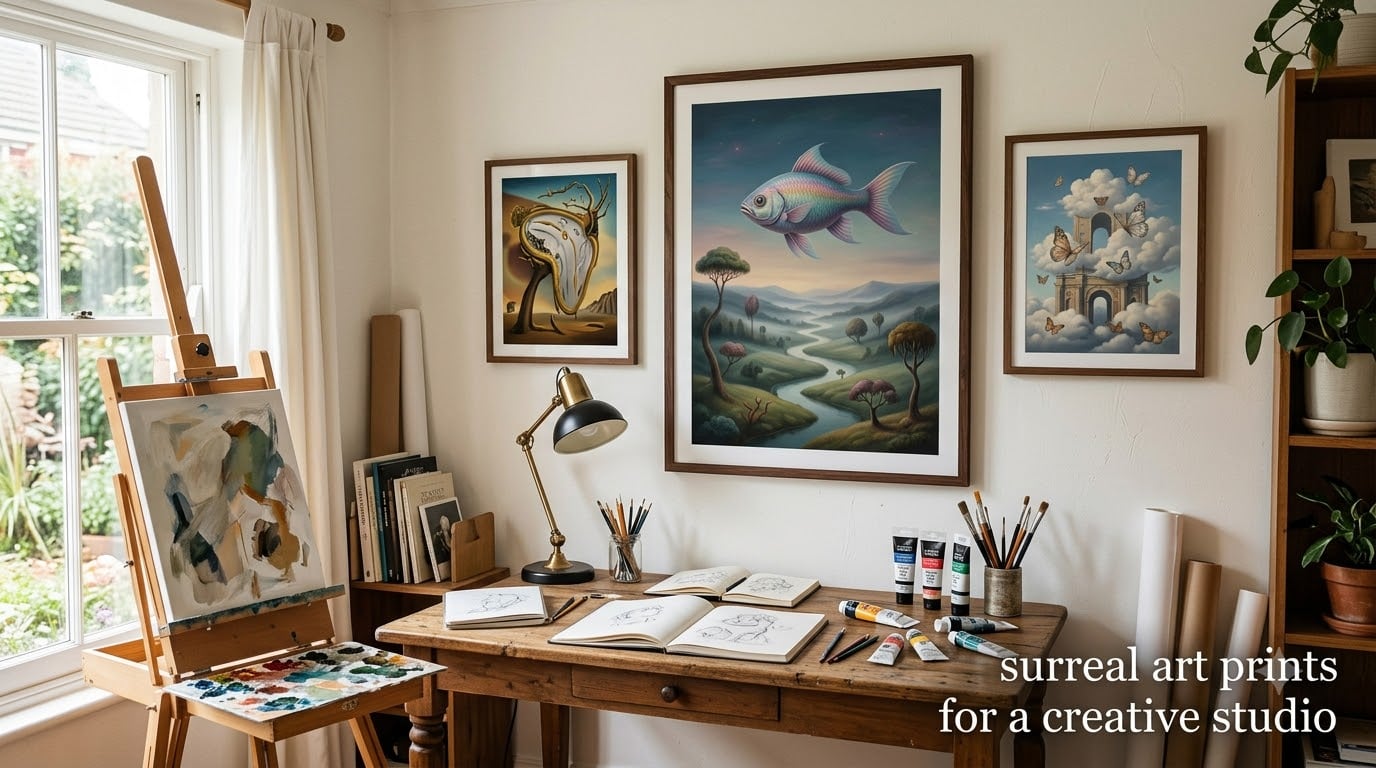
Surrealism is an artistic and intellectual movement founded in Paris in 1924 by André Breton that explores dreams, the unconscious, imagination and unexpected combinations of familiar things to create dreamlike images.
If you have ever walked into a working artist’s studio and felt something shift in the air, chances are the walls had a hand in it. I started hanging surreal art prints in my own studio after a long stretch of staring at blank drywall and wondering why every project felt heavier than it should. Within a month the room felt different. My sketches loosened up. I started keeping ideas instead of discarding them.
This guide is everything I have learned since, organized so you can move from “I like surrealism” to “my studio walls are doing their job” in a single afternoon. We will walk through the history, the visual language, why surrealism specifically suits a creative workspace, how to choose prints that actually fit your room, where to source them without falling into a generic poster trap, and how to arrange them so the room does the inspiring for you.
Table of Contents
A Brief History of Surrealism and Why It Still Speaks to Creators
Surrealism began as a literary movement in 1920s Paris and was officially named by André Breton in his 1924 Manifesto of Surrealism. It grew out of the ashes of Dadaism, the First World War, and a fascination with Freudian psychoanalysis. Breton wanted to free the human mind from the rational chains he saw as the cause of that destruction.
He proposed a simple, almost radical method: bypass the editor of the conscious mind and reach the raw material underneath. Writers did this with automatic writing, painting freely without planning the next sentence. Painters did it by letting dream images, chance encounters and unexpected pairings guide the brush. The result was a body of work that felt like waking into someone else’s dream and recognizing yourself in it.
The reason this history still matters to a creative studio today is that the movement was never really about decoration. It was a working theory of how ideas actually arrive. When you surround yourself with images that model that process – a melting clock next to a mountain, a giant eye floating over a city, two hands that almost touch across an empty sky – you are training your eye to expect the unexpected. That expectation is exactly the muscle creative work asks you to use.
The 7 Characteristics of Surrealist Art
If you have ever tried to explain surrealism to a friend and ended up saying “you know, weird stuff with clocks,” here is a cleaner vocabulary. The seven recurring characteristics below show up in everything from Dalí’s melting landscapes to contemporary prints you can hang this week.
- Dreamlike imagery drawn from sleep, memory and the unconscious rather than observed reality.
- Unexpected juxtapositions of unrelated objects placed together with quiet confidence.
- Impossible scale or impossible physics, where everyday objects become giant or gravity stops working.
- Metamorphosis and transformation, with figures mid-shift between human, animal and object.
- Symbolic objects that read like visual puns – apples, mirrors, doors, birds, clocks, eyes.
- Mystery and visual silence, with empty landscapes and open skies that hold a question without answering it.
- A subtle sense of unease, uncanny rather than horror – the feeling of almost recognizing a place you have never been.
Keep this list nearby when you browse prints. If a piece has three or more of these qualities working together, it is probably doing the thing surrealism is supposed to do.
Why Surrealism Works So Well for Creative Studios
This is the question no competitor page I read actually answered well, and it is the one that matters most when you are choosing art for a workspace where you do your actual thinking. The short answer is that surrealism interrupts habit, and habit is the enemy of new ideas.
Our brains are pattern machines. They build a model of every room we walk into and then quietly ignore it so we can save energy for things that matter. That is useful for an office. It is lethal for a studio. The moment a room becomes background, the art on its walls has stopped earning its space.
Surrealist imagery refuses to become background. A floating fish over a desert still makes the eye stop six months after you hung it. A face hidden behind an apple still pulls a small double-take every time you walk to the kettle. That micro-interruption is exactly what creative work needs. Each glance is a tiny reminder that the world does not have to look the way it usually does.
In community threads on Reddit I have seen artists describe this in their own words. In r/HomeDecorating, owners of surrealist pieces consistently say guests are intrigued rather than uncomfortable – the “weirdness” becomes a conversation starter. In r/ARTIST, whimsical abstract surrealism gets the most love and engagement from viewers. The pattern is consistent. People spend longer looking at surrealist work than at safer decorative art, and the room that holds a longer look is the room where better ideas happen.
How to Choose Surreal Art Prints for Your Studio
Choosing prints is where most people stall. There are too many beautiful options and not enough framework. After hanging surrealist work in my own studio and helping three friends redo theirs, here is the framework I keep coming back to.
Start with the work you make. Writers tend to respond to imagery with narrative weight – a figure at a doorway, a letter floating in the air. Designers and digital artists usually prefer cleaner geometric surrealism, scale shifts, single striking objects. Painters and illustrators gravitate toward layered dream landscapes. Let your medium vote first.
Then match the color palette to the room. You do not need a perfect match. You need a conversation. If your studio walls are warm white, lean into prints with cool blues and deep purples for contrast. If your walls are moody or dark, pick prints with a single bright focal element that lifts the eye.
Decide scale before you browse. A single oversized print reads as a statement piece and gives the eye a clear destination. A salon-style cluster of small prints reads as an ongoing visual conversation. Most studios benefit from one anchor print plus a cluster of two to four smaller companions.
Check the print quality. A few quick terms to know. A giclée print is a high-resolution inkjet on archival paper, which is acid-free paper designed to resist yellowing for decades. Both are worth paying a little more for if you plan to keep the print on your wall for years. Cheap poster prints look tired within months; a real giclée on archival paper still looks like new art in five years.
Mix in your own work. This is the trick nobody talks about. If you are a maker – and I am assuming you are, since you are reading a guide about creative studios – your own work belongs on those walls too. Print one of your own pieces at archival quality and frame it the same way as the surrealist prints you buy. The result feels honest in a way a fully curated wall never does.
Where to Buy Surrealist Art Prints (Without the Guesswork)
Sourcing is where most buyers either overpay or settle. There is a wide middle ground, and once you know the four channels below you will rarely need to look anywhere else.
Etsy for independent artists. Etsy is where most working illustrators and surrealist painters sell their prints directly. You will find artists like Ebbflostudio and Betsymaeshop – both names that come up repeatedly in r/femalelivingspace when people ask for art recommendations. The advantage is that you are paying an actual artist, often with editions of 50 to 200 prints, and you can usually message the maker directly.
InPrnt for higher-end giclée prints. InPrnt curates a smaller roster of artists and prints everything in archival quality at a consistent standard. This is the right channel if you want print quality you can trust without sorting through endless options.
Society6 for affordable designer-driven work. Society6 leans toward graphic surrealism – bold colors, clean compositions, often more decorative than painterly. It is the right channel for studios on a tighter budget or for filling a cluster wall without spending serious money on every piece.
Museum shops, gallery print programs and artist-direct releases. If you want something with real provenance – a museum-licensed print of a Magritte, a Leonora Carrington, a Dalí – the museum shop or the artist’s estate site is the right path. Slower to ship, more expensive, but the prints carry history.
One trust signal worth raising. Across r/surrealism, r/ARTIST and r/photoshop, buyers consistently say they want to know whether a print was made by a person or by an AI image generator. Both can look beautiful. If authenticity matters to you, look for an artist statement, a named signature, an edition number, or a shop that sells original work alongside prints. The artists doing it the long way are usually proud to say so.
How to Arrange Surreal Prints in a Creative Studio
Good art hung badly looks bad. Great art hung thoughtfully becomes part of how you think. Studio walls are not gallery walls. They are working walls, and the layout should serve the work.
Above the desk as your primary focal point. The wall you look at while you work is the highest-value wall in the room. Put your strongest print there. It should be visible without strain, with the center of the print roughly at eye level when you sit. This is the one spot where a single statement piece almost always wins.
Opposite the workstation for the pause-glance wall. Every creator pauses. We get up to refill water, to think, to stare out the window. The wall you face during those pauses gets more looks per day than any other. Use it for something surreal enough to keep interrupting you. This is the right wall for a piece that asks a question rather than answers one.
Try a salon-style hang on the longest wall. A salon hang is a tight, slightly asymmetrical cluster of prints at mixed sizes, often sharing a frame color or a mat. The 3-5-7 rule from interior design works beautifully here: arrange prints in odd-numbered clusters of three, five or seven, because the eye reads odd numbers as more natural and less symmetrical. Three large surrealist prints above a side table, or seven smaller pieces along a hallway leading into the studio, both feel composed without feeling staged.
Pick a single statement piece for small studios. If your studio is under 10 by 10 feet, do not try to hang eight prints. Pick one oversized surrealist piece, give it breathing room, and let it do all the work. Crowding a small studio with art is the fastest way to make it feel chaotic instead of creative.
Rotate the collection seasonally. One thing I learned from drool-art’s rotation guide: a print you look at every day loses its edge after a few months. Store three or four pieces in flat files and swap them in every two to three months. The room feels new each time, and you start noticing details you missed the first round.
Mixing Your Own Work with Curated Surrealist Prints
Most guides stop at “buy art for your walls.” That advice is incomplete for a creative studio. Your own work has a place there too, and the combination of personal pieces with curated surrealism is what makes a studio feel like a studio instead of a gallery.
I print my own digital pieces at archival quality and frame them the same way I frame the surrealist prints I buy. Same frame profile, same mat width, same glass. The result reads as one collection rather than two, and the wall quietly tells the story of who works there.
If you are a photographer, illustrator or digital artist, try alternating one personal piece between two surrealist anchors along the same wall. If you are a writer or a maker without visual output of your own, consider hanging one of your finished projects – a printed manuscript page, a small object in a shadow box, a favorite tool – alongside the prints. It still counts as your work on the wall.
One small thing to keep in mind: keep the framing consistent. Mismatched frames turn a thoughtful wall into a thrift-store wall in about ten seconds.
Frequently Asked Questions
What is Surrealism in art?
Surrealism is an artistic and intellectual movement founded in Paris in 1924 by André Breton that explores dreams, the unconscious, imagination and unexpected combinations of familiar things to create dreamlike images. It grew out of Dadaism and Freudian psychoanalysis and was first defined in Breton’s Manifesto of Surrealism.
What are the 7 characteristics of Surrealist art?
The seven recurring characteristics of Surrealist art are: dreamlike imagery, unexpected juxtapositions of unrelated objects, impossible scale or impossible physics, metamorphosis and transformation of forms, symbolic objects with hidden meaning, mystery and visual silence, and a subtle sense of unease that feels uncanny rather than horrifying.
Why is surrealism good for a creative studio?
Surrealism is good for a creative studio because its dreamlike, unexpected imagery interrupts habitual thought patterns. Each glance at a surrealist piece is a small reminder that the world does not have to look the way it usually does. That micro-interruption is the exact muscle creative work asks you to use, and it helps keep ideas flowing.
How do I choose surreal art prints for my studio?
Start with the work you make – writers, designers, painters and digital artists all respond to different kinds of surrealist imagery. Then match the color palette to your studio walls, decide between one statement piece or a salon-style cluster, check for giclée print quality on archival paper, and consider mixing in your own framed work.
Where should I hang surreal art in a studio?
Hang your strongest surrealist print above the desk as your primary focal point, put a more questioning or unsettling piece opposite the workstation for pause-glance moments, and use a salon-style hang of three, five or seven prints on the longest wall. For studios under 10 by 10 feet, choose a single statement piece instead of a crowded wall.
Final Thoughts on Building a Studio That Inspires You
A creative studio is not a storage room with a desk in it. It is the place where your mind goes to make things that did not exist before, and the walls you look at while you work quietly shape what you are willing to imagine. Surreal art prints for a creative studio work because they keep that imagination honest. They refuse to become background, and they remind you every day that the usual way of seeing is not the only way.
If you remember nothing else from this guide, remember the simplest version: pick one print you genuinely cannot stop looking at, source it from a real artist on Etsy or InPrnt, hang it above your desk, and let it earn its space. Then add a second piece next month, and a third the month after that. Within a season you will have a room that does some of your thinking for you, and that is when the work starts to get interesting.