
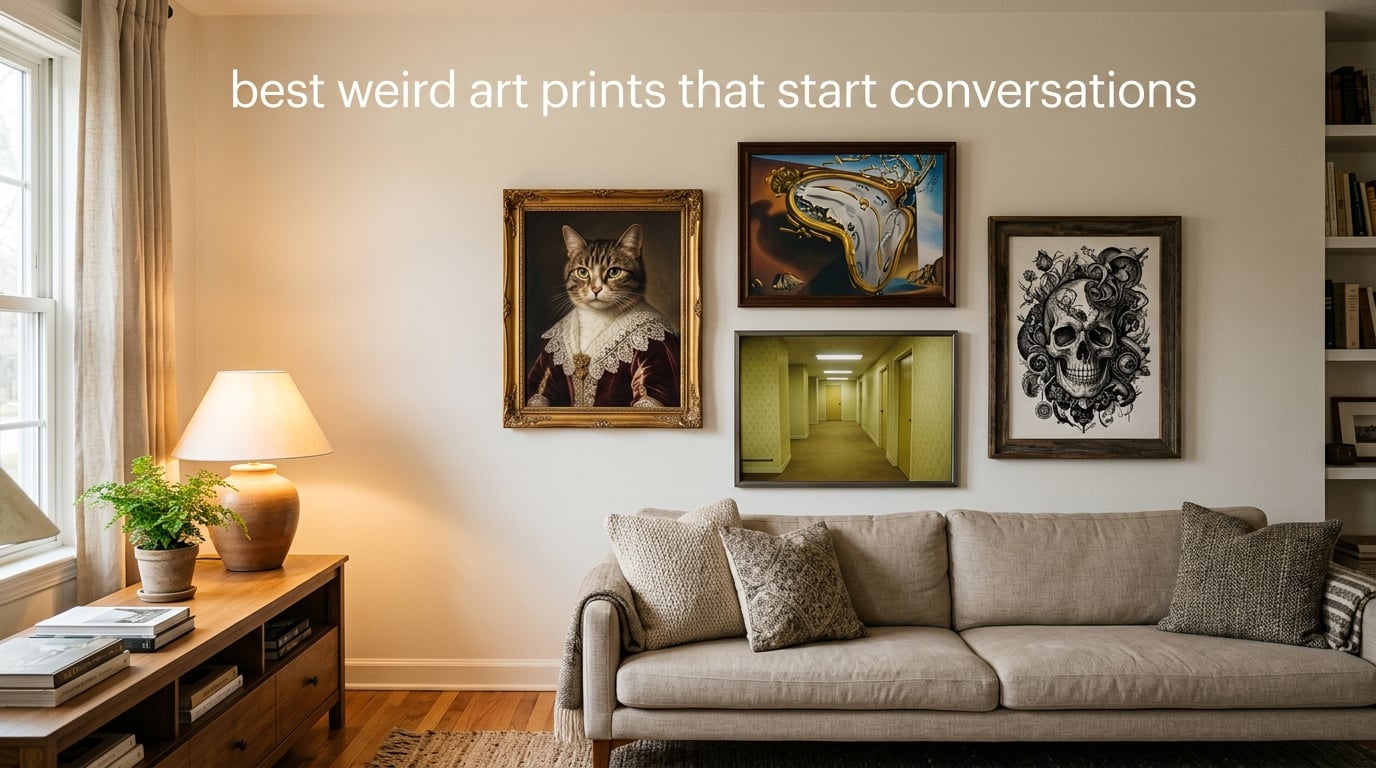
Weird art prints that start conversations are the cheapest conversation tool most homes leave on the table. A single surrealist print can do more for a dinner party, a first date, or a job interview small-talk than any seating arrangement ever will.
I have spent years curating surrealist art for this site, and I have watched the same thing happen over and over: a guest walks in, glances at the walls, and the awkward silence evaporates because someone spots a Renaissance portrait of a cat in ermine robes. That single image does more social work in 30 seconds than a polite tray of appetizers does in three hours.
Below is the guide I wish existed when I started buying weird prints. We will cover what makes art a true conversation starter (and why most generic prints fail), the eight weird-art styles that actually work, the family tree of weird art movements from Dalí to Weirdcore, room-by-room placement, the sizing rule that saves you from guessing, the mistakes that waste money, and the best places to find weird prints without paying gallery prices.
Table of Contents
What Makes Weird Art a Conversation Starter (and Why It Beats Generic Prints)
Conversation-starter art is any piece that visually interrupts a guest’s pattern-recognition long enough for their brain to ask, “Wait, what?” That pause is the conversation opening. The wall decor does the small talk before anyone has to.
Generic abstract prints – the soft beige squiggles and blue-green washes that fill every catalog and showroom – do not do this. Reviewers on r/malelivingspace put it bluntly: generic abstract art “just fills space” without sparking anything. Your guests look right past it.
Weird art works because of three things stacked together:
- Pattern interruption. The brain is wired to stop scanning when it sees something unfamiliar. A melting clock, a saintly hamster, or a thermostat chart from 1650 forces the eye to land.
- An implicit story. Strange images carry a built-in “why” that safe art lacks. Guests don’t ask why a beige wave exists; they do ask why a frog is wearing a powdered wig.
- A safe opening line. Awkward silence is the enemy of hosting. Art is a neutral, low-stakes prompt: “Where did you find that?” is a question anyone can ask without feeling forward.
I have tested this repeatedly. A gallery wall of three weird prints outperforms a wall of fifteen matching neutral abstracts every single time, because visitors linger on the few strange pieces and skip right over the pretty-but-safe ones.
8 Weird Art Styles That Start Conversations
When you search for “bizarre art ideas,” the results tend to be vague (“try abstract!” – useless) or exhausted (the same Dalí clock). The eight categories below are the ones that consistently deliver at the dinner table, the office, and the bathroom.
1. Surrealist Prints
Surrealist prints remain the gold standard of weird wall art for one reason: the movement was built to provoke. Salvador Dalí’s melting clocks, René Magritte’s men in bowler hats, and Hieronymus Bosch’s earthly gardens are the original template. If you want one piece that reliably draws guests closer, start here. Our surrealist art collection leans into this category specifically because the hit rate is so high.
2. Renaissance Pet Portraits
Pets dressed as European nobility – aristocratic cats in ermine collars, dogs in powdered wigs, hamsters with monacle portraits – are the highest-performing weird-print genre of the last five years. They are charming enough not to alienate a guest’s grandmother and strange enough to provoke a laugh. A single 16×20 Renaissance pet portrait in a dark wood frame is the closest thing to a guaranteed conversation starter you can buy.
3. Pop Culture Posters and Meme Art
Posters that subvert pop culture – a Star Wars stormtrooper in a Renaissance painting, a pizza slice in a Dutch still life, a kitten as a Greek philosopher – tap into shared references your guests already carry in their heads. These prints work because the joke lands instantly. The risk is dating yourself: pick ones that still feel funny in five years, not ones tied to a meme of the week.
4. Typography Prints and Deadpan Quotes
Typography prints only count as “weird” when the message is deadpan, obscure, or quietly absurd – not the usual “Live Laugh Love” fare. A single sentence of dry, ironic typography in a clean serif font reads as quietly strange rather than as decoration. Think of the line as a confession in a 24-point font. Browse weirdcore-leaning Etsy shops for the best examples.
5. Macabre and Dark Surrealism
Skulls, skeletons in clothing, anatomical drawings, and slightly creepy Victorian-era scientific illustrations all live in this category. They work as conversation starters because guests lean in to look more closely – and proximity is the first stage of engagement. A small dark-surrealism print is one of the few pieces that will draw a guest from the other side of the room.
6. Dada-Inspired Absurdist Illustrations
The original Dadaists made art as a reaction against meaning. Their descendants still do. Absurdist prints – a man walking a ladder, a fish wearing shoes, a clock that runs backward – read as jokes without punchlines. They are also the closest thing to evergreen weird art: an absurdist drawing from 1922 still confuses and charms in 2026.
7. Pop Surrealism, Lowbrow, and Weirdcore
These three newer movements (Lowbrow since the 1970s, Pop Surrealism since the 1990s, Weirdcore since the 2010s) are where the modern weird-art conversation actually happens. The aesthetic blends manga, vintage Americana, internet imagery, and dark humor. For Gen Z hosts especially, Weirdcore posters are the most-shared form of weird art on TikTok and Tumblr. We cover this family tree in detail further down.
8. Maps, Charts, and Odd Data Visualizations
Hand-drawn maps of imagined places, fictional subway systems for cities that don’t exist, and “scientific” charts of nonsense phenomena are an underrated category. One Reddit user shared a hand-printed map of urban farms in their city – every guest studies it, and the host ends up having the same conversation about local food every visit, which is exactly the point.
The Weird-Art Movement Family Tree: From Surrealism to Weirdcore
No competitor defines a “weird-art taxonomy,” and I think that’s the largest gap in this topic. Below is the family tree, in plain English, of the five movements that gave us the weird-art conversation today.
- Surrealism (1920s onward). The original. Founded by André Breton in 1924 to unlock the unconscious mind. Signature artists: Dalí, Magritte, Leonora Carrington, Max Ernst. Look here for melting clocks, floating bowler hats, and impossible architecture.
- Dada (1916 onward). Earlier and angrier than Surrealism. Founded in Zurich as a reaction to World War I. Signature artists: Marcel Duchamp, Hannah Höch, Hugo Ball. Look here for the readymade, the collage, and the joke as political weapon.
- Pop Surrealism (1990s onward). Also called “lowbrow.” Combines pop-culture references with surreal imagery. Signature artists: Mark Ryden, Camille Rose Garcia, Nicoletta Ceccoli. Look here for doll-eyed children in candy-coated nightmares.
- Lowbrow Art (1970s onward). Underground comic, hot-rod, and tattoo-scene art that refused the gallery system. Often weird by default. Look here for skeletons, devils, monsters, and pinups drawn with a heavy hand.
- Weirdcore (2014 onward). The internet-age contribution. Glitchy, nostalgic, liminal-space imagery. Aestheticized by Gen Z on Tumblr and TikTok. Look here for empty mall photos, sunsets with floating text, and 2003-Microsoft-energy illustrations.
Understanding the family tree matters because the movements stack. A good weird-art collection usually has at least one piece from each generation – a Magritte anchor, a Mark Ryden middle layer, and a Weirdcore oddball at the edge. Mixing eras is what makes a gallery wall feel curated rather than themed.
Where Weird Art Actually Belongs: Room-by-Room Placement
Most guides default to the living room. That’s lazy. Weird art works in every room – including the ones nobody talks about – and the placement logic changes by room.
- Bathroom. A single 11×14 dark-surrealism or skeleton-in-clothing print hung above the towel rack is the easiest win in the house. Guests spend two to four minutes here; a strange image is the only thing they will remember.
- Office. A typography print behind your monitor, visible on Zoom calls, works as a remote-conversation starter. Pick something dry and slightly weird, not a quote your coworkers have seen fifty times.
- Kitchen. Clusters of 5×7 and 8×10 small weird prints in tight groupings read well at this scale. A Renaissance pet portrait in the breakfast nook is unusually charming.
- Entryway. A single large statement piece at eye level greets every guest. This is where you earn the first “Where did you get that?” – the rest of the visit follows from there.
- Living room. One anchor piece (large, 24×36 or bigger) plus an adjacent cluster of three to five smaller weird prints. Build the wall around the strangest piece, not the safest.
- Hallway. Underrated. A series of 8×10 absurdist illustrations spaced evenly down a long hallway turns a transitional space into a mini gallery.
The general rule: anywhere guests stand still, weird art performs. Anywhere guests flow through (kitchens, narrow hallways at peak traffic), keep it tighter so the eye can register it.
How to Hang Weird Art: The 2/3 Rule and Sizing Without a Tape Measure
You will see the 2/3 rule referenced in every PAA box on this topic, so here is the direct answer: your art should cover approximately two-thirds of the available wall space above the furniture or surface it hangs over.
Concretely, if your sofa is 84 inches wide, the art (or combined art width, if hung as a group) should be roughly 56 inches wide. That is the two-thirds mark. Anything smaller looks timid; anything larger looks crammed. The same ratio works vertically – art should fill about two-thirds of the wall space from furniture top to ceiling.
Two sibling rules apply:
- The 70/30 rule for color balance. Roughly 70 percent of a room’s color should come from the dominant palette (walls, large furniture, rug); 30 percent from accent pieces including art. Weird prints earn their 30 percent by carrying colors that tie the room together – pull one hue from the print and repeat it on a cushion or vase.
- The 57-inch eye-level rule. Hang the center of the frame at 57 inches from the floor in standard rooms; 56-60 inches in rooms with very high ceilings. This is roughly average human eye height and is what galleries use.
For budget-friendly large prints, the trick is to skip the custom frame and use standard sizes (16×20, 18×24, 24×36) which fit IKEA and Target frames. A 24×36 print hung vertically above a console reads as “large art” without any custom work.
Mistakes to Avoid When Buying Weird Art Online
This is the second-largest content gap in the topic. Most buying guides skip the failure modes. Here are the seven that waste the most money.
- The IKEA-poster trap. Anything you’ve seen in a roommate’s apartment is already dead as a conversation starter. Originality beats taste, every time.
- Etsy listings with no artist info. A real weird-art seller has a name, a bio, and a portfolio. No info = a reseller reposting stock images. Skip it.
- The “vintage” bait. Etsy and eBay are full of listings claiming a piece is a vintage original. If the seller can’t show provenance, it’s a reproduction.
- Buying before measuring. Roughly half of “this art is too small” complaints trace back to buying without tape-measuring the wall first.
- Wrong paper for the room. Bathrooms and kitchens kill unprotected paper prints within months. Pick giclée-on-acid-free-paper or canvas for humid rooms.
- Five-piece “set” listings. Sets are mass-produced and read as cookie-cutter. One well-chosen piece always beats a matching five-pack.
- Mismatched frames. A great weird print in a cheap frame looks worse than a mid print in a great frame. Budget at least as much for the frame as for the art.
Where to Find Weird Art Prints Without Overpaying
The best weird-art sources share three traits: independent artists, transparent pricing, and a backstory for the work. The five channels I recommend, in order of hit rate:
- Independent artists on Etsy. The widest selection of weird prints, with prices starting low for digital downloads. Vet each shop the way you’d vet a contractor: read the reviews, check the shop’s “about” page, and look for one person rather than a brand.
- Society6 and Redbubble. Curated catalogs of independent illustrators. Quality control is more reliable than open Etsy, but the styles lean polished rather than rough. Good for first weird-print buyers who want a safe entry point.
- Artist Instagram and Patreon. The deepest cuts. Follow ten weird illustrators on Instagram, look at who’s tagging the art you like in their feed, and you will surface in 4-6 weeks a network of small shops you cannot find by searching.
- Local art fairs and open studios. In person, you can ask the artist directly what the piece “is about,” which becomes your talking point for every guest who asks later.
- Small-run galleries and zine shops. Independent bookshops and zine fairs stock hand-printed weird prints in editions of 50-200. These are the rarest category and make the strongest statement.
Vetting checklist for any weird-art seller: readable return policy, photo of the actual print (not just a digital mockup), clear mention of paper/ink, and ideally a process post or shop update in the last 60 days. If two of those four are missing, look elsewhere.
Frequently Asked Questions
What are some bizarre art ideas?
Start with one piece from each weird-art movement: a Surrealist anchor (Dalí, Magritte), a Renaissance pet portrait (a cat or dog in royal robes), a Pop Surrealism piece (Mark Ryden-style candy-coated nightmare), a typography print with deadpan or ironic wording, a Weirdcore oddball with glitchy or liminal imagery, and one hand-printed map or chart of an imagined place. Mix the eras so the gallery wall reads as curated, not themed.
What is the 2/3 rule for wall art?
The 2/3 rule for wall art says your artwork (or the combined width of a grouped gallery wall) should cover about two-thirds of the wall space above the furniture it hangs over. For example, an 84-inch sofa pairs with art roughly 56 inches wide. Anything smaller looks timid; anything larger looks crammed. The same two-thirds rule applies vertically from furniture top to ceiling.
What is the 70/30 rule in art?
The 70/30 rule is a color-balance guideline: roughly 70 percent of a room’s color should come from the dominant palette (walls, large furniture, rug) and 30 percent from accent pieces including art. The trick is to pick one hue from your weird print and repeat it on a cushion, vase, or throw so the art feels integrated, not random.
Where can I find unique art prints?
The best sources for unique art prints are independent artists on Etsy, curated marketplaces like Society6 and Redbubble, artist Instagram and Patreon feeds (follow the artists you like and trace their networks), local art fairs and open studios, and small zine shops that hand-print limited runs. Vet any seller by looking for a real artist’s bio, reviews, clear paper and ink specs, and a working return policy.
What makes art a conversation starter?
A conversation-starter print interrupts the brain’s pattern-recognition. When a guest enters a room full of safe, generic prints, they look past them. When they see a Renaissance cat in royal robes, a melting Dalí clock, or a hand-printed map of an imagined city, their brain pauses to process – and that pause is where conversation begins. Strange art gives guests a low-stakes opening line like u0022Where did you find this?u0022
What art does Gen Z like?
Gen Z gravitates toward Weirdcore (glitchy, liminal-space imagery from Tumblr and TikTok), Pop Surrealism (Mark Ryden-style candy-coated nightmares), ironic typography prints, Renaissance pet portraits, and any art that skewers pop culture – stormtroopers in classical paintings, pizzas in Dutch still lifes, internet memes printed on archival paper. The throughline is shareability: a print that looks good in a photo and carries a joke earns its wall space.
Final Thoughts
The shortest path to a weirder, more talkative home is to start with one piece. Pick a Surrealist anchor, a Renaissance pet portrait, or any print from this guide that makes you laugh – and hang it somewhere guests will stand still. You will hear the question within the first visit, and that question is the entire point.
Once one piece lands, build from there. Add one new weird print every few months until your walls tell a story only your home can tell. That is what conversation-starter art actually is: a story, hung on a wall, waiting for someone to read it aloud.