
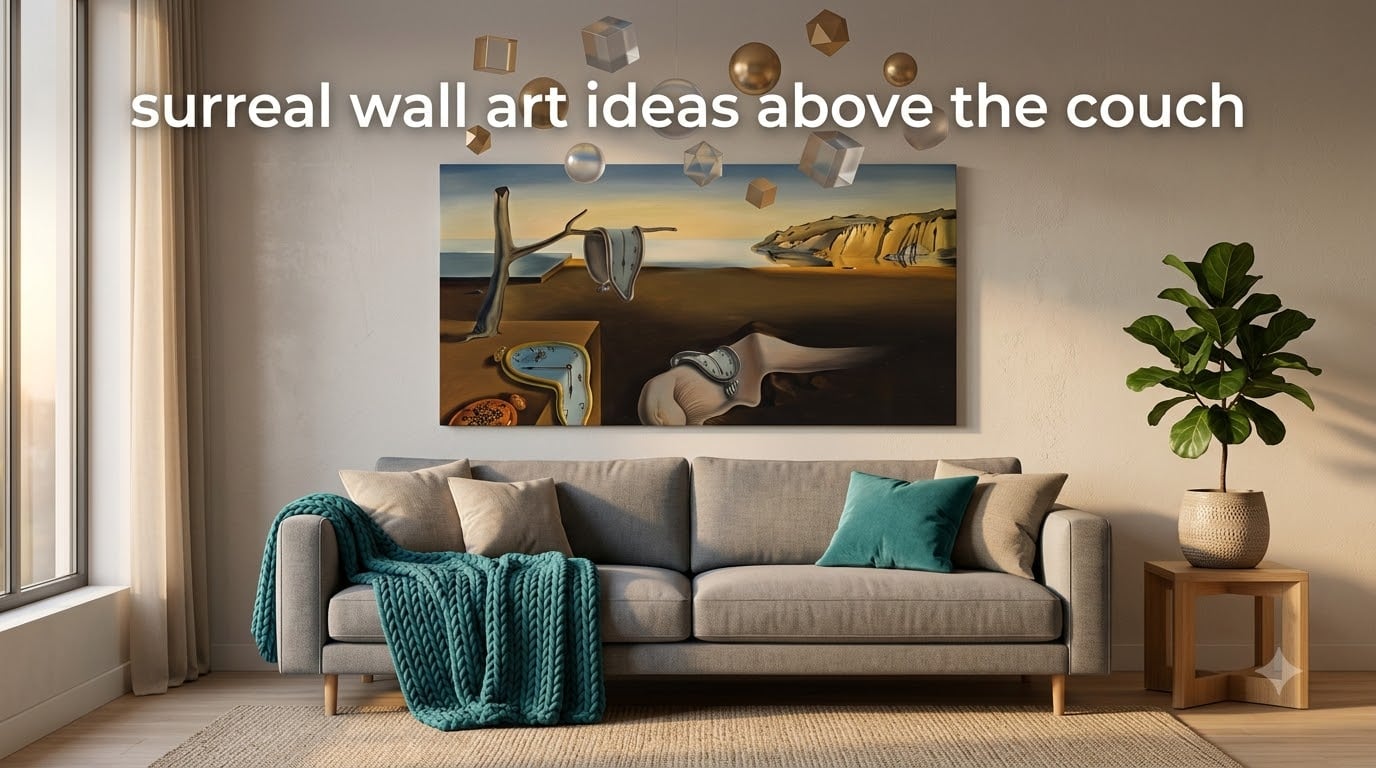
I walked into a friend’s living room last spring and stopped mid-sentence. Above her couch hung a single oversized canvas of a melting clock draped over a tree branch, and the entire room suddenly felt cinematic. That is the kind of reaction surreal wall art pulls out of a space, and it is exactly why so many people are searching for surreal wall art ideas above the couch right now.
If your sofa wall feels flat, generic, or stuck in safe-territory abstract prints, surrealism gives you permission to be weird in the best possible way. Floating doors, impossible staircases, dreamscapes that bend at the horizon — these are pieces people actually look at and talk about. In this guide I will walk you through how surreal wall art works above a couch, the placement rules that make it look intentional, the style categories worth exploring, and the layout, color, and format choices that turn a sofa wall into the most interesting wall in your home.
Table of Contents
What Is Surreal Wall Art and Why It Works Above a Couch
Surreal wall art is artwork inspired by the Surrealism movement — a 20th-century art movement built around dreamlike imagery, unexpected juxtapositions, and visual puzzles that bypass rational thought. Classic surrealism plays with floating objects, impossible architecture, melting forms, oversized eyes, and quiet scenes that feel one layer deeper than reality. In a home, surreal wall art pulls the same trick: it gives your eye somewhere strange and wonderful to land.
Above the couch is the single highest-visibility spot in most living rooms. It is the wall you face when you sit down, the wall guests see first when they walk in, and the surface that frames your seating area. A bold surreal piece in that spot becomes the focal point of the room without you having to rearrange a thing.
Three reasons surreal art thrives above the couch more than anywhere else:
- Visual scale matches a wide wall. A large surreal canvas fills the horizontal stretch above a sofa in a way a single small print never could.
- Imagery invites conversation. A floating staircase or a Magritte-style bowler hat gives guests something to ask about, instead of a generic landscape they smile past.
- Mood without clutter. Surreal pieces carry atmosphere in a single image, so you get a moody or whimsical room without piling on accessories.
If you have ever walked through a model home and thought, “Why does this feel like no one actually lives here?”, surreal wall art is one of the fastest ways to fix that. It injects personality into rooms that are otherwise correct but forgettable.
Sizing Rules for Surreal Wall Art Above the Couch
The most common mistake people make when hanging surreal wall art above the couch is going too small. A 16-by-20-inch print above an 84-inch sofa looks like a postage stamp. The artwork needs to claim the wall, not hover politely in the middle of it.
The single most useful guideline is the 2/3 rule.
The 2/3 Rule Explained
The 2/3 rule says that wall art above a sofa should be roughly two-thirds the width of the sofa below it. A 90-inch sofa wants about 60 inches of art width. A 72-inch sofa wants about 48 inches of art width. This proportion keeps the artwork visually anchored to the furniture without crowding the wall.
Designers often relax the rule into a 60 to 75 percent range. Anywhere in that zone reads as intentional. Below 50 percent, the art starts looking lost. Above 80 percent, it starts crowding the sofa and the wall edges.
How High to Hang Surreal Art Above the Sofa
The standard height rule is 6 to 8 inches between the top of the sofa back and the bottom edge of the frame or canvas. That gap is wide enough that the piece reads as hanging art, not as a headboard, but close enough that the sofa and the artwork feel connected.
For very tall ceilings, you can stretch the gap up to 10 or 12 inches without breaking the relationship. For low ceilings or chunky sofas with deep backs, lean toward the 6-inch side.
Size Cheat Sheet by Sofa Width
| Sofa Width | Art Width Target (2/3 rule) | Recommended Format |
|---|---|---|
| 72 inch (small loveseat) | 48 inch | Single 36×48 or 40×30 canvas |
| 84 inch (standard 3-seat) | 56 inch | Single 48×36 or pair of 24×36 |
| 96 inch (long sofa) | 64 inch | Wide-format panoramic or triptych |
| 108 inch+ (sectional) | 72 inch or more | Gallery wall or oversized canvas |
What If My Sofa Is Small or My Wall Is Huge?
If you have a small sofa on a very large wall, do not chase the 2/3 rule by leaving the rest of the wall bare. Instead, treat the art as one element in a larger composition: anchor a console table beneath it, add a tall plant on one side, or extend the surreal theme with a smaller companion piece further down the wall. The goal is to make the wall feel curated, not empty.
If your sofa is large and the wall above it is short, go with a wide-format panoramic canvas or a tight pair of pieces that together hit the 2/3 mark. Vertical portraits rarely work above a couch — the proportions fight each other.
How High and How Far Apart to Hang Surreal Art
Height matters as much as size. Art hung too high makes a room feel like a museum gallery with uncomfortable sightlines; art hung too low makes the room feel cramped and the sofa wall feel like it is sagging.
Eye Level vs Above-Couch Height
The classic gallery rule is 57 to 60 inches from the floor to the center of the artwork. Above a couch, that rule changes. Because the sofa raises the viewer’s eye line while seated, art above a couch should be centered around 55 inches from the floor in many rooms, with the bottom edge sitting 6 to 8 inches above the sofa back. Standing visitors still see the piece at a natural height, and seated visitors are not craning their necks.
Spacing Between Pieces in a Set
When you hang two or three surreal canvases as a set, keep 2 to 4 inches of space between each piece. Anything wider than 4 inches starts to read as separate artworks rather than a coordinated group. Anything tighter than 2 inches makes the set feel cramped, especially with framed pieces.
For gallery walls with multiple smaller surreal prints, plan 2 to 3 inches between frames. Lay everything out on the floor first, then trace paper templates and tape them to the wall before you commit to nail holes. This is the single best tip from experienced decorators and it costs you nothing but an afternoon.
Vertical Center Alignment
Whether you hang one piece or several, line up the visual center of the artwork with the visual center of the sofa — usually about 24 inches off the floor for a standard sofa back. You want the wall composition to feel like it is sitting on the sofa, not floating above it.
Surreal Art Style Ideas to Try Above Your Couch
Surrealism is a visual language, not a single look. Here are the seven style categories I see pulling the most weight in living rooms right now, with examples of what each one looks like hanging above a sofa.
Dreamscape Art
Dreamscape art shows hazy, atmospheric scenes that feel half-remembered — fog over impossible water, soft cliffs that fade into nothing, melting horizons. Above a neutral sofa, a dreamscape brings depth and calm without literal subject matter. It works especially well in muted tones if your room already has color elsewhere.
Fantasy Landscapes
Fantasy landscape surrealism layers impossible geography: staircases climbing into clouds, floating islands, doors set into cliff sides. A wide-format fantasy landscape is the single best option for very long sofas because the horizontal composition mirrors the furniture line. Pair it with a quiet, neutral sofa so the artwork stays the loudest thing in the room.
Surreal Portraits
Surreal portraits place human figures in unexpected contexts — a face half-hidden behind a floating apple, a figure with clouds for hair, eyes replaced by windows. Hung above a couch, a single large surreal portrait becomes instantly iconic. This is the style to choose if you want one piece to define the entire room.
Impossible Architecture
Impossible architecture shows buildings that could not exist: staircases looping into themselves, rooms with the ceiling as the floor, facades stretching forever. For modern or minimalist living rooms, an impossible architecture print delivers visual interest without being loud. The geometry tends to feel architectural, which suits clean-lined furniture.
Floating Objects and Defying Gravity
Floating-object surrealism isolates one or two objects hovering against a soft background — a key drifting in mid-air, an open book with letters spilling out, a teacup floating above a saucer. Above a couch, this style reads whimsical and light. It is a strong choice for smaller sofas where a single oversized canvas would feel heavy.
Magritte-Inspired Optical Illusions
Magritte-inspired work uses clean compositions and ordinary objects placed in impossible relationships — bowler hats, apples, pipes, mirrors, doors. The clarity of these images makes them photograph well and read clearly from across the room. A Magritte-style piece above a couch becomes a quiet puzzle the room keeps solving.
Dali-Style Melting and Metamorphosis
Dali-style surrealism leans into soft, distorted forms: melting clocks, draping shapes, figures morphing into landscapes. This is the boldest surreal category and the one that makes the strongest statement. It is the style I picked for my friend’s couch, and it earned its place because everything else in the room was restrained enough to let it sing.
Choosing a Layout: Single Piece, Triptych, or Gallery Wall
The layout you choose shapes how surreal your couch wall feels. Each option creates a different room personality.
One Oversized Surreal Statement
A single oversized canvas commands the wall and stops the eye. This is the cleanest layout and the one most designers reach for first. It works best when the artwork itself has enough internal detail — a layered dreamscape or a complex portrait — to hold attention without neighbors.
Two-Piece Diptych for Wide Sofas
A pair of matching surreal canvases, hung 2 to 4 inches apart, gives a wide sofa visual rhythm. Choose pieces that share a palette or a theme — for example, two dreamscape panels that read as one continuous scene, or two portraits in matching scale. The diptych reads as one composition while feeling less heavy than a single oversized canvas.
Three-Piece Triptych Balance
A triptych — three panels of equal size — is the classic balanced layout. It works above standard 84-inch sofas because the three panels together hit the 2/3 width target naturally. Triptychs are especially powerful with surreal landscapes because the eye moves across the panels like a slow pan.
Gallery Wall With Mixed Surreal Themes
A gallery wall of smaller surreal prints gives you the most flexibility. You can mix dreamscapes, surreal portraits, and impossible architecture under a unifying palette or mat style. The downside is gallery walls are more work to lay out well, and they reward patience. Tape your templates on the wall and live with them for a few days before you commit.
Color Palettes: Coordinating Surreal Art With Your Living Room
Color is where most people get stuck. Forum threads are full of the same worry: “What if the art clashes with the couch?” The fix is to pick your palette on purpose.
Bold Surreal Art in Neutral Rooms
If your living room is white, beige, gray, or otherwise neutral, you have permission to go bold with the artwork. A vivid Dali-style piece or a saturated dreamscape becomes the entire color story of the room. Pull one accent color from the artwork into a throw pillow or a vase and the room suddenly feels designed.
Muted Surreal Pieces for Colorful Rooms
If your sofa, rug, and accessories are already colorful, choose surreal art with a quieter palette — soft blues, dusty pinks, charcoal, sepia, or monochromatic surrealism. This is the move that experienced decorators reach for when the room is already loud. The art gives the wall interest without competing with the rest of the room.
Black-and-White Surreal Photography Style
Black-and-white surreal photography — long exposures, double exposures, composite imagery — is the safest choice for any room. It reads as art without injecting new color, which makes it a strong pick if you are nervous about clashing or if you redecorate seasonally and want the wall art to last through several room refreshes.
Famous Surrealists Whose Work Inspires Living Room Walls
Knowing a few foundational artists helps you describe what you want, even if you end up buying from contemporary print shops rather than museums.
Salvador Dali: Melting and Dream Imagery
Dali is the artist most people picture when they hear “surreal.” His melting clocks, draping figures, and impossible landscapes defined the visual shorthand for the entire movement. Above a couch, Dali-inspired work brings theater. It also tends to be polarizing, so make sure you genuinely love it — not just recognize it.
René Magritte: Optical Illusions and Bowler Hats
Magritte’s clean compositions and ordinary-object puzzles are easier to live with than Dali’s drama. A single Magritte-inspired image — a floating apple, a pipe with text beneath it, a man with an apple for a face — gives a living room intellectual warmth without overwhelming it.
Yves Tanguy: Organic Abstract Dreamscapes
Tanguy’s work sits closer to abstract surrealism: biomorphic shapes drifting in hazy space, no recognizable objects, no horizon line. Above a minimalist couch, a Tanguy-inspired piece feels modern and grown-up. It is a great choice if you like surrealism but want to avoid the “obvious Dali” look.
Contemporary Surrealists Worth Knowing
A new generation of surrealist artists is producing work that lives beautifully in living rooms: Duy Huynh’s vibrant storybook scenes, Rob Gonsalves’ optical-illusion architecture, and Mike Worrall’s softly impossible landscapes. Searching these names gives you a fast starting point when you are browsing prints and want to refine what you are drawn to.
Framed, Canvas, or Acrylic: Picking the Right Format
The same surreal image looks completely different depending on the format you choose. Picking the right one is part of the design decision, not an afterthought.
Canvas Prints: Relaxed and Modern
Canvas prints wrap the image around a wooden frame, with no visible border. They read contemporary and casual, which suits most modern living rooms. Canvas is also the most forgiving format for large sizes because it is light and easy to hang with a single nail.
Framed Prints: Polished and Traditional
Framed surreal prints bring a traditional, museum-like quality to a room. A thin black frame with a wide white mat is the classic look and pairs well with transitional or classic decor. Framed prints are heavier than canvas and may need two wall anchors.
Acrylic Face Mounts: Vibrant and Gallery-Like
Acrylic face mounts print the image on paper or metal and mount it behind a sheet of clear acrylic. The result is high-contrast, vivid, and reflective. Above a couch with strong lighting, acrylic face mounts make surreal colors glow. They are the most premium format and the most expensive, but the impact is real.
Wide-Format Panoramas for Long Sofas
If you have a long sofa or sectional, a single panoramic surreal canvas is the cleanest solution. The 2:1 or 3:1 aspect ratio mirrors the furniture line and avoids the visual chopping that paired pieces can introduce. Panoramic dreamscapes and fantasy landscapes work especially well in this format.
Common Mistakes to Avoid When Hanging Surreal Art Above a Couch
Most surreal art looks great in a print shop and less great above an actual couch because of placement mistakes. Here are the four I see most often.
Hanging Too High or Too Low
Art hung from a 60-inch eye-level rule looks floating and disconnected when the sofa back sits at 32 inches. Pull the center of the artwork down by 3 to 5 inches so the bottom edge lands 6 to 8 inches above the sofa. If you have to tilt your head back to see the art, it is too high.
Choosing Art That Is Too Small
If your art looks like it could be a window into a smaller room, it is too small. Step back to the far side of the room. If the art reads as a tiny element on a vast wall, go up a size. The 2/3 rule exists to prevent exactly this.
Ignoring Sofa Width Proportions
Above a wide sectional, a single narrow print floats awkwardly. Above a small loveseat, an oversized canvas feels like a billboard. Match the art’s width to the sofa’s width using the 2/3 rule, not the wall’s width and not your personal preference for large art.
Clashing Colors With the Room Palette
Surreal art tends toward bold color, which is part of its appeal. But if your room already has a strong palette, the art can fight it instead of anchoring it. Pick the art first and pull accents from it, or pick the art last and choose a piece that complements the room you already have. Either order works as long as you do it on purpose.
Frequently Asked Questions
What artwork to put above a couch in a living room?
Surreal wall art works beautifully above a couch because the wide horizontal span above a sofa gives oversized pieces room to breathe. Pick one large canvas in the style that matches your room — dreamscape, fantasy landscape, surreal portrait, or impossible architecture — sized to about two-thirds the width of your sofa. The surreal style adds personality and a conversation piece without needing additional accessories on the wall.
Should you put art above a couch?
Yes, the wall above a couch is the most visible wall in most living rooms and the natural focal point of the seating area. Hanging art there anchors the sofa, balances the room, and gives the eye somewhere intentional to land. Without art above the couch, that wall usually reads as empty and the room feels unfinished.
What are the rules for hanging art above my sofa?
Four rules cover most situations: (1) Size the art to about two-thirds the width of the sofa. (2) Hang the bottom edge 6 to 8 inches above the sofa back. (3) Center the artwork visually over the sofa, not the wall. (4) Keep the center of the piece at roughly 55 inches from the floor when standing. Following these keeps the art feeling connected to the seating rather than floating above it.
What is the 2/3 rule for wall art?
The 2/3 rule states that wall art above a sofa should be roughly two-thirds the width of the sofa itself — so a 90-inch sofa wants about 60 inches of art width. Designers often accept anything from 60 to 75 percent of sofa width as a comfortable range. Below 50 percent the art looks too small, above 80 percent it starts crowding the wall edges.
What is the ideal size for wall art above a sofa?
For a standard 84-inch sofa, aim for artwork that is roughly 56 inches wide. For a 72-inch loveseat, target around 48 inches. For a 96-inch sofa, look at 64 inches or use a wide-format panoramic canvas. In height, 30 to 40 inches works for most horizontal layouts, and oversized single canvases at 36 by 48 inches or larger tend to make the strongest statement.
What is the 70/30 rule in art?
The 70/30 rule in art and interior design suggests dedicating about 70 percent of a room’s visual weight to one dominant element and 30 percent to supporting elements. Above a couch, that means the wall art should be the dominant element — the largest, most colorful, or most detailed piece in the room — while the sofa, rug, and accessories stay quieter so the artwork remains the focal point.
Final Thoughts: Make Your Sofa Wall Unforgettable
Above-the-couch wall art is the easiest place in your home to do something a little strange, and surrealism is the easiest style to do it well. Pick a dreamscape, a Magritte-inspired puzzle, or a Dali-style melting moment, size it to two-thirds of your sofa, hang it 6 to 8 inches above the back, and let the wall do the talking. Surreal wall art ideas above the couch all come back to the same simple idea: choose something that makes you look twice, then give it room to be itself.