
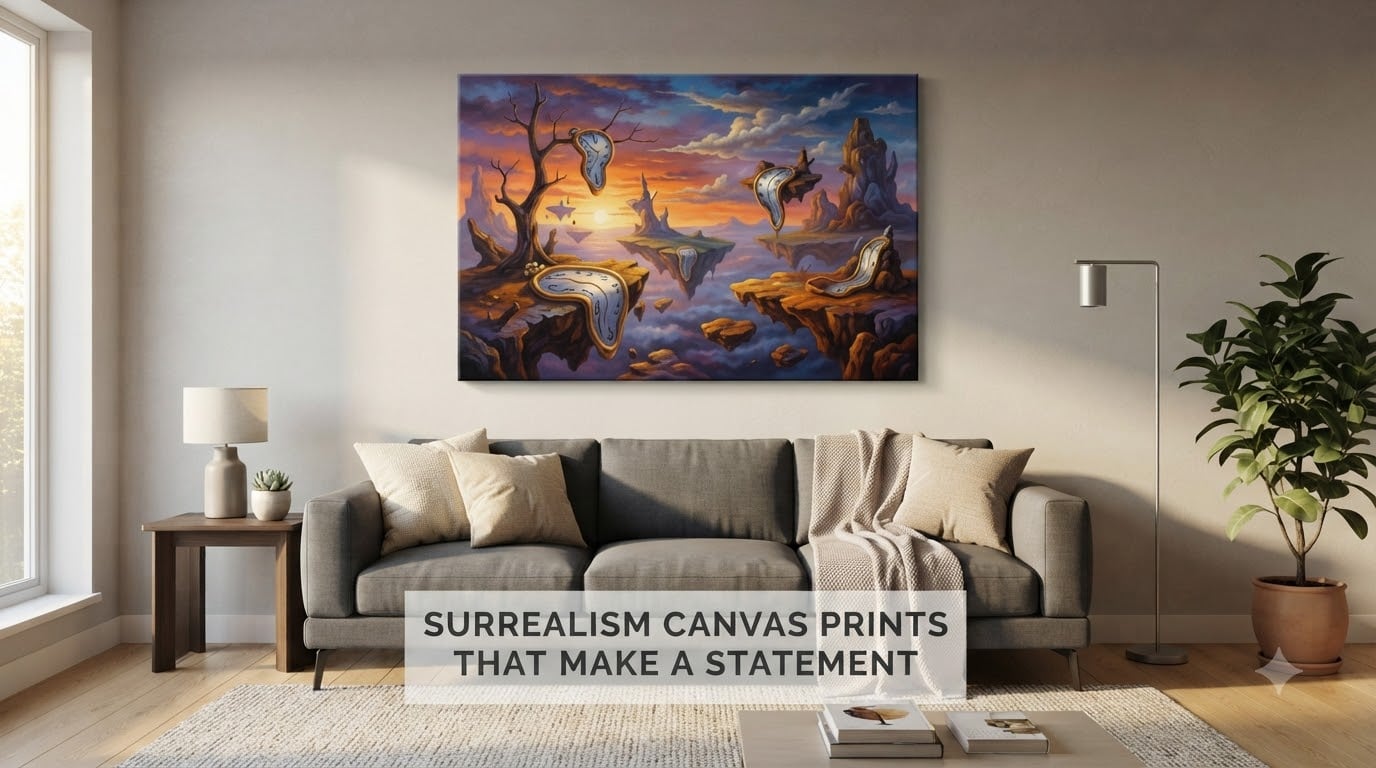
Surrealism canvas prints that make a statement are large-scale reproductions of dreamlike, subconscious imagery that anchor a room and spark conversation. They blend impossible juxtapositions, vivid color, and psychological depth to turn an empty wall into the defining feature of your space.
I have spent years collecting and living with surrealist wall art, and I can tell you the right surrealism canvas print does more than decorate. It sets the mood of the room, pulls the furniture layout together, and gives visitors something to talk about the moment they walk in. In this guide for 2026, I will walk you through what makes a surrealism canvas print a true statement piece, the artists and motifs to know, how to size and place one in any room, and how to match it to your interior style.
Table of Contents
Surrealism Canvas Prints That Make a Statement: A Direct Definition
A surrealism canvas print is a wall art reproduction of a surrealist work – imagery that blends dreamlike, subconscious, or impossible scenes to surprise the viewer. When one “makes a statement,” it is typically a large-scale, visually arresting piece that anchors a room and sparks conversation. Think melting clocks above the sofa, a giant eye staring from behind the dining table, or a cosmic sky spilling across a hallway wall.
What separates a statement surrealism canvas from a generic canvas print is intent. Statement surrealism canvas prints are chosen for emotional impact, not just color coordination. They are usually 36 inches or larger on the longest side, carry a single dominant motif the eye cannot ignore, and reflect the owner’s taste rather than a department store trend.
The 7 Characteristics of Surrealist Art
If you want to recognize genuine surrealism in canvas prints – and not just generic “dreamy” art – look for these seven characteristics:
- Dreamlike imagery. Scenes that feel pulled from sleep rather than waking life.
- Unexpected juxtaposition. Familiar objects placed in impossible combinations.
- Distorted perspective. Impossible scale, tilted horizons, melting or floating forms.
- Symbolism and metaphor. Clocks, eyes, mirrors, doors, and animals loaded with meaning.
- Vivid or unusual color. Bold palettes, dream-saturated blues, sunset pinks, desert ochres.
- Psychological mood. Melancholy, wonder, unease, or quiet humor.
- Subconscious themes. References to dreams, memory, desire, or inner worlds.
What Turns a Print Into a “Statement Piece”
Not every surrealist canvas print qualifies as a statement piece. A statement piece needs four things working together. It must be large enough to command the wall – usually 36 by 48 inches or bigger. It must carry a single, dominant image the eye lands on within a second. It must connect to the room’s mood or color story. And it must feel personal, like a piece you chose rather than one you inherited.
Why Surrealism Works as Statement Wall Art
Surrealism hijacks the brain’s expectation of reality, which is why it works so well above the couch or across from the bed. When you see a clock draped over a tree branch or a face dissolving into a forest, your mind pauses to make sense of it. That pause is exactly what a focal point is meant to create.
Designers and homeowners on r/interiordecorating and r/wallart often describe the same effect: surrealist prints feel alive in a room that other art just hangs in. Reviewers on shopping platforms say surreal canvas prints are their favorite conversation starters, because guests immediately ask what the image means – and the homeowner gets to answer.
There is also a practical reason surrealism earns its wall. It anchors the entire room. Your furniture, rug, and lighting end up arranging themselves around the print, not the other way around. That is a level of authority no other decor category delivers as cheaply or as fast.
Signature Surrealist Motifs and Artists to Know
The strongest surrealism canvas prints draw on a century of visual vocabulary. Once you know the signature motifs, you start spotting them everywhere, and you can choose prints that feel intentional rather than random.
The Historical Canon
Salvador Dali is the household name for a reason. Melting clocks, elongated shadows, and barren dreamscapes define his visual language. Max Ernst brings frottage, textured scratching, and forested jungles that feel pulled from a child’s fever dream. Rene Magritte built his career on apples, bowler hats, pipes, and clouds that hide faces – clean surrealism that suits modern minimalist rooms.
Frida Kahlo rounds out the historical quartet. Her self-portraits blend pain, identity, and surreal symbolism in ways that resonate deeply in bedrooms and private studies. Together, these four artists gave surrealism its core grammar.
Contemporary and Pop Surrealism
Modern surrealism has split into a few streams worth knowing. Pop surrealism (sometimes called lowbrow) blends cartoon-like characters with dream logic – big eyes, candy colors, and twisted innocence. Artists like Mark Ryden and Camille Rose Garcia built the visual template. Cosmic surrealism takes the dream logic into space, with stars, planets, and impossibly vast skies.
Psychological surrealism leans darker, more introspective. It suits reading rooms and offices. Whimsical surrealism is light and playful, perfect for bedrooms and children’s spaces. Vintage surrealism mimics the muted palettes of mid-century surrealist posters, which makes it a natural match for mid-century modern interiors.
Surrealism by Theme: A Quick Reference
Here is the cheat sheet I wish someone had handed me when I started collecting. Each theme carries a different room mood, and each pairs better with certain interiors.
| Theme | Signature Feel | Best Room | Pairs With |
|---|---|---|---|
| Cosmic | Vast skies, planets, stars | Living room, hallway | Minimalism, modern |
| Whimsical | Playful, dreamlike, soft humor | Bedroom, nursery | Boho, eclectic |
| Psychological | Dark, introspective, symbolic | Office, study | Mid-century modern |
| Pop Surrealism | Cartoon-meets-dream, vivid | Studio apartment, den | Maximalism, retro |
| Vintage | Muted, mid-century palette | Dining room, hallway | Mid-century modern, traditional |
6 Surrealist Techniques You See in Modern Canvas Prints
Surrealism has its own toolbox. When you understand the techniques, you start choosing prints with confidence instead of guessing.
- Juxtaposition. Placing unrelated objects together to create new meaning – a bird wearing a hat, a clock on a tree branch.
- Distortion. Stretching, melting, or warping familiar forms – Dali’s signature move.
- Symbolism. Loading everyday objects with hidden meaning – mirrors, doors, eggs, eyes.
- Dream imagery. Pulling visuals directly from dream logic: floating, falling, impossible architecture.
- Metamorphosis. One form turning into another mid-image, like a body dissolving into leaves.
- Levitation. Objects or figures floating with no gravity – common in cosmic and whimsical prints.
Modern surrealism canvas prints almost always blend two or three of these techniques. The combinations are what give each print its personality.
How to Choose the Right Surrealism Canvas Print
Choosing the right surrealism canvas print comes down to four decisions: size, color, theme, and room. Get those right, and even an inexpensive print looks like it belongs.
Size and Scale Cheat Sheet
Size is the single biggest mistake I see people make. A print that is too small disappears on a big wall; a print that is too large overwhelms a small room. Here is the cheat sheet I use:
- Small accent (16×20 to 24×36 inches): Gallery walls, narrow hallways, above a desk or shelf.
- Medium statement (30×40 inches): Above a sofa in a standard apartment, bedroom wall opposite the bed.
- Oversized statement (36×48 to 48×60 inches): The real showpiece size. Living room focal wall, large dining room, open-plan lofts.
- Gallery wall moment: Mix one 24×36 piece with three to five smaller surreal prints, all with similar palettes, hung 2 inches apart.
As a rule, a statement canvas should cover roughly two-thirds to three-quarters of the wall space above your furniture. Anything smaller and the wall feels half-finished.
Color Palette and Mood Guide
Color is where surrealism canvas prints earn their keep. The palette you choose does emotional work the entire room benefits from.
- Cool blues and deep greens: Calm, contemplative, meditative. Ideal for bedrooms and reading nooks.
- Warm reds, ochres, and burnt oranges: Bold, dramatic, social. Ideal for living rooms and dining spaces.
- Black, white, and grayscale: Sophisticated, graphic, modern. Pairs with minimalist and Scandinavian interiors.
- Vivid candy palettes: Playful, energetic, youthful. Perfect for studios and creative spaces.
- Muted vintage tones: Quiet, nostalgic, mid-century. Works in traditional and transitional homes.
Theme vs Room Match
Match the theme to the room’s job. Whimsical prints in a bedroom feel warm; the same prints in an office can feel distracting. Cosmic prints above the sofa read as grand; in a small hallway they feel cramped. Psychological prints in a private study feel thoughtful; in a busy kitchen they feel heavy.
Where to Hang a Statement Surrealism Canvas
Placement matters as much as the print itself. I have watched people ruin good art with bad hanging – too high, too low, lost between windows, or floating on a wall that is too small.
Living Room: Above the Sofa
This is the classic statement spot. Hang the canvas 6 to 10 inches above the sofa back, centered horizontally on the sofa (not the wall). The center of the canvas should sit roughly 57 to 60 inches off the floor – standard eye level.
Bedroom: Opposite the Bed
The first thing you see when you wake up deserves a print that sets the tone for the day. Choose a theme that matches the energy you want. Cosmic or whimsical works beautifully here. Avoid anything visually aggressive directly above the bed – it can feel oppressive.
Home Office: Behind Your Camera or Chair
A surrealism canvas behind you on video calls adds personality without distracting from your face. Choose something with strong vertical or central composition so it does not pull attention away.
Hallway and Entryway
Hallways are perfect for oversized surrealism canvases. Guests walk toward them and the imagery grows as they approach. Pair a single large canvas with good lighting – a picture light or a directional warm LED – to give the piece presence.
The 70/30 Rule
Designers often use the 70/30 rule when introducing statement art: roughly 70 percent of the room stays in a calm, supporting palette, and 30 percent carries the bold accent colors of the canvas. Pull two or three accent shades from the print and repeat them in a cushion, a vase, or a small rug. That repetition ties the art into the room instead of letting it float.
How to Mix Surrealism Prints With Your Interior Style
This is the part most guides skip, and it is the part that decides whether your surrealism canvas print looks intentional or random.
Minimalism
Minimalist rooms need one bold surrealist piece, not several. Choose a print with generous white space – lots of sky, cloud, or empty horizon – and a single dominant motif. Magritte-style works beautifully here because the compositions are clean.
Maximalism
Maximalism thrives on layered surrealism. Mix a large statement canvas with smaller surreal prints, vintage frames, mirrors, and objects that pick up the same color story. The denser the layering, the more a dreamlike surreal print feels at home.
Mid-Century Modern
Mid-century modern pairs with vintage surrealism, muted palettes, and artists inspired by the 1950s and 60s. Look for prints that lean warm and earthy, with simple wood or thin black frames.
Boho and Eclectic
Boho is the easiest match for surrealism. Whimsical, cosmic, and pop surrealism all feel native. Mix canvas prints with macramé, plants, layered textiles, and warm wood. The more textures, the better.
Frequently Asked Questions
What is surrealism in art?
Surrealism is an art movement built around dreamlike, subconscious, and impossible imagery. Founded in the 1920s by Andre Breton, it explores the inner world through unexpected juxtapositions, distorted forms, and symbolic objects. Modern surrealism canvas prints carry that same visual language into today’s homes.
What are the 7 characteristics of surrealist art?
The seven defining characteristics are dreamlike imagery, unexpected juxtaposition, distorted perspective, symbolism and metaphor, vivid or unusual color, psychological mood, and subconscious themes. Look for prints that combine several of these traits rather than just one.
What are the 6 surrealist techniques?
The six core surrealist techniques are juxtaposition, distortion, symbolism, dream imagery, metamorphosis, and levitation. Juxtaposition places unrelated objects together. Distortion warps familiar forms. Symbolism loads objects with hidden meaning. Dream imagery pulls from sleep. Metamorphosis transforms one form into another. Levitation suspends objects without gravity.
What size canvas print counts as a statement piece?
A statement canvas print is typically 36 by 48 inches or larger on the longest side. For above a sofa, 30×40 inches works as a smaller statement. Anything below 24×36 inches reads as an accent rather than a focal point.
What makes a focal point in a room?
A focal point is the strongest visual element in a room – the first thing the eye lands on. A large, well-placed surrealism canvas print creates a focal point by combining size, dominant imagery, and contrast with the surrounding wall. Lighting and clear space around the piece strengthen the effect.
Which rooms work best with surrealism canvas prints?
Living rooms, bedrooms, home offices, hallways, and dining rooms all work well with surrealism canvas prints. Living rooms handle the boldest pieces. Bedrooms benefit from calmer cosmic or whimsical themes. Offices suit psychological or vintage surrealism. Hallways are ideal for oversized pieces that draw the eye as you walk through.
Where can I buy surrealism canvas prints online?
Surrealism canvas prints are widely available through Etsy, Society6, GreatBigCanvas, Elephant Stock, iCanvas, Hive Artes, and independent artist shops on platforms like Redbubble. Look for archival or museum-quality materials, visible ratings, and clear print specifications. Many buyers on r/wallart and r/interiordecorating recommend checking multiple sellers to compare print quality, frame options, and shipping before committing to a large statement piece.
Final Thoughts on Surrealism Canvas Prints That Make a Statement
The right surrealism canvas print changes a room in a way no other decor category can. It anchors the space, sets the emotional temperature, and gives visitors something real to respond to. Choose a print that speaks to you personally, size it correctly for the wall, place it where the eye lands first, and repeat two or three accent colors from the image around the room.
Start with the theme that matches the room’s job – cosmic for a living room, whimsical for a bedroom, psychological for an office. Then pick the largest canvas your wall and budget can handle. A single, well-chosen surrealism canvas print will do more for your space than a dozen smaller pieces scattered around. That is the real statement.