
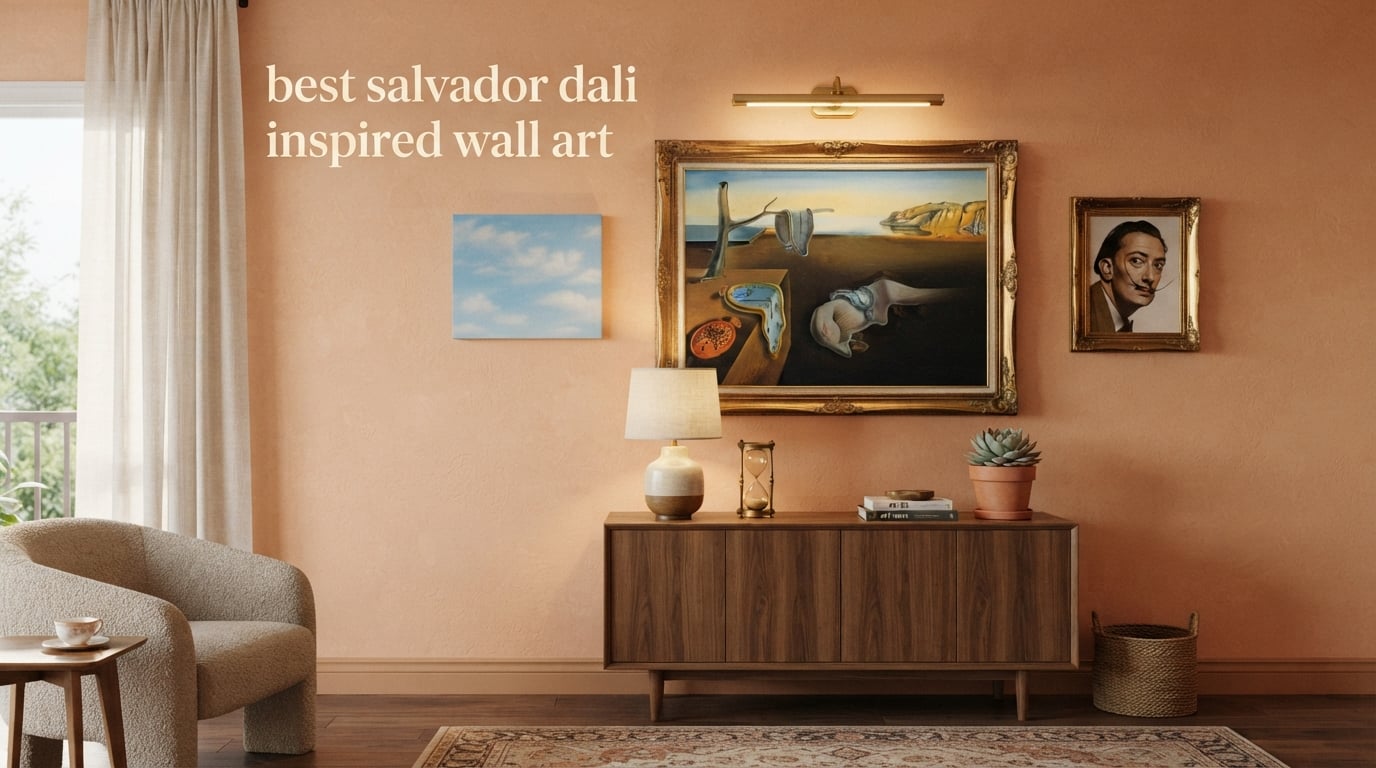
If you’ve ever caught yourself staring at a wall and wishing it could dream out loud, you’ve already understood why Salvador Dali inspired wall art has outlasted every other art movement of the 20th century. I started collecting surrealist prints for my own living room three years ago, and the moment a melting clock went up over the sofa, the entire room changed register. Suddenly the bookshelf looked like a movie set. This guide is everything I learned, and everything our team at One Surrealist A Day has catalogued after hanging reproductions in homes, studios, and galleries.
Salvador Dali inspired wall art is the category of decor that reproduces or reinterprets the Spanish surrealist Salvador Dali’s paintings, lithographs, and motifs — most recognizably The Persistence of Memory’s melting clocks — for display in homes, offices, and galleries. In the next ten minutes, we’ll define exactly what counts as Dali-inspired wall art, walk through eight signature pieces worth hanging, teach you how to read the difference between a museum-quality giclée and a poster-grade print, and show you how to style the work so it actually reads as surrealism rather than dorm-room kitsch. For the full archive of artist and motif explainers, browse our surrealist editorial library on the One Surrealist A Day homepage.
Table of Contents
What Is Salvador Dali Inspired Wall Art?
Salvador Dali inspired wall art is decor that reproduces or reinterprets the Spanish surrealist Salvador Dali’s paintings, lithographs, and motifs for display in homes, offices, and galleries. The category includes direct museum reproductions of his oil paintings, officially licensed lithographs of his graphic work, and contemporary pieces “inspired by” his surrealist imagery without copying a specific canvas.
The simplest way to think about it: anything that brings Dali’s dreamlike visual vocabulary — melting clocks, elephants on stilts, crutches, ants, double images, the rocky Cap de Creus coastline — onto a wall in your home. That vocabulary belongs to a movement called Surrealism, which Salvador Dali practiced from the late 1920s through the 1970s.
Surrealism and the Paranoiac-Critical Method
Surrealism was a 1920s literary and artistic movement that tried to release the creative power of the unconscious mind. Dali didn’t just join the movement — he invented his own private technique inside it called the Paranoiac-Critical method, a way of looking at the world so that one image could simultaneously be read as two different things. The swans in Swans Reflecting Elephants are also elephants. The rock in The Persistence of Memory is also a melting camembert. The crutch under the lobster in a still-life is also the limp posture of a dreamer.
This double-image trick is exactly why Dali’s imagery works so well on a wall: the longer you look, the more you see, and the room starts to feel inhabited by something with its own subconscious.
Reproductions vs Lithographs vs Posters vs Digital Downloads
Not everything labeled “Dali” is the same kind of object, and the label matters more than people think.
- Museum reproduction — A high-resolution scan of an oil painting, printed on canvas or fine art paper, usually sold by the museum that owns the original (MoMA, Salvador Dali Museum St. Petersburg, Reina Sofia) or by licensed partners like Great Big Canvas, Elephant Stock, or iCanvas.
- Giclée print — An archival inkjet print on cotton rag paper or canvas, made with pigment-based inks that hold color for decades. This is the format collectors and serious decorators prefer.
- Framed canvas — A giclée or HD print wrapped around wooden stretcher bars and floated inside a wood or metal frame, often ready-to-hang with pre-attached hardware.
- Lithograph — A print made from a stone or metal plate, traditionally hand-pulled. Vintage Dali lithographs from the 1960s and 70s can be collectible if signed and editioned; modern reprints are decorative.
- Poster — A standard offset or digital print on coated paper. Affordable and bright, but color and paper life are noticeably weaker than a giclée.
- Inspired-by artwork — A new composition by a living artist that borrows Dali’s surrealist motifs (melting forms, floating eyes, impossible landscapes) without copying a specific painting. Often the best value and the freshest visual style.
The difference between these is mostly paper, ink, and licensing. We’ll dig into that in the buying guide.
8 Signature Dali Pieces Worth Hanging
This is the section our readers ask for most. The question underneath every search for Dali-inspired wall art is the same: which painting should I actually hang? Below are eight canvases that hold up on a wall, the motifs that make them instantly readable, and the room each one loves.
The Persistence of Memory (1931) — Melting Clocks
The Persistence of Memory is a small 1931 oil on canvas by Salvador Dali, and it is the single most recognized surrealist painting in the world. It depicts a Catalonian dreamscape where pocket watches appear to melt over a barren landscape, a tree branch, and a strange fleshy form lying at the center of the composition. The piece is held by the Museum of Modern Art in New York.
On a wall, The Persistence of Memory is a statement piece and should be treated like one. The warm peach palette of the Catalan plain pulls browns, terracottas, and aged gold out of surrounding decor. Hang it in a living room or library where the light is warm and slightly directional — the painting reads as memory, so indirect light helps. Buyers who want the motif without the original’s tan-and-cream palette often pick a high-contrast giclée that keeps the melting clock iconic but pushes the background into dusk blues. Avoid framing it in thin black metal; it shrinks the composition. A natural walnut or antique gold frame is the period-correct choice.
Swans Reflecting Elephants (1937) — Double Image
Swans Reflecting Elephants is a 1937 oil that uses the surface of a lake to mirror three swans as three elephants standing on their own reflections. The painting is one of the purest visual demonstrations of the Paranoiac-Critical method: one image, two readings, no narrative tricks.
This is the work to hang where you want a conversation piece. It rewards long looking in a way that single-image paintings don’t, which makes it ideal for a reading nook, a long hallway, or the wall behind a dining table. The cool grey, taupe, and muted gold palette plays well with linen upholstery and warm wood floors.
The Elephants (1948) — Elephants on Stilts
The Elephants, also called “Elephants,” is a 1948 oil painting showing a long line of elephants with impossibly thin, stilt-like legs carrying obelisks on their backs across a sun-bleached desert. The image is simultaneously weighty and fragile, and it became one of the defining surrealist motifs of the postwar era.
On a wall, the elephants work as a vertical anchor. Their long legs and tall obelisks draw the eye upward, so the painting suits a room with low ceilings or a corner where you want to push the sightline higher. Pair it with deep blue or oxblood walls for the contrast Dali loved, or with bone-white walls if you want the obelisks to feel sculptural.
The Burning Giraffe (1937) — Dreamlike Landscape
The Burning Giraffe is a 1937 oil in which a long-necked giraffe erupts in flames against the dark silhouette of a Catalonian coastline. The flames double as drawers opening outward from the giraffe’s body — another Paranoiac-Critical double image, with the closed female form opening like a cabinet.
The Burning Giraffe belongs in a study, a creative studio, or a bedroom with darker, moodier walls. The painting is largely dark — midnight blue, black, and ember orange — and it disappears on a beige wall but glows on a charcoal or aubergine wall.
Dream Caused by the Flight of a Bee (1944) — Subconscious
Dream Caused by the Flight of a Bee Around a Pomegranate a Second Before Awakening is the long title of a 1944 oil painting that shows a reclining woman floating above a rocky coastline, with a bee, a pomegranate, and a small fish all suspended in mid-air near her. It is the most direct visual statement of Freudian dream theory in Dali’s body of work, painted shortly after he met Sigmund Freud in London.
On a wall, this is the painting for someone who wants surrealism to feel intimate rather than dramatic. The pastel ochres and slate blues suit a quiet bedroom or a guest room. The recurring bee and pomegranate motifs read well at smaller sizes (16×20 and up), which makes it a friendly pick for the wall next to a door or above a side table.
The Disintegration of the Persistence of Memory (1952–54) — Cosmic Symbolism
The Disintegration of the Persistence of Memory is a 1952–54 oil that revisits the original 1931 canvas as if seen through a fisheye lens, now broken into bricks, atoms, and a coastline divided by a bay of water. It is the painting where Dali brought his melting clocks into dialogue with nuclear physics and Catholic iconography.
This is the harder of the two Persistence works, and it suits a more architectural room. Hang it in a modern living room, an entry hall with high ceilings, or a media room where the geometric, almost Mondrian-like breakdown of the original scene can speak against clean lines.
Metamorphosis of Narcissus (1937) — Double Image
Metamorphosis of Narcissus is a 1937 oil paired with a long handwritten poem. The canvas shows Narcissus kneeling by a pool, while a neighboring stone egg cracks open to release a flowering hand holding an egg-shaped flower — a visual translation of the Ovid myth in which self-absorption produces a new, strange life.
On a wall, Metamorphosis of Narcissus feels literary. It is the right painting for a library, a writer’s desk, or a transitional hallway where visitors pause. The cool greys, bone whites, and pale ochres blend with neutral interiors, and the broken-egg motif gives the eye somewhere to land without overwhelming a small space.
The Hallucinogenic Toreador (1970) — Hidden Venus
The Hallucinogenic Toreador is a large 1970 oil that contains a bullfighter, a Venus of Willendorf, a swarm of flies, and a Catalan bay — all built out of one another in a hidden-image composition that takes several minutes to decode. It is the late-period masterwork in which Dali’s Paranoiac-Critical method runs at full power.
The Hallucinogenic Toreador demands a wall large enough to back away from. It belongs in a dining room, a wide entry hall, or a gallery wall where the hidden Venus can take her time revealing herself. Pair it with strong overhead light or a slim picture light; the painting rewards close inspection and rewards it more when the light rakes across the surface.
Signature Pieces Comparison Table
Here is the same eight pieces compressed into a quick reference. Use this as a one-glance decision grid when you’re choosing what to hang first.
| Painting | Year | Dominant Motif | Mood | Best-Fit Room |
|---|---|---|---|---|
| The Persistence of Memory | 1931 | Melting clocks | Warm, dreamlike | Living room, library |
| Swans Reflecting Elephants | 1937 | Double image | Cool, contemplative | Reading nook, dining |
| The Elephants | 1948 | Elephants on stilts | Tall, sculptural | Low-ceiling room, corner |
| The Burning Giraffe | 1937 | Flames, drawers | Dark, dramatic | Study, bedroom |
| Dream Caused by the Flight of a Bee | 1944 | Subconscious float | Intimate, pastel | Bedroom, guest room |
| Disintegration of Persistence of Memory | 1952–54 | Atomic bricks | Architectural, cosmic | Modern living, entry hall |
| Metamorphosis of Narcissus | 1937 | Egg, hand, flower | Literary, quiet | Library, hallway |
| The Hallucinogenic Toreador | 1970 | Hidden Venus | Dense, cryptic | Dining room, gallery wall |
Buying Guide: Canvas, Print, Framed, or Lithograph?
Once you’ve picked the painting, the next decision is the format. This is where most first-time buyers either overpay or under-buy. Here’s how to read the labels on the listing page like someone who has hung a few of these before.
Reproduction Formats Compared
Start with the format that matches your wall, your light, and your tolerance for repainting the room around the art in five years.
- Poster (paper, offset print) — Bright and inexpensive. Best for tight budgets, dorm rooms, and small accent walls. Expect visible dot pattern up close; framing behind glass helps.
- HD print on canvas — A digital print on poly-cotton canvas, often gallery-wrapped around stretcher bars. The most popular ready-to-hang format. Color is sharper than a poster but a step below giclée.
- Giclée on canvas or cotton rag — Archival pigment ink on premium substrate. The reference standard for color fidelity and longevity. Choose this when you want a single focal-point piece.
- Framed canvas or framed print — Any of the above inside a wood or metal frame. Adds presence, defines the room, and protects the edges. Period-correct frames for Dali are warm walnut, antique gold, or thin black.
- Signed lithograph — A vintage or modern hand-pulled print, often numbered. The price range is wide, and so is the authenticity risk. We’ll cover that next.
How to Spot (and Avoid) Low-Quality Reproductions
Forum threads on r/SalvadorDali and r/artcollecting are full of the same complaint: a “Dali reproduction” arrived warped, blurry, or with faces that no longer resemble faces. Six checks cut through most of those problems.
- Read the substrate. Poly-cotton canvas with a stated weight (e.g., 340gsm) beats an unstated “canvas.” Cotton rag paper with a stated weight beats generic “fine art paper.”
- Check the inks. Giclée and archival pigment are good signs. Solvent, eco-solvent, or “HD digital” without a substrate weight is neutral at best.
- Look at the stretcher bars. Genuine kiln-dried pine or finger-jointed poplar with visible corner bracing beats MDF. MDF warps in humid rooms.
- Inspect the frame joinery. Real wood corners are glued and pinned or doweled. Plastic or vinyl-wrapped MDF corners chip at the first move.
- Zoom into a face or a clock. If the seller posts a close-up and the eyes or numerals look soft, the source scan was low resolution. Walk away.
- Verify the museum attribution. MoMA’s poster store, the Salvador Dali Museum shop, and Reina Sofia’s print store publish their licensed partners. If a listing claims “museum quality” without a partner name, treat the claim as marketing.
Print Authenticity and Value
The question underneath every signed Dali print search is the same: is this thing worth anything? The honest answer is that original Salvador Dali paintings are worth real money on the auction market, but most of what is sold as a “Dali print” is a decorative reproduction with no secondary-market value. A small group of vintage signed lithographs from the 1960s and 70s can resell for thousands, but only when four conditions all hold: a clean provenance (a documented chain of ownership), a stated edition size (e.g., EA, HC, or a numbered run like 75/150), a matching Certificate of Authenticity, and a signature that has been reviewed by a Dali specialist.
The catalog raisonne authority for Dali prints is the Fundació Gala-Salvador Dalí, and serious auction houses (Christie’s, Sotheby’s, Bonhams) use their authentication when accepting lots. If a signed lithograph is being sold without paperwork, by a seller with no documented history of holding Dali work, the assumption should be that the signature is forged. Reddit’s r/SalvadorDali and r/whatsthisworth threads are full of inherited “Dalis” that turned out to be signed prints from the 1980s mass market.
Price Expectations Across Tiers
Without quoting numbers — those move daily and the buttons on each listing are the only reliable reference — here’s how the tiers shake out in plain language.
- Entry tier — Posters and small HD prints on paper. The cheapest way to test whether you love the motif on your wall.
- Mid tier — Gallery-wrapped canvas prints, ready-to-hang, in standard sizes. The sweet spot for most living rooms.
- Premium tier — Giclée on cotton rag or canvas, with a hand-finished frame and a museum partnership. The format serious decorators and collectors choose.
- Collectible tier — Vintage signed lithographs with provenance, COA, and edition documentation. A different purchase entirely; treat it like a small antique.
How to Style Dali-Inspired Wall Art in a Surrealist Room
This is the section none of the major Dali print pages cover well, and it’s the difference between a wall that looks surrealist and a wall that just looks like a poster was taped to it. Three rules carry most of the weight: extract the palette, scale to the room, and pair with a second artist.
Color Palette Extraction
Pick one dominant color from the painting and let it set the room. For The Persistence of Memory, that’s warm peach and antique gold — the room should answer with cream walls, walnut wood, and one or two pieces of brass. For The Burning Giraffe, the dominant is midnight blue, and the room should answer with charcoal walls, plum textiles, and warm low lighting. For Swans Reflecting Elephants, the dominant is cool taupe, and the room should answer with linen, raw wood, and one deep blue accent.
If you only do one thing, do this: pull a single color from the painting and put it on the largest wall opposite it. The room will feel intentional without feeling themed.
Scale and Focal-Point Placement
Dali’s paintings reward distance. The Hallucinogenic Toreador in particular demands four to six feet of viewing distance so the hidden Venus can resolve. A 16×20 print reads as a desk accent; a 36×48 or larger giclée reads as a focal point.
Hang the canvas so its center sits at roughly eye level for the seated viewer (about 55–60 inches from the floor to the center of the frame). Allow 4–6 inches of breathing room above a sofa or sideboard, and avoid hanging two focal-point pieces directly across from each other — they fight for the eye.
Pairing With Other Surrealist Artists
This is the trick that turns a one-print room into a small gallery wall. Dali sits naturally next to three other artists whose visual languages don’t clash with his.
- Rene Magritte — For sky, clouds, and bowler hats. Pair The Persistence of Memory with a Magritte cloud canvas for a paired “dream above the room” composition.
- Max Ernst — For forests, frottage, and textured surfaces. A small Ernst forest piece beside Swans Reflecting Elephants grounds the room in the same era without repeating the motif.
- Frida Kahlo — For portrait intensity. A small Kahlo portrait next to The Elephants pulls the wall toward the human figure and balances the animal motif.
Lighting for Surrealist Mood
Dali’s canvases have a lot of mid-tone. A bright overhead light washes them out, and dim ambient light loses them in the corner. The right light is warm (2700K), directional (a slim picture light mounted 6–8 inches above the frame, or a wall washer from the ceiling), and dimmable. The painting should glow rather than glare. If you want to push the surrealist mood further, put a small warm accent light behind the frame so a thin halo spills onto the wall — that halo is the cheapest “gallery wall” effect available.
Frequently Asked Questions
What is Salvador Dali’s most famous artwork?
Salvador Dali’s most famous artwork is The Persistence of Memory, a 1931 oil painting held by the Museum of Modern Art in New York. The painting shows melting pocket watches draped over a Catalan landscape and is the most recognized surrealist image in the world.
What is Salvador Dali’s art style called?
Salvador Dali’s art style is called Surrealism, and inside Surrealism he developed his own technique known as the Paranoiac-Critical method, a way of perceiving one image as two things at once. Melting clocks, elephants on stilts, and double images are visual signatures of this method.
Did Salvador Dali do Surrealism?
Yes, Salvador Dali did Surrealism. He joined the Surrealist movement in the late 1920s and remained one of its defining figures through the 1970s. He also extended the movement with his private Paranoiac-Critical method, which gave his paintings their signature double images.
Are Salvador Dali paintings worth anything?
Yes, original Salvador Dali paintings are worth real money on the auction market and can sell for seven figures at the high end. The Fundacio Gala-Salvador Dali in Figueres is the official authority on authentication, and auction houses rely on their catalog raisonne when accepting lots.
Is a Salvador Dali print worth anything?
Some Salvador Dali prints are worth real money, but most are not. Vintage signed lithographs from the 1960s and 70s with documented provenance, stated edition size, and a matching Certificate of Authenticity can resell for thousands. Mass-market posters and unlicensed reproductions have decorative value only.
How to tell if a Dali print is real?
To tell if a Dali print is real, verify four things: a clean chain of provenance, a stated edition size with a matching number on the print, a Certificate of Authenticity from the seller or the Fundacio Gala-Salvador Dali, and a signature reviewed by a Dali authentication specialist. If any of these four is missing, treat the signature as suspect.
What are some of Salvador Dali’s most famous prints?
Some of Salvador Dali’s most famous prints include The Persistence of Memory, Swans Reflecting Elephants, The Elephants, The Burning Giraffe, Dream Caused by the Flight of a Bee, The Disintegration of the Persistence of Memory, Metamorphosis of Narcissus, and The Hallucinogenic Toreador. Each one carries a different surrealist motif that reads instantly as Dali.
Did Salvador Dali like Picasso?
Salvador Dali admired Pablo Picasso as a fellow Catalan-born innovator, met him in Paris in 1926, and was influenced by Picasso’s cubist vocabulary in his own early work. The two artists had a complicated relationship in public, with Dali at times poking at Picasso in interviews, but Picasso remained a touchstone throughout Dali’s career.
Bringing Dali Home Without the Heist
Salvador Dali inspired wall art works because it translates the visual language of 20th-century surrealism into something a living room can hold. Pick one signature piece, match the reproduction format to the wall, verify the listing, and let one color from the painting set the room. That is the entire recipe — the rest is just looking.
For more surrealist room ideas, motif deep-dives, and artist pairings, the One Surrealist A Day archive keeps growing every week.