
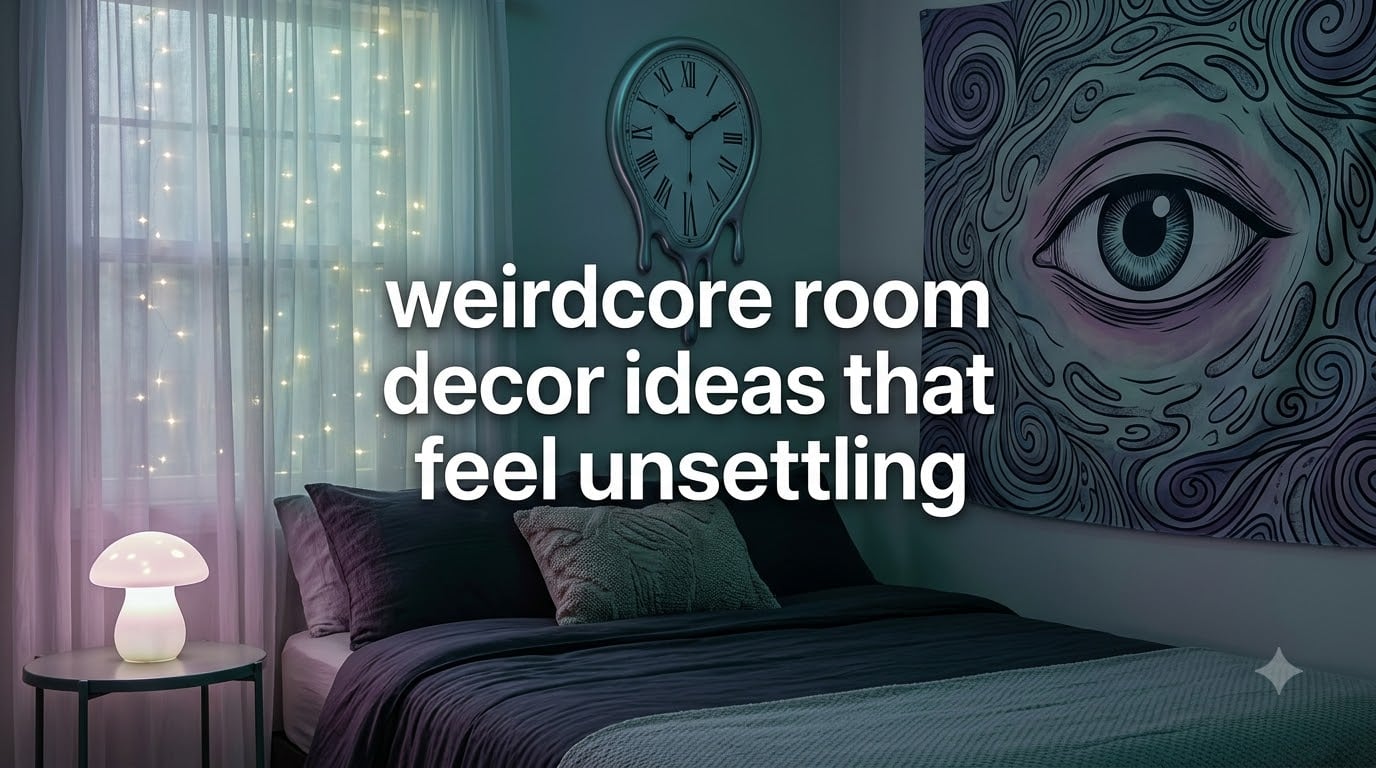
If your Pinterest feed has started sliding toward floating eyes, melted clocks, and empty hallways that feel one step too familiar, you’re not alone. The weirdcore aesthetic has quietly reshaped how a generation decorates, turning bedrooms into dreamlike dioramas that feel half-comforting and half-haunted. I spent weeks pulling apart Pinterest boards, Reddit threads, and surrealist art history to put together this guide on weirdcore room decor ideas that feel unsettling, without tipping into tacky Halloween territory.
Below, I’ll cover what weirdcore actually is, why it triggers that specific eerie feeling, the motifs you can’t skip, twelve concrete ideas you can pull off in a weekend, and the one rule that separates intentional unsettling from costume-shop chaos.
Table of Contents
What Is Weirdcore?
Weirdcore is a surreal, low-fidelity internet aesthetic that pairs familiar, nostalgic imagery with distorted, dreamlike visuals, including floating eyes, melting clocks, liminal hallways, and warped text, to create a subtle feeling of psychological unease. Think of an old family photo that has been slightly warped, a hallway in a building you almost remember, or a child’s drawing where one face is just a little too wide.
Is weirdcore a real aesthetic? Yes, although it’s less a strict design movement and more an internet-born mood board that spread through Tumblr, TikTok, and indie horror games like Yume Nikki and LSD Dream Emulator. It borrows directly from surrealist painters like René Magritte and Salvador Dalí, then layers in digital artifacts – grainy textures, glitchy color, low-res scans – that feel half-familiar, half-wrong.
It also lives next door to several sibling aesthetics, and people mix them up constantly. Here’s how the main four compare.
| Aesthetic | Core Vibe | Signature Motifs | Lighting Mood | Best Room Type |
|---|---|---|---|---|
| Weirdcore | Unsettling, dreamlike, slightly wrong | Floating eyes, distorted faces, warped text, liminal spaces | Dim warm lamps, flickering LEDs, blacklight accents | Bedroom, reading nook, creative studio |
| Dreamcore | Soft, sleepy, nostalgic | Empty pools, pastel skies, floating doors, soft clouds | Soft pink or lavender glow, fairy lights | Bedroom, child’s room |
| Strangecore | Quirky, maximalist, playful | Bright colors, kitsch objects, layered patterns | Bold neons, colorful bulbs | Kitchen, studio apartment, shared spaces |
| Creepycore | Horror-leaning, gothic, darker | Dolls, blood imagery, abandoned places | Cold blue, harsh shadows | Halloween room, themed event spaces |
You can absolutely mix them – a weirdcore bedroom with one creepycore shelf, for instance – but knowing the difference keeps your room from drifting into a different genre entirely.
Why Weirdcore Feels Unsettling
The eerie feeling weirdcore triggers isn’t random. It comes from the brain trying to resolve a contradiction: the imagery looks familiar, but something is just slightly off. Psychologists call this the uncanny valley effect, and it’s the same reason mannequins, wax figures, and slightly-too-real robots give us chills.
Three ingredients are usually in play at once.
Nostalgia turned slightly wrong
Old photos, 90s anime stills, children’s TV textures, vintage milk cartons – all the comfort cues of a remembered childhood. Weirdcore keeps the comfort, then warps one detail. A smile becomes too wide. An eye moves to the forehead. The brain registers the comfort and the wrongness at the same time, which creates a low-grade dread that lingers.
Liminal spaces
Liminal spaces are transitional places caught between uses – empty malls at 3 a.m., hotel hallways, abandoned classrooms, airports after the last flight. They feel familiar because we have all been in them, but stripped of people they read as eerie. Weirdcore leans hard on this, using empty corridors and unlit pools to create a feeling of almost-recognition.
Low-fidelity visuals
Grainy textures, 240p scans, GIF artifacts, and warped color all signal “old” or “found” to the brain. That aged quality turns a normal image into something that feels recovered from a memory, which makes the distortion feel earned rather than staged.
Together, these three layers produce what fans describe as “something off in a familiar place.” It’s that phrase, more than any specific motif, that defines the weirdcore feeling.
Core Weirdcore Motifs Every Room Needs
You don’t need every weirdcore motif to pull the aesthetic off, but the strongest rooms usually carry three or four of these recurring visual elements. If you only pick one or two, choose based on what feels personal to you – that’s how you avoid the Halloween-in-July trap.
Floating eyes and winged eyes
The single most common weirdcore image. Eyes by themselves, sometimes winged, sometimes bleeding, sometimes gently watching from a corner. They work because eyes carry emotional weight without needing a face attached.
Mushrooms with a sickly glow
Mushroom lamps, mushroom prints, mushroom-shaped cushions. They read as fairy-tale at first, then slightly toxic on closer look – which is exactly the weirdcore sweet spot.
Distorted faces and smiles
A face that’s been stretched, blurred, or stretched into an impossibly wide grin. Often borrowed from old meme edits or vaporwave edits.
Melting clocks and warped text
Directly from Dalí’s “The Persistence of Memory.” A melted wall clock or a piece of text that droops like it’s been left in the sun.
Empty hallways, pools, and staircases
The liminal space toolkit. Print one poster of an empty pool at dusk, and your entire room reads differently.
Weirdcore Room Decor Ideas That Feel Unsettling
Here are twelve ideas you can layer into a bedroom, reading nook, or studio. Start with one or two, then add pieces as you find them – weirdcore rooms feel best when they’re collected, not decorated in a single afternoon.
1. Build a wall collage of distorted portraits
Print or thrift a dozen old portrait photos, then digitally warp one feature on each – widen a smile, slide an eye, blur a jawline. Print in black and white and pin them tightly together on one wall. The eye sees a cluster of faces first, then catches the wrongness on closer look.
2. Hang a melting clock as the room’s anchor
One large melting clock above the bed or desk works as a focal point. The Dalí reference gives the room cultural weight, and the warped silhouette signals the aesthetic before anyone reads anything on the walls.
3. Add a mushroom lamp with a sickly warm glow
Mushroom lamps in amber, pink, or bruised-purple glass give off light that feels half-nursery, half-marsh. Place one on a side table or shelf where the bulb is hidden – the glow does the work.
4. String fairy lights behind a floating curtain
Sheer white curtains hung slightly off the wall, with warm fairy lights tucked behind, create a hazy barrier that softens the whole room. It reads as dreamy, then slightly trapped once the lights dim.
5. Drape one surrealist tapestry
One large tapestry beats five small posters. Look for prints that remix classical art – an H.R. Giger figure, a Magritte cloud, a giant floating eye – and let it cover a wall. Tapestries are also a major weirdcore staple on Etsy and Redbubble.
6. Use dim warm lamps instead of overhead lights
Overhead light is the enemy of weirdcore. Swap your ceiling bulb for a dimmer or leave it off entirely, and run the room on two or three low-wattage warm lamps. The shadows do the unsettling work.
7. Add a flickering LED candle on the shelf
A single flickering candle – LED is fine – on a stack of old books or a small altar instantly reads uncanny. The trick is to leave it alone; the flicker should be the only thing moving in that corner.
8. Place a small blacklight behind a sheer print
Blacklight posters get a bad rap because of dorm rooms, but one UV bulb behind a thin, surreal print creates a glow that’s eerie without being obvious. Choose prints with strong shapes – a winged eye, a giant moth, a moon.
9. Layer old clocks, keys, and small objects on a tray
A tray of thrifted oddities – pocket watches, brass keys, a single porcelain eye, a small ceramic hand – becomes a still-life on your shelf. It’s the kind of detail people notice third, which is when the room starts to feel curated.
10. Choose bedding with warped prints
A duvet cover with a single repeated surreal motif – giant floating eyes, melting faces, distorted florals – sets the tone before any wall art does. Stick to washed-out pastels, dirty yellows, or bruised purples for that liminal palette.
11. Project a slow-moving light pattern at night
A small rotating gobo or aurora projector throws soft shapes across the ceiling. Aim it at a wall with peeling texture or a curtain and the moving light reads as something alive in the room.
12. End with a scent that doesn’t match the room
Weirdcore is visual, but scent closes the loop. Try a candle that smells like wet stone, cold linen, or old paper. A scent that doesn’t match what the eye expects is the final unsettling note.
How to Keep Weirdcore Unsettling Without Looking Tacky
This is the question every Reddit thread on weirdcore decor lands on. The difference between intentional and tacky almost always comes down to restraint, palette, and a single anchor piece.
Pick one anchor piece. One large, serious surrealist object – a melting clock, a giant eye tapestry, a single surrealist painting – does more work than ten small gimmicks. The room reads as collected, not cluttered.
Stick to a muted palette. Washed-out pastels, off-whites, bruised purples, dirty yellows, and deep greens hold the dreamlike tone. Bright primary colors pull the room toward strangecore or kid’s room.
Avoid glow-in-the-dark stars and obvious Halloween props. Plastic skeletons, dripping fake blood, and glow-in-the-dark ceiling stars are the fastest path to tacky. They signal costume, not aesthetic.
Hide the light sources. If you can see the bulb, the room reads as lit. If you only see the glow, the room reads as atmospheric. Tuck lamps behind books, inside paper lanterns, or under sheer fabric.
Edit at the end. Take three things off the shelf. Almost every tacky weirdcore room is over-stocked, not under-stocked. The unsettling feeling comes from the right detail in the wrong place, which means there has to be space for it to feel out of place.
Where to actually find these pieces matters too. Etsy, Depop, and Redbubble are the main hunting grounds for weirdcore art prints and tapestries. Thrift stores and estate sales are the best source for old clocks, brass keys, vintage portraits, and odd ceramics. Independent Zines and small-press artists on Instagram are where you’ll find the genuinely strange pieces that don’t show up on Amazon.
Frequently Asked Questions
What is the weirdcore aesthetic?
Weirdcore is a surreal, low-fidelity internet aesthetic that pairs familiar, nostalgic imagery with distorted, dreamlike visuals – floating eyes, melting clocks, liminal hallways, and warped text – to create a subtle feeling of psychological unease.
Is weirdcore a real aesthetic?
Yes. Weirdcore is an established internet-born aesthetic that spread through Tumblr, TikTok, and indie horror games like Yume Nikki. It borrows from surrealist painters like Magritte and Dalí and adds digital artifacts like grain, glitch, and low-res scans to create a feeling of something slightly off in a familiar place.
What is the difference between weirdcore and dreamcore?
Dreamcore leans soft, sleepy, and nostalgic – empty pools, pastel skies, fairy lights, and a quiet dreamy mood. Weirdcore keeps that dreamlike base but warps one detail to make it unsettling – a face that’s too wide, an eye in the wrong place, a hallway that feels one shade too empty.
How do I make my room look weirdcore without it being tacky?
Pick one anchor piece instead of many small gimmicks, stick to a muted palette of washed-out pastels and bruised purples, hide your light sources so only the glow is visible, and edit three items off the shelf at the end. Skip glow-in-the-dark stars, plastic skeletons, and obvious Halloween props – those signal costume, not aesthetic.
What are some creepy art styles similar to weirdcore?
Other creepy-but-aesthetic art styles include dreamcore (soft and sleepy), strangecore (quirky and maximalist), creepycore (darker and horror-leaning), dark academia (moody libraries and old buildings), and liminal space photography (empty transitional places like hallways and pools).
Conclusion
The best weirdcore room decor ideas that feel unsettling share one rule: the room has to feel remembered, not decorated. Pick one anchor piece, build a muted palette around it, hide the lights so only the glow shows, and edit aggressively at the end. The unsettling feeling comes from a single wrong detail in an otherwise familiar space, which is why restraint matters more than the size of the collection.
Start with a melting clock, a mushroom lamp, or a single floating-eye tapestry, then layer from there. The room will feel like a dream you almost had – and that’s exactly the point of weirdcore room decor ideas that feel unsettling.