
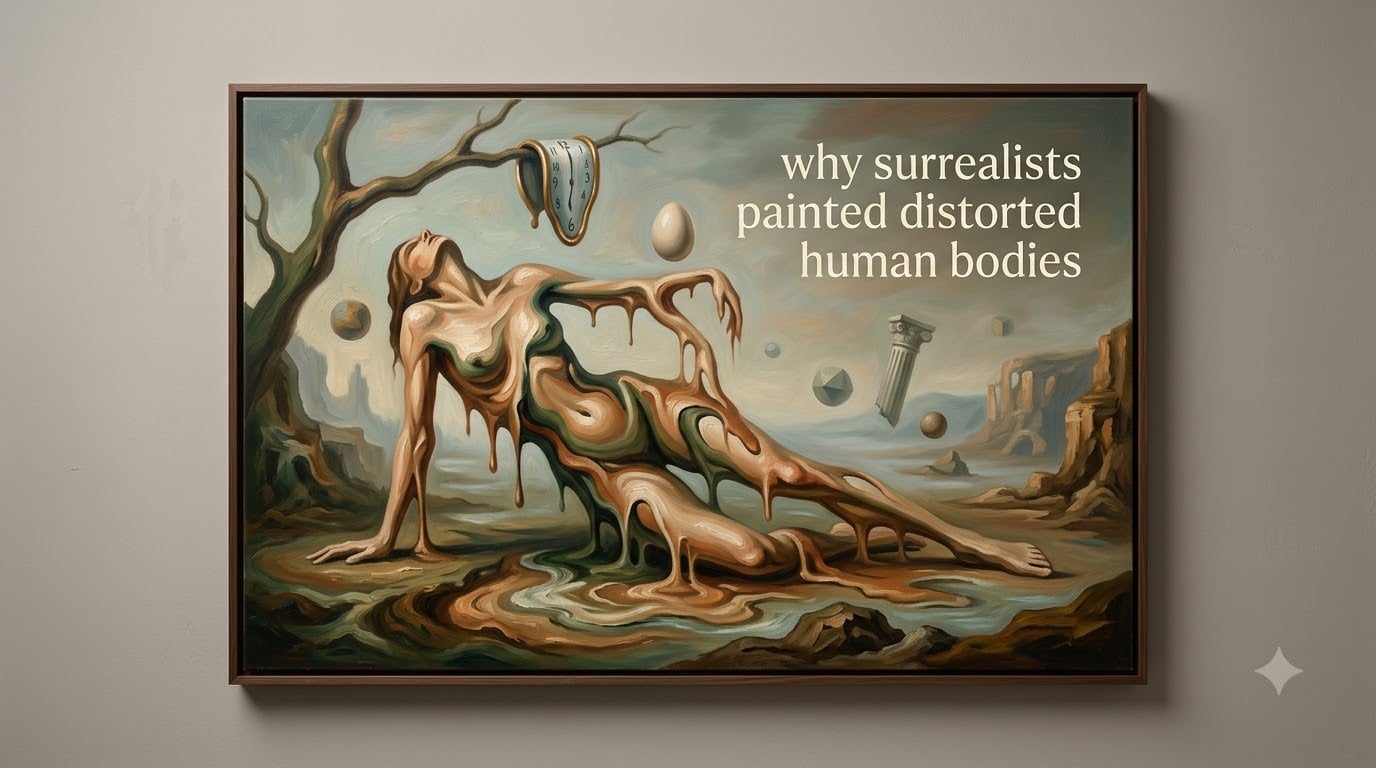
Surrealists painted distorted human bodies because they believed the unconscious mind—not rational thought—revealed the deepest truths about human existence. Influenced by Freudian psychoanalysis, artists like Salvador Dalí, René Magritte, and Frida Kahlo used distortion to express repressed desires, confront war trauma, and challenge classical ideals of beauty. The distorted body became Surrealism’s most powerful tool for exposing what civilized society preferred to hide.
Table of Contents
What Is Surrealism and Why Does the Body Matter?
Surrealism emerged in 1920s Paris as a revolutionary artistic and literary movement. André Breton published the Manifesto of Surrealism in 1924, defining the movement as “psychic automatism in its pure state”—a way to express thought free from rational control.
From its earliest days, Surrealism placed the human body at its center. Unlike Cubism, which fragmented objects into geometric planes, Surrealists distorted the body to reveal psychological truths. The body became a canvas for the unconscious, a site where desire, fear, trauma, and identity collided.
MoMA’s curators note that “Surrealists produced objects and images with an insistently erotic dimension,” driven by their deep engagement with Freudian psychology. The distorted body wasn’t random—it was a deliberate strategy to bypass the rational mind and speak directly to the viewer’s unconscious.
Freud, the Unconscious, and the Distorted Body
Sigmund Freud’s theories became the intellectual backbone of Surrealism. His ideas about the unconscious mind, dream interpretation, and repressed desires gave Surrealists a framework for understanding why distortion felt more “true” than realistic representation.
Freud argued that dreams are the “royal road to the unconscious”—that beneath our waking rationality lies a world of forbidden wishes, childhood memories, and primal fears. Surrealists took this literally. If the unconscious distorts reality in dreams, then art should distort the human body to access those same hidden truths.
The concept of repression was crucial. Freud taught that civilized society forces us to suppress our deepest impulses—sexual desire, aggression, anxiety about death. These repressed feelings don’t disappear; they surface in dreams, slips of the tongue, and neurotic symptoms. Surrealists saw distorted bodies as visual manifestations of these repressed forces breaking through to the surface.
As one Reddit user on r/ArtHistory explains, many viewers struggle to connect Freudian concepts to specific paintings. But the connection is direct: when Dalí paints melting clocks draped over a human figure, he’s visualizing how time and mortality haunt the unconscious mind. When Magritte obscures lovers’ faces with cloth, he’s showing how desire is always partially hidden, always incomplete.
Dreams, Automatism, and the Surrealist Technique
Surrealists developed specific techniques to access the unconscious and produce distorted imagery. The two main approaches were automatism and veristic Surrealism—and each produced different kinds of bodily distortion.
Automatism involved drawing or painting without conscious control. Artists like André Masson and Joan Miró would let their hands move freely across the canvas, producing biomorphic forms—organic, flowing shapes that suggested human bodies without depicting them realistically. These automatic drawings often revealed strange, hybrid creatures that seemed to emerge directly from the artist’s unconscious.
Veristic Surrealism took the opposite approach. Artists like Dalí and Magritte painted with meticulous technical skill, but depicted impossible scenes rendered with photographic precision. Dalí called this technique “hand-painted dream photographs.” The distortion here wasn’t in the brushwork—it was in the subject matter itself. Bodies melted, fragmented, or merged with objects in ways that defied physics but felt psychologically true.
Both approaches shared a common goal: bypassing the “censor” of rational consciousness. Whether through spontaneous gesture or precise rendering, the distorted body was a gateway to the unconscious mind.
War Trauma and the Fractured Human Form
The historical context of Surrealism cannot be separated from its distorted bodies. The movement emerged in the aftermath of World War I, a conflict that shattered European confidence in rational progress and civilized values.
MoMA’s exhibition materials highlight the direct connection between WWI veterans and Surrealist imagery. Many early Surrealists had witnessed the war’s devastation firsthand. They had seen bodies torn apart by industrial warfare, faces disfigured by gas attacks, soldiers returning home as psychological wrecks. The classical ideal of the perfect human body—the Renaissance inheritance of Michelangelo and Raphael—seemed obscene in a world that had produced the trenches of the Somme.
The interwar period brought its own anxieties: economic collapse, the rise of fascism, the threat of another global conflict. Surrealists responded by painting bodies that reflected this fractured reality. Figures split apart, merged with machines, or dissolved into landscapes—visual metaphors for a civilization that seemed to be coming apart at the seams.
Francis Bacon, though often associated with post-war existentialism rather than pure Surrealism, pushed this logic to its extreme. His screaming popes and distorted portraits captured the raw vulnerability of human existence. As one art critic notes, Bacon believed that “if you want to convey fact, this can only ever be done through a form of distortion.”
Identity, the Self, and Bodily Transformation
For Surrealists, the distorted body was also a way to question the very concept of stable identity. If Freud showed that we are divided between conscious and unconscious drives, then the self is never unified, never whole. The fragmented body in Surrealist art reflects this psychological fragmentation.
Metamorphosis—the transformation of one thing into another—became a central Surrealist motif. Dalí’s bodies morph into furniture, animals, or geological formations. Magritte’s human figures dissolve into sky or stone. These transformations suggest that identity is fluid, unstable, and always in flux.
This interest in transformation connects to broader Surrealist concerns with dreams, madness, and altered states of consciousness. In dreams, we become other people, fly through the air, watch our own bodies dissolve. Surrealists sought to capture this dreamlike instability in paint, creating bodies that are simultaneously human and other, familiar and strange.
Notable Surrealist Artists and Their Distorted Bodies
Understanding why surrealists painted distorted human bodies requires looking at specific artists and their signature approaches to bodily distortion.
Salvador Dalí: Melting, Morphing, Dissolving
Dalí’s bodies are perhaps the most recognizable in Surrealist art. His figures melt like cheese, stretch like taffy, or sprout drawers and crutches. In The Persistence of Memory (1931), the melting clocks suggest a body unmoored from linear time. In The Great Masturbator (1929), a soft, biomorphic head shape absorbs and transforms surrounding figures, visualizing the way sexual anxiety distorts perception.
Dalí’s technique was precise—he painted with academic skill—but his subjects defied logic. This combination of realistic rendering and impossible content created what he called “irrational knowledge,” a way of seeing that bypassed rational thought to access deeper truths.
René Magritte: Hidden Faces and Obscured Bodies
Magritte’s distortions are subtler but equally unsettling. In The Lovers (1928), two figures kiss with their faces shrouded in white cloth—intimate yet impossibly separated. In The Son of Man (1964), a man’s face is hidden behind a floating green apple. These images suggest that identity is always partially concealed, that we can never fully know ourselves or others.
Magritte’s bodies aren’t melting or fragmenting; they’re being obscured, covered, made anonymous. His distortion works through concealment rather than deformation, raising questions about visibility, identity, and the masks we wear.
Frida Kahlo: Pain, Surgery, and the Broken Body
Kahlo’s self-portraits are among the most visceral depictions of the distorted body in art history. A bus accident at age 18 left her with lifelong injuries—her spine, pelvis, and right leg were severely damaged. Her paintings transform this personal trauma into universal imagery.
In The Broken Column (1944), Kahlo paints herself with her torso split open to reveal a crumbling ionic column in place of her spine. Nails pierce her skin. A surgical brace holds her together. This is distortion as autobiography—the body as a site of ongoing pain and resilience. Kahlo’s work demonstrates that distortion can be deeply personal, not just philosophical.
Max Ernst: Collage, Frottage, and Hybrid Creatures
Ernst pioneered techniques like frottage (rubbing) and grattage (scraping) to create textures that suggested bodily forms. His collages assembled human figures from disparate parts—bird heads, mechanical limbs, geological fragments—creating hybrid beings that seemed to exist between species and kingdoms.
Ernst’s bodies are often violent, sexual, or both. His 1920s collages combine Victorian engravings with anatomical illustrations, producing figures that are simultaneously elegant and monstrous. These works suggest that the human body is always composite, always assembled from fragments of culture, biology, and desire.
Female Surrealists and the Distorted Body
While male Surrealists like Dalí and Magritte dominate popular discussions, female Surrealists developed their own distinctive approaches to bodily distortion—and their work has been critically underexamined.
Leonora Carrington painted fantastical creatures that are part-human, part-animal, part-mythological being. Her bodies don’t just distort—they transform entirely, suggesting that identity is something we construct, not something we’re born with. Carrington’s work draws on Celtic mythology, alchemy, and Jungian psychology to create a vision of the body as endlessly mutable.
Remedios Varo, Carrington’s close friend and fellow exile in Mexico, created figures that seem to be in constant states of becoming. Her women often appear caught mid-transformation—growing wings, dissolving into light, merging with architecture. Varo’s distortion is gentler than Dalí’s but equally radical, suggesting that the female body can be a site of creative power rather than just objectification or pain.
Frida Kahlo’s work, discussed above, represents perhaps the most personal use of bodily distortion in Surrealism. Her self-portraits don’t just distort the body—they expose it, laying bare the physical and emotional wounds that shaped her life. Kahlo’s approach was fundamentally different from her male contemporaries: where they theorized about the unconscious, she painted her lived experience.
As scholars have noted, female Surrealists often approached bodily distortion from a position of lived experience rather than theoretical abstraction. Their bodies weren’t symbols of Freudian desire—they were sites of personal history, cultural identity, and creative resistance.
The Erotic and Transgressive Dimension
MoMA’s curators identify an “insistently erotic dimension” in Surrealist art, and the distorted body was central to this eroticism. Surrealists drew heavily on the writings of the Marquis de Sade and Georges Bataille, who argued that transgression—the violation of taboos—was a path to liberation.
Bataille, in particular, influenced how Surrealists depicted the body. His concept of “eroticism” wasn’t about romantic love; it was about the dissolution of boundaries between self and other, life and death, pleasure and pain. Surrealist bodies that bleed, merge, or dissolve visualize this boundary-dissolution.
This transgressive dimension helps explain why Surrealism can feel disturbing or “scary” to modern viewers. The distorted body in Surrealist art isn’t meant to be comfortable. It’s meant to unsettle, to provoke, to force viewers to confront desires and fears that rational culture has taught them to suppress.
Frequently Asked Questions
What are the 7 characteristics of surrealist art?
The seven key characteristics of surrealist art are: dreamlike imagery, unexpected juxtapositions, automatism (creating without conscious control), biomorphic forms, distorted or metamorphosing bodies, symbolic or irrational content, and a focus on the unconscious mind. These characteristics work together to bypass rational thought and access deeper psychological truths.
What did Freud say about Surrealism?
Freud never directly endorsed Surrealism, but his theories about the unconscious mind, dream interpretation, and repressed desires became the movement’s intellectual foundation. Surrealists adopted his idea that dreams reveal hidden truths and that civilized behavior masks primitive impulses. Breton and others saw art as a way to access the unconscious, just as Freud used free association and dream analysis in therapy.
Why is Surrealism scary?
Surrealism can feel disturbing because it depicts the contents of the unconscious mind—repressed fears, desires, and anxieties—that rational culture teaches us to suppress. Distorted bodies, melting forms, and impossible scenes tap into primal fears about identity, mortality, and bodily integrity. The movement also emerged from the trauma of World War I, so its imagery often reflects real violence and psychological devastation.
Who is the father of Surrealism?
André Breton is considered the father of Surrealism. A French writer and poet, Breton published the first Manifesto of Surrealism in 1924, defining the movement as ‘psychic automatism’ aimed at expressing thought free from rational control. He led the Surrealist group in Paris throughout the 1920s and 1930s, establishing the theoretical framework that guided the movement’s artists and writers.
Conclusion: Why Surrealists Painted Distorted Human Bodies
The distorted body in Surrealist art is far more than artistic provocation. It is a deliberate strategy for accessing the unconscious mind, confronting war trauma, questioning stable identity, and challenging the classical ideals of beauty that Western art had inherited from the Renaissance.
From Dalí’s melting figures to Kahlo’s exposed organs, from Magritte’s hidden faces to Carrington’s hybrid creatures, Surrealists used distortion to reveal what realistic representation conceals. They showed that the human body is not a fixed, stable entity but a site of desire, fear, transformation, and endless psychological complexity.
Understanding why surrealists painted distorted human bodies means understanding the movement’s core conviction: that the unconscious mind holds truths more profound than rational thought, and that art’s highest purpose is to make those truths visible. In a world scarred by war and haunted by repression, the distorted body became Surrealism’s most powerful—and most necessary—invention.