
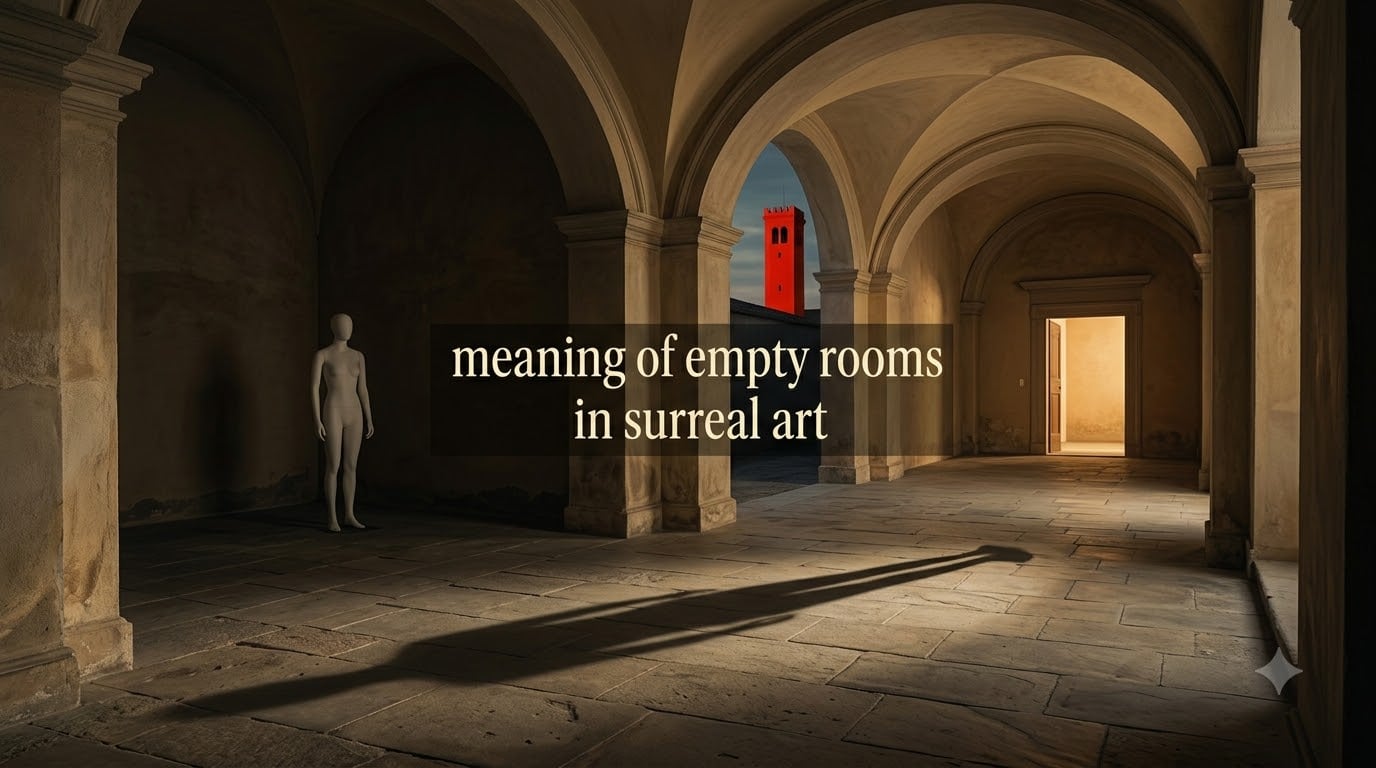
An empty room in surreal art is a deliberately depopulated interior or architectural scene used by Surrealist and earlier metaphysical painters to evoke the unconscious, memory, loneliness, and the threshold between dream and reality – what is missing becomes the true subject of the painting. When Giorgio de Chirico painted sunlit Italian piazzas with no figures in them, and when René Magritte hung a single lamp in a backlit bedroom sky, they were not depicting absence as lack. They were inviting the viewer to feel it.
I have spent years looking at surrealist paintings in galleries and reproductions, and the empty-room motif keeps pulling me back. In this guide, I’ll walk you through where the empty room came from, what it means, who painted the most important examples, and how to read one when you stand in front of it. By the end, you will see these deceptively quiet canvases the way the artists intended – as doors left wide open.
Table of Contents
What Empty Rooms Mean in Surreal Art
In surreal art, an empty room is a deliberate compositional choice in which the human figure is removed so that atmosphere, light, perspective, and shadow carry the painting’s meaning. The emptiness is not a void. It is a signal. By clearing the room of narrative, the painter forces the viewer to project his or her own memories, anxieties, and dreams into the space.
Across decades of work by de Chirico, Magritte, Dalí, Balthus, and others, this motif has carried a recognizable cluster of meanings:
- Threshold and transition. Empty rooms sit between indoors and outdoors, past and present, sleep and waking – a doorway you have not yet stepped through.
- Memory and absence. The room is the shape someone left behind. You feel the figure who should be there.
- Modern alienation. A space built for people, emptied of them, mirrors the loneliness of the modern city.
- Unconscious dreaming. Following André Breton and Freud, Surrealists used empty interiors as waking dreams – the mind as a furnished room no one has entered.
- Mortality and stillness. A room with no one in it hints at memento mori: a quiet house after the family has gone.
- The uncanny. Familiar domestic things – a window, a corridor, a curtain – become strange when the warmth of a body is removed.
The next sections trace where this idea began, who carried it forward, and how to spot it on a gallery wall.
From Metaphysical Painting to Surrealism
The empty room did not begin with Surrealism. It began a few years earlier, in a movement called metaphysical painting (in Italian, pittura metafisica), which flourished in Italy between roughly 1910 and 1920. Its founders, Giorgio de Chirico and Carlo Carrà, painted Italian arcades and piazzas in a realist style but emptied them of ordinary life, leaving only statues, arcades, and unnaturally long shadows.
Surrealism inherited this device and pushed it further. André Breton published the first Surrealist Manifesto in 1924, defining the movement as a way to express the unconscious mind. Empty rooms fit perfectly: with no figure competing for attention, the painting could behave like a dream – illogical perspective, frozen time, unsettling light. So when readers ask about metaphysical painting vs Surrealism, the simplest answer is this: metaphysical painting invented the empty room, and Surrealism made it a language.
Giorgio de Chirico and the Birth of the Empty Room
If anyone “owns” the empty-room motif, it is Giorgio de Chirico. Between 1911 and about 1919 he produced a string of paintings – Mystery and Melancholy of a Street (1914), The Red Tower (1913), The Soothsayer’s Recompense (1913), and many others – that defined the visual grammar every later artist worked from.
The de Chirico formula is recognizable at a glance:
- Italian piazzas and arcades painted in crisp, academic realism.
- Exaggerated, often contradictory perspective, with deep shadows that fall at impossible angles.
- Long, sharp shadows cast by statues, towers, or buildings, suggesting a hidden protagonist just out of frame.
- Faceless mannequins or classical statues standing in for the absent human.
- A sense of haunting stillness, like a stage after the actors have left.
De Chirico said he wanted to capture “disturbing insight” – a metaphysical moment when the surface of the everyday cracks and another world shows through. Nietzsche’s philosophy and the death of his father in 1905 shaped this vision. The empty room, in his hands, is not nostalgic. It is a warning that reality is thinner than it looks.
Vilhelm Hammershøi: The Quiet Predecessor
Long before de Chirico and the Surrealists, the Danish painter Vilhelm Hammershøi (1864-1916) was building the same kind of silence. Working in apartments in Copenhagen, he painted nearly identical rooms – pale walls, a single door, a stove, a window – over and over, almost always without figures.
Hammershøi’s interiors are not “surrealist,” but they read like a rehearsal of the motif. The same soft north light, the same stripped-down geometry, the same sense that someone has just stepped out. Many later painters, including the Surrealists, knew his work, and his stripped-back interiors have resurfaced today as the visual style behind many “liminal space” images online.
If you want to understand why a surrealist room feels empty, it helps to look first at a Hammershøi. He is the silence the Surrealists amplified.
René Magritte’s Haunting Interiors
René Magritte used the empty room in a more cerebral way than de Chirico. Where de Chirico evokes atmosphere, Magritte sets up visual contradictions. His most famous painting in this mode, Empire of Light (also called The Dominion of Light, begun in the late 1940s and repeated through 1954), shows a quiet suburban street at night while the sky above glows with full daylight. A lamppost, a tree, a house – everything ordinary – yet the world is wrong.
Magritte’s other empty-interior work, including pieces like The Hereafter and the fireplace paintings, uses a fireplace, a mirror, or a curtained window as the only “character” in an otherwise unoccupied room. His goal, he said, was not to symbolize the unconscious but to make the viewer see the world afresh.
It is worth pausing on a small but important fact: Magritte himself denied that his empty interiors carried fixed symbolic meaning. He insisted they were exercises in mystery, not coded messages. That refusal is part of the point. A surrealist empty room is not a puzzle to solve. It is an instrument to play.
Dalí, Balthus, and Tanguy: Other Voices in the Empty
Salvador Dalí is the surrealist whose name most people know, and his contribution to the motif is the empty landscape more than the empty room. In The Persistence of Memory (1931) and many later paintings, he gave us barren Catalan horizons with melting clocks and no living figures. The landscape itself becomes the room – an interior of the mind with no walls.
Balthus (Balthasar Klossowski de Rola) approached the empty room with a colder, more charged stillness. His painting The Living Room (1943) shows a bare, sun-bleached room with a partially undressed adolescent figure – included here as a counter-example, because Balthus so often builds the same quiet interior as his Surrealist peers but refuses to leave it fully empty. The tension between presence and absence is the picture’s subject.
Yves Tanguy, finally, removed architecture altogether and replaced the empty room with an empty plain – rocky, lunar, infinite – as in Mama, Papa is Wounded! (1927). His work shows how the surrealist “empty” eventually escaped the room and became the surrealist void.
How to Recognize an Empty-Room Surrealist Painting
Once you know the clues, you start to see these paintings everywhere. Here are seven characteristics that almost always appear together:
- No central human figure. People may be implied or shown from behind, but the main character is the space itself.
- Architectural perspective that feels “off.” Floor tiles, arcades, or walls recede at angles slightly sharper than reality.
- Long, dramatic shadows. Shadows often fall in two directions or in directions that contradict the visible light source.
- Faceless mannequins or classical statues standing in for absent figures.
- Domestic objects isolated. A single chair, a curtain, a lamp, a door – one object asked to carry the whole painting.
- Quiet, frozen atmosphere. No wind, no movement, no narrative action – the moment after something happened, or before something will.
- Color or lighting that contradicts itself (most famously in Magritte’s Empire of Light).
Spotting five of these seven in a single painting is a strong signal you are looking at the surrealist empty-room tradition.
5 Canonical Empty-Room Paintings
For quick reference, here are five works that define the motif. I have kept the list short on purpose – these are the ones worth committing to memory.
- Giorgio de Chirico, The Red Tower (1913) – A glowing red tower rises behind arcades; the long shadow of an unseen figure points toward it. Threshold, mystery, foreshadowing.
- Giorgio de Chirico, Mystery and Melancholy of a Street (1914) – A girl runs past a wagon in an empty piazza; an arcade opens into a bright, unreachable distance. Childhood, anxiety, dream.
- Vilhelm Hammershøi, Interior with a Woman at the Piano (1901, plus many similar interiors) – A figure seen from behind in a stripped-down Copenhagen room. Quiet, memory, modern solitude.
- René Magritte, Empire of Light (series, 1949-1954) – A suburban street at night under a bright daylight sky. The uncanny, contradiction, the everyday made strange.
- Balthus, The Living Room (1943) – A bare, sunlit room with a single seated figure, posed as still as a mannequin. Tension between presence and absence.
Why Empty Rooms Feel Uncanny: The Psychology of Absence
There is a psychological reason the empty room works so consistently. Freud called it das Unheimliche – the uncanny. A place that should be familiar, like a living room or a city square, becomes unsettling the moment the warmth of a person is removed. We recognize the room and feel uneasy at the same time.
Artists exploit this through a figure-ground reversal: in most paintings, the figures are the “figure” and the room is the “ground.” In surrealist empty rooms, the room becomes the figure – the subject – and any ghost of a person is only background. The viewer’s eye stops looking for a character and starts reading the space itself.
This is why the surrealist empty room has resurfaced online as the “liminal space” or “Backrooms” aesthetic. A flooded hotel lobby, an empty mall at 3 a.m., a yellow wallpapered office with no windows – these are modern, internet-native versions of the same device. The motif has outlived its original painters.
How to Read an Empty-Room Surrealist Painting
Standing in front of one of these paintings, the worst thing you can do is look for a story. Try this instead:
- Notice the light first. Where is it coming from? Is it daytime or nighttime? Are the shadows consistent with it? Magritte’s contradictions hide here.
- Count the figures. People, mannequins, statues – or none at all. The number tells you whether the painting is “empty” in the surrealist sense or merely deserted.
- Follow the perspective lines. Walk your eye along the floor tiles or the vanishing point. If the angles feel slightly wrong, you are inside the surrealist trick.
- Identify the lone object. Surrealist empty rooms usually have one chair, lamp, curtain, or door asked to do the heavy lifting. What is it?
- Name the mood without naming the symbol. “Haunting,” “lonely,” “frozen,” “dreamy” – these are honest descriptions. Resist the urge to translate them into a fixed message.
Do this once, in a gallery or in front of a screen, and the next painting you look at will already look different.
Frequently Asked Questions
What does u0022empty spaceu0022 mean in art?
In art, empty space (also called negative space) is the area around and between the main subjects. In surrealist paintings, empty space is used deliberately to direct attention, create mood, and let the unconscious surface. An empty room is not a missing subject – it is the subject made visible by what is left out.
What is metaphysical painting?
Metaphysical painting (pittura metafisica) is an Italian art movement founded around 1910 by Giorgio de Chirico and Carlo Carrà. It depicted Italian piazzas, arcades, and interiors in a realist style but emptied them of ordinary life, replacing people with statues, long shadows, and exaggerated perspective. Surrealism inherited its use of the empty room and developed it further after André Breton published the first Surrealist Manifesto in 1924.
What is the meaning behind de Chirico’s art?
Giorgio de Chirico’s art aims to capture what he called ‘disturbing insight’ – moments when the surface of everyday reality cracks and a deeper, metaphysical world shows through. He painted Italian piazzas and arcades in academic realism but emptied them of figures, replaced people with faceless mannequins, and used exaggerated perspective and impossibly long shadows. The meaning of his work is the eerie sense that the ordinary world is thinner and stranger than it appears.
Why do surrealist paintings show empty rooms?
Surrealist painters showed empty rooms to evoke the unconscious mind, memory, and modern alienation without narrative distraction. Following André Breton and Freud, they used absence as a way to make dreamlike, archetypal, or anxious feelings surface without rational explanation. An empty room also produces the uncanny – a familiar space made strange by the removal of human warmth.
What are the 7 characteristics of surrealist art?
The seven characteristics of surrealist art most often cited are: dreamlike or unconscious imagery, unexpected juxtapositions of ordinary objects, use of the uncanny, vivid or symbolic color and light, precise realist technique applied to impossible scenes, exploration of desire, memory, and anxiety, and recurring motifs such as empty rooms, faceless mannequins, long shadows, and exaggerated perspective. The empty room is one of the strongest visual signatures of the movement.
Conclusion
The meaning of empty rooms in surreal art is not a single message but a method. By removing the human figure, de Chirico, Magritte, Dalí, Balthus, Tanguy, and the lesser-known Hammershøi before them turned the room itself into a subject – one that could carry memory, dream, anxiety, mortality, and the uncanny without ever needing a face. The empty room is surrealism’s most quiet, most repeatable, and most enduring idea.
Next time you stand in front of a de Chirico, a Magritte, or one of the modern “liminal space” images that have inherited this tradition, give the silence a few seconds. The painting is waiting for you to walk in.