
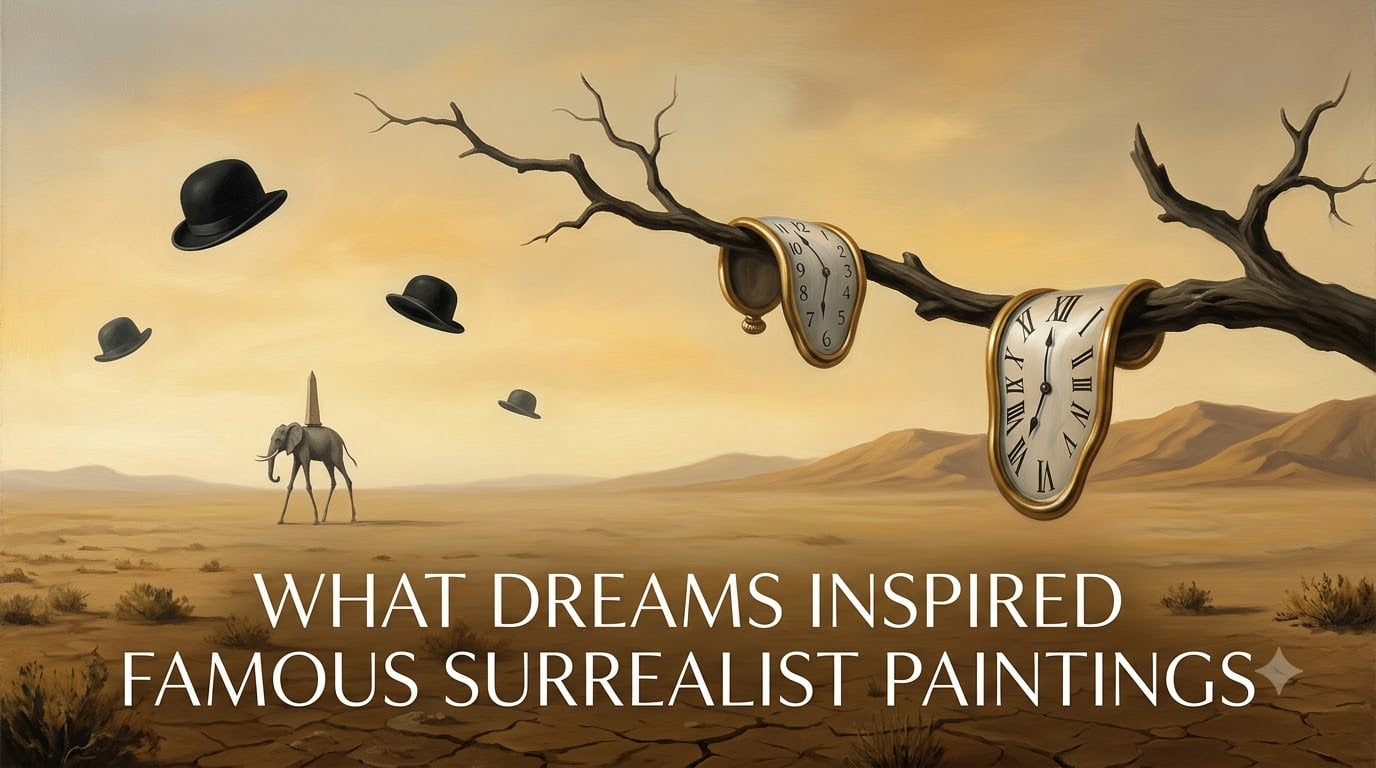
Surrealism is a 20th-century art movement that drew directly on the imagery of dreams to unlock the creative power of the unconscious mind. Founded in 1924 by André Breton and inspired by Sigmund Freud’s psychoanalytic theories, surrealist painters translated sleeping visions, free associations, and hallucinatory states onto canvas with startling precision. The question of what dreams inspired famous surrealist paintings leads us into a world where melting clocks, bowler-hatted men, and floating elephants emerged straight from the sleeping mind.
Below, I walk through the artists, the specific dreams behind their most celebrated works, and the techniques they used to bypass rational thought entirely. Whether you are an art student, a Freud reader, or simply drawn to dreamlike imagery, this guide maps the direct line from a painter’s unconscious to the masterpiece hanging in a museum.
Table of Contents
How Freud and Breton Turned Dreams Into Art
Before a single surrealist brushstroke was painted, Sigmund Freud published The Interpretation of Dreams in 1900. Freud argued that dreams are the “royal road to the unconscious” — a space where repressed desires, childhood memories, and forbidden thoughts surface in disguised, symbolic form. His book gave artists a theoretical framework for taking dreams seriously as creative material.
In 1924, André Breton published the Surrealist Manifesto, defining the movement as “pure psychic automatism” — the expression of thought in the absence of any rational control. Breton explicitly cited Freud’s dream theory as the movement’s intellectual foundation. Artists were now encouraged to record dreams, practice automatic writing, and treat the unconscious mind as a collaborator rather than an obstacle.
This philosophical shift produced a generation of painters who did not merely depict dreamlike scenes. They actively documented specific dreams, used psychoanalytic free association during the creative process, and developed technical methods designed to suppress conscious decision-making. The result was an art movement uniquely tied to the sleeping mind.
Salvador Dalí: The Dream Behind The Persistence of Memory
Salvador Dalí is the artist most closely associated with dream painting, and his 1931 masterpiece The Persistence of Memory is the movement’s most recognized image. Dalí claimed the melting clocks came to him in a half-sleeping state after staring at a piece of Camembert cheese melting in the sun. The soft, drooping watches symbolize the fluid, elastic way time behaves in dreams — stretching, collapsing, and losing all rigid structure.
Dalí developed what he called the paranoiac-critical method, a technique for inducing a self-induced paranoid state to generate hallucinatory imagery while remaining awake. He would enter a trance-like condition and allow irrational associations to flood his perception, then paint the resulting visions with meticulous, almost photographic realism. This method produced paintings like The Great Masturbator (1929) and Sleep (1937), the latter depicting a massive, unsupported sleeping head — a literal portrait of the dreaming mind.
Dalí also kept a dream journal and studied Freud’s writings obsessively. He even met Freud in person in 1938, an encounter Freud described as more interesting than his own theories. Dalí’s paintings of elephants on spider legs, drawers protruding from human bodies, and eggs cracking open on barren landscapes all drew from documented dream sequences and Freudian symbolism.
René Magritte: Bowler Hats, Pipes, and Dream Logic
René Magritte approached dreams differently from Dalí. Rather than painting hallucinatory visions, Magritte constructed scenes that feel like dreams through logical impossibility. His 1929 painting The Treachery of Images — a realistic pipe beneath the words “Ceci n’est pas une pipe” (“This is not a pipe”) — captures the way dream objects are simultaneously present and absent.
Magritte’s The Lovers (1928), showing two figures kissing with their faces wrapped in cloth, reflects the dream experience of intimacy blocked by invisible barriers. The draped faces are not random surrealism — they echo the way dream characters often appear familiar yet visually obscured, as if recognition itself is withheld. Many art historians connect this painting to the suffocation Magritte witnessed as a child when his mother’s body was pulled from a river with her nightgown wrapped around her face.
The Son of Man (1964), his self-portrait with a floating green apple obscuring the face, explores the dream tension between what is visible and what is hidden. Magritte once said he wanted to paint the conflict between the visible and the hidden — which is precisely what dreams do every night.
Max Ernst: Frottage, Decalcomania, and the Dream Machine
Max Ernst invented several techniques specifically to mimic the random, uncontrolled imagery of dreams. His method of frottage involved placing paper over textured surfaces — wood grain, leaves, fabric — and rubbing with a pencil to produce patterns his conscious mind had not planned. These accidental textures became forests, birds, and alien landscapes in works like Forest and Dove (1927).
Ernst also developed decalcomania, pressing paint between two surfaces and peeling them apart to create organic, biomorphic forms that resemble dream visions. His painting The Antipope (1942) uses this technique to produce figures that seem to emerge from primordial sludge — the kind of imagery that surfaces in hypnagogic states between waking and sleeping.
His recurring motif of birds, particularly his alter ego “Loplop, the Superior of Birds,” appeared across dozens of works and stemmed from a childhood hallucination. Ernst connected these visions to dream states throughout his career, making him one of the few surrealists who openly acknowledged that their visual vocabulary came from documented altered states of consciousness.
Women Surrealists and Their Dream Visions
Leonora Carrington and Remedios Varo created some of the most visually compelling dream paintings in the surrealist canon, yet they remain less celebrated than their male peers. Carrington’s The Inn of the Dawn Horse (1937–38) is a self-portrait surrounded by symbolic dream elements — a white rocking horse, a hyena, and a mysterious pendant — drawn from her own dream diaries and childhood folk tales.
Remedios Varo’s Still Life Reviving (1963) and Creation of the Birds (1957) depict scenes of alchemical transformation that feel like hypnagogic visions. Varo kept detailed dream journals and practiced automatic writing, translating sleeping imagery into paintings with the precision of an illustrator recording an observed reality. Her work has gained enormous recognition in recent years, with museum retrospectives drawing record attendance.
Leonor Fini, another overlooked surrealist, painted feline, powerful female figures that she explicitly described as dream archetypes. Fini rejected Breton’s formal surrealist group but maintained that her painting method was identical — she painted directly from dream imagery without conscious censorship. Together, these women demonstrate that the surrealist dream tradition was far broader than the Dalí-Magritte axis suggests.
Famous Dream-Inspired Paintings at a Glance
The table below maps the most famous surrealist paintings to the specific dream or unconscious state that inspired them. This is the clearest way to see how directly dreams shaped the movement’s masterworks.
| Artist | Painting | Year | Dream Origin | Key Symbol |
|---|---|---|---|---|
| Salvador Dalí | The Persistence of Memory | 1931 | Half-sleep vision of melting cheese | Melting clocks |
| René Magritte | The Lovers | 1928 | Childhood trauma; blocked intimacy in dreams | Shrouded faces |
| René Magritte | The Son of Man | 1964 | Visible vs. hidden in dream states | Floating apple |
| Max Ernst | The Antipope | 1942 | Hypnagogic imagery via decalcomania | Biomorphic figures |
| Salvador Dalí | Sleep | 1937 | Literal depiction of dreaming consciousness | Unsupported sleeping head |
| Leonora Carrington | The Inn of the Dawn Horse | 1938 | Personal dream diary entries | White rocking horse |
| Joan Miró | Harlequin’s Carnival | 1924–25 | Hunger-induced hallucinations | Biomorphic forms, musical notations |
Surrealist Techniques: How Artists Painted Dreams
Artists developed specific methods to bypass rational thought and access dream imagery directly. Understanding these techniques reveals why surrealist art looks the way it does — and why it continues to feel so uncannily dreamlike.
Automatism was the foundational surrealist technique. Artists drew or wrote without conscious control, allowing the hand to move freely across the surface. André Masson’s automatic drawings from the 1920s, done while in trances, produced tangled lines and organic forms that became the basis for finished paintings. Joan Miró used a similar approach for works like Harlequin’s Carnival, which began as a hunger-induced hallucination and was developed through spontaneous mark-making.
Dalí’s paranoiac-critical method went further — it was a deliberate practice of entering a paranoid, hallucinatory state to generate images. Unlike automatism, which suppresses control, the paranoiac-critical method actively cultivates irrational perception while maintaining enough awareness to record it. Dalí described it as a “spontaneous method of irrational knowledge based on the critical and systematic objectivity of the associations and interpretations of delirious phenomena.”
Frottage and grattage, invented by Max Ernst, used textured surfaces and scraping techniques to produce random patterns that the artist then developed into recognizable imagery. Exquisite Corpse, a collaborative drawing game, required each participant to draw part of a figure without seeing what others had drawn — producing composite bodies that resemble the fragmented, impossible anatomy of dreams.
Why Surrealist Dream Paintings Still Captivate Us
Surrealist dream paintings remain compelling because the unconscious has not changed since the 1920s. The anxieties, desires, and impossible logic that Freud documented in dreams are still the ones we experience every night. When we see Dalí’s melting clocks or Magritte’s floating apple, we recognize something from our own sleeping life — a feeling that rational daylight imagery cannot produce.
Directors like David Lynch, Guillermo del Toro, and Jan Švankmajer have carried the surrealist dream tradition into cinema. Advertising borrows surrealist imagery constantly — floating objects, impossible scales, dream-logic transitions — because the unconscious responds to it. The rise of AI-generated imagery has produced millions of images that resemble surrealist dreamscapes, suggesting that the movement’s visual language remains the most accurate transcription of how the human mind actually experiences its sleeping hours.
Frequently Asked Questions
Is Surrealism inspired by dreams?
Yes. Surrealism is fundamentally rooted in dreams. André Breton founded the movement in 1924 after reading Sigmund Freud’s The Interpretation of Dreams, and virtually every major surrealist painter used dream imagery, dream journals, or psychoanalytic free association as the starting point for their work.
What famous paintings were inspired by dreams?
The most famous dream-inspired surrealist paintings include Salvador Dalí’s The Persistence of Memory (1931), which came from a half-sleeping vision of melting cheese; René Magritte’s The Lovers (1928), connected to childhood dream trauma; and Max Ernst’s The Antipope (1942), created using decalcomania to mimic hypnagogic imagery.
Is there a Dalí dream painting?
Several Dalí paintings directly depict dream states. Sleep (1937) is a literal portrait of the dreaming mind — a massive, unsupported head with closed eyes. The Persistence of Memory (1931) captures the elastic, fluid sense of time in dreams. Dream Caused by the Flight of a Bee Around a Pomegranate a Second Before Awakening (1944) explicitly portrays a specific dream sequence.
What is the meaning behind Magritte’s paintings?
Magritte’s paintings explore the gap between perception and reality — a core dream experience. The Treachery of Images shows a pipe that is not a pipe, questioning whether images are ever what they seem. The Lovers depicts intimacy blocked by cloth, reflecting how dream figures feel simultaneously familiar and obscured. His work consistently asks what we really see versus what we think we see.
Did surreal artists explain their artwork?
Yes, many surrealist artists were highly articulate about their methods. Salvador Dalí published detailed explanations of his paranoiac-critical method. André Breton wrote the Surrealist Manifesto as a programmatic document. René Magritte gave extensive interviews explaining his philosophical approach. Max Ernst documented his techniques of frottage and decalcomania in writing.
What is the paranoiac-critical method?
The paranoiac-critical method was Salvador Dalí’s technique for entering a self-induced paranoid state to generate hallucinatory imagery while remaining awake enough to paint it. Unlike automatism, which suppresses conscious control, the paranoiac-critical method actively cultivates irrational perception. Dalí used it to produce the double images and impossible perspectives in paintings like The Great Masturbator.
Why do surrealist paintings look like dreams?
Surrealist paintings look like dreams because they were created using techniques designed to bypass rational thought. Automatism mimics the free-association of sleep, frottage produces the random textures of hypnagogic states, and the paranoiac-critical method induces waking hallucinations. The artists deliberately used these methods to access and reproduce the imagery of the unconscious mind.
Conclusion
The relationship between dreams and surrealist art is not metaphorical — it is literal. Artists like Dalí, Magritte, Ernst, Carrington, and Varo painted directly from documented dreams, hypnotic trances, and psychoanalytic free association. Understanding what dreams inspired famous surrealist paintings means understanding that the unconscious mind was not an influence on the movement; it was the movement’s entire creative source.
Start by visiting a museum with surrealist holdings — the MoMA, the Dalí Theatre-Museum in Figueres, or the René Magritte Museum in Brussels. Keep a dream journal for a week. Then look at these paintings again. You will recognize the imagery immediately.