
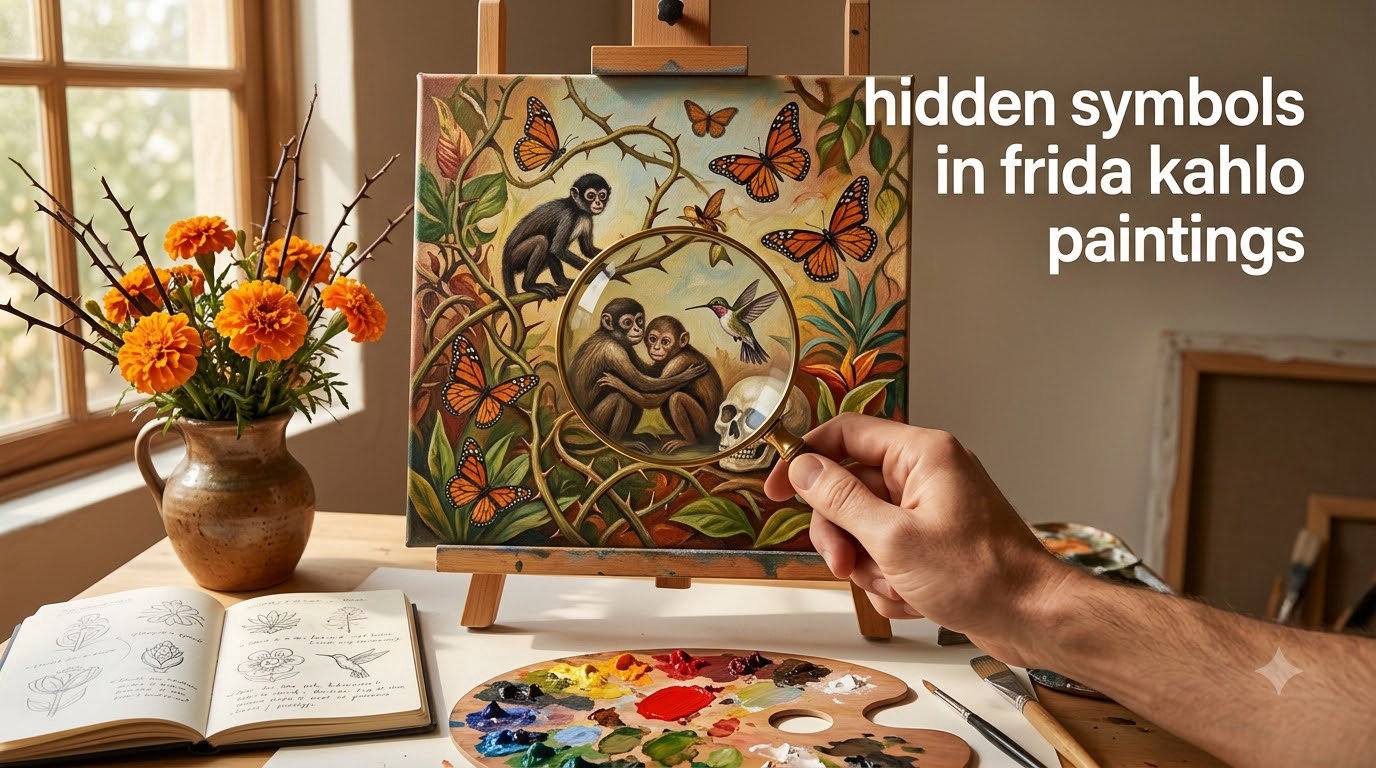
Frida Kahlo spent most of her life inside a corset of pain. After a 1925 bus crash in Mexico City shattered her spine and pelvis, she lay in bed, taught herself to paint, and turned her own face into a canvas of coded images. By the time she died in 1954 she had produced roughly 143 paintings — 55 of them self-portraits — every one of them loaded with hidden symbols in Frida Kahlo paintings that most viewers still walk past without noticing.
I have spent years studying her work at the Casa Azul in Coyoacán and in front of museum reproductions, and I keep coming back to the same realization: Kahlo was not a surrealist in the dreamy Breton sense. She insisted, “I never painted my dreams. I painted my own reality.” That reality was a private alphabet of animals, Catholic martyrs, Mexican folk saints, indigenous deities, blood, thorns, flowers and the colors of her pain — all stitched into a single, dense visual diary.
This guide is a decoder for that alphabet. You will learn what the monkeys actually meant, why a dead hummingbird dangles from her neck, what the number nine is doing in the forest behind a wounded deer, and why the green ribbon in The Two Fridas looks like a cut vein. By the end you will be able to read the hidden symbols in Frida Kahlo paintings the way she wrote them — one personal, political, and mythological clue at a time.
Table of Contents
Quick-Reference Decoder: 15 Hidden Symbols in Frida Kahlo Paintings
Bookmark this table. It is the fastest way to decode any Kahlo canvas you meet.
| Symbol | What It Means | Where to See It |
|---|---|---|
| Hummingbird | Hope, luck, resurrection — and the Aztec war god Huitzilopochtli | Self-Portrait with Thorn Necklace and Hummingbird (1940) |
| Spider monkey | The children she never had; also protection and lust | Self-Portrait with Monkeys (1943), various self-portraits |
| Thorn necklace | Crown of thorns; Christ’s suffering she took on her own body | Self-Portrait with Thorn Necklace and Hummingbird (1940) |
| Wounded deer | Frida-as-Saint-Sebastian, pierced by arrows of fate | The Wounded Deer (1946) |
| Black cat | Bad luck, superstition, the shadow side of her relationships | Self-Portrait with Thorn Necklace and Hummingbird (1940) |
| Butterfly | Resurrection, rebirth after the bus accident | Self-Portrait with Thorn Necklace and Hummingbird (1940) |
| Ionic column | An architectural spine, fractured by injury | The Broken Column (1944) |
| Marigold (cempasúchil) | Day of the Dead; the flower that guides spirits home | Still life and altar paintings |
| Calla lily | Mexican funerary symbol; phallic femininity | Rooted in Diego Rivera’s still life tradition |
| Tehuana headdress | Zapotec pride, Mexicayotl identity, matriarchal resistance | Self-Portrait as a Tehuana (1943) |
| Cut vein / red ribbon | Bleeding connection between her two selves | The Two Fridas (1939) |
| Spiderweb | Fate, fragility, being caught | Self-Portrait as a Tehuana (1943) |
| Nails | Crucifixion; pain piercing the body | Without Hope (1945), The Wounded Deer (1946) |
| Skeleton / Judas figure | Day of the Dead papier-mâché effigies; mockery of suffering | Tree of Hope (1946) |
| Roots | Connection to Mexican land, being held by the earth | Portrait of Diego (unfinished) |
Animal Symbolism in Frida Kahlo’s Paintings
If you only have time to learn one layer of Kahlo’s code, learn her animals. They appear in nearly every major self-portrait and carry the heaviest emotional freight. Reviewers across r/ArtHistory and r/ArtConnoisseur consistently call her animal symbolism the “key” most viewers miss.
The spider monkey as surrogate child
Kahlo kept pet monkeys in her Casa Azul and painted them with a tenderness that has confused casual viewers for decades. In Self-Portrait with Monkeys (1943) the small spider monkeys curl around her shoulders like infants.
Biographer Hayden Herrera confirms what art historians have long argued: the monkeys stand in for the children Kahlo could not carry to term after the bus accident. Miscarriages in 1930, 1932, and 1934 left her childless and heartbroken. Diego Rivera, by contrast, had children from previous relationships. The monkeys, then, are both pets and stand-ins — soft, dark-eyed substitutes for the babies she lost.
The same monkey also carries older Mexican folklore associations with lust and mischief. Kahlo knew both readings and used them on purpose: she wanted her surrogate children to look a little dangerous too.
The hummingbird: hope, Aztec war god, and a dangling corpse
The hummingbird appears in roughly a dozen of her paintings, but the most loaded is the black, lifeless one hanging at the center of her neck in Self-Portrait with Thorn Necklace and Hummingbird (1940).
Mexican folklore treats the hummingbird as a messenger of love and a bringer of luck — a good omen. But Kahlo’s bird is dead, tangled in the thorns that pierce her throat. André Breton, who championed her in Paris, called this tension “a surrealist jewel.” Yet the bird is also Huitzilopochtli, the left-handed Aztec god of sun and war, whose name means “hummingbird of the south.” A god of war, dangling dead against her chest, becomes a private announcement that hope itself has been sacrificed.
The wounded deer as Frida-as-Saint Sebastian
Few images in art history are as quietly devastating as The Wounded Deer (1946). A young deer with Kahlo’s soft, sad face stands in a forest, its flank pierced by a dozen arrows, blood running down its white-spotted body.
The deer is Frida. The arrows are the blows she could not escape — the accident, the failed pregnancies, Diego’s affairs, the corsets, the operations. The forest behind her contains a breaking storm and, on a cut tree trunk, a little Frida-face peering out, suggesting that her true self watches from another place. Most critics also read the deer as Saint Sebastian, the Roman martyr whose arrow-pierced body became one of art history’s most painted emblems of suffering.
Black cats, panthers, butterflies and the language of luck
The black cat crouched in the branches of Self-Portrait with Thorn Necklace is the unlucky omen of Mexican and European folklore both — a warning that the beauty in the picture is about to cost the sitter something. The jaguar or panther in some works signals masculine danger; Rivera often appeared to her as a panther-like figure.
Butterflies, by contrast, are resurrection. Kahlo, a Catholic from a devout family, borrowed the Christian symbolism of the butterfly as the soul leaving the body. In her post-accident paintings butterflies are nearly always a sign of survival.
Religious and Christian Iconography Hidden in Her Work
Kahlo’s father was a German-Mexican photographer of Jewish heritage; her mother was a devout Catholic who raised her daughters with saints and processions. Every Catholic image in her work — thorns, nails, arrows, bleeding — carries that childhood weight.
The thorn necklace as crown of thorns
The most famous Catholic reference is also her most literal. In Self-Portrait with Thorn Necklace and Hummingbird, the chain pulls at her neck, drops of blood sliding down into the white Mexican huipil below. DailyArt Magazine reads this as a direct reference to Christ’s crown of thorns — Kahlo choosing to wear the suffering of the Passion on her own body.
Compare it with Matthias Grünewald’s Isenheim Altarpiece or Andrea Mantegna’s Lamentation over the Dead Christ and the parallel is unmistakable: the same wounds, the same resigned face, the same question — what is beauty worth when it is paid for in pain?
Saint Sebastian and the bleeding arrows
The Wounded Deer is the clearest Saint Sebastian parallel, but the motif appears across her work. Saint Sebastian, the Roman soldier martyred by arrows, became the gay icon and the artist’s saint in 20th-century Europe — and Kahlo, who knew Breton’s circle intimately, knew that tradition.
Read alongside her many portraits of herself tied, pierced, bleeding or pinned down, the Saint Sebastian reading becomes a political as well as religious statement: a woman who suffers as men have been painted suffering for centuries.
Nails, blood, and crucifixion imagery
In Without Hope (1945), Kahlo lies strapped to a table while a funnel pours liquid down her throat — a documentary image of one of her many forced feedings in hospital. Behind her, a piñata shaped like a deer dangles from the ceiling, pierced by arrows. The piñata, the funnel, and the binding read together as a Mexican folk crucifixion.
The Broken Column substitutes an Ionic pillar for her shattered spine; nails appear at intervals along her body. Wounds, piercings, and bindings in her work are rarely decorative. They are devotional.
Color Symbolism in Frida Kahlo Paintings
Most online guides skip color, which is exactly why this section exists. Kahlo used her palette as deliberately as she used her monkeys and thorns.
Yellow as sickness, madness, and fear
Across her self-portraits, sickly yellow washes — a jaundiced cadmium — sit behind her face, in her skin, in the walls of her room. Reviewers on r/ArtConnoisseur have pointed out that the yellow tones in Henry Ford Hospital and in several Detroit self-portraits line up almost exactly with the hospital walls she described in letters. Yellow is her fever palette. It also nods to the Mexican folk belief that yellow is the color of sickness and madness.
Red as blood, life, and Mexican earth
Red is Kahlo’s color of vitality. The rebozo around her shoulders, the ribbon tying the two Fridas together, the drops of blood on the thorns, the ripe pitahayas on the table — all red. Red is also the red of Mexican earth and the red of the Revolution; it carries political weight she did not hide.
Green as hope and Mexicanness
Green appears most clearly in the lush jungle backgrounds of Self-Portrait on the Borderline Between Mexico and the United States (1932), where pre-Columbian ruins grow on the Mexican side and modern factories rise on the American side. Green here is hope, fertility, Mexicanness — the green of the flag.
Blue, black, and the palette of pain
When Kahlo is at her most isolated she is in blue and black. The Two Fridas wears one Frida in a white Victorian dress and the other in a Tehuana gown, but the stormy sky behind them is a slate blue that announces emotional fracture. Black appears on the cat, the panther, the Judas figure in Tree of Hope, and on her own thick eyebrows and hair. Black is not evil in her work — it is the color of the inner self.
Floral Symbolism: Marigolds, Calla Lilies, and Roses
Flowers in Kahlo are never just decoration. They are altars.
Marigolds and the Day of the Dead
The orange marigold, cempasúchil, is the flower of Día de los Muertos. Its scent, Mexicans believe, guides the spirits of the dead back to the land of the living for one night a year. When Kahlo painted marigolds in still lifes or hung them in her hair, she was building a private altar inside the canvas. Facebook art-appreciation groups repeat the same reading: marigolds are Kahlo’s funeral flowers, the ones she laid down for the children she lost and for the Frida she used to be.
Calla lilies as Mexican funerary symbol
The calla lily — la alcatraz — was one of Diego Rivera’s signature motifs, and he gave Kahlo a print of his famous still life Vendedora de Alcatraces as a gift. In Mexican folk art the calla lily doubles as a symbol of death and as a phallic image of female sexual power. Kahlo painted calla lilies in her own still lifes knowing both readings.
Roses: passion, femininity, blood
Roses cluster around her in several early self-portraits — the red of romance and the blood-red of menstruation at once. Sometimes a single white rose appears, mourning and pure. Floral symbolism in Kahlo always reads two ways at once: life and death in a single stem.
Mexican and Indigenous Heritage: Mexicayotl, Tehuana, and Pre-Columbian Codices
The single most under-covered layer in most online guides is also Kahlo’s most political layer. Her Mexican-Indigenous symbolism is not folklore flavor; it is the deliberate costume of a cultural movement.
The Mexicayotl movement and anti-colonialist dress
After the Mexican Revolution, the Mexicayotl movement tried to rebuild a “Mexican essence” out of pre-Columbian, indigenous, and mestizo roots. Kahlo and Rivera were part of it. Every time she picked up a Tehuana dress, a huipil, or a rebozo she was making a nationalist statement against European and U.S. cultural dominance.
The Tehuana headdress as political costume
The white lace huipil and braided crown of the Tehuana region, in the Isthmus of Tehuantepec, was reserved in Kahlo’s day for the Zapotec matriarchs who ran the markets. To wear it in Mexico City in the 1940s was to claim matriarchal authority. Self-Portrait as a Tehuana (Diego on My Mind) and dozens of other self-portraits position this headdress as her armor.
Pre-Columbian imagery and Huitzilopochtli
The ruins and stone idols behind her in Self-Portrait on the Borderline Between Mexico and the United States are direct quotations from pre-Columbian codices that Kahlo studied at the National Museum of Anthropology. The hummingbird at her throat is Huitzilopochtli, the Aztec hummingbird god of war. Bones, stone faces, and jade jewelry also show up in her still lifes, anchoring her personal suffering inside a 3,000-year-old lineage.
The Body as Symbol: Pain, Suffering, and the Broken Column
Kahlo’s body is her most consistent symbol. After roughly 30 operations and a lifetime in corsets, she turned that body into architecture.
The Broken Column: the Ionic pillar as shattered spine
The Broken Column (1944) shows her split open from chest to hips, an Ionic column holding her torso together. The column is cracked, and nails pierce the skin on either side of the crack. Tears run down her face. It is the most clinical image she ever painted: her spine drawn as a ruin of classical architecture, her body as both temple and wreckage.
Henry Ford Hospital: the floating objects of miscarriage
Painted after her 1932 miscarriage in Detroit, Henry Ford Hospital (The Flying Bed) shows her bleeding on a hospital bed that floats above an industrial city. Around her, six objects dangle on red threads — a male fetus, a snail, a flower, an orthopedic machine, a purple cone, a steel maquette of a pelvis. Each is a coded note in her diary of the miscarriage: the snail of slow miscarriage pain, the flower of fertility that died, the pelvis that betrayed her, the machine that would be needed to repair her.
The Two Fridas: duality stitched together
The Two Fridas (1939), painted during her divorce from Rivera, shows her twice: one Frida in a white Victorian European dress, the other in a Tehuana gown, both seated holding hands, their hearts connected by a vein that the European Frida is cutting with surgical forceps. The blood drips onto her white dress. This is dual identity, cultural duality, the public and the private Frida, the wife Frida and the independent Frida — all in a single painting.
Case Study: Self-Portrait with Thorn Necklace and Hummingbird
No single canvas compresses more Kahlo symbolism into one frame. Painted in 1940, shortly after her divorce from Rivera, it is the painting to study if you want to learn her alphabet fast.
The hummingbird, the cat, the butterflies, the thorns
Read it top to bottom. A hummingbird — Aztec god, dead messenger of love — hangs from her neck. Black cat crouches in the leaves, bad luck. Two butterflies frame her face like living earrings, resurrection symbols. Thorns pierce her throat, blood runs down. The lush green leaves behind her are Mexicanness; the white huipil on her chest is Tehuana lineage. The whole painting is an Aztec-versus-Christian argument about hope.
A Christian-versus-Aztec reading
DailyArt Magazine makes the case plainly: the Christian reading sees thorns as Christ’s crown, blood as Passion, butterflies as resurrection. The Aztec reading sees the hummingbird as Huitzilopochtli, the leaves as the Mexican jungle, the butterflies as the souls of dead warriors. Kahlo wanted both readings at once, because she was both Catholic and Mexican, both colonial and indigenous, both victim and survivor.
Numeric and Diary Symbolism: The Number Nine and Frida’s Own Words
One of the rarest layers in her work is also her most personal: numbers and diary quotes.
In The Wounded Deer, the arrows that pierce her are exactly nine — and the lightning flash that splits the sky behind her also points to the number nine, which in Aztec cosmology is the number of the underworld and of death. Kahlo, who could not bear children, was fascinated by nines; she had nine fingers and toes visible in some X-rays, and the ninth hour on the clock appears in several diary drawings.
Her diary itself, kept from 1944 until shortly before her death, is full of symbols she later reused: little devils, broken hearts, skeletons, falling women, the word “alone” written repeatedly. When modern readers look at her paintings and ask, “Where did she say what the monkey means?” the answer is usually in the diary.
Modern Legacy: Frida Kahlo Symbolism in Tattoos, Fashion, and Surrealist Aesthetic
Almost a century after she was born, Kahlo’s hidden symbols have crossed off the canvas and onto skin, fabric, and Instagram.
Why her symbols became tattoo canon
Onesurrealistaday.com readers will already know the lineage: the unibrow, the flower crown, the thorned neck, the Tehuana braid, the monobrow silhouette, and the lone deer have become some of the most-pinned tattoo references of the last decade. Each symbol travels because it is self-contained — a small icon you can ink on a forearm and still feel the whole painting behind it.
Fashion, photography, and the surrealist-aesthetic revival
The Tehuana headdress has been reissued by designers from Carolina Herrera to Frida-themed costume lines. Surrealist-aesthetic photo shoots borrow her color palette of yellow, red, and green. Pinterest boards titled “Frida Kahlo aesthetic” routinely feature the same handful of motifs: marigolds, hummingbirds, calla lilies, the unibrow, and the broken column. The symbolism works because Kahlo built it to travel — small, repeatable, emotionally exact.
Frequently Asked Questions
What are some of the symbols used in Frida Kahlo’s paintings?
The most common hidden symbols in Frida Kahlo paintings are the hummingbird (hope and the Aztec war god Huitzilopochtli), the spider monkey (the children she could not have), the thorn necklace (Christ’s crown of thorns), the wounded deer (Frida-as-Saint-Sebastian), black cats (bad luck), butterflies (resurrection), the Ionic column (her shattered spine), the Tehuana headdress (Mexican indigenous pride), marigolds (Day of the Dead), calla lilies (Mexican funerary symbol), the red ribbon/vein (a bleeding connection between her two selves), the spiderweb (fate and fragility), nails (crucifixion), and the skeleton or Judas figure (Day of the Dead papier-mache effigies).
What is the deeper meaning behind Frida Kahlo’s paintings?
Kahlo’s paintings are a coded visual diary of her physical pain from the 1925 bus accident, her turbulent marriage to Diego Rivera, her miscarriages, her Mexican and indigenous identity, and her Catholic faith. Each animal, plant, color and piece of clothing in a Kahlo painting is rarely decorative — it almost always points to a specific memory, saint, folk belief, or pre-Columbian reference. That is what makes the hidden symbols in Frida Kahlo paintings feel personal: they decode her life one motif at a time.
What flowers represent Frida Kahlo?
The three flowers most associated with Frida Kahlo are marigolds (cempasuchil), which are the Day of the Dead flowers that guide spirits home; calla lilies (alcatraces), a Mexican funerary and phallic symbol that Diego Rivera also painted; and red and white roses, which signal passion, femininity, and menstrual blood at once. Marigolds in particular appear in her still lifes and altar paintings as flowers of remembrance.
What does Frida Kahlo symbolize?
Frida Kahlo has come to symbolize resilience in the face of physical pain, Mexican and indigenous pride, feminist defiance, queer visibility, and the right to turn personal suffering into art. Her unibrow, Tehuana headdress, and flower crowns have become shorthand for a woman who refused to hide her disability, her mixed heritage, or her politics. That is why the hidden symbols in Frida Kahlo paintings still resonate — they encode a life lived out loud.
What is the meaning behind Frida’s unibrow?
Kahlo’s signature unibrow and faint mustache were a deliberate rejection of European beauty standards and an embrace of her Mexican and indigenous heritage. She once said, ‘I was born a bitch. I am a bitch. I will die a bitch.’ Keeping her brows thick and visible was an act of Mexicayotl pride rather than a beauty choice. In several self-portraits the unibrow reads almost like a brushstroke across her forehead, tying her face to the foliage, vines and thorns around her.
Did Frida have tattoos?
There is no firm historical evidence that Frida Kahlo had permanent tattoos herself — her famous ‘tattoo’ of a small bird on her right arm, seen in a black-and-white photograph, may have been a temporary henna or pen drawing, or possibly a friend’s hand. What is certain is that her imagery — hummingbirds, deer, thorns, marigolds, the Tehuana braid, the unibrow — has become some of the most tattooed iconography in modern body art.
Who was Frida Kahlo’s female lover?
Frida Kahlo had a number of well-documented relationships with women in addition to her marriage to Diego Rivera, including the American singer and sculptor Emmy Lou Packard, the Hungarian-American photographer Nickolas Muray, and (most famously) the Mexican painter and activist Josefa Dolores (‘Lola’) Alvarez Bravo and the Marxist journalist and bisexual pioneer Blanca Luz Brum. Her affairs with women are widely accepted by her biographers and were referenced openly in her diary drawings.
Was Frida Kahlo part of the LGBTQ community?
Yes — by today’s standards Frida Kahlo was queer. She had documented relationships with women, kept a bisexual and feminist social circle that included Tina Modotti and Andre Breton’s Paris circle, and the Saint Sebastian imagery in her paintings was widely read in mid-century Europe as a queer visual code. While the term ‘LGBTQ’ did not exist in her lifetime, her diary, letters and biographies (notably Hayden Herrera’s) place her inside the bisexual and gender-nonconforming history of 20th-century art.
Conclusion
The hidden symbols in Frida Kahlo paintings are not riddles. They are a private language she built because she had to. After the 1925 bus accident, the failed pregnancies, the betrayals, the corsets and the operations, Kahlo needed a way to set down a life that ordinary words could not carry. She borrowed from Catholic saints, from Aztec codices, from Mexican folk altars, from the colors of fever and blood, and from the animals she kept in the Casa Azul — and she stitched them into 143 paintings that read like a single, continuous diary.
Now you have the decoder. The next time you stand in front of a Kahlo reproduction, look first at the animal perched on her shoulder, then at the flower behind her head, then at the color behind her face, and finally at the small details — a number, a thread, a nail. Each one is a sentence. Together they are her voice.
If this guide helped you see Kahlo differently, save the Quick-Reference table and return to it the next time you look at a Frida Kahlo painting. Her symbols were made to be read by people who care enough to slow down.