
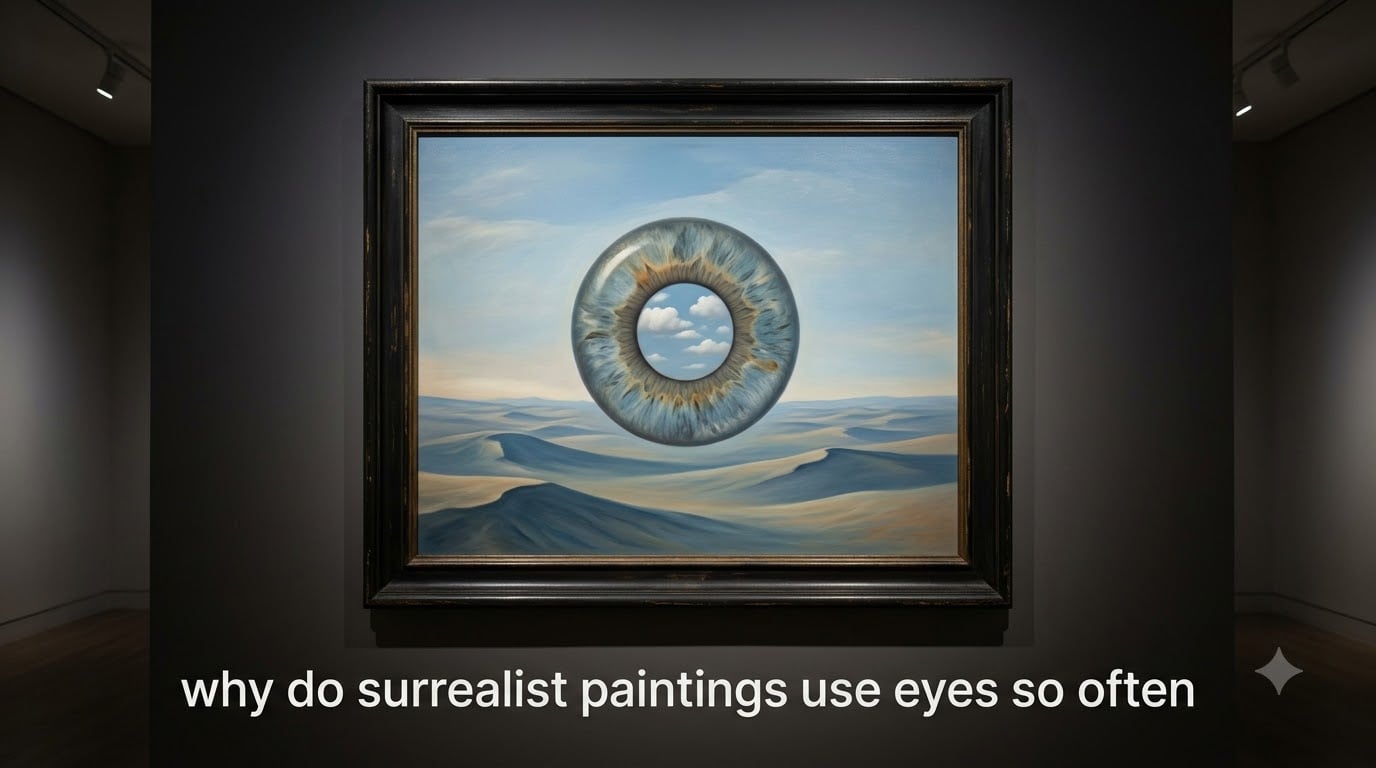
If you have ever stood in front of a Magritte and felt the painting look back at you, you have already felt the answer to why surrealist paintings use eyes so often. The eye was surrealism’s favorite symbol because it does in a single image what the whole movement tried to do: collapse the wall between what is seen and what is felt, between the waking mind and the dream. I have spent years looking at these works in person, and the eye motif keeps showing up for reasons that run deeper than aesthetic taste. It is hardwired into the way surrealists thought about the unconscious, the gaze, and the boundary between inner and outer worlds.
In this guide I will walk you through the symbolism, the science, and the key artists behind the eye motif in surrealism. We will start with what surrealism itself was trying to do, then unpack seven meanings the eye carries, look at the anchor paintings by Magritte and Dalí, and finish with the female surrealists who used the eye in ways most guides ignore.
Table of Contents
Surrealism at a Glance: Why the Eye Fits the Movement
Surrealism began in 2026 as the literary twin of Dada, and it earned its name from André Breton’s 1924 Manifesto of Surrealism. Breton defined it as “pure psychic automatism” – art made by tapping the unconscious mind, free from rational control. The movement drew on Freudian psychoanalysis, dream journals, hypnosis, and chance.
Seven traits recur across the most consistent surrealist work, and the eye motif lives inside each one:
- Dreamlike imagery: scenes that feel remembered rather than observed.
- Dislocation of body parts: ears where eyes should be, eyes that drift outside faces.
- Juxtaposition of unrelated objects: a violin in a hallway, an eye inside a desert.
- Visual paradox: a pipe that is not a pipe, a mirror that does not reflect.
- Triggers of the uncanny: images that feel just wrong enough to unsettle.
- Symbolic motifs drawn from the unconscious: eyes, hands, keys, staircases, eggs, lattices.
- Reversal of power between viewer and artwork: the painting watches you back.
The eye is one of the few objects that does all seven at once. It dreams, drifts off the face, sits inside unrelated landscapes, behaves like a mirror or a window, lands squarely in uncanny territory, and turns the viewer into the viewed.
What Do Eyes Represent in Surrealism?
The short answer: eyes in surrealism are portals. They mark the place where conscious seeing, dreaming, and the unconscious inside-view all meet. From Magritte’s cloud-filled iris to Dalí’s dripping eyelids, the eye was the surrealists’ way of drawing a door onto a canvas and inviting the viewer to step through.
When I look at the recurring eye across the movement’s biggest names, seven symbolic meanings show up over and over:
- Portal to the unconscious mind. The eye is a doorway inward, an acknowledgment that what we see with two open eyes is only the surface.
- The watching gaze. Surrealist eyes look back, refusing the polite contract where a painting decorates a wall while the viewer remains unseen.
- Perception under pressure. A giant or distorted eye reminds us that what we think is real is just one way of seeing.
- Vulnerability and exposure. An eye stripped of its face is raw nerve. It carries feeling with nothing to protect it.
- Inner vision and dreams. Eyes float in landscapes the way dream images float in sleep, without gravity or context.
- Divine or mystical vision. The eye echoes the all-seeing eye of Egyptian, Byzantine, and Renaissance tradition.
- Sexual and psychological charge. Following Freud and Breton, the eye was treated as a charged site of desire, fear, and unconscious want.
These meanings were not always separate. A Magritte eye can be a portal, a challenge, a vulnerability, and a divine echo all in one frame.
Eye Symbolism in Art History: The Ancient Roots
Surrealism did not invent the symbolic eye. It revived a tradition stretching back thousands of years. Understanding what the eye meant before surrealism helps explain why it packed so much weight when the movement picked it up.
In ancient Egypt, the Eye of Horus stood for protection, royal power, and the restoration of wholeness after injury. The evil eye, or ayin hara, traveled through Greek, Roman, and Mediterranean cultures as a symbol of envy given destructive force.
In Byzantine icons, the all-seeing eye of God became a shorthand for divine omniscience, carried into medieval Christian art as a watchful triangle above the head of Christ. Renaissance painters, from Leonardo’s window-of-the-soul to the countless “eye of Providence” motifs in ceiling frescoes, kept the eye tied to truth, knowledge, and inner light.
By the time the surrealists came along, the eye already meant: divine sight, hidden knowledge, the boundary between worlds, and the dangerous power of being seen. Surrealism inherited all of that symbolic freight and turned it loose on the unconscious.
Magritte’s The False Mirror: The Anchor Example
If one painting is the doorway into the whole question of surrealist eyes, it is René Magritte’s The False Mirror (1928). A single disembodied eye fills the canvas, and its iris holds a blue sky with soft white clouds. The title tells you it is a mirror, yet the eye does not reflect the room you stand in – it reflects weather.
Magritte had strong feelings about what this painting did. In a 1928 letter he wrote, “Everything we see hides another thing. We always want to see what is hidden by what we see. I show an eye, the eye sees the viewer. So I show the eye looking at the viewer, that is, I am showing the painting looking back at you.” That single sentence is the entire surrealist eye philosophy in plain language.
The 1965 work is held by MoMA in New York and remains one of the most reproduced surrealist paintings. What I find striking about it is its emotional shape: it is neither menacing nor sentimental. The clouds keep drifting, calm and indifferent. The vulnerability comes from the fact that the eye has no face, no mouth to reassure you, no voice to explain.
Try this next time you stand in front of it. Walk up close, then back away. Notice how the painting’s “behavior” stays the same at any distance, while a regular portrait falls apart under the same test. That stability is part of why Magritte’s eye unsettles people. It does not give away whose eye it is.
Dalí and the Eye Motif
Salvador Dalí may be the most obsessive painter of eyes in the entire 20th century. He returned to the motif in oil paintings, lithographs, sculpture, jewelry, and theater designs across five decades.
Two paintings sit at the center of his eye work. The Eye of Time (1945) shows a melting clock resting in a barren landscape, but close inspection reveals a soft eyelid and lashes along the soft edges. The clock is also an eye, drooping in a dream. The Eye of Surrealist Time (1971) takes the idea further: a draped cloth floats across an open eye, and the pupil contains an entire watch face engraved on a coin.
Dalí called his working method the paranoiac-critical method – a deliberate cultivation of paranoid associations in the viewer, fed into the painting to be read like a hallucination shared between artist and audience. The eye was the perfect paranoiac-critical object. It is paranoid by design, since eyes are made to be watched.
Dalí’s theory also leaned hard on Freud, whom he met in London in 1938. He wrote in The Secret Life of Salvador Dalí that “the eye is the only part of the body capable of developing a paranoiac form.” That line of thinking is exactly why an eye in a Dalí landscape is rarely just an eye. It is a clock, a coin, a kiss, a wound, and a screen, all in one curve.
Man Ray, Max Ernst, and the Disembodied Eye
The eye motif in surrealism was not a Magritte-and-Dalí monopoly. Man Ray, who is better remembered for photography, made one of the era’s defining eye works in 1932.
Indestructible Object (also called Object to be Destroyed) is a metronome with a photograph of an eye glued to the swinging pendulum. The mechanical arm makes the eye rock back and forth like a sleepless clock. When Man Ray and his partner Lee Miller later split, he reportedly made a version of the metronome and shot it. For surrealism that single gesture – a working eye becoming destructive when loved – is the whole movement in miniature.
Max Ernst, working in collage and frottage, displaced eyes onto birds, masks, and chimera in works like The Eye of Silence (1943-44). The displaced eye became a signature. For Ernst, eyes belonged to no one, the way dream images belong to no one.
What this shows me is that the eye was less a personal Dalí tic than a movement-wide obsession. Pick a male surrealist at random – Magritte, Dalí, Man Ray, Ernst, Tanguy, Delvaux – and the eye is usually somewhere in the work.
The Female Surrealists and Eye Imagery
Most guides to surrealist eye symbolism stop at Magritte and Dalí. That is a big mistake. The women of the surrealist movement worked with the eye in ways that often ran deeper than the men’s, because they had more at stake. The eye, for them, was not just a meditation on the unconscious. It was a meditation on being watched.
Leonora Carrington’s Self-Portrait (Inn of the Dawn Horse) (1937-38) is one of the most arresting surrealist self-portraits ever made. Carrington sits in a chair inside a small room while a white horse and a rocking horse hover behind her, and a chaotic menagerie gathers at the open window. Where her face should be is a rocking horse’s face – eyes included – held up by her own hand. The eye is there, but it is not hers. It belongs to the dream she is caught inside.
Remedios Varo, who worked in Mexico after fleeing Europe, painted the eye as mystic aperture. In Celestial Pablum (1938) and Creation of the Birds (1957), eyes sit inside bells, lanterns, and cosmic tools, often framed as a third eye or a window to a higher plane. Where Dalí’s eyes were theatrical, Varo’s were devotional. They turned the surrealist eye toward older esoteric traditions.
Dorothea Tanning brought the eye motif into a more bodily register. In Birthday (1942) and the later Eine Kleine Nachtmusik (1943), tufts of fur and stone become eyes; doorways peek open to reveal a single corridor of eyes. Tanning made the eye feel gothic and domestic at once – the feeling of being watched in your own hallway.
What unifies these three is something the male surrealists did not always reach: a sense that the eye motif is intimate, not just iconic. Carrington, Varo, and Tanning treated the eye as something felt in the body, not just displayed in a frame.
The Gaze Reversal: Why the Viewer Is Watched Too
There is one surrealist eye question I see asked again and again in forums: why does it look like the eyes of a painting are following me? Walk into a room with a single eye painting, and most visitors slow down or look away. Why?
Modern visual theory talks about this as the gaze. The French psychoanalyst Jacques Lacan called the gaze what the painting does back to the viewer – the moment when you stop being the subject of looking and become its object. Surrealism leaned hard into that reversal. A traditional portrait promises you the privilege of looking; the surrealist eye takes it away.
In Magritte’s False Mirror, this gets literal. The painting has only one organ of perception, and it is pointed at you, the room, and the world outside the gallery. You do not get to look without being looked at. The gallery visitor’s polite contract with art – I observe, it decorates – has been broken.
That is also why floating eyes in landscapes disturb people. A face is a controlled space. An eye alone, free of face and body, looks at you from anywhere. It can be in the sky, in a hallway, in a doorway. The idea that something watches you without a body attached to it is one of the oldest fears in folklore, and the surrealists pressed on it deliberately.
Eyes and the Unconscious Mind: The Neuroscience Angle
Surrealists were writing poems about the unconscious before neuroscientists had a working name for it. Today we know that humans are biologically wired to look at eyes first.
Brain imaging studies have identified the fusiform face area, a region of the temporal lobe that activates within about 100 milliseconds of seeing a face. Within the face itself, the eyes are the part that draws the strongest activation. Visual cognition researchers, including Maryse von Grünau and Stuart Anstis, have shown that even a single eye on a blank field will pull and hold a viewer’s attention.
So when surrealists put a giant eye in a desert, or two closed eyes on a corpse, they were not making a poetic accident. They were tapping a perceptual reflex older than any art theory. The eye motif works on us before we have time to argue about its symbolism. It hooks the visual system first and only then asks the brain to interpret.
This is also why an eye motif persists in modern surrealism and adjacent post-surrealist work, from Roy Lichtenstein’s Stepping Out (1978) to contemporary surrealist painters working today. We have not outgrown the reflex.
Reading Surrealist Eye Imagery for Yourself
Forum discussions I read while researching this article often return to one shared frustration: how do you tell meaningful surrealism from decorative weirdness? Eye imagery is a good place to start, because surrealist eyes tend to follow a small number of patterns.
Ask yourself four questions when you meet a surrealist eye:
- Is it disembodied? (floating with no face attached)
- Is it disproportionate? (giant compared to its surroundings)
- Does it contain something inside it? (sky, clock, another scene)
- Is it watching the viewer from an unexpected place? (in a landscape, on a wall, inside a household object)
When the answer is yes to two or more, you are likely looking at meaningful surrealism rather than decoration. The eye is doing symbolic work, not just visual flourish. That four-question filter has helped me cut through a lot of contemporary surrealism that goes for shock without substance.
8 Surrealist Eye Paintings at a Glance
The following table is a quick reference for the most-cited surrealist paintings that place the eye at the center of the image. Use it as a starting point for further reading or as a checklist when you visit a museum.
| Artist | Year | Painting | How the Eye Works |
|---|---|---|---|
| René Magritte | 1928 | The False Mirror | Disembodied eye, sky reflected in iris, mutual gaze with viewer |
| Salvador Dalí | 1945 | The Eye of Time | Melting clock as drooping eye in a barren landscape |
| Salvador Dalí | 1971 | The Eye of Surrealist Time | Draped cloth across an open eye, watch face inside the pupil |
| Man Ray | 1932 | Indestructible Object | Eye photograph on a swinging metronome pendulum |
| Leonora Carrington | 1937-38 | Self-Portrait (Inn of the Dawn Horse) | Animal eye replacing the artist’s own face, dream-held gaze |
| Remedios Varo | 1938 | Celestial Pablum | Third-eye motif inside a bell, mystical aperture |
| Max Ernst | 1943-44 | The Eye of Silence | Mask with single central eye, fragment of an imaginary city |
| Dorothea Tanning | 1943 | Eine Kleine Nachtmusik | Gothic corridor of eyes inside an open hotel doorway |
Frequently Asked Questions
What do eyes represent in Surrealism?
Eyes in surrealism act as portals between the conscious and unconscious mind. They collapse the boundary between viewer and artwork by looking back, symbolize inner vision and dreams, draw on ancient divine-eye symbolism, and tap into Freudian ideas about desire, fear, and the gaze.
What is the symbolism of eyes in art?
Eyes in art across history have signaled divine sight (Eye of Horus, Byzantine icons), the window of the soul (Leonardo), protection against the evil eye, truth and knowledge, and – in surrealism specifically – the collapse between what is seen on the canvas and what is felt inside the viewer.
What does the eye sculpture symbolize?
Sculptural eyes in surrealism, like Man Ray’s Indestructible Object (1932), usually carry the same meaning as painted eyes: a returned gaze, a clock-like rhythm of looking, and the unsettling possibility that objects remember the people who use them.
Why does it look like the eyes of a painting are following you?
Your visual system is wired to lock onto eyes faster than almost any other stimulus (the fusiform face area activates within about 100 milliseconds), and surrealist eyes are exaggerated, disembodied, and centered in the frame – all of which make the gaze feel directed at you specifically.
What is The False Mirror about?
Magritte’s The False Mirror (1928) is a single disembodied eye whose iris holds a cloud-filled sky. Magritte described it as a painting that looks back at the viewer, turning ordinary seeing into a reciprocal act. The painting is held by MoMA in New York and is widely seen as a manifesto for surrealism’s interest in perception.
Conclusion
So why do surrealist paintings use eyes so often? Because the eye is the one symbol that does everything the surrealist movement wanted to do, in a single image. It opens a portal to the unconscious. It looks back at the viewer and breaks the polite contract of looking. It revives ancient ideas about divine sight. It hooks us before the brain has time to argue.
Look at the actual works when you can. Magritte’s False Mirror at MoMA, Carrington’s Self-Portrait at the Metropolitan, Dalí’s clocks and eyes at the Dalí Museum in St. Petersburg, Florida. Each one will tell you more in person than any guide can. Notice whether the eye is disembodied, disproportionate, holding a scene inside it, or watching you from an unexpected place. That four-question filter is your reading tool from here.
If surrealist eye symbolism interests you, our other surrealism guides on One Surrealist A Day go deeper into individual artists and dream theories. Start with the work. The eye will do the rest.