
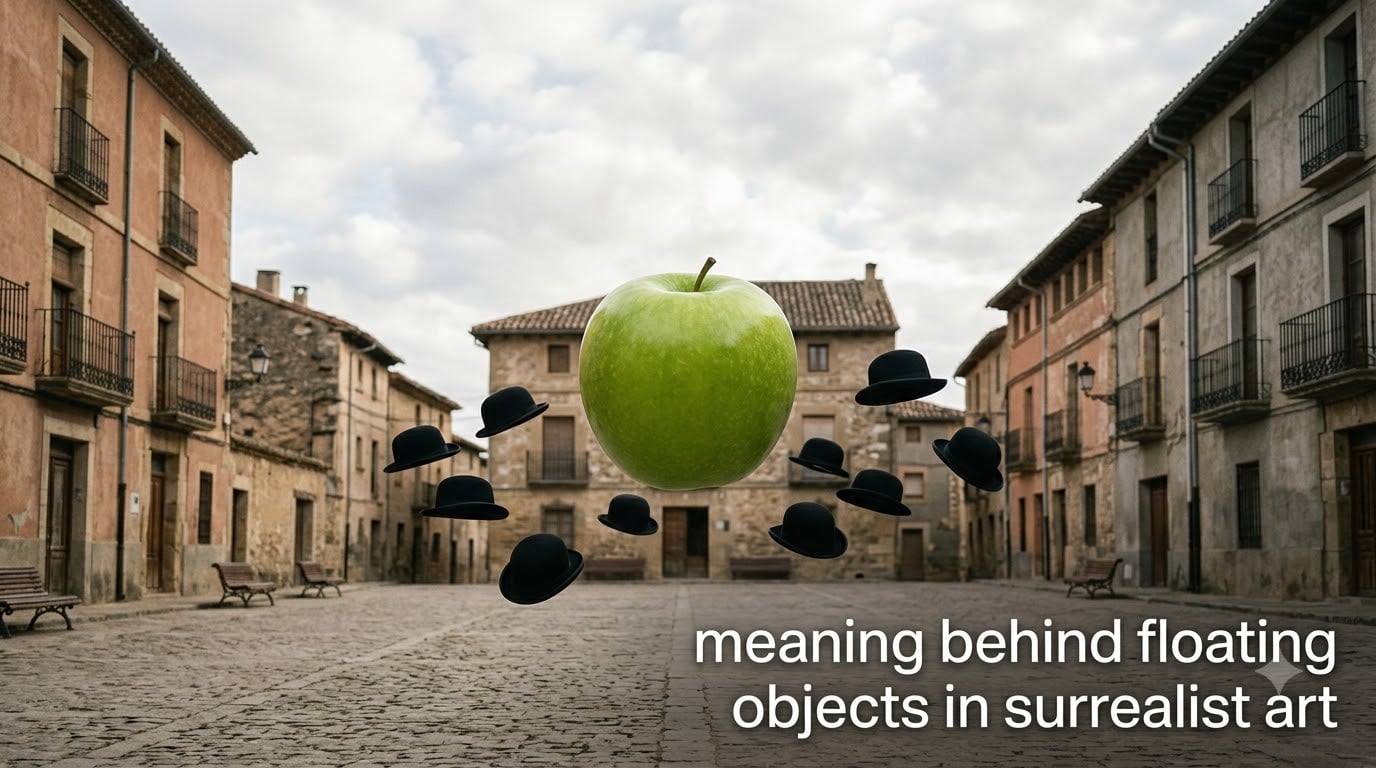
Floating objects in surrealist art represent the unconscious mind breaking free from rational, physical constraints. By suspending gravity, artists like René Magritte and Salvador Dalí externalised the way dreams, desires, and hidden thoughts float unmoored from logic. A levitating rock, a hovering apple, a man in a bowler hat raining from the sky – each is a visual stand-in for psychic automatism, the state Breton believed art should reach. We have spent months reading the manifestos, the diaries, and the catalogue raisonnés so you can decode the meaning behind floating objects in surrealist art without needing an art-history degree.
Surrealism is not just a style of dreamlike paintings. It is a movement with a manifesto, a method, and a mission, and floating objects are one of its sharpest tools. Below, we walk through the psychology, the painters, the famous canvases, and the symbolism, then give you a decoder you can carry into any museum.
Table of Contents
What Is Surrealism and Why Did Floating Objects Become Its Signature Motif?
Surrealism is a twentieth-century cultural movement launched in 1924 by the French writer André Breton, who defined it in the Manifesto of Surrealism as “pure psychic automatism” – thought expressed without rational control. The word itself had been coined by Guillaume Apollinaire in 1917 to describe a ballet that fused the real and the dream.
The movement fused Freud’s theory of the unconscious, Dada’s instinct for disruption, and a post-World War I hunger for meaning beyond the rational. Surrealists believed the rational mind had produced the trenches, the gas, and the mechanised slaughter. To reach a deeper truth they turned to dreams, free association, hypnosis, and chance.
Floating objects became the signature motif because they are the most economical way to show that something has escaped gravity, and therefore the rules of waking life. A stone in the sky needs no caption. The viewer knows instinctively that they have crossed into the dream. From Magritte’s levitating boulders to Dalí’s dripping clocks, the moment an object refuses to fall, the rational contract is broken.
The seven characteristics of surrealist art
- Dreamlike or hypnagogic imagery drawn from the unconscious.
- Unexpected juxtaposition of familiar objects in unfamiliar contexts.
- Biomorphic shapes that suggest bodies, organs, or living matter.
- Hyperrealistic rendering that makes the impossible feel photographic.
- Defamiliarization (dépaysement) – making the everyday feel strange.
- Levitation, metamorphosis, and other motifs of transformation.
- A hidden face or obscured identity, signalling the loss of a fixed self.
Why Did Surrealists Defy Gravity? Freud, Dreams, and the Unconscious
Surrealists defied gravity because they wanted to externalise the inner life. Freud’s 1899 essay The Interpretation of Dreams had argued that dreams are the “royal road to the unconscious,” and that the unconscious obeys none of the laws of waking physics. Breton, who had served as a medical orderly in a neurological ward during the war, devoured Freud’s work and built his manifesto around it.
When the conscious mind is bypassed – through dream, hypnosis, or automatism – ideas appear to “float” freely. A surrealist painter could not literally show a thought, but they could show a stone, a clock, or a bowler-hatted clerk doing exactly what an unmoored thought does: hovering without tether, explanation, or apology.
The technique that produced this imagery was psychic automatism: drawing or writing without preconception, letting the hand move faster than the censor. Magritte, Dalí, and their peers used it to seed the dream-content that levitating objects later made visible.
“Surrealism is based on the belief in the superior reality of certain forms of association heretofore neglected, in the omnipotence of dream, and in the disinterested play of thought.”
– André Breton, Manifesto of Surrealism, 1924
How surrealism relates to dreams
Surrealism treats the dream as both subject and method. A dream is the place where gravity fails, faces melt, strangers wear your clothes, and you can fly without wings. The painter’s job was to bring that space into the gallery. Levitation was the visual proof that the canvas had crossed over.
The unconscious mind in surrealism
For Breton, the unconscious was not a metaphor. It was a real psychic zone where repressed memories, desires, and traumas circulated. By freeing the image from gravity, the surrealist painter argued that they were showing that zone to the viewer, unedited and uncut.
René Magritte: The Painter Who Made Stones Float
No artist made levitation more central than René Magritte. The Belgian painter, born in 1898, returned from the same war that haunted the surrealists and painted objects that refused to behave. Wikipedia summarises the motif exactly: “Magritte painted rocks – heavy, inanimate objects – often floating cloud-like in the sky.”
Magritte called his philosophy “mystery,” not symbolism. He insisted the image was not a code but an experience.
“My visible images conceal nothing, they evoke mystery.”
– René Magritte
The most famous painting in his whole catalogue, The Son of Man (1964), features a bowler-hatted man whose face is obscured by a hovering green apple. It is only partial levitation, but it is enough – the apple refuses to fall, and the man’s identity refuses to appear.
Personal Values: oversized domestic objects in mid-air
In Personal Values (1952), a comb the size of a bed floats above a bedroom. A wine glass towers over a wardrobe. The home, normally a place of safety and scale, has been rearranged by a giant’s hand or by dream-logic. The floating objects say: nothing in your house is as fixed as you think.
Time Transfixed: the floating locomotive
Time Transfixed (1938) shows a steam locomotive hurtling out of a fireplace, suspended above a dining-room table. The train is not on rails but mid-air, as if a domestic routine had been punctured by a memory of travel or by an eruption of the industrial unconscious.
Empire of Lights: a day-and-night sky
Empire of Lights (1954) stacks an evening street under a midday sky. Nothing literally floats, but the contradiction of the two times of day produces the same destabilising effect as levitation: the viewer’s sense of what is possible quietly breaks.
Golconda Explained: Why Magritte’s Bowler-Hat Men Float Like Rain
Golconda (1953) is the painting most people picture when they think of surrealist levitation. Rows of bowler-hatted men in overcoats fall, float, and rain through the air above a sleepy Belgian town. None of them look at each other. None of them look alarmed. The town below goes about its day.
There are three common readings of the painting.
- The parachute reading. In 1953 Magritte was looking at photographs of Allied paratroopers from the Second World War, and scholars have long connected the raining men to the descent of soldiers. Levitation becomes a frozen moment of mass arrival – men poured from the sky like objects.
- The conformity reading. Every figure wears the same hat, the same coat, the same face. The repetition turns individuality into a pattern. The men are bureaucrats, clerks, everymen – the human wallpaper of industrial society.
- The absurdity reading. Because they do not react, the men become ridiculous. Gravity, the most basic law, has been suspended without comment. Magritte is mocking the seriousness of the bourgeois everyman by lifting him, quite literally, off the ground.
The painting’s name, Golconda, comes from a ruined Indian city once famous for its diamond mines, adding a buried thread about value, extraction, and the alchemy of the everyday.
Beyond Magritte: Dalí, de Chirico, Tanguy, and Other Floating-Object Painters
Magritte was the loudest practitioner, but he was not alone. The levitating object runs through the whole movement, and a few of its best examples sit outside Magritte’s catalogue.
Salvador Dalí: clocks that sag, not float
Dalí’s The Persistence of Memory (1931) shows watches that droop like soft cheese over a branch, a ledge, and a strange fleshy creature on the ground. The clocks are not floating, but they are refusing time. The motif is the same – the laws of physics have been overruled – and the meaning is similar: time itself belongs to the dream, not the clock.
Giorgio de Chirico: the metaphysical precursor
Before Magritte and Dalí, Giorgio de Chirico was already painting silent piazzas with mannequins, arcades, and shadows that fell at impossible angles. His work is called metaphysical painting, and surrealists later claimed him as a father. De Chirico’s levitating or weightless objects prefigure Magritte’s rocks and set the template: an empty Italian square is already uncanny.
Yves Tanguy: stones that hover over an infinite plain
Yves Tanguy painted dreamlike deserts where biomorphic stones float in formation over a never-ending plain. The work feels less like a single idea and more like a hallucination. The stones refuse to fall because the plain refuses to be a place.
The women surrealists who floated themselves
Several women surrealists used their own bodies as the floating object. Meret Oppenheim’s Ma gouvernante (1936) shows a pair of bound feet hovering in a wine glass. Leonora Carrington painted women drifting through towers. Remedios Varo sent alchemists up the stairs of impossible towers. Dorothea Tanning painted a girl crawling through a hallway that opens onto a desert. In each case, the floating or shifting figure is the artist refusing the gravity of the domestic role assigned to her.
A Symbolism Catalog: What Each Floating Object Means
Below is a quick decoder for the most common floating-object motifs. Use it the next time you stand in front of a surrealist canvas.
- Floating rocks (Magritte). The weight of reality has been lifted. Stones do not float, and that is the point: the unconscious does not respect physics.
- Floating apples (Magritte, The Son of Man). A biblical fruit turned into a veil. Knowledge, temptation, and identity all hidden behind a single piece of fruit.
- Floating bowler-hatted men (Magritte, Golconda). Conformity, the bourgeois everyman, the loss of individuality under industrial capitalism.
- Oversized household objects (Magritte, Personal Values). The domestic sphere is no longer safe or to scale. The private world has been rearranged by dream.
- Floating locomotive (Magritte, Time Transfixed). Memory, travel, and the intrusion of the industrial into the home.
- Melting clocks (Dalí, The Persistence of Memory). Time is elastic, subjective, and belongs to the dream.
- Floating torsos or figures (Oppenheim, Carrington, Varo). The self in motion, escaping domestic gravity, refusing fixed identity.
- Floating spheres (Magritte, multiple works). Purity, the unknowable, and Breton’s “convulsive beauty” – a shape that can mean anything and refuse to settle.
Floating Across Cultures: Buddhist, Islamic, and Modern Echoes of Surrealist Levitation
Surrealism did not invent levitation. The motif appears across cultures, and a short tour helps the surrealist image feel less like a Western oddity and more like a shared human question.
- Tibetan thangka paintings. Buddhas and bodhisattvas hover above lotus thrones, signaling that they have risen above samsara, the cycle of suffering. The visual grammar is the same: a figure no longer obeying the world’s pull.
- Islamic miniatures and the flying carpet. From the Thousand and One Nights to Persian miniatures, the carpet lifts the hero above the law of the earth. Gravity is the obstacle, and the saint or hero is the exception.
- Hindu vimanas and Vedic sky chariots. Ancient Indian texts describe self-moving aerial vehicles used by gods and heroes. The levitating object is a sign of cosmic rank.
- Modern advertising and AI art. Today, defying gravity is the default look of luxury ads, perfume bottles, and the AI-generated “floating-product” prompt. Surrealism’s vocabulary has become the visual grammar of the algorithm.
In each case, levitation signals one of two things: the subject has escaped the world’s rules, or the artist is reminding you that the world’s rules were always negotiable.
Where to See the Originals
If you want to stand in front of these paintings, here is where the originals live.
- Magritte Museum (Brussels). The largest collection of Magritte’s work, including The Empire of Lights, Time Transfixed, and several versions of The Son of Man.
- MoMA (New York). Houses Magritte’s The False Mirror and The Lovers, plus Dalí’s The Persistence of Memory.
- Menil Collection (Houston). A deep surrealist collection including Magritte, Ernst, and Tanguy.
- SFMOMA (San Francisco). Magritte’s Time Transfixed and a strong surrealist holdings.
Frequently Asked Questions
What does it mean if you levitate in your dreams?
In dream psychology, levitation usually signals a release of psychic weight – the dreamer has set down a burden they carry in waking life. Freud read such dreams as wish-fulfilment, the body escaping a constraint the conscious mind still obeys. Surrealists, who took Freud’s Interpretation of Dreams as scripture, treated levitation as direct evidence of the unconscious breaking through.
How does surrealism relate to dreams?
Surrealism treats dreams as both subject and method. André Breton’s 1924 Manifesto of Surrealism argued that dreams reveal a superior reality hidden by rational thought. Painters translated that conviction into levitating objects, melting clocks, and metamorphosed bodies – visual proof that gravity, time, and identity are negotiable inside the dream.
What is the unconscious mind in surrealism?
For the surrealists, the unconscious was a real psychic zone where repressed memories, desires, and traumas circulated. Influenced by Freud, Breton believed that bypassing the rational mind could access truths the waking censor would not allow. Levitating objects in paintings are a way of showing that zone to the viewer, unedited.
What is the meaning behind Magritte’s paintings?
Magritte’s paintings insist that what you see is not what you know. A floating rock is not a code but an experience of mystery. He wanted the viewer to feel the everyday world slip, then to notice that the slip is the point. In his own words, his visible images evoke mystery rather than conceal a fixed answer.
What is the meaning of surrealism in paintings?
Surrealism in paintings is the visual expression of André Breton’s belief in the superior reality of the dream and the unconscious. It uses juxtaposition, hyperreal rendering, metamorphosis, and levitation to short-circuit rational reading. The aim is not decoration but revelation: a glimpse of a reality the rational mind usually hides.
What is Magritte’s most famous painting?
Magritte’s most famous painting is The Son of Man (1964), a self-portrait-style canvas in which a hovering green apple obscures the face of a bowler-hatted man. It is widely used on posters, in films, and as a meme template, and has become shorthand for surrealism itself.
What are the key symbols used in surrealist art?
Common surrealist symbols include floating rocks and apples (Magritte), melting clocks (Dalí), bowler hats (Magritte), mannequins and metronomes, biomorphic stones (Tanguy), lobsters, eyes, gloves, birds, and the train emerging from a fireplace. Each symbol is less a fixed code than a recurring dream-ingredient the artist reused until it carried weight.
What are the 7 characteristics of surrealist art?
The seven characteristics are: dreamlike imagery, unexpected juxtaposition, biomorphic shapes, hyperreal rendering, defamiliarization (dépaysement), levitation and metamorphosis, and the obscured or hidden face. Each one pulls the viewer out of rational reading and into the dream-logic the surrealists believed revealed hidden truth.
What is the meaning behind Magritte’s painting Golconda?
Golconda (1953) shows bowler-hatted men floating and raining over a town. The painting is usually read as a critique of conformity, bourgeois anonymity, and the mechanisation of the modern worker. The parachute reference and the diamond-mine title Golconda add a layer about value, descent, and the alchemy of the everyday.
Why were dreams and the subconscious important in surrealism?
The surrealists believed that rational thought had produced the catastrophe of the First World War. Dreams and the subconscious, freed from rational control, offered access to a deeper truth. Breton’s 1924 manifesto made psychic automatism – the unedited flow of the unconscious – into the movement’s central method.
What is the spiritual meaning of levitation?
Spiritually, levitation is read as transcendence – the soul or holy figure has risen above material weight. Tibetan thangka Buddhas hover above lotus thrones; Christian saints are lifted by rapture; Islamic heroes rise on flying carpets. Surrealism borrows this grammar and redirects it: in a Magritte canvas the rising subject is the unconscious mind itself.
Why do surrealist paintings defy physics?
Surrealist paintings defy physics because the movement believed that the laws of waking life were not the laws of the inner life. Defying gravity, melting time, and merging bodies were ways to externalise what Freud called the primary processes of the unconscious – the rules the mind follows in dreams but not in daylight.
Why Floating Objects Still Speak to Us
The meaning behind floating objects in surrealist art is not a single answer. It is a decoder. Once you have it, you can walk into any surrealist room and read the levitating rocks, the hovering apples, the raining bowler-hatted men, and the melting clocks as the same gesture: a refusal of the rational contract and an invitation to look at the world as the unconscious sees it.
Magritte, Dalí, de Chirico, Tanguy, Carrington, Tanning, Varo, and Oppenheim all reached for the floating object because gravity is the simplest stand-in for the rules we accept in daylight. Lift the rules off the canvas, and the viewer is forced to ask what those rules were for in the first place. That is the moment surrealism happens.
The motif has outlived the movement because the question has outlived the twentieth century. Every AI-generated image of a floating perfume bottle, every advertising spread of a defying-gravity sneaker, every meme of a hovering figure is a quiet heir to Magritte’s stones. The dream is still doing its work, and gravity is still the thing we most enjoy being told is optional.