
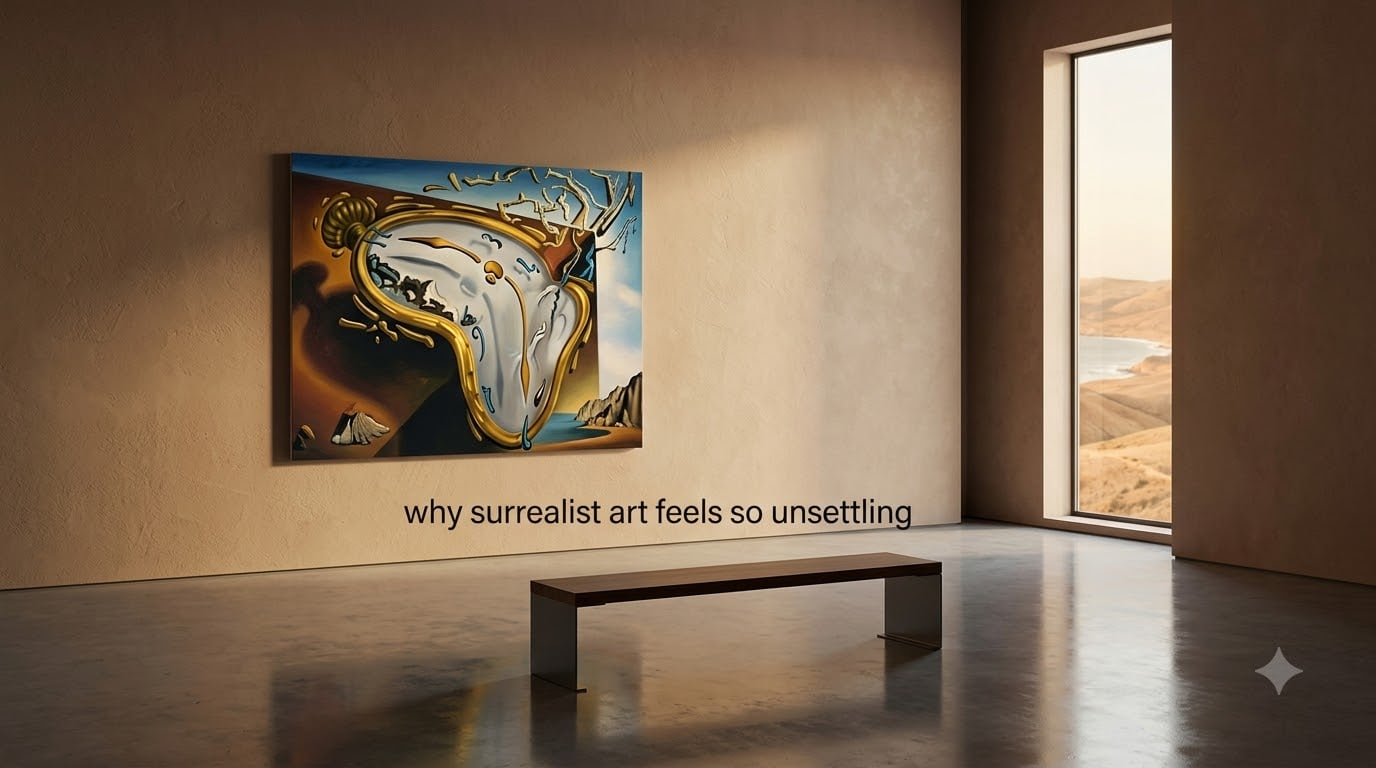
Why surrealist art feels so unsettling comes down to a small set of psychological tricks the movement learned to exploit: it disrupts the brain’s pattern recognition, places familiar objects in impossible contexts, and pulls imagery straight from the unconscious mind, where fear and meaning tangle together. The result is a feeling the body registers long before the mind can name it.
I remember standing in front of a Dalí reproduction for the first time and feeling my stomach drop without any obvious reason. The clocks were melting. The background was sun-baked. Nothing in the painting should have scared me, but something inside me whispered that the rules of the room had changed. That feeling is the entire point of surrealism, and it is not random. We are going to walk through exactly why your body reacts this way, where the technique came from, and how it still works on us more than a century later.
Table of Contents
What Is Surrealist Art and Why Does It Feel Unsettling?
Surrealist art is a 20th-century movement that uses dreams, symbols, and illogical juxtapositions to bypass rational thought and reach the unconscious mind. It feels unsettling because it deliberately combines elements your brain recognizes with arrangements it cannot resolve, which creates a low-grade alarm signal your body reads as danger.
Surrealism was not built to be comfortable. The movement’s founder, André Breton, defined it in his 1924 Surrealist Manifesto as pure psychic automatism, a way to express the real functioning of thought without any control from reason or aesthetics. The goal was not beauty. The goal was truth, including the parts of the mind that polite society preferred to ignore.
That is the engine behind the unsettling feeling. Surrealists pulled imagery from dreams, fears, and desires, then painted it with the technical skill of a classical academy. The combination is what hits you. The painting looks finished, confident, even beautiful, and the content is a room with no ceiling or a man whose face is melting off his plate. Your brain holds both facts at once and cannot decide which one to trust.
The Historical Roots: How WWI Created Surrealism
Surrealism was born out of the wreckage of the First World War, when a generation of European artists concluded that rational civilization had failed them. The movement emerged directly from Dada, the anti-art protest that rose in neutral Zurich during the war, and quickly became something more focused on the unconscious.
By 1924, Breton had gathered the original Surrealist group in Paris and published the Manifesto that gave the movement its name. The artists involved had watched four years of industrial slaughter justified by appeals to reason, patriotism, and progress. Their conclusion was not subtle. If reason had produced the trenches, reason was the problem.
Freud’s writings on the unconscious, dream interpretation, and repression were enormously influential. The Surrealists read him like a manual. They experimented with automatic writing, hypnosis, and free association to reach material that the waking mind kept censored. What came up was rarely cheerful. It was erotic, violent, anxious, and strange, and the paintings they made from it have not lost their charge.
The Uncanny: When the Familiar Becomes Strange
The uncanny is the psychological state that surrealism targets most precisely, and it is the reason a painting of a normal room with one impossible detail can disturb you more than a painting of an outright monster. The term comes from Freud’s 1919 essay on the unheimlich, the unhomely, the feeling that something inside what should be safe has gone wrong.
Freud argued that the uncanny happens when something we thought we had outgrown or buried returns in a form we almost recognize. A doll that moves on its own. A face that is almost familiar. A clock that droops like skin. The brain cannot file these images as safe and cannot file them as dangerous either, so it sits in a kind of alert limbo.
This is why Magritte’s The Treachery of Images, a perfectly painted pipe with the caption “this is not a pipe,” still unsettles people nearly a century later. Nothing in the image is threatening. The threat is to the category the brain relies on, the link between a thing and what it means. Surrealism excels at this particular violation.
How the Brain Reacts to Surreal Imagery
Neuroscience gives us a clearer picture of why surreal art lands so hard. The brain runs on prediction. At every moment, it compares what it expects to see with what it actually sees, and it learns from the gap. Surreal imagery creates large, unresolvable gaps.
When you look at a normal scene, your visual cortex makes predictions and the world confirms them within milliseconds. The system runs smoothly and you feel calm. When you look at a surreal painting, the predictions fail. A clock should be rigid. A face should be symmetrical. A window should show a view that obeys perspective. When none of those predictions pay off, the brain keeps firing error signals.
Research on predictive processing suggests this error signal is closely linked to the same systems that flag potential threat. The amygdala, the brain’s alarm center, listens to the cortex for surprise. Persistent, low-level surprise is read as something is wrong here, even when you consciously know you are in a museum. The feeling you walk away with is the residue of that alarm firing for longer than it should have.
This is also why surreal dreams feel so charged. During REM sleep, the predictive system loosens its grip and the image generator runs without the usual reality check. You feel the alarm of an impossible scene, but you also have no waking frame to dismiss it. Surrealist painters deliberately recreate that state on canvas.
The Techniques Surrealists Use to Unsettle You
Surrealism is not one trick. It is a toolkit, and most unsettling works combine several at once. Here are the techniques that come up most often, with the artists who made them famous.
Juxtaposition of unrelated objects. A lobster on a telephone, a sewing machine on an operating table. René Magritte and Salvador Dalí both used this method to force the brain to invent a relationship that does not exist. The effort of trying to connect two unrelated things creates a low-level mental strain that the body registers as unease.
Scale distortion. A tiny figure in a giant empty landscape, or a huge eye filling the sky. Yves Tanguy painted endless plains littered with ambiguous shapes that may be machines or bones. The wrong scale makes the viewer feel either gigantic and exposed or small and abandoned, both of which the body reads as a threat.
Wrong lighting or perspective. Forum readers often describe this as one of the most powerful surreal techniques, and the research agrees. A scene with two light sources casting incompatible shadows forces the brain to keep rebuilding its mental model. The feeling that something about the room is off is hard to shake.
Metamorphosis and transformation. Figures that become landscapes, faces that dissolve into walls, hands that grow extra fingers. The transition state is more disturbing than either endpoint, because the brain cannot categorize what it is looking at.
Fragmentation of the body. Max Ernst’s collage figures, Hans Bellmer’s dolls, and the hybrid creatures painted by Leonora Carrington all break the body into rearranged parts. The body is the most familiar image we have, and its disruption is read as a direct threat to the self.
Dream symbolism drawn directly from the artist’s unconscious. Eggs, eyes, locusts, mirrors, doorways. These symbols are not universal in any simple sense, but the act of treating them as if they carried buried meaning makes the viewer hunt for meaning too. The hunt rarely resolves, and the unresolved tension is what lingers.
Surrealism vs. Fantasy vs. Symbolic Art: What’s the Difference?
One of the most common questions we see from readers is how surrealism differs from fantasy art or from older symbolic painting. The three overlap but trigger different responses, and the difference is worth being clear about.
Surreal art works by collapsing the world you know. It uses realistic technique on impossible content. Fantasy art builds a different world with its own rules. Symbolic art uses stable metaphors within the real world.
Surrealism takes your living room and puts a third story on it. Fantasy builds a different house entirely. Symbolic art hangs a painting of a skull on the wall of your living room and tells you what it means. The reason surrealism feels more unsettling is that it refuses to offer the alternative rule-set fantasy gives you, and it refuses the stable meaning symbolic art provides.
This is also why surrealism often gets confused with random weirdness. Genuine surreal work has internal logic, the logic of dreams. Random weirdness has none, and it usually feels cute rather than unsettling. The unease comes from the sense that the image means something you cannot quite reach.
Surrealism and the Unconscious Mind: Dreams as Source Material
The Surrealists did not treat dreams as decoration. They treated dreams as primary source material. Automatic writing, where the hand moves without the conscious mind directing it, was supposed to bypass censorship and reach buried content.
What surprised the early Surrealists was how often that buried content was not pleasant. When you stop filtering, the unconscious serves up a steady diet of small fears, sexual anxieties, hostile impulses, and unresolved grief. The paintings they made from this material retain that raw quality because the method did not include a step to sand off the rough edges.
This is also why surreal art feels loaded even when it does not show anything obviously disturbing. The artist is presenting imagery they pulled from the place where the mind stores what it cannot fully process, and that place has a particular emotional temperature. The viewer picks up on the temperature even when the imagery looks like an empty field or a bowl of fruit.
The Body Transformed: Fragmentation and Flesh in Surreal Art
The human body shows up in surreal art more often than almost any other subject, and it almost never shows up intact. Dalí’s soft watches droop over what look like organic forms. Carrington’s figures sprout wings, hooves, and beaks. Ernst’s early frottage drawings suggested body parts emerging through floorboards.
The body is the image we have the most practice reading. Tiny changes register immediately. The uncanny valley, the dip in comfort we feel when something looks almost human but not quite, sits at the heart of why distorted bodies in art disturb us more than distorted landscapes.
Surrealism also leaned into transformation rather than finished monsters. The midpoint of a metamorphosis reads as more threatening than either the human or the animal alone, because the brain cannot settle on a category. This is a different kind of fear than the jump-scare, and it stays with the viewer much longer.
Why Surreal Art Still Feels Unsettling Today
Surrealism was supposed to be a 1920s movement, but it has only become more relevant. The reason is that the conditions surrealism was designed to address have not gone away.
The world we live in now is full of imagery that obeys dream logic more than rational logic. Deepfakes blend real faces onto fabricated actions. AI image generators produce scenes that look almost right and not quite. Social media feeds mix the real and the synthetic so constantly that the brain’s predictive system is under continuous low-grade stress. Surrealism gave us a vocabulary for that experience almost a century before the technology arrived.
Climate dread also reads as surreal. Storms that don’t match the season, skies the wrong color, coastlines that look unrecognizable to the people who grew up on them. Contemporary surrealists like Justin Mortimer and Julie Mehretu lean into this, and their work feels current because the world it depicts is the one we actually have.
Modern horror cinema, from David Lynch to Ari Aster to the recent wave of folk-horror films, is also deeply surrealist in its bones. The slow dread, the wrong details in the room, the sense that meaning is just out of reach, all of that comes straight from the techniques the original Surrealists worked out in paint. The unsettling feeling has migrated from the gallery wall to the streaming queue, but the engine is the same.
Frequently Asked Questions
Why is Surrealism scary?
Surrealism is scary because it uses realistic technique on impossible content, which prevents the brain from filing the image as either safe or dangerous. The predictive system keeps firing error signals, the body reads that as a low-level threat, and the feeling lingers because the image does not offer a stable alternative reality the way fantasy art does.
What is the uncanny in surrealism?
The uncanny in surrealism is the feeling that something familiar has gone wrong, the sense that a familiar object or scene has been altered just enough that the brain cannot settle on what it is. Freud called this the unheimlich, and surrealism is the art movement that built itself around producing it deliberately.
Why do surreal paintings give me anxiety?
Surreal paintings give you anxiety because they reproduce the experience of an anxiety dream in a medium that holds still. The brain cannot resolve what it sees, the body stays in alert mode, and the inability to look away keeps the alarm firing longer than it would in a normal nightmare.
What is the difference between surreal art and fantasy art?
Surreal art uses realistic technique on impossible content drawn from the unconscious, while fantasy art builds an alternate world with its own rules. The unsettling feeling in surrealism comes from the refusal to give the viewer an alternative rule-set to settle into, which is exactly what fantasy art provides.
Final Thoughts: Sitting With the Unsettling
Surrealist art feels unsettling because it deliberately builds a small, contained malfunction in the system your brain uses to tell what is real. The malfunction is not random, and the unsettling feeling is not a failure of the art. It is the art working exactly as the makers intended.
When you stand in front of a Dalí or a Magritte and feel your stomach drop, you are feeling the same alarm system that fires when you walk into a room and cannot immediately tell what is wrong. The painting has done its job. The next move, the one the Surrealists actually wanted from you, is to stay in the feeling long enough to ask what the image is reaching for. The unease is the door, not the destination.
That is part of why surrealism still matters more than a century after Breton published his Manifesto. The world keeps handing us images that follow dream logic, and the movement gave us a way to read them. If you want to keep going, look up Max Ernst’s collage novels, dive into Leonora Carrington’s novels, or rewatch a Lynch film with the framework above in mind. The unsettling feeling is the start of a longer conversation, not the end of one.