
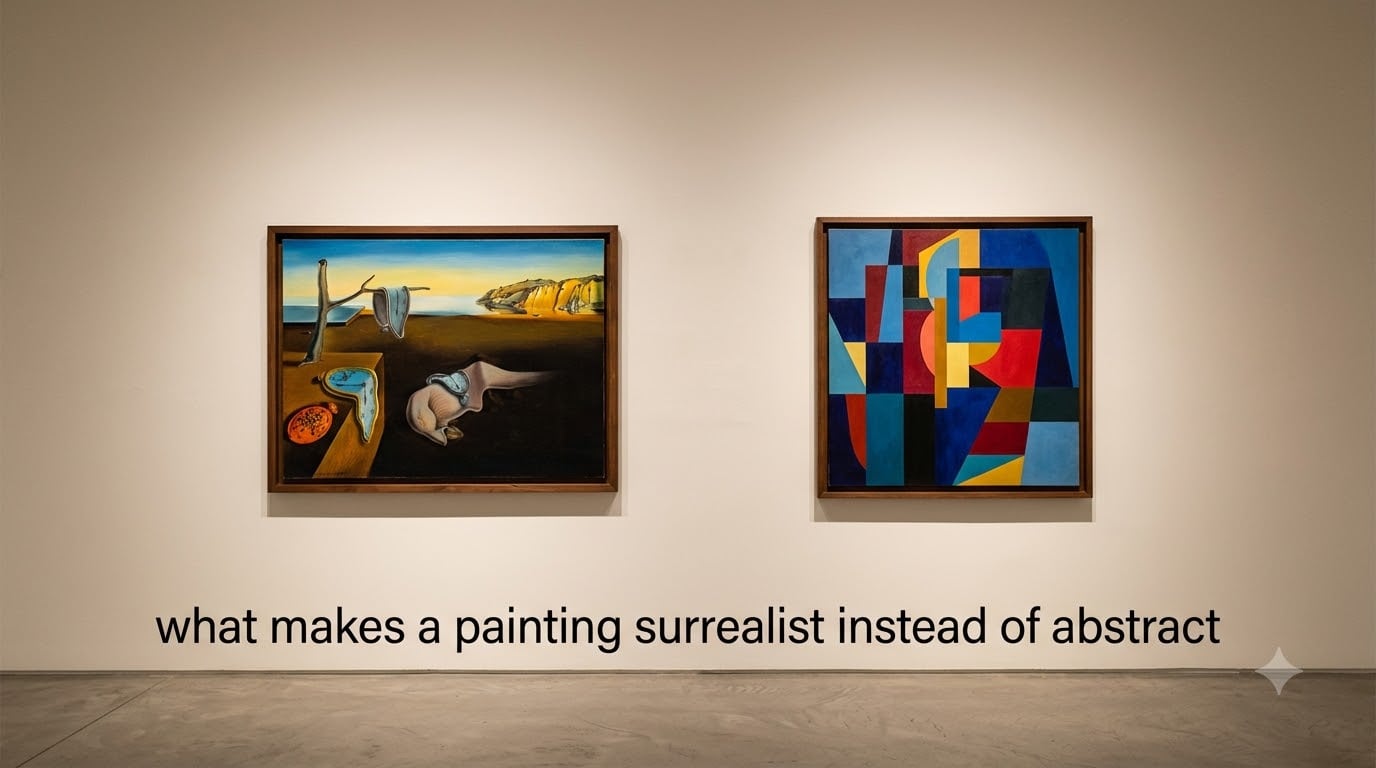
Surrealism and abstract art are two of the most influential movements in modern art, yet they are constantly confused. The simplest distinction is this: surrealist paintings depict recognizable objects — clocks, pipes, apples, human figures — but arrange them in impossible, dreamlike ways to access the unconscious mind. Abstract paintings eliminate recognizable imagery entirely, treating color, shape, line, and form as the subject itself. When you stand before a Dalí melting clock, you can still name what you see. When you stand before a Kandinsky composition, you see pure visual language with no representational anchor. That single difference — distortion of reality versus replacement of reality — is what separates the two.
Table of Contents
What Is Abstract Art?
Abstract art emerged in the early twentieth century as artists began rejecting the centuries-old goal of depicting the visible world. Rather than painting landscapes, portraits, or still lifes, abstract artists focused on the formal elements of art itself: color, shape, line, texture, and composition.
Wassily Kandinsky is widely credited as a pioneer of abstract painting, creating works like Composition VII (1913) that used swirling colors and geometric forms without any recognizable subject. The Swedish painter Hilma af Klint was actually producing abstract work even earlier, though her paintings were not publicly shown during her lifetime.
Abstract art is non-representational. That means the viewer does not look for objects or figures in the painting. Instead, the painting asks you to respond to its visual qualities directly — the tension between warm and cool colors, the rhythm of curved and straight lines, the weight of shapes on the canvas. Jackson Pollock later described his drip paintings as “energy and motion made visible,” a phrase that captures abstract art’s core mission perfectly.
What Is Surrealism?
Surrealism was formally founded in 1924 when André Breton published the Surrealist Manifesto in Paris. Breton defined surrealism as “pure psychic automatism,” meaning the attempt to express thoughts free from rational control, moral judgment, or aesthetic concern. The movement grew directly out of Dada, absorbing its anti-establishment spirit while adding a psychological dimension rooted in Sigmund Freud’s theories of the unconscious mind.
Unlike abstract art, surrealism does not abandon recognizable imagery. Instead, it takes familiar objects and subjects them to strange transformations. A clock melts over a tree branch in Salvador Dalí’s The Persistence of Memory (1931). A pipe is labeled “this is not a pipe” in René Magritte’s The Treachery of Images (1929). A nightgown stands alone in a deserted landscape in Paul Delvaux’s paintings. These are things you can identify — clocks, pipes, nightgowns — placed in contexts that defy logic and reason.
Surrealism’s goal was to bypass the conscious mind and reveal the hidden truths of the unconscious. Dreams, free association, unexpected juxtapositions, and the element of surprise were all tools surrealist artists used to shock viewers out of habitual perception.
The Core Difference: Depicting Reality vs. Replacing It
The distinction comes down to what each movement does with visible reality.
Surrealism distorts reality. It starts with recognizable objects and subjects — human bodies, everyday items, natural forms — then bends, combines, or transforms them in ways that could never happen in the physical world. A surrealist painting always gives you something identifiable to hold onto, even if the context is bewildering. That is why you can describe a Dalí painting (“melting clocks on a barren beach”) or a Magritte painting (“a man in a bowler hat with an apple obscuring his face”) in ordinary language.
Abstract art replaces reality. It offers nothing recognizable to describe. You cannot say “there is a clock” or “there is a pipe” when looking at a Rothko color field or a Mondrian grid. The painting’s content is its form. The meaning lives in how colors interact, how shapes relate to each other, and how lines move across the surface. Abstract art does not distort the world — it steps outside it entirely.
This difference in intent shapes the viewer’s experience profoundly. Standing before a surrealist work, you are invited to interpret a scene — even an impossible one. Standing before an abstract work, you are invited to feel a visual experience without narrative context. One speaks in the language of dreams; the other speaks in the language of pure perception.
Surrealist Techniques That Distinguish the Movement
Surrealist artists developed specific methods that set their work apart from abstract painters. Understanding these techniques helps you identify surrealism even when a painting looks visually unusual.
Psychic Automatism: Breton’s central concept involved creating art without conscious control. André Masson pioneered automatic drawing, allowing his hand to move freely across the paper while in a near-trance state. The resulting images were then refined into finished works. This technique directly influenced Jackson Pollock’s later drip method, which is one reason surrealism and abstract expressionism are sometimes confused.
Unexpected Juxtapositions: Surrealist paintings deliberately place unrelated objects together to create shock or disorientation. Meret Oppenheim’s fur-covered teacup (Object, 1936) is a famous example. The objects themselves are ordinary — a teacup, a saucer, a spoon — but their combination with animal fur triggers an involuntary psychological response.
Dream Imagery: Many surrealist works reproduce the logic of dreams, where scenes shift without warning and objects transform mid-image. Dalí called his method “hand-painted dream photographs” and aimed for the hyper-realistic rendering of irrational content. The more precisely the objects are painted, the more disturbing the irrationality becomes.
Frottage, Grattage, and Decalcomania: Max Ernst developed frottage (rubbing pencil over textured surfaces) and grattage (scraping paint off canvas onto textured materials) to generate unexpected forms. Oscar Dominguez pioneered decalcomania, pressing paint between sheets to create organic, biomorphic shapes. These techniques produced imagery that hovered between recognizable and abstract, which is precisely why they contributed to the confusion between the two movements.
Abstract Surrealism: The Overlap Zone
Part of the confusion between surrealism and abstract art exists because some surrealist artists painted abstractly. This is not a contradiction — it is a recognized subcategory called abstract surrealism.
Joan Miró is the most famous example. His paintings like The Birth of the World (1925) use loose washes of color, biomorphic shapes, and scattered lines that look purely abstract. Yet Miró considered himself a surrealist and exhibited with the Surrealist group throughout his career. His work was rooted in the unconscious and in poetic associations, not in the formal investigation of color and shape that motivated abstract artists like Kandinsky.
André Masson and Yves Tanguy also worked in this overlap zone. Masson’s automatic drawings produced abstract forms that emerged from unconscious processes. Tanguy’s paintings feature smooth, biomorphic shapes floating in empty landscapes — forms that are not quite identifiable objects but are not purely abstract either.
Wolfgang Paalen, Roberto Matta, and other members of the Surrealist circle who fled Europe during World War II continued exploring abstract approaches in the United States. Their work directly influenced the Abstract Expressionist movement, which is one reason the historical relationship between surrealism and abstraction is so tangled.
The key distinction is intent. When Miró painted biomorphic shapes, he was following the logic of dreams and the unconscious. When Kandinsky painted geometric forms, he was pursuing a spiritual language of pure visual elements. The paintings may look superficially similar, but the artistic purpose behind them is fundamentally different.
A Viewer’s Quick-Reference Checklist
When you encounter a painting and cannot ask the artist which movement it belongs to, use these questions to make an informed judgment:
1. Can you name specific objects in the painting? If you can identify a clock, a face, a pipe, a body, an apple — even in distorted form — the painting has surrealist tendencies. If you see only colors, shapes, and lines without identifiable objects, it leans abstract.
2. Does the painting suggest a scene or setting? Surrealist works often include landscapes, rooms, or spatial environments, however strange. Abstract works typically lack spatial depth or recognizable settings.
3. Is the style of rendering realistic, even if the content is impossible? Dalí and Magritte painted with precise, academic realism. Their technique was traditional; their subject matter was not. Abstract artists generally do not use realistic rendering techniques.
4. Does the painting feel like a dream or a riddle? Surrealist works tend to provoke interpretation — you find yourself asking “what does this mean?” Abstract works provoke sensation — you respond to color, rhythm, and energy before any meaning.
5. Are recognizable objects combined in impossible ways? A lobster replacing a telephone handset, a train emerging from a fireplace, a giant eye floating in the sky — these surrealist combinations depend on recognizable objects placed in illogical arrangements.
6. Does the artist’s broader body of work include representational elements? Even Miró, who painted abstractly, also created works with identifiable figures, eyes, and birds. Checking an artist’s full portfolio often clarifies their movement affiliation.
Frequently Asked Questions
What are the key differences between abstract art and surrealism?
The key difference is how each movement treats recognizable imagery. Surrealism depicts recognizable objects — clocks, pipes, human figures — but combines them in impossible, dreamlike ways to access the unconscious mind. Abstract art eliminates recognizable imagery entirely, making color, shape, line, and form the subject itself. Surrealism distorts reality; abstract art replaces it.
What are the 7 characteristics of Surrealist art?
The seven defining characteristics of Surrealist art are: dreamlike imagery, unexpected juxtapositions of unrelated objects, elements of surprise and non sequitur, automatic or uncontrolled creation techniques, fascination with the unconscious mind, hyper-realistic rendering of irrational content, and the use of symbols and free association. These traits distinguish surrealism from abstract art, which focuses on formal visual elements rather than psychological content.
Is abstract art the same as surrealism?
No, abstract art and surrealism are fundamentally different movements. Abstract art emerged in the early twentieth century as a rejection of representational imagery, focusing instead on color, shape, and form as the primary subject. Surrealism, founded by André Breton in 1924, retains recognizable imagery but transforms it through dreamlike logic and unconscious processes. The confusion arises because some surrealist artists, like Joan Miró and André Masson, painted abstractly — creating a hybrid category called abstract surrealism.
Was Salvador Dalí an abstract artist?
No, Salvador Dalí was not an abstract artist. Dalí was a figurative surrealist who painted with meticulous, almost photographic realism. His subject matter was irrational and dreamlike — melting clocks, elephants on spider legs, distorted human bodies — but his technique was grounded in traditional representational painting. Dalí himself described his method as ‘hand-painted dream photographs,’ emphasizing that surrealism depicts recognizable objects in impossible arrangements rather than eliminating representation entirely.
What is abstract surrealism?
Abstract surrealism is a subcategory where surrealist artists create works that lack clearly identifiable objects while still pursuing the Surrealist goal of expressing the unconscious mind. Artists like Joan Miró, André Masson, and Yves Tanguy worked in this style, producing biomorphic shapes and automatic drawings that look abstract but are rooted in dream logic and unconscious processes rather than the formal investigation of color and shape that defines pure abstract art.
Conclusion
Understanding what makes a painting surrealist instead of abstract comes down to one question: can you identify the objects in it? Surrealism takes the real world and transforms it through dream logic, unconscious imagery, and impossible juxtapositions. Abstract art steps outside the real world entirely, presenting color, shape, and form as subjects in themselves. The overlap zone of abstract surrealism — where artists like Miró and Masson worked — proves that the two movements are not mutually exclusive. But the intent behind each remains distinct. Once you learn to read that intent, you can walk into any gallery and tell the difference with confidence.