
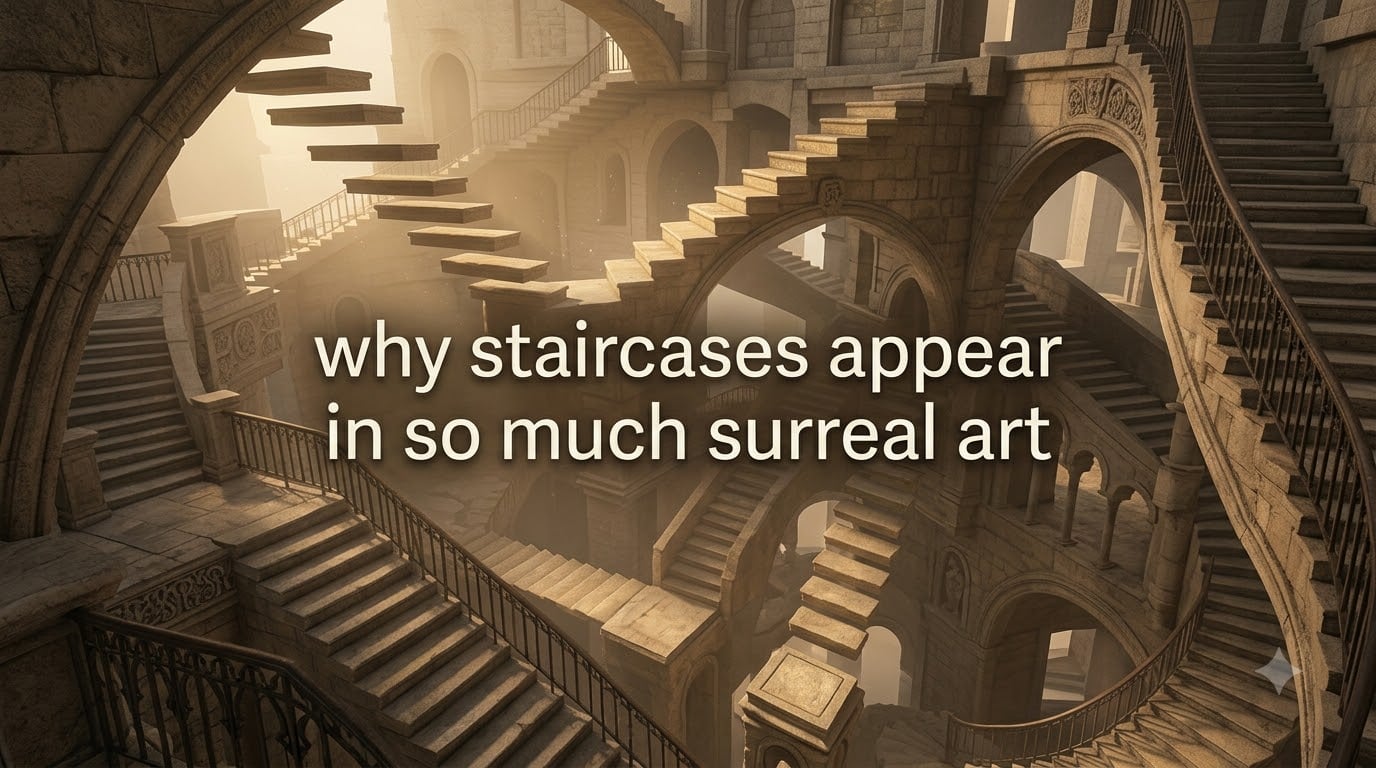
Staircases in surreal art symbolize transition between worlds, the unconscious mind, gravity-defying impossibility, and the journey between reality and dream. The reason staircases appear in so much surreal art is that they are simultaneously the most familiar object in everyday architecture and the most flexible symbol for breaking the rules of that architecture: artists can stretch them upward, flip them, loop them, or send figures climbing into nowhere.
I have spent the past several months tracing this motif through art history, dream psychology, and modern visual culture. What I found is that the staircase is surrealism’s favorite doorway because it lets one image carry several meanings at once – transition, ascent, descent, infinity, and the irrational.
In this guide, I will walk you through the surrealist roots of the motif, the most famous staircase paintings, the symbolic meanings artists lean on, the difference between Freudian and Jungian dream interpretation of stairs, and why this motif still floods your Pinterest feed today.
Table of Contents
How Staircases Became a Symbol of the Unconscious Mind
To answer why staircases appear in so much surreal art, you have to start with the surrealist movement itself. When André Breton published the Surrealist Manifesto in 1924, he defined surrealism as psychic automatism – thought expressed without rational control. Breton and his circle were obsessed with Sigmund Freud’s model of the unconscious, and they wanted visual art that behaved like a dream.
A staircase was perfect for that dream logic. Every building has one. Yet a staircase also implies movement between floors, between states, between the rational world above and the shadowy basement below. It is an everyday object that already suggests a threshold.
For surrealists, the staircase could represent the unconscious itself: a place you descend into, climb out of, or get lost on. This is why so many of their paintings show figures pausing on steps, looking over edges, or peering up into nowhere. The image quietly insists that you are standing on the boundary of two worlds.
It also helps that stairs are geometric. The repeating rectangles of steps are easy to draw, easy to repeat, and easy to manipulate. Once you tilt them, the same simple geometry becomes impossible architecture.
Famous Staircase Paintings in Surreal Art History
The most famous painting of staircases in surreal art is M.C. Escher’s Relativity (1953), a lithograph in which figures climb staircases that obey three different gravitational directions at once. The image looks ordinary at first glance, then collapses the moment you try to walk through it in your mind.
Escher was not technically a surrealist – he worked independently – but Breton championed him, and Relativity became the visual shorthand for the impossible in art. It also inspired the Penrose stairs, an impossible object drawn by Lionel and Roger Penrose after Escher, in which a staircase loops endlessly while appearing to climb.
Marcel Duchamp’s Nude Descending a Staircase, No. 2 (1912) came earlier and pushed the opposite direction: instead of bending space, Duchamp smeared a body across multiple steps at once to show motion as a single painted strip. The painting scandalized the 1913 Armory Show and helped launch modernism in America.
Salvador Dalí returned to staircases throughout his career. In works like Sleep (1937) and several of his later Madonnas, Dalí placed figures on impossibly balanced steps that float in empty space, treating the staircase as a stage for dream-logic tableaux.
Long before any of these artists, Rembrandt’s Philosopher in Meditation (c. 1632) framed a small spiral staircase as the entry into the inner life of the mind. Caspar David Friedrich’s Caroline on the Stairs and other 19th-century Romantics built on the same idea – the staircase as the path inward.
Why Staircases Work as Surreal Symbols
Staircases are surrealism’s favorite motif because they carry six overlapping symbolic meanings that artists can mix and match at will.
- Transition. A staircase is the only piece of architecture whose entire job is to take you from one state to another.
- Gravity defiance. Escher, Dalí, and countless surrealists use stairs to show weightlessness, multiple gravities, or no gravity at all.
- Perspective trickery. Repeating steps are easy to redraw from impossible viewpoints.
- Infinity and looping. Penrose stairs show how a stair can climb forever without going anywhere.
- The unconscious. Descending a staircase has long been a metaphor for entering the psyche.
- The impossible. Stairs naturally produce paradoxes that visual art loves.
The Penrose stairs in particular became a kind of mathematical meme after Escher. The object was formally described by Lionel Penrose and his son Roger Penrose in 1958, and it spread into everything from Monopoly board games to Inception. The reason it sticks is that it shows our intuition failing inside a shape we think we understand.
Architects and critics also describe staircases as liminal spaces: in-between places that belong fully to neither floor. Anthropologists use the same word for thresholds, waiting rooms, and doorways. Surrealism adopted the staircase as the visual emblem of that liminality.
Stairs in Dreams: Freudian vs Jungian Interpretation
Staircases in dreams are one of the most reported images in dream interpretation, and Freudian and Jungian readings of them diverge sharply.
Sigmund Freud treated stairs as a classic symbol of sexual symbolism. Climbing or descending a staircase stood for intercourse, repression, or the rhythm of desire. A broken staircase meant anxiety about the act itself. This reading is why older dream dictionaries describe staircases in such loaded, bodily terms.
Carl Jung rejected Freud’s narrow symbolism and treated stairs as a path of individuation – the lifelong process of becoming your full self. For Jung, ascending stairs meant movement toward consciousness, the Self, and integration of the shadow. Descending meant returning to the unconscious, the anima or animus, or repressed material. The spiral staircase in particular mapped directly onto Jung’s mandala imagery: a return to the center after circling outward.
Here is a quick side-by-side comparison of how each school reads a staircase in a dream.
- Freud: Stairs = sexual act; climbing = desire, descending = repression, falling = performance anxiety.
- Jung: Stairs = individuation; ascending = growth toward the Self, descending = descent into the unconscious, spiral = return to the center.
A spiral staircase carries an especially rich meaning in both traditions. Its endless curve reads as either obsessive repetition of desire (Freud) or the slow circling inward that Jung associated with spiritual growth. That is why so many surrealist paintings use spirals rather than straight flights – they capture the dreamlike sense of motion without arrival.
Staircases in Contemporary Sculpture and Photography
The surreal staircase did not stay on canvas. In the 20th and 21st centuries, sculptors began building staircases that physically did what Escher only painted. Do Ho Suh’s translucent fabric Staircase-III (2010) hangs in mid-air and lets light pass through every step. Olafur Eliasson installed a glowing staircase at the Tate Modern in 2003 that visitors could climb into a single sun-like disc.
Photographers also leaned into the motif. Alexander Rodchenko’s 1925 stairwell photographs turned Moscow apartment blocks into abstract geometry. Henri Cartier-Bresson used the Budapest staircases of the early 1930s as compositional laboratories. Rachel Whiteread, Ursula von Rydingsvard, and Michel de Broin have all built stairs that go nowhere, fold into knots, or hover above the ground.
Architect Frank Gehry’s Art Gallery of Ontario in Toronto turns the staircase itself into a sculptural experience, which is why visitors regularly post photos of it on Reddit’s r/woahdude with the caption “I cannot believe this is real.” The motif survives because every generation rediscovers how strange a familiar staircase can look once you photograph it from the right angle.
Why the Staircase Motif Endures in Modern Visual Culture
The reason the staircase motif keeps returning is that it offers modern viewers the same thing it offered Breton: a familiar shape that refuses to behave. On Pinterest, TikTok, and Instagram, the most-shared surrealist images are almost always stairs – infinite loops, Escher redrawings, AI-generated impossible architecture, and dreamy Gen Z surrealism that lifts staircase elements straight from Dalí.
Film and literature have leaned on the motif too. Christopher Nolan’s Inception (2010) built its entire second act around the Penrose staircase paradox, with characters walking endlessly up a corridor that loops back on itself. The Truman Show (1998) ends with Jim Carrey climbing a staircase into a literal door in the sky – the perfect surrealist punchline. The Hogwarts moving staircases in Harry Potter turn the motif into children’s architecture. Mark Z. Danielewski’s novel House of Leaves describes a house whose interior staircase is physically impossible to map.
What ties all of these together is the same thing surrealists saw a century ago: a staircase is the simplest, most universal image of a person in motion between two states. As long as people keep moving between rooms, screens, dreams, and identities, the staircase will keep being the picture they reach for.
Frequently Asked Questions
What do staircases symbolize?
In surreal art, staircases symbolize transition between worlds, the unconscious mind, gravity defiance, infinity, the impossible, and the journey between reality and dream. Artists use them because the everyday shape can be tilted, looped, or sent upward into nowhere without losing its meaning.
What is the spiritual meaning of staircase?
Spiritually, a staircase represents the path of the soul upward toward enlightenment, or downward into the hidden self. In Christianity, Judaism, and Islam, ladders and stairs often appear as bridges between heaven and earth, and Jung treated them as a symbol of individuation toward the Self.
What is the most famous painting of staircases?
The most famous painting of staircases in surreal art is M.C. Escher’s Relativity (1953), which shows three gravities operating inside one impossible building. Marcel Duchamp’s Nude Descending a Staircase, No. 2 (1912) is the most famous modernist staircase painting, and Salvador Dali used staircases in many of his dream-logic scenes.
What does a staircase represent in a dream?
In dreams, a staircase most often represents transition between emotional or psychological states. Ascending usually signals growth or progress, descending signals return to the unconscious or repressed material, and a broken or impossible staircase signals anxiety about change.
What do spiral staircases represent in dreams?
Spiral staircases in dreams represent slow, circling movement toward the center of the self. Carl Jung read them as mandala-like symbols of individuation, while Sigmund Freud read them as obsessive repetition of desire. Both traditions agree that the spiral shape suggests motion without arrival.
What does a spiral staircase represent?
A spiral staircase represents continuous movement inward and upward at the same time. In art and architecture it is used as a symbol of self-discovery, infinity, and the layered nature of the psyche. Surrealists love it because the curve already looks irrational before any trick is applied.
What is the staircase paradox?
The staircase paradox refers to impossible staircases such as the Penrose stairs, in which a flight of steps appears to climb endlessly while remaining level, or returns to its starting point without reversing direction. Escher made the idea famous in Relativity (1953) and the Penroses formalized it in 1958.
What do stairs symbolize in life?
In everyday life, stairs symbolize progress, effort, and transition between stages – climbing a career ladder, graduating, moving between roles, or aging. Surrealism takes that familiar meaning and pushes it into the irrational, showing how a small shift in perspective can turn ordinary progress into a dream.
Why Staircases Will Keep Appearing in Surreal Art
The reason staircases appear in so much surreal art is that they are the cleanest image human beings have of being in motion between two states. Surrealism is the art of bending everyday reality, and no other everyday object bends as gracefully as a staircase.
Whether you are staring at an Escher lithograph, scrolling a Pinterest board of impossible architecture, or watching Ariadne fold a Penrose corridor in Inception, you are seeing the same century-old promise: that the next step might take you somewhere rational cannot reach.