
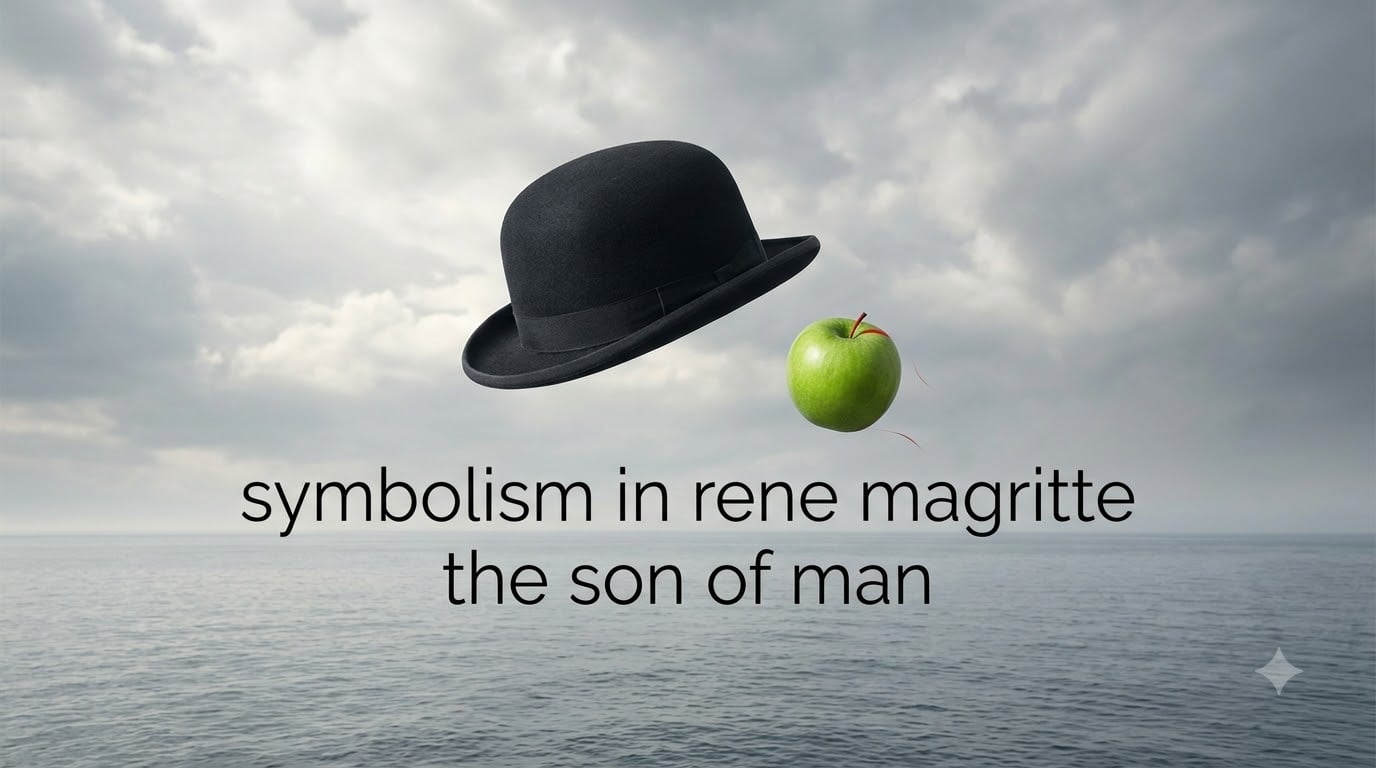
The Son of Man is a 1964 oil-on-canvas self-portrait by Belgian Surrealist René Magritte. It shows a man in a bowler hat and dark overcoat standing before a low wall with the sea and cloudy sky behind him, his face largely obscured by a hovering green apple. Magritte described the painting’s central tension this way: “Everything we see hides another thing. We always want to see what is hidden by what we see.” The work is his most famous painting and one of the most reproduced images in art history.
In this guide, we will unpack every layer of symbolism in The Son of Man, from the green apple and bowler hat to the hidden details most viewers never notice. Whether you are studying Surrealism or simply curious about what this iconic image means, the analysis below will give you a complete understanding of the painting and its place in Magritte’s body of work.
What makes this painting endure is its simplicity. Unlike many Surrealist works that rely on bizarre or dreamlike imagery, The Son of Man uses entirely ordinary objects, a suit, a hat, an apple, to create something unsettling. It asks a question that never gets a satisfying answer: what is hidden behind the things we see every day?
Table of Contents
What Is The Son of Man Painting?
The Son of Man (French: Le fils de l’homme) is an oil painting on canvas measuring 116 by 89 centimeters. Magritte completed it in 1964 as a self-portrait, though the figure’s face is almost entirely hidden. The composition is formal and symmetrical: a man stands in the center foreground, wearing a dark gray overcoat, white shirt, red necktie, and a bowler hat.
Behind him is a low stone sea wall, the ocean, and a cloudy sky. The most striking element is a green apple floating directly in front of the man’s face, obscuring everything except a sliver of his left eye and the left side of his forehead. The painting belongs to a private collection and has not been publicly displayed since it was sold at auction in 1998.
Who Was René Magritte?
René Magritte (1898-1967) was a Belgian artist and one of the leading figures of the Surrealist movement. Unlike Salvador Dalí or Max Ernst, who painted dreamlike, melting landscapes, Magritte’s style was deliberately ordinary and realistic. He depicted everyday objects, apples, pipes, bowler hats, in strange contexts to challenge how people perceive reality.
His work asks the viewer to question what they see. A pipe is not a pipe. An apple can hide a face. A painting of an object is not the object itself. This philosophy of dislocation, treating familiar things as mysterious, runs through nearly all of his work. Magritte often wore a bowler hat and dark suit himself, making the figure in The Son of Man a direct stand-in for the artist.
Magritte’s approach was intellectual rather than emotional. He did not paint from dreams or subconscious urges like many of his Surrealist peers. Instead, he constructed images methodically, arranging ordinary objects in ways that expose the strangeness of everyday life. A 1964 interview quoted him saying he wanted to make viewers feel that the world itself is mysterious, not just his paintings.
The Symbolism of The Son of Man
The Son of Man layers multiple symbolic meanings into a single, deceptively simple image. The painting works on at least four levels: a meditation on temptation, a commentary on conformity, an exploration of visibility and concealment, and a veiled religious reference. Each element, from the apple to the hat to the pose, carries weight.
The Green Apple: Temptation and Concealment
The green apple is the painting’s most recognizable symbol. On the surface, it references the Garden of Eden and the forbidden fruit that led to the fall of Adam and Eve. The apple represents temptation, knowledge, and original sin. But Magritte chose a green apple, not a red one, which departs from centuries of Western art tradition that depicts the forbidden fruit as red.
The green color suggests the fruit is unripe, an incomplete temptation, something that has not yet been fully consumed. In color psychology, green often represents growth, potential, and the natural world, but in this context it also suggests something forbidden that has not yet been chosen. The apple hovers impossibly in midair, defying gravity, which is itself a surrealist gesture. It is not resting on a table or held in a hand. It exists in a state of suspension, just as the act of temptation exists in a state of perpetual possibility.
The apple also serves a purely formal purpose: it hides the man’s face, turning the figure into an anonymous silhouette. As the top answer on Reddit’s Explain Like I’m Five forum puts it, the face is “obscured by temptation that he is struggling to overlook,” and you can see one eye peeking out as if the man is trying to look past the obstacle in front of him. The apple is positioned with geometric precision, its curved edge following the contour of the man’s cheekbone, as if it were designed specifically to fit this face.
The Bowler Hat: Conformity and Anonymity
The bowler hat and dark overcoat are quintessential symbols of the anonymous modern businessman. In the early twentieth century, the bowler hat was standard office wear in London and Brussels, a uniform of conformity. By dressing his figure this way, Magritte transforms a specific person into a generic everyman.
This was personal for Magritte. He regularly wore a bowler hat and dark suit in his own life, not as a costume but as his daily attire. The painting is therefore a self-portrait in the truest sense: it shows Magritte as he appeared in public, with the one difference that his face is hidden. The message is that we all wear masks. Our outward appearance, the suit, the hat, the tie, presents a controlled image to the world while the real self remains concealed.
The Visible and the Hidden
Magritte’s central artistic theme was the relationship between what is visible and what is hidden. He once explained: “Everything we see hides something else. We want to see what is hidden by what we see.” The Son of Man is the purest expression of this idea. A green apple, something ordinary and visible, blocks the viewer from seeing the man’s face, which is hidden behind it.
This is not just a clever visual trick. Magritte is making a philosophical point about perception itself. We assume that seeing something means understanding it, but the painting argues the opposite. What we see, the apple, the suit, the hat, actually prevents us from understanding what lies beneath. In his 1927 essay “The Words and the Images,” Magritte wrote about this gap between objects and their representations, and The Son of Man brings that essay to life on canvas.
Religious Meaning: The Son of Man
The title directly references the biblical phrase “Son of Man,” which appears over 80 times in the New Testament as a title Jesus used for himself. In the Book of Daniel and the Gospels, “Son of Man” refers to both a human being and a divine figure. By using this title, Magritte places his anonymous bowler-hatted figure in conversation with religious tradition.
The painting can be read as a modern Adam, the first man, whose sin was eating the forbidden fruit. The apple floating before his face is the very object of temptation, perpetually present and perpetually obscuring. Some art historians argue this is a stretch, pointing out that Magritte was not particularly religious. But the title is deliberate, and Magritte was careful with his words. He chose “Son of Man” rather than a neutral title like “Man with Apple,” suggesting he wanted the biblical resonance even if he did not intend a strictly religious reading.
Hidden Details: The Elbow and the Peeking Eye
Two details in The Son of Man are easy to miss but deeply significant. The first is the backward-bent left elbow. If you look closely, the man’s left arm bends in a slightly unnatural direction, as if his elbow is bending backward. This subtle distortion is a deliberate surrealist device, a reminder that the image is not a photograph of reality but a constructed painting designed to unsettle.
The second detail is the sliver of the man’s left eye visible above the apple and to the left of the viewer. This is not just a compositional choice. Art historians have connected this visible eye to the death of Magritte’s mother, who drowned herself in the Sambre River when Magritte was fourteen. Her body was recovered with her face obscured by her nightgown. The traumatic image of a face hidden by fabric, with perhaps one eye visible, appears to have left a lasting mark on Magritte’s imagination and recurs in multiple paintings.
Color Palette: Monotones and Accents
The painting’s color scheme is deliberately restrained. The suit, hat, wall, ocean, and sky are all rendered in gray-blue monotones, creating a flat, almost mechanical atmosphere. Against this muted background, only two elements break the pattern: the red necktie and the green apple. These are the only saturated colors in the entire composition.
The red tie draws the eye downward, grounding the figure’s identity in a small, human detail. The green apple draws the eye upward to the face that is not there. The two accents create a visual tension between what is revealed (the tie, suggesting a real person) and what is concealed (the face behind the apple). This two-color accent system is a masterclass in using a limited palette to direct the viewer’s attention.
Magritte’s Recurring Motifs
The bowler hat and the apple appear in many of Magritte’s paintings, not just The Son of Man. The bowler-hatted man shows up in The Man in a Bowler Hat (1964), Golconda (1953), and The Masterpiece (1948). In Golconda, dozens of identical bowler-hatted men rain down on a Belgian town, turning individuality into mass conformity.
The apple appears in The Listening Room (1952), where a single enormous green apple fills an entire room, and in This Is Not an Apple (1964), where a realistic apple is labeled “Ceci n’est pas une pomme” (This is not an apple), echoing his famous pipe painting. By repeating these motifs across decades, Magritte built a personal vocabulary of symbols. Each new painting gains meaning from the others.
Similar Paintings by Magritte
The Son of Man belongs to a group of 1964 paintings that explore similar themes. The Great War on Facades shows a woman in a bowler hat, her face hidden by flowers instead of an apple. Man in a Bowler Hat presents a nearly identical composition but with a different background. A Taste of the Invisible uses the same bowler-hatted silhouette against a neutral backdrop.
These companion works form a series that investigates concealment from different angles. Each painting hides the figure’s face with a different object, flowers, a bird, an apple, while keeping the same formal pose. Together they argue that identity is always partially hidden, no matter what object stands in the way.
What is remarkable about this series is how Magritte varies the emotional tone through his choice of concealing object. Flowers suggest beauty and fragility. A bird suggests freedom and flight. An apple suggests knowledge and sin. The same man, the same pose, the same anonymity, but each object tells a different story about what it means to be hidden.
Pop Culture Legacy
The Son of Man has become one of the most referenced paintings in popular culture. The Simpsons recreated the image in a 1999 episode with Homer standing in for Magritte’s figure. The 1999 film The Thomas Crown Affair features the painting as a central plot device, with the characters stealing it from a museum. Norman Rockwell painted a tribute called Mr. Apple in 1970, replacing the green apple with a red one.
The painting also has a surprising connection to The Beatles. In 1966, Paul McCartney purchased a short surrealist film called Le Jeu de Mortre, which features a bowler-hatted figure identical to the one in The Son of Man. The film’s title translates to “The Game of Death,” and it was made by Magritte’s friend Marcel Mariën. The image of the bowler-hatted man with a hidden face became part of the visual aesthetic of Apple Corps, the Beatles’ company. McCartney has spoken about Magritte’s influence on his approach to art and imagery, and the connection between Surrealism and the counterculture of the 1960s runs deeper than many people realize.
In the decades since, The Son of Man has appeared on posters, t-shirts, tattoos, and internet memes. The r/tattoos subreddit regularly features users who have the floating apple inked on their skin, treating it as a standalone symbol of hidden truth. The painting’s visual language is so clear and so immediately recognizable that it works outside the context of art history, communicating something primal about the human desire to see behind surfaces.
Where Is The Son of Man Now?
The Son of Man was commissioned in 1963 by Harry Torczyner, a New York lawyer and Magritte’s close friend and patron. Torczyner wanted a self-portrait, and Magritte delivered a painting that hid his own face behind an apple. After Torczyner’s death, the painting was sold at Christie’s in New York in November 1998 for 5,392,500 US dollars.
It is currently held in a private collection and has not been on public display since the auction. This means the only way to see the original painting today is through high-quality reproductions or the occasional loan to a major exhibition. The painting’s absence from public view has only increased its mystique and made it one of the most discussed works that few people have seen in person.
The 1998 sale at Christie’s was a landmark moment for Surrealist art. The hammer price of over 5 million dollars confirmed that Magritte’s work had moved from being admired by critics and collectors to being recognized as a major cultural asset. Today, The Son of Man is valued not just as a painting but as an image, a symbol that transcends the art world and belongs to popular culture in a way few other paintings do.
Frequently Asked Questions
What does The Son of Man by Magritte symbolize?
The Son of Man symbolizes the tension between what is visible and what is hidden. The green apple represents temptation and concealment, the bowler hat represents conformity, and the hidden face represents the unknowable self. Magritte himself said the painting shows that everything we see hides something else.
Why is there a green apple in front of the man’s face?
The green apple hides the man’s face to create a visual paradox: we see an ordinary object blocking something we want to see. It references the Garden of Eden and original sin, but its green color suggests the temptation is unfinished or unripe. The apple makes the figure anonymous, turning a specific person into an everyman.
What does the bowler hat mean in The Son of Man?
The bowler hat symbolizes conformity and the anonymous modern businessman. Magritte wore a bowler hat and dark suit himself, making the painting a self-portrait. The hat transforms the figure into a generic representative of ordinary people, suggesting that we all wear masks of respectability that hide our true selves.
Is The Son of Man a religious painting?
The title references the biblical phrase Son of Man, which Jesus used to describe himself. The painting can be read as a modern Adam with the forbidden fruit perpetually before his face. However, Magritte was not overtly religious, and the painting works equally well as a secular meditation on perception and identity.
Where is The Son of Man painting now?
The Son of Man is in a private collection. It was commissioned by Harry Torczyner in 1963 and sold at Christie’s in New York in 1998 for over 5 million dollars. The painting has not been publicly displayed since the auction and can only be seen through reproductions or rare exhibition loans.
Conclusion
The Son of Man is far more than a man with an apple in front of his face. It is a layered meditation on temptation, conformity, perception, and the limits of visibility. The green apple hides the face but reveals the idea: we can never fully know another person, and what we see always conceals something deeper. The symbolism in René Magritte’s The Son of Man works on multiple levels simultaneously, which is why it continues to fascinate viewers more than six decades after it was painted.
Magritte’s painting remains one of the most recognizable and most analyzed works of Surrealism because its message is universal. We all wear bowler hats. We all have apples in front of our faces. The question The Son of Man asks is whether we can look past the visible to find what is hidden. The answer, Magritte suggests, is that we cannot, and that this inability is not a failure but a fundamental part of being human.