
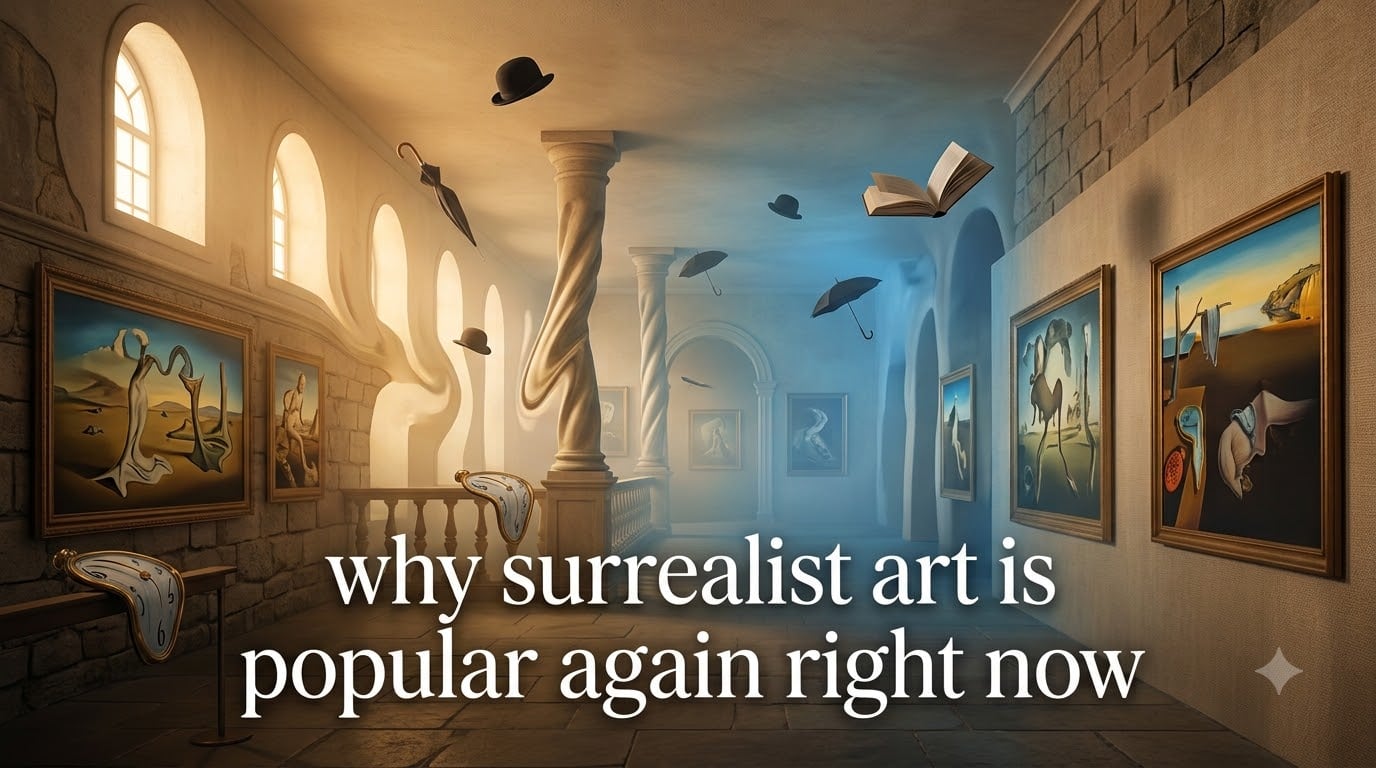
Surrealist art is popular again right now because a perfect storm of factors collided at once: the 2024–2025 centenary of the movement brought blockbuster museum shows, women Surrealists like Leonora Carrington shattered auction records, and today’s anxieties around AI, pandemics, and global conflict echo the post–World War I conditions that first birthed Surrealism over a century ago.
If you have noticed dreamlike paintings everywhere from museum walls to your TikTok feed, you are not imagining things. Surrealism — the art movement born from trauma, dreams, and the unconscious mind — is experiencing its biggest revival in decades. The reasons go deeper than a centenary milestone, and they reach all the way into how we live, scroll, and cope with uncertainty right now.
In this guide, I walk through exactly why surrealist art is popular again right now, from auction-house headlines to Gen Z weirdcore aesthetics. Whether you are a longtime collector or someone who just discovered Remedios Varo on Instagram, there is a clear story behind the resurgence.
Table of Contents
A Quick Refresher: What Surrealism Was and Where It Started
Surrealism launched in 1924 when the French poet André Breton published the Surrealist Manifesto. He argued that rational thought had failed humanity — World War I proved that — and that art should tap directly into the unconscious mind.
The early Surrealists included painters like Salvador Dalí, René Magritte, Max Ernst, and Man Ray. They used dreamlike imagery, unexpected juxtapositions, and automatic drawing techniques to bypass logic. Melting clocks, floating eyes, and impossible rooms became their visual language.
The movement never fully “ended” in the way Cubism or Futurism did. Its influence seeped into advertising, film, fashion, and later into video games and digital art. That persistence is one reason the current revival feels so natural — Surrealism never really left. It just went quiet in mainstream art conversations for a while.
The Centenary Spark: Why 2024–2025 Changed Everything
The 100th anniversary of the Surrealist Manifesto was the single biggest trigger. Museums worldwide organized major exhibitions timed to the centenary, and the art world paid attention in a way it had not for decades.
“Dreamworld: Surrealism at 100” traveled to multiple venues and drew record attendance. The Centre Pompidou in Paris mounted “Surréalisme,” a sprawling retrospective that became one of the museum’s most-visited shows. The Philadelphia Museum of Art ran its own centenary exhibition. These were not niche academic events — they were cultural moments covered by mainstream media.
Blockbuster exhibitions do something that online content alone cannot: they give people a physical encounter with Surrealist works. Standing in front of a Magritte painting is a different experience than seeing a JPEG. Visitors left those shows wanting more, and that appetite fed directly into gallery visits, book sales, and collector interest.
Auction Houses Are Breaking Records for Surrealist Art
The market data tells the same story the museum lines do, but with bigger numbers. Surrealist art is selling at prices that would have seemed impossible a decade ago.
René Magritte’s “L’empire des lumières” sold at Christie’s for over 121 million dollars — a record for the artist and a signal that top-tier Surrealist works now compete with Impressionist and Contemporary blue-chip pieces. Leonora Carrington’s “Les Distractions de Dagobert” fetched 28.5 million dollars, a record for any Surrealist woman artist. Remedios Varo’s prices have climbed steeply as well.
Sotheby’s reported that Surrealism’s market share roughly doubled between 2018 and 2024, according to ArtTactic data. The Karpidas collection sale in London brought in over 100 million pounds. These are not isolated spikes — they reflect sustained institutional and private demand for works that were once considered secondary to Abstract Expressionism or Pop Art.
Collector interest is also globalizing. Latin American and Asian buyers are driving demand, particularly for artists like Varo and Carrington who spent significant time in Mexico. The days when Surrealism was treated as a European art-history footnote are over.
Women Surrealists Are Finally Getting the Spotlight
This is one of the most significant shifts behind the revival. For decades, Surrealism was taught and exhibited as a boys’ club: Dalí, Magritte, Ernst, Breton. The women who were central to the movement — as artists, not just muses — were systematically overlooked.
That is changing fast. Leonora Carrington, Remedios Varo, Dorothea Tanning, and Meret Oppenheim are now the subjects of major retrospectives and record-breaking auction lots. Collectors describe “awakening” moments when they first encounter these artists at museum shows — a pattern I have seen repeated across forum discussions and collector profiles.
Part of the appeal is that their work often feels more emotionally accessible than the theoretical manifestos of Breton’s circle. Carrington’s strange creatures and Varo’s architectural dreamscapes carry a narrative pull that connects with contemporary viewers. As one gallerist noted, these women were “less doctrinaire” than the movement’s male founders, and that freedom makes their art feel fresh to a new audience.
The reassessment is also market-driven. When auction prices for Carrington and Varo climb into the millions, collectors and institutions pay attention. Scarcity plays a role too — fewer major works are available compared to Dalí or Magritte, which pushes prices higher and generates headlines.
The 1920s and the 2020s: Why the Parallels Feel Uncanny
Surrealism was born from crisis. World War I shattered faith in reason and progress. The 1918 flu pandemic killed millions. Political extremism was rising across Europe. Breton and his contemporaries responded by turning inward — into dreams, symbols, and the irrational.
The 2020s carry a hauntingly similar charge. The COVID-19 pandemic disrupted daily life on a global scale. Climate anxiety, geopolitical conflict, and the rapid rise of artificial intelligence have created a pervasive sense of uncertainty. People are once again looking for art that acknowledges chaos rather than pretending everything is fine.
Surrealist imagery offers both escapism and emotional honesty. A Dalí melting clock or a Magritte sky-blocked-by-a-boulder does not pretend the world makes sense. It validates the feeling that things are strange. As collector and gallerist Norris told Galerie magazine, the resurgence is “attributed to the tumult of the current moment.” That quote captures it perfectly.
Gen Z, TikTok, and the Digital Surrealist Aesthetic
Here is a factor that most competitors overlook entirely: younger audiences are discovering Surrealism through social media, not museums.
On TikTok, the “weirdcore” and “dreamcore” aesthetics — glitchy, nostalgic, dreamlike digital collages — draw directly from Surrealist visual traditions. Accounts that blend AI-generated imagery with Surrealist compositions rack up millions of views. Gen Z users who have never heard of André Breton are instinctively creating Surrealist art because the cultural mood demands it.
AI image generators like Midjourney and DALL-E have played a surprising role. Their default visual mode is often inherently Surrealist — impossible architecture, melting forms, uncanny juxtapositions. When millions of people experiment with “surreal” prompts, they are absorbing Surrealist vocabulary without realizing it. That familiarity lowers the barrier to engaging with the original artworks.
Reddit’s r/surrealart community captures this dynamic well. Users describe surrealism as “a way to process emotions that don’t fit normal language” — a framing that resonates with a generation navigating anxiety, digital overload, and identity questions through visual culture. The movement’s emotional vocabulary feels contemporary even though it is a century old.
Pop Surrealism: The Lowbrow Offshoot That Feeds the Revival
Pop Surrealism — sometimes called lowbrow art — emerged in 1970s California as a street-level, accessible cousin to classical Surrealism. Artists like Mark Ryden, Marion Peck, and Camille Rose Garcia blend cartoon aesthetics with dreamlike strangeness.
This subgenre is thriving right now and feeding directly into the broader Surrealism revival. Pop Surrealism’s visual language is instantly recognizable: oversized eyes, candy-colored palettes, vintage cartoon references layered with unsettling undertones. It grabs attention in the way that Surrealism always has — it is weird but beautiful, fun but deep.
The distinction matters. Classical Surrealism is rooted in psychoanalytic theory and the unconscious. Pop Surrealism is rooted in popular culture, illustration, and street art. Both tap into the same human appetite for imagery that breaks free from realism, but they reach different audiences. Many younger collectors enter through Pop Surrealism and then discover the historical canon.
Surrealism Beyond the Gallery: Fashion, Film, and Home Design
The revival is not confined to gallery walls and auction houses. Surrealist aesthetics have bled into fashion, cinema, and interior design in ways that keep the movement visible across everyday culture.
Schiaparelli — the fashion house founded by Surrealist artist Elsa Schiaparelli in the 1930s — has been a major presence on recent runways. Creative director Daniel Roseberry’s lobster dresses, golden-toe shoes, and anatomical motifs are direct descendants of the Surrealist tradition. Other designers have followed, incorporating dreamlike prints and impossible silhouettes into their collections.
In home design, Surrealist-inspired interiors have become a recognizable trend. Think organic-shaped furniture, Dalí-esque curved mirrors, and Max Ernst–inspired textured walls. It matches the broader “maximalism” turn in interior design, where personality and visual impact take priority over minimalist restraint.
How to Start Exploring Surrealism Right Now
If the revival has piqued your interest, there are accessible entry points. Start with a visit to any major museum’s Surrealist collection — the MoMA, Tate Modern, and Centre Pompidou all have strong holdings. Online, the Google Arts and Culture platform offers high-resolution views of key works.
For reading, start with André Breton’s Surrealist Manifesto (it is short) and then move to biographies of the women artists — Joanna Moorhead’s book on Leonora Carrington is a standout. On social media, follow museum accounts and search for weirdcore or dreamcore aesthetics to see how younger artists are reinterpreting the tradition.
Frequently Asked Questions
Why do people like surrealist art?
People are drawn to Surrealist art because it offers a visual language for feelings that realism cannot capture — anxiety, wonder, dreams, and the strangeness of modern life. It bypasses rational thought and speaks directly to emotion and imagination, which is why it resonates so strongly during uncertain times.
When did Surrealism end?
Surrealism never formally ended. The original movement’s most active phase ran from 1924 through the 1960s, but its influence persisted in advertising, film, fashion, and digital art. The current centenary revival proves that its visual vocabulary remains as relevant as ever.
What type of art is in high demand right now?
Figurative and narrative art — including Surrealism — is in high demand. Auction data shows record-breaking sales for Surrealist masters and women Surrealists alike. Pop Surrealism and digital surrealism are also surging, driven by younger collectors and social media discovery.
What art style does Gen Z like?
Gen Z gravitates toward visual styles that feel emotionally honest and digitally native — weirdcore, dreamcore, Pop Surrealism, and AI-generated surreal imagery. These aesthetics share Surrealism’s DNA: dreamlike imagery, uncanny juxtapositions, and a rejection of polished realism.
Why does surreal art still feel so powerful today?
Surreal art remains powerful because it addresses the same human need it did a century ago: the desire to express what rational language and realistic imagery cannot. In an era of AI, pandemic recovery, and global anxiety, Surrealist imagery validates the feeling that reality itself is strange and disorienting.
How did surrealism begin?
Surrealism began in 1924 when French poet André Breton published the Surrealist Manifesto in Paris. Building on the anti-logic legacy of Dada, Breton argued that the unconscious mind — accessed through dreams, automatic writing, and unexpected imagery — held deeper truths than rational thought. Artists like Dalí, Magritte, and Ernst quickly translated these ideas into painting.
Conclusion
The answer to why surrealist art is popular again right now comes down to convergence. A centenary milestone, long-overdue recognition for women artists, auction records that signal deep institutional faith, and a cultural moment that mirrors the movement’s original conditions have all aligned at once. Surrealism is not just a historical curiosity — it is the art language that matches how the world feels right now. If you have been curious about the movement, there has never been a better moment to start looking.