
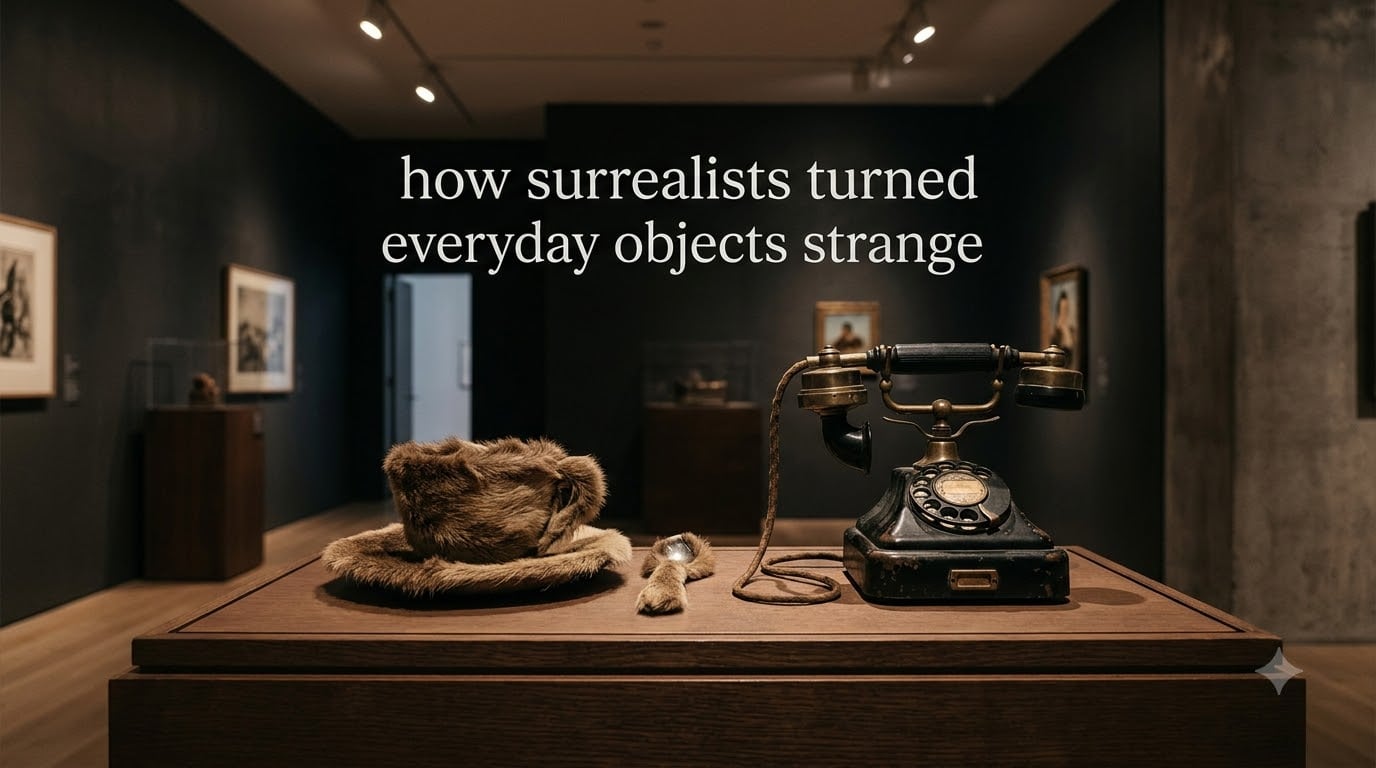
A surrealist object is a three-dimensional artwork made by combining everyday items in ways that subvert their ordinary function and summon unconscious, dreamlike, or uncanny associations. This practice was codified by André Breton’s surrealist group in Paris during the 1930s, when artists began turning teacups, telephones, irons, and shoes into objects that made viewers question reality itself.
If you’ve ever wondered how surrealists turned everyday objects strange, the answer lies in a set of deliberate techniques—juxtaposition, displacement, scale distortion, transformation, metamorphosis, and automatism. Each method was designed to puncture the viewer’s assumptions and reveal the hidden meanings lurking in ordinary things. Breton called it a “total revolution of the object,” and nearly a century later, these strange creations continue to influence designers, artists, and anyone who’s ever looked at a household item and thought it could be something else entirely.
Table of Contents
The Techniques That Made Everyday Objects Strange
Surrealists didn’t just randomly combine objects. They relied on named techniques, each producing a distinct psychological effect. Here are the six core methods:
1. Juxtaposition — Combining two unrelated objects so their meanings collide. Salvador Dalí’s Lobster Telephone pairs a crustacean with a communication device, creating an absurd tension between the organic and the mechanical. The effect is immediate: your brain scrambles to reconcile two things that have no business existing together.
2. Displacement — Removing an object from its normal context and placing it somewhere unexpected. Meret Oppenheim lined a teacup, saucer, and spoon with fur, transforming a breakfast ritual into something deeply unsettling. The familiar suddenly feels alien.
3. Scale Distortion — Making an object dramatically larger or smaller than expected. Dalí’s Mae West Lips Sofa reshaped a mouth into functional furniture, turning the human body into architecture. When scale shifts, the object stops being what it pretends to be.
4. Transformation — Altering an object’s material or surface to change its identity. Man Ray’s Gift coated an ordinary flatiron with a row of tacks, turning a tool of smoothing into one of destruction. The object retains its shape but loses its purpose.
5. Metamorphosis — Fusing organic and inorganic forms into hybrids. Alberto Giacometti’s Suspended Ball combines a sphere and a crescent in a cage-like structure that suggests both sculpture and a strange biological specimen. The result exists between categories.
6. Automatism — Allowing unconscious impulses to guide the selection or arrangement of objects. André Breton’s “exquisite corpse” games and automatic drawing sessions produced combinations no conscious mind would plan. The technique aimed to bypass rational thought entirely, trusting that the subconscious would surface truths hidden by logic.
These techniques weren’t isolated experiments. They formed a coherent system for what Breton called “bewildering sensation”—disrupting the automatic way we process the familiar world.
The Famous Objects That Defined Surrealism
Some surrealist objects became so iconic they practically define the movement. Here are the essential works to know:
Meret Oppenheim’s Object (1936) — A fur-lined teacup, saucer, and spoon. This is arguably the most famous surrealist object ever made. Oppenheim reportedly created it after Pablo Picasso complimented her fur bracelet, saying anything could be covered in fur. The piece now lives at MoMA and remains a gateway to understanding how surrealists turned everyday objects strange.
Dalí’s Lobster Telephone (1936) — A functioning telephone with a plaster lobster replacing the handset. Commissioned by Edward James, this object turns a mundane communication tool into something absurd and faintly threatening. The lobster’s tail hangs where the cord should be.
Man Ray’s Gift (1921) — A flatiron studded with a row of thirteen tacks glued to its sole. This early surrealist object destroys the very function it seems to promise. Ironing with it would shred fabric.
Dalí and James’s Mae West Lips Sofa (1937) — A sofa shaped like the actress’s famously full lips, upholstered in pink fabric. It exists at the intersection of furniture, portraiture, and obsession—turning a living person’s anatomy into something you sit on.
Elsa Schiaparelli’s Shoe Hat (1937) — A hat designed in collaboration with Dalí, shaped like a woman’s high-heeled shoe worn upside down on the head. Fashion became surrealist sculpture.
Eileen Agar’s Hat for Eating Bouillabaisse (1937) — A headpiece constructed from cork, fish bones, coral, and sea urchin spines. Found objects from the beach became wearable absurdity.
Each of these works demonstrates the same core move: taking something ordinary and making it impossible to look at the same way again.
Breton’s Three Categories of Surrealist Objects
In his 1936 essay, Breton identified three types of surrealist objects. Understanding these categories clarifies what separates a surrealist object from a random assemblage:
Found Objects — Everyday items selected because they carry unconscious associations for the finder. A chance encounter with an object in a flea market could trigger a dream memory or poetic connection. Marcel Duchamp’s bottle rack is sometimes cited here, though Duchamp himself would have resisted the surrealist label.
Interpreted Found Objects — Found objects that have been slightly modified or recontextualized. Oppenheim’s fur teacup fits this category: a real teacup, altered just enough to become uncanny.
Phantom Objects — Items that exist only in dreams or imagination, then constructed to match the vision. Dalí’s Lobster Telephone has phantom qualities—you sense it shouldn’t exist, yet here it is.
This taxonomy matters because it shows surrealism wasn’t just about bizarre combinations. There was a deliberate theory behind which objects to choose and how to transform them.
Surrealist Object vs. Dada Readymade
One common confusion: how are surrealist objects different from Marcel Duchamp’s readymades? The distinction is real and important.
Duchamp’s readymades—his urinal (Fountain, 1917), his bottle rack, his bicycle wheel—were ordinary objects declared art through the artist’s choice alone. They were not modified. Duchamp’s point was conceptual: the act of selection made them art.
Surrealist objects, by contrast, were typically combined, altered, or displaced. They were meant to trigger unconscious associations and emotional responses, not just intellectual ones. Where Duchamp asked “Is this art?”, the surrealists asked “What does this make you feel?”
Forum discussions on r/ArtHistory confirm this distinction matters to people studying the movement. The surrealist object is more psychological; the readymade is more philosophical.
From Surrealist Objects to Modern Design
The surrealist object didn’t stay in 1930s Paris. Its influence spread into fashion, interior design, and contemporary art.
Elsa Schiaparelli’s collaborations with Dalí produced wearable surrealist objects—the Shoe Hat, the Lobster Dress, the Skeleton Dress. She brought the uncanny into haute couture, and designers like Alexander McQueen and Iris van Herpen have continued that tradition.
In product design, the surrealist sensibility appears in objects that play with function and expectation. Think of Philippe Starck’s lemon squeezer (Juicy Salif)—a piece of kitchen equipment that looks like an alien insect and works poorly as a squeezer. It’s surrealist in spirit if not in intent.
Contemporary artists like Rebecca Horn, Wim Delvoye, and Maurizio Cattelan continue making objects that transform the familiar into the strange. The techniques Breton’s group developed remain active tools for anyone looking to unsettle viewers.
How to Make Your Own Surrealist Object
Creating a surrealist object doesn’t require art school or expensive materials. Here’s how to start:
Step 1: Choose a familiar object. Pick something from everyday life—a kitchen utensil, a piece of clothing, a tool, a toy. The more ordinary, the better. A fork. A shoe. A clock.
Step 2: Select a technique. Decide which method from the list above appeals to you. Want to try displacement? Put the object somewhere it doesn’t belong. Want to try transformation? Change its material—wrap it in fur, coat it in wax, embed it in concrete.
Step 3: Follow the absurd. Let your unconscious guide you. What associations does the object trigger? A fork might suggest hands, teeth, or combing hair. A shoe might suggest a boat, a vase, or a cradle. Don’t overthink it.
Step 4: Assemble and observe. Place the finished object somewhere you’ll see it daily. Does it still surprise you after a week? Good. If not, transform it further.
Breton’s group found their materials at flea markets, which remain excellent sources for cheap, evocative objects. The key is to trust the strange impulse—if an idea feels absurd, it’s probably on the right track.
Frequently Asked Questions
What are some examples of Surrealist objects?
Famous surrealist objects include Meret Oppenheim’s fur-lined teacup (Object, 1936), Salvador Dalí’s Lobster Telephone (1936), Man Ray’s Gift (a flatiron with tacks, 1921), the Mae West Lips Sofa by Dalí and Edward James (1937), and Elsa Schiaparelli’s Shoe Hat (1937). These works all take ordinary items and transform them into something uncanny through techniques like displacement, transformation, and juxtaposition.
What are 6 techniques used in Surrealism?
The six core techniques for making surrealist objects are: (1) Juxtaposition—combining unrelated objects; (2) Displacement—placing objects in unexpected contexts; (3) Scale Distortion—changing an object’s size; (4) Transformation—altering an object’s material or surface; (5) Metamorphosis—fusing organic and inorganic forms; and (6) Automatism—allowing unconscious impulses to guide creation. Each technique produces a different psychological effect, from absurdity to the uncanny.
What are the 7 characteristics of surrealist art?
The seven key characteristics of surrealist art are: (1) dreamlike imagery drawn from the unconscious; (2) unexpected juxtapositions of unrelated objects; (3) transformation of the familiar into the strange; (4) automatism as a creative method; (5) interest in the uncanny and Freudian psychology; (6) rejection of rational logic; and (7) use of found objects and everyday materials. Not every work includes all seven, but these traits define the movement overall.
What are some elements of Surrealism?
Core elements of Surrealism include the unconscious mind as a source of creativity, dream imagery, automatic drawing and writing, found objects, unexpected combinations, scale distortion, metamorphosis of forms, and the subversion of everyday function. Surrealism was influenced by Sigmund Freud’s theories of dreams and the unconscious, and it sought to reveal hidden truths beneath rational thought.
What are the five common themes found in Surrealism?
Five recurring themes in Surrealism are: (1) dreams and the unconscious mind; (2) the uncanny and the familiar-made-strange; (3) desire, love, and eroticism; (4) the irrational and the absurd; and (5) the transformation of everyday objects. Surrealists believed these themes revealed deeper truths about human experience that rational thinking could not access.
What is the difference between a surrealist object and a readymade?
A readymade, pioneered by Marcel Duchamp, is an unaltered everyday object declared art through the artist’s choice alone—it asks ‘Is this art?’ A surrealist object, by contrast, is typically modified, combined, or displaced to trigger unconscious associations and emotional responses. The readymade is philosophical; the surrealist object is psychological.
Conclusion
The surrealist project of turning everyday objects strange wasn’t just an art-historical footnote. It was a systematic attempt to crack open the automatic way we process the familiar world. Through techniques like juxtaposition, displacement, and automatism, artists including Oppenheim, Dalí, Man Ray, and Schiaparelli created objects that still make viewers stop and question what they’re looking at. Understanding how surrealists turned everyday objects strange reveals a creative toolkit that remains as potent today as it was in 1930s Paris—whether you’re studying the movement’s history or making your own surrealist object at home.