
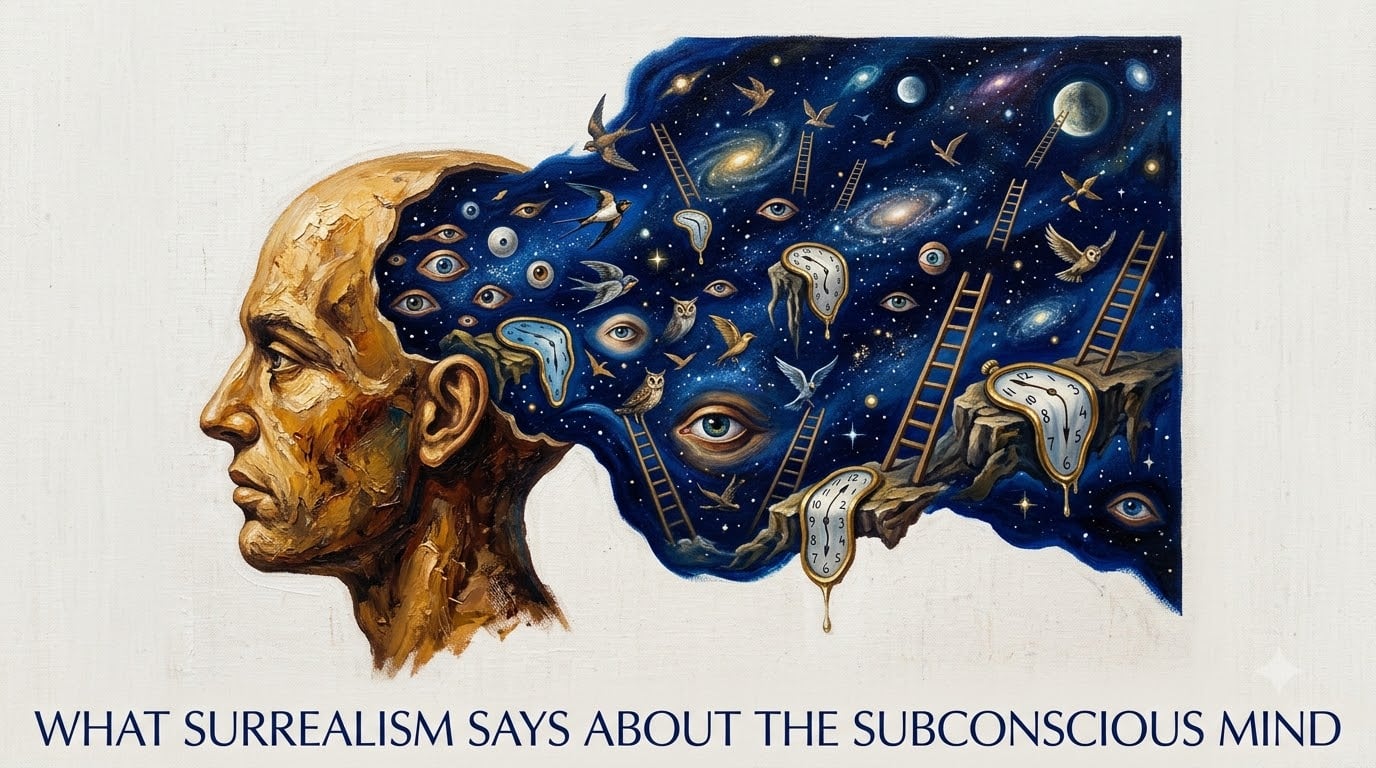
Surrealism says the subconscious mind is a vast reservoir of dreams, hidden desires, and symbolic imagery that shapes how we see reality. The movement treats the unconscious as the truest source of creativity, arguing that rational thought alone produces only surface-level art. By combining Freudian psychoanalysis with experimental techniques, Surrealist artists turned dream logic into a window on the human psyche. This guide walks through what that vision looks like, how the artists practiced it, and what it still teaches us in 2026.
I have spent years reading Surrealist manifestos, visiting exhibitions, and trying the techniques myself. What follows is a working map of the subconscious as Surrealism understood it, written for anyone who wants to look beneath the surface of the movement.
Table of Contents
How Freud’s Theory of the Unconscious Shaped Surrealism
Surrealism begins with Sigmund Freud. Without his 1899 book The Interpretation of Dreams and his later model of the mind, there is no Surrealist movement. Freud proposed that human behaviour is driven by forces we cannot see, including repressed wishes, childhood conflicts, and instinctual drives.
His central claim was simple and radical. Most of what we think, feel, and dream is governed by a part of the mind we are not consciously aware of. Art, slips of the tongue, jokes, and dreams all leak content from this hidden reservoir. For Surrealists, this was an invitation.
Freud’s Three Levels of Consciousness
Freud divided the mind into three interacting layers, and Surrealist art often visualises each one.
- The conscious mind is what you are using right now to read this sentence. It handles logic, language, and short-term memory.
- The preconscious stores ordinary memories you can pull into awareness with effort, like your childhood address.
- The unconscious holds repressed memories, instinctual drives, and the symbolic content of dreams. Freud called its chaotic core the id.
Within the unconscious, Freud placed the id, ego, and superego as a structural trio.
- Id — the primitive, pleasure-seeking part. It wants immediate gratification and operates on impulse.
- Ego — the reality-checker. It mediates between the id, the outside world, and the superego.
- Superego — the internalised voice of authority and morality, built from parental and social rules.
Surrealists were fascinated by the id. They believed dreams, free association, and accidental marks could bypass the ego and let the id speak directly. That belief is the engine of every melting clock and floating eye you have ever seen in a Surrealist painting.
Freud’s Dream Theory and Its Pull on the Movement
Freud treated dreams as coded messages from the unconscious. He argued that wishes too threatening for waking life return at night in disguised form, using symbols shaped by what he called dream-work. Two of its main operations, condensation (merging multiple ideas into a single image) and displacement (shifting emotional charge from one image to another), became visual tools for Surrealist painters.
Dalí’s soft watches are condensed objects. They hold memory, decay, and elastic time in a single symbol. Magritte’s floating apples fuse a pipe, a face, and a window in one frame. The unconscious, in Freud’s view, never speaks in clean sentences. It speaks in images that compress several meanings at once.
André Breton and the Birth of the Surrealist Movement
Surrealism officially began in 1924, when French poet André Breton published the Surrealist Manifesto. He defined Surrealism as pure psychic automatism, the act of expressing the real functioning of thought without rational control or aesthetic concern. The goal was to dissolve the boundary between waking and dreaming, conscious and unconscious.
The movement grew out of Dada, the anti-art rebellion that flourished in Zurich and Paris during the First World War. Dada artists rejected bourgeois culture after the carnage of 1914 to 1918. Breton and his circle asked a more constructive question. If logic and civilisation had produced industrial slaughter, what could the unconscious offer instead? The answer was a new way of seeing, dreaming, and making.
By the mid-1920s, Paris had a formal Surrealist group with membership cards, exhibitions, and regular manifestos. Writers, painters, and filmmakers worked side by side, all searching for what Breton called the marvellous, the sudden encounter with something both strange and familiar that reveals a deeper truth.
Surrealist Techniques for Accessing the Subconscious
Surrealists did not wait for inspiration. They built specific procedures to force the unconscious to the surface. Each technique is a kind of door, and the Surrealists were obsessed with finding every key.
Psychic Automatism and Automatic Writing
Automatism is Breton’s signature method. The artist writes or draws quickly, without planning, and without crossing anything out. The hand is supposed to move on its own, letting the unconscious dictate shape and content. The results are often strange, fragmented, and unexpectedly revealing. I have tried this myself with a notebook and a timer, and the first ten minutes are usually nonsense. Somewhere around minute fifteen, a real image or phrase breaks through.
Free Association
Borrowed directly from Freud’s clinical practice, free association asks the artist to say or sketch whatever comes to mind after a single stimulus word or image, without editing. Surrealists used it in group sessions, where one person’s chain of associations would spark another’s drawing.
Dream Recording
Many Surrealists kept dream journals beside their beds. The moment of waking was treated as the most valuable moment of the day, because the unconscious is still close to the surface. Breton, Dalí, and Ernst all filled notebooks with dream images that later appeared in their art.
Frottage, Decalcomania, and the Exquisite Corpse
When automatism needed a physical trigger, Surrealists invented tactile methods.
- Frottage — Max Ernst placed paper over textured surfaces like wood grain and rubbed with graphite, letting the texture suggest imaginary landscapes.
- Decalcomania — pressing wet paint between surfaces to create chance patterns, then developing them into images.
- Exquisite corpse — a collaborative drawing game where each artist adds to a folded paper without seeing the previous contribution, producing hybrid figures.
Each method shares a single principle. The artist sets conditions, then surrenders control. The unconscious fills the space reason leaves empty.
Illusionistic vs Automatist Surrealism: Two Doors to the Unconscious
Scholars often divide Surrealism into two wings, both aiming at the unconscious but using opposite methods.
Illusionistic Surrealism paints hyper-real dreams. Dalí, Magritte, and Tanguy built meticulously detailed worlds where impossible objects cast real shadows. The precision is the point. When the rendering is photographic, the dream content feels even more uncanny, because the eye trusts the surface and the mind rejects the content.
Automatist Surrealism rejects finish and control. Miró, André Masson, and later Matta treated the canvas as a record of inner gesture. Shapes are simplified, lines are raw, and the painting looks unfinished on purpose. The rawness is meant to prove the work came from somewhere deeper than skill.
Both wings claim to reveal the subconscious. Illusionistic Surrealism argues the unconscious produces coherent, dreamlike scenes. Automatist Surrealism argues the unconscious is fragmented and should not be tidied up. The disagreement is itself a clue. The subconscious, in Surrealist terms, is not a single place. It behaves differently depending on how you approach it.
Key Surrealist Artists and Their Subconscious-Inspired Works
Four artists dominate any honest map of Surrealism. Each took a different door into the unconscious, and each left paintings that still function as visual arguments about how the mind works.
Salvador Dalí and The Persistence of Memory
Dalí called his method paranoiac-critical, a state of self-induced delusion in which he would hallucinate one object as another and then paint both at once. The Persistence of Memory (1931) shows soft watches drooping over rocks, a tree branch, and a fleshy face on the ground. The painting is often read as a meditation on the elasticity of time within dreams, where a minute can stretch and an hour can vanish. For Dalí, this was not metaphor. It was a description of how time actually feels inside the unconscious.
René Magritte and The Treachery of Images
Magritte worked the opposite side of the same question. The Treachery of Images (1929) shows a pipe above the caption Ceci n’est pas une pipe, which translates to This is not a pipe. Magritte pointed out the obvious. The image is a representation, not the object. The unconscious, he suggested, confuses representation with reality constantly, and every dream is a treachery of images in this sense.
Max Ernst and the Forest as Inner Landscape
Ernst invented frottage in 1925 and used it to build a personal mythology of forests, birds, and wounded angels. His Forest series treats landscape as a projection of inner conflict. Trees become bones, leaves become eyes, and the whole wood feels like a single nervous system turned outside in. For Ernst, the unconscious was less a place of dreams than a place of ancient, half-buried trauma.
Joan Miró and the Automatist Field
Miró worked in the Automatist wing. His paintings of the 1920s and 1930s scatter stars, eyes, ladders, and biomorphic shapes across pale backgrounds. There is no illusionistic depth. Everything floats on the surface, the way images float in hypnagogic states between waking and sleep. Miró once said he wanted his work to feel like a fly walking across a blank page. The unconscious, in his hands, was an open field rather than a hidden room.
Freud vs Jung: Two Visions of the Unconscious in Surrealist Art
Freud is the public face of Surrealism’s psychology, but Carl Gustav Jung shaped the movement almost as deeply. Most histories underplay this, which is why it is worth slowing down here.
Freud saw the unconscious as personal. It holds repressed memories, childhood sexuality, and the residue of individual experience. Jung saw a deeper layer beneath the personal unconscious, which he called the collective unconscious. This layer holds archetypes, the hero, the mother, the shadow, the trickster, that appear in myths across every culture.
You can see Freud’s model in Dalí’s loaded personal symbols, the soft watches of his own childhood fear of decay, and Ernst’s private forest of personal trauma. You can see Jung’s model in Miró’s stars and ladders, which feel like archetypes that belong to everyone, and in Masson’s ritual figures, which read as mythological rather than autobiographical.
Both visions mattered. Freud gave Surrealism its method, free association and dream interpretation. Jung gave Surrealism its symbols, the universal patterns that recur in dreams across centuries. The deepest Surrealist works use both, sliding between private confession and shared archetype in the same canvas.
What Modern Neuroscience Tells Us About the Subconscious
Freud’s specific model of repression has aged poorly, but his core intuition has held up. Modern neuroscience confirms that most mental life happens outside conscious awareness. Decisions are prepared in the brain seconds before you are aware of making them. Emotion, memory, and perception are processed in systems that never report to conscious thought in plain language.
Brain imaging shows that dreams activate the limbic system, the emotional centre, while the prefrontal cortex, the logical editor, goes quiet. That is a remarkably close match for Freud’s claim that dreams leak unconscious content while the rational mind sleeps. Surrealism was right about the architecture, even when it was wrong about the contents.
Default mode network research adds another layer. When the mind is at rest, it runs an internal simulation, replaying memories, imagining futures, and constructing narratives that no one asked for. This is the closest modern analogue to what Surrealists meant by the unconscious as a creative engine. The mind is always dreaming, even when you think you are doing nothing.
How to Practice Surrealist Techniques Today
Surrealism is unusually easy to try at home, because its methods are simple on the surface and strange in effect.
- Keep a dream journal. Write or sketch the moment you wake, before checking your phone. Five minutes is enough. Within a month you will see recurring symbols.
- Set a 15 minute automatic drawing timer. Move the pen without lifting it from the page. No crossing out, no judging. Look at the result only after the timer ends.
- Try a free association chain. Pick one word, write the first thing that comes to mind, then write the first thing that comes to that, and so on for ten steps. The links are where the unconscious shows up.
- Make a frottage. Place paper over a wood floor, a brick wall, or tree bark, and rub with the side of a pencil. Let the texture suggest a landscape before you finish rubbing.
- Play the exquisite corpse. Fold a sheet into thirds. Each person draws the head, midsection, or feet without seeing the others. The hybrid figure that emerges is a small lesson in shared unconscious imagery.
None of this requires skill. It requires willingness to be surprised, which is the one thing Breton asked of every Surrealist in 1924 and the one thing the subconscious still rewards today.
Frequently Asked Questions
What did Freud say about Surrealism?
Freud viewed Surrealism with mixed feelings. He accepted that art could draw on unconscious material, but he never endorsed the movement as a scientific method. André Breton visited Freud in London in 1938, and the two men spoke for a single afternoon without reaching agreement. Freud’s lasting contribution to Surrealism was the framework, not the blessing.
What is Freud’s theory of the subconscious mind?
Freud proposed that the mind is divided into conscious, preconscious, and unconscious levels. The unconscious holds repressed wishes, instinctual drives, and the symbolic content of dreams. These hidden contents shape behaviour, art, and slips of the tongue, even when the person is unaware of them.
What are Freud’s three levels of consciousness?
Freud described three levels. The conscious mind handles current awareness and logic. The preconscious stores memories that can be retrieved with effort. The unconscious holds repressed material and instinctual drives, including the id, ego, and superego as its internal structure.
How did Freud influence Surrealism?
Freud gave Surrealism its founding idea, that the unconscious is a richer source of truth than rational thought. His techniques of free association, dream interpretation, and analysis of slips provided the movement’s working methods. Without Freud there is no automatism and no Surrealist Manifesto.
Why was Surrealism created?
Surrealism was created after the First World War as a response to the failure of rational, bourgeois civilisation. André Breton and his circle believed that the unconscious held a more honest truth than the public logic that had produced industrial slaughter. The movement aimed to reunite waking and dreaming life through art and writing.
What Surrealism Says About the Subconscious Mind
What Surrealism says about the subconscious mind is that the inner world is bigger, stranger, and more honest than the outer one. Dreams, slips, and chance images carry real information about who we are, and art is one of the few languages able to translate that information. The movement gave us Freud’s model of the unconscious, Breton’s method of automatism, and a century of paintings that still teach us how to look inward.
Start a dream journal tonight. Try a fifteen minute automatic drawing this week. The unconscious, in Surrealist terms, has been waiting for an invitation, and it does not need much.