
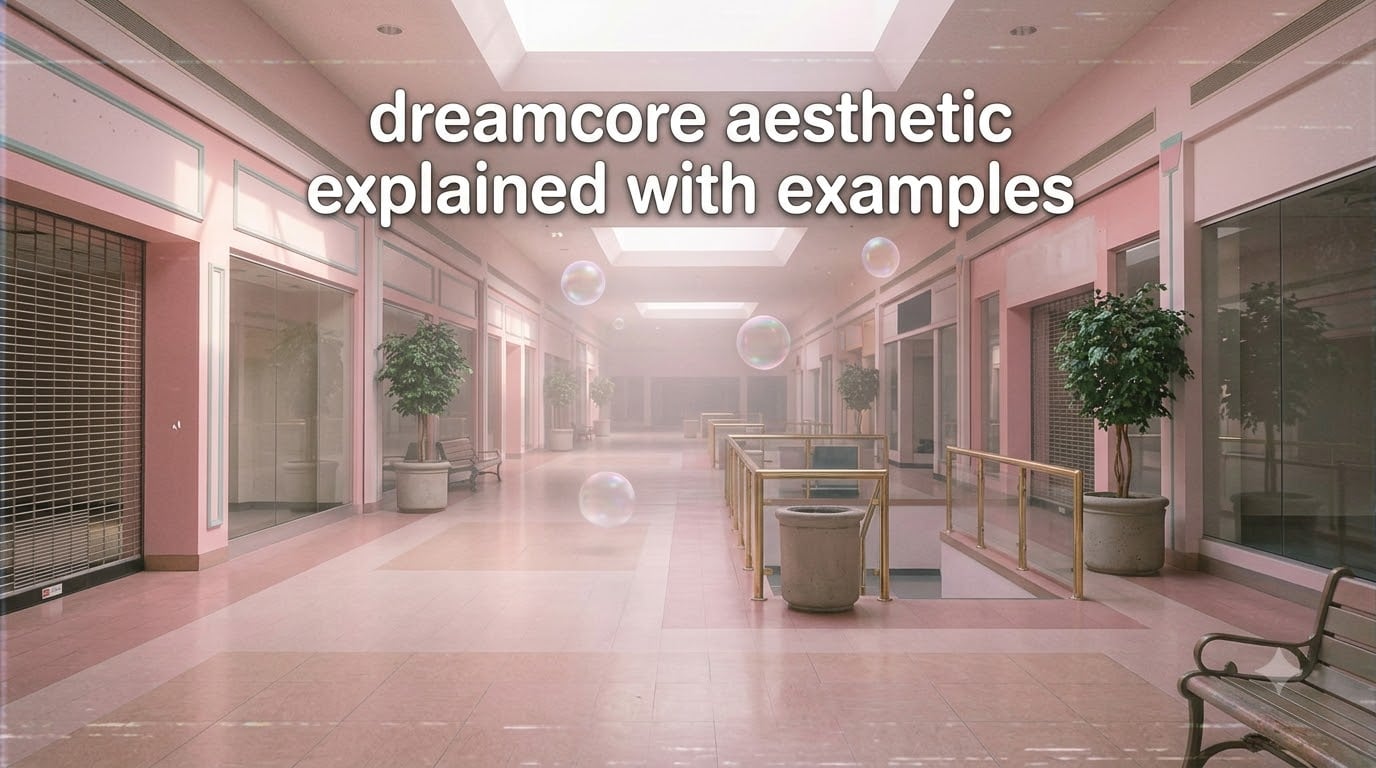
Dreamcore is a surreal internet aesthetic that emerged in the early 2020s, focusing on dreamlike visuals that blend nostalgia, familiarity, and subtle unease through empty spaces, soft pastels, and distorted imagery. If you’ve ever scrolled past a blurry photo of an abandoned mall bathed in pink light and felt a strange pull between comfort and creepiness, you’ve encountered the dreamcore aesthetic. In this guide, we’ll break down what dreamcore is, explore its visual elements, compare it to related aesthetics, and show you how to create dreamcore art yourself.
Table of Contents
What Is the Dreamcore Aesthetic?
Dreamcore is a digital art movement and internet aesthetic built around recreating the feeling of a half-remembered dream. It takes ordinary environments like schools, malls, playgrounds, and suburban neighborhoods and strips them of people, then bathes them in soft pastels, grainy textures, and hazy light.
Unlike many internet aesthetics that lean into a single emotion, dreamcore occupies a liminal space between comfort and discomfort. The imagery feels familiar because we’ve all had dreams set in places like these. But something is always slightly off. Colors are too saturated or too muted. Perspectives feel wrong. Shadows don’t fall where they should.
The aesthetic draws heavily from surrealism, but it’s not trying to be high art. It’s a grassroots visual language that emerged organically on platforms like Tumblr, Reddit, and TikTok. On r/dreamcoreaesthetic, users describe it as “that feeling when you can’t tell if a memory is real or from a dream.”
Dreamcore content typically includes photographs, digital edits, short video loops, and mood boards. The unifying thread is that every piece should feel like a scene from a dream you can’t quite remember upon waking. That ambiguity is the whole point.
Origins and History of Dreamcore
Dreamcore as a named aesthetic began coalescing around 2019-2020 on Tumblr and Reddit. The r/LiminalSpace subreddit, which predates dreamcore, laid groundwork by popularizing images of empty transitional spaces. But dreamcore took that concept and pushed it further into overtly surreal territory.
The COVID-19 pandemic played a significant role in dreamcore’s growth. With people stuck at home and processing collective isolation, dreamlike imagery of empty public spaces resonated deeply. Suddenly, photos of vacant hallways and abandoned buildings felt less abstract and more reflective of lived experience.
TikTok became the primary growth engine starting around 2020-2021. The platform’s algorithm surfaced dreamcore content to users interested in adjacent aesthetics like cottagecore and dark academia. Video editors began creating short dreamcore loops set to slowed-down music, and the format spread rapidly.
Reddit’s r/dreamcoreaesthetic community grew alongside TikTok, serving as a space for more curated discussion. Users share original creations, debate what qualifies as dreamcore, and offer feedback on edits. The community has been particularly vocal about distinguishing dreamcore from its many offshoots.
By 2026, dreamcore has become one of the most recognizable internet aesthetics. It influences graphic design, fashion photography, music videos, and even video game design. Artists like Frank Ocean have incorporated dreamcore elements into their visual identity, most notably at the Met Gala.
Key Dreamcore Visual Elements
Dreamcore has a consistent visual vocabulary. Once you learn to recognize these elements, you’ll start seeing them everywhere. Here are the core building blocks that define the aesthetic.
Liminal Spaces
Liminal spaces are transitional environments captured in a state of emptiness. Think hallways, stairwells, parking garages, hotel lobbies, and airport corridors. The word “liminal” comes from the Latin word for threshold, and these spaces are powerful in dreamcore because they exist between destinations without a clear purpose of their own.
In dreamcore, liminal spaces are rarely photographed in harsh, realistic light. Instead, they’re bathed in soft pinks, blues, and lavenders. The lighting often comes from an unclear source, which adds to the dreamlike quality. Fluorescent lights might glow an unnatural hue, or sunlight might stream in from windows that don’t quite make architectural sense.
Empty Settings
One of dreamcore’s most distinctive features is the complete absence of people. Playgrounds with no children, classrooms with no students, shopping malls with no shoppers. This emptiness creates tension because our brains expect these spaces to be populated.
The most commonly cited dreamcore locations include:
- American suburban malls and food courts
- School hallways and classrooms
- Empty playgrounds and parks
- Residential neighborhoods at dusk
- Swimming pools without swimmers
- Office buildings with flickering lights
Pastel Color Palettes
Dreamcore heavily favors pastel tones. Soft pinks, baby blues, gentle lavenders, muted yellows, and powder greens dominate. These colors create a visual softness that mimics the hazy quality of dreaming.
That said, dreamcore isn’t limited to pastels. Some creators use oversaturated neons or desaturated earth tones to achieve a different kind of dreamlike effect. The key is that the color palette feels intentional and slightly unnatural, never quite matching how colors appear in waking life.
VHS Effects and Analog Distortion
Many dreamcore images incorporate retro technology aesthetics. VHS tracking lines, scan lines, grainy footage, and color bleeding all signal that the image exists outside normal time and space. These effects were originally flaws in analog recording, but in dreamcore, they become deliberate artistic choices.
Common VHS-inspired effects include:
- Horizontal tracking lines across the image
- Color separation and chromatic aberration
- Timestamp overlays in vintage fonts
- Static noise and grain
- Warped edges and vignetting
Blurry and Distorted Imagery
Sharp, high-resolution photography actually works against the dreamcore aesthetic. Instead, creators intentionally blur, soften, or distort their images. Motion blur, soft focus, and gaussian blur all contribute to the feeling that you’re looking at a memory rather than a photograph.
Some creators distort perspective as well. Impossible geometry, warped hallways, and Escher-like staircases tap into the way dreams often feature spaces that don’t obey physics. Even subtle perspective shifts can create unease.
Floating Objects and Surreal Elements
Objects floating in midair, oversized items in unexpected settings, and things existing where they shouldn’t all feature in dreamcore. A massive rubber duck in an empty parking lot. A child’s toy floating in a swimming pool. Furniture arranged in impossible configurations.
These surreal additions transform otherwise mundane scenes into something dreamlike. They break the logic of the physical world in a way that feels gentle rather than aggressive, more curious than threatening.
Dreamcore vs Related Aesthetics
One of the most common points of confusion is how dreamcore relates to similar internet aesthetics. Several movements share overlapping visual elements, but each has distinct characteristics, moods, and intentions.
Dreamcore vs Weirdcore
Weirdcore and dreamcore are often confused, but they create fundamentally different emotional experiences. Dreamcore evokes nostalgia and gentle unease. Weirdcore leans into disorientation and anxiety. Weirdcore imagery tends to feature bold, clashing colors, glitchy digital effects, and surreal text overlays that feel more aggressive than dreamcore’s soft haziness.
Think of dreamcore as the aesthetic equivalent of a pleasant dream that takes an odd turn. Weirdcore is more like a fever dream where nothing makes sense and the disorientation is the point.
Dreamcore vs Traumacore
Traumacore deals explicitly with trauma, mental health struggles, and emotional pain. Its imagery often includes darker themes, text overlays addressing personal experiences, and visual elements designed to express psychological distress. While dreamcore can feel unsettling, it doesn’t intentionally reference trauma.
The distinction matters. Dreamcore is a visual aesthetic anyone can explore for its artistic qualities. Traumacore is more personal and often functions as a form of expression for people processing difficult experiences.
Dreamcore vs Kidcore
Kidcore celebrates childhood nostalgia through bright colors, toys, cartoons, and early internet imagery. It overlaps with dreamcore in its nostalgia, but kidcore is joyful and vibrant where dreamcore is hazy and ambiguous. A kidcore image of a colorful playground celebrates childhood. A dreamcore image of the same playground, empty and bathed in pink light, asks questions about memory and time.
Comparison Table
| Aesthetic | Primary Focus | Color Palette | Mood | Key Visuals |
|---|---|---|---|---|
| Dreamcore | Dreamlike nostalgia | Soft pastels | Unsettling comfort | Empty spaces, blur, VHS effects |
| Weirdcore | Disorientation | Bold, clashing | Anxious confusion | Glitchy text, surreal landscapes |
| Traumacore | Emotional expression | Dark, muted | Distress, processing | Personal imagery, text overlays |
| Kidcore | Childhood joy | Bright primary colors | Nostalgic happiness | Toys, cartoons, retro tech |
Why Does Dreamcore Feel So Unsettling?
Dreamcore’s emotional power comes from a psychological phenomenon called cognitive dissonance. Your brain recognizes the environment as safe and familiar, but something is wrong. That mismatch creates tension that you can’t easily resolve.
The uncanny valley effect applies here too. We typically associate that concept with humanoid robots, but it extends to environments. A school hallway that’s almost right but subtly wrong triggers the same discomfort as a face that’s almost human but not quite.
Derealization, a psychological state where the world feels unreal or detached, is another lens for understanding dreamcore’s appeal. Many people have experienced mild derealization during illness, exhaustion, or stress. Dreamcore recreates that sensation visually, which can be both unsettling and strangely validating.
There’s also a nostalgia component. Many dreamcore images reference childhood environments and early internet aesthetics. Nostalgia itself carries a bittersweet quality. You’re drawn to the warmth of the memory while recognizing it’s gone. Dreamcore captures that emotional complexity visually.
The emptiness amplifies everything. Human beings are wired to notice absence. An empty mall doesn’t just look vacant. It feels wrong. Our brains fill in the missing people, creating a ghostly afterimage that heightens the dreamlike quality.
How to Create Dreamcore Art
Creating dreamcore content doesn’t require expensive software or advanced skills. Here’s a practical step-by-step approach to making your own dreamcore art.
Step 1: Choose Your Setting
Start with a location that carries inherent familiarity. Schools, malls, parking lots, parks, residential streets, and hotel lobbies all work well. The ideal setting is somewhere you’ve been a hundred times but photographed at an unusual time or from an unusual angle.
Step 2: Capture or Source Your Base Image
If you’re photographing, shoot during golden hour or on overcast days for soft, diffused light. If you’re working with existing images, look for photos of empty public spaces. The key is that the environment should be recognizable but devoid of people.
Step 3: Adjust Color and Tone
Shift the color palette toward pastels. In most editing apps, this means:
- Raising the brightness slightly
- Reducing contrast
- Shifting the white balance toward warm pink or cool blue
- Desaturating harsh colors while boosting pinks, blues, and lavenders
Step 4: Add Dreamlike Effects
Apply a slight gaussian blur or soft focus effect. Add grain or noise to simulate analog texture. If you want the VHS look, overlay horizontal tracking lines and add chromatic aberration by slightly offsetting the red, green, and blue channels.
Step 5: Add Surreal Elements (Optional)
For a more surreal result, composite in floating objects, impossible light sources, or oversized elements. A giant rubber duck in a parking lot, a floating chair in a hallway, or an extra moon in the sky can transform a straightforward photo into a dreamcore piece.
Tools for Dreamcore Creation
Several apps make dreamcore editing accessible to beginners:
- Adobe Express: Offers templates and filters specifically designed for dreamlike aesthetics
- PicsArt: Strong compositing tools for adding surreal elements
- VSCO: Excellent for pastel color grading and film emulation
- CapCut: Popular for creating dreamcore video loops for TikTok
- GIMP: Free alternative for more advanced editing
Frequently Asked Questions
What defines the Dreamcore aesthetic?
Dreamcore is defined by its use of familiar environments in empty or altered states, combined with soft pastel colors, VHS-inspired effects, blurry or distorted imagery, and surreal elements. The aesthetic recreates the feeling of a half-remembered dream, blending nostalgia with gentle unease. It emerged on platforms like Tumblr, Reddit, and TikTok in the early 2020s.
What are the different types of Dreamcore aesthetics?
Dreamcore has several subgenres including soft dreamcore (gentle, pastel-focused), dark dreamcore (darker tones, more overtly unsettling), retro dreamcore (heavy VHS and 90s internet influence), and nature dreamcore (outdoor settings, forests, fields bathed in dreamlike light). Each variation maintains the core dreamlike quality while emphasizing different moods and visual approaches.
What are the rules of Dreamcore?
Dreamcore has flexible guidelines rather than strict rules. Core principles include: the setting should be a recognizable everyday environment, the image should feel dreamlike rather than realistic, the color palette should lean toward soft pastels or intentionally unnatural tones, and the scene should be empty of people. VHS effects, blur, and surreal additions are common but not required.
Why is Dreamcore so unsettling?
Dreamcore feels unsettling due to cognitive dissonance. Your brain recognizes the environment as familiar and safe, but subtle distortions create a mismatch that triggers unease. The absence of expected people, unnatural lighting, and slight perspective shifts activate the same discomfort as the uncanny valley effect, but applied to spaces rather than faces.
Conclusion
The dreamcore aesthetic occupies a unique space in internet culture. It’s not quite art movement, not quite meme, not quite therapy, but somehow all three at once. Its power lies in visualizing something universal: the experience of dreaming and the strange beauty of memories that don’t quite hold together.
Whether you’re exploring dreamcore for the first time or looking to create your own content, the aesthetic rewards attention to detail. Start with familiar spaces, soften the edges, and let the strangeness emerge naturally. The best dreamcore art doesn’t force the uncanny. It discovers it hiding in plain sight.