
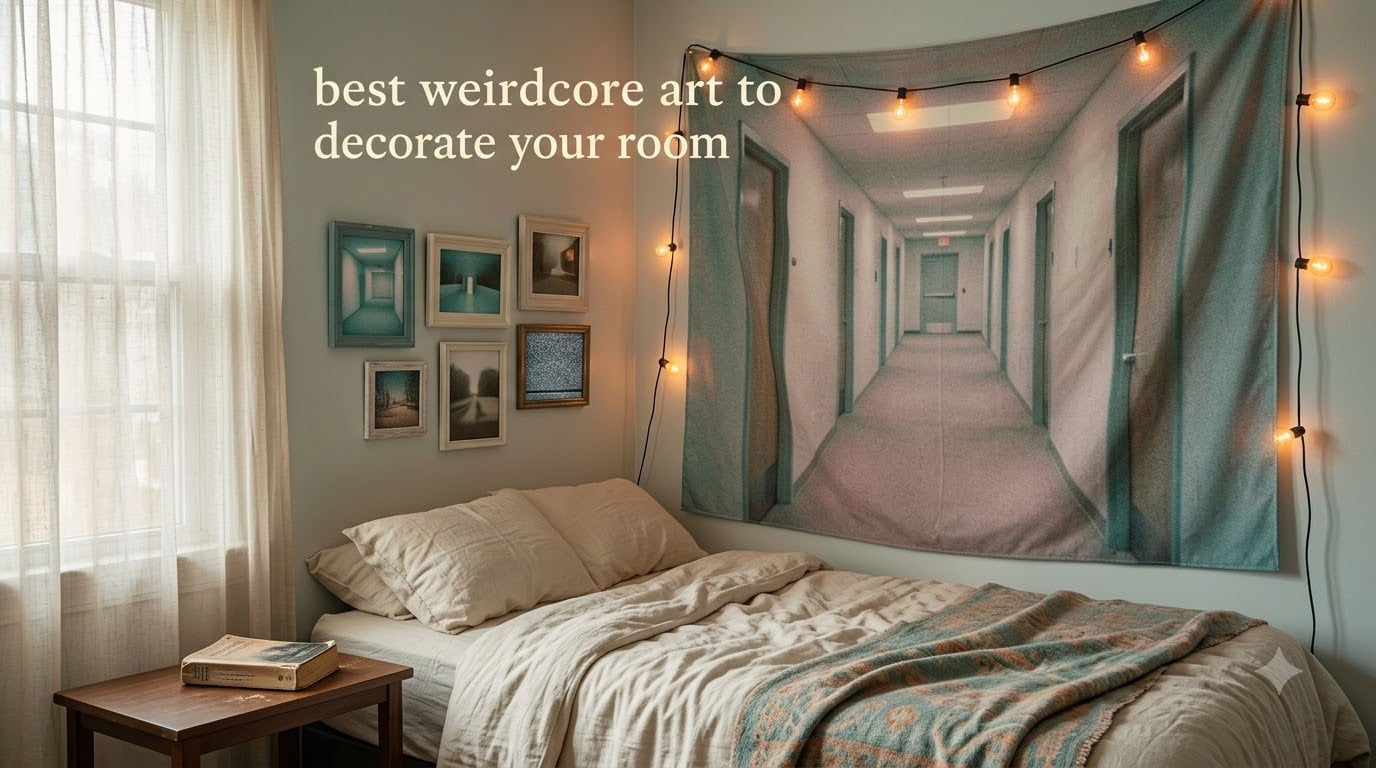
Looking for the best weirdcore art to decorate your room? You’re in the right place. I’ve spent months collecting strange little prints, glow-in-the-dark tapestries, and liminal-space photos that make my own space feel like a fever dream you can walk into.
Weirdcore is one of the fastest-growing room aesthetics on Pinterest and TikTok, and for good reason. It’s surreal, personal, and surprisingly easy to build on any budget. In this guide, I’ll walk you through what weirdcore actually is, the visual elements that make it instantly recognizable, the best art types to start with, and how to style your room so the whole space feels cohesive instead of chaotic.
Table of Contents
What Is Weirdcore? A Clear Definition
Weirdcore is a surreal internet aesthetic built on lo-fi, dream-like imagery that feels both familiar and slightly off. It blends low-resolution photography, distorted visuals, liminal spaces, and nostalgic color palettes to create an atmosphere that is equal parts eerie and comforting.
The aesthetic pulls heavily from old digital photos, forgotten web pages, and amateur photography that feels accidentally profound. You’ll see empty malls at 3 a.m., grainy sunsets, foggy hallways, and faces that look slightly stretched. The point is not realism. The point is that gut-level feeling of “I’ve been here before, but something is wrong.”
I think of weirdcore as the visual cousin of a half-remembered dream. It’s the aesthetic equivalent of finding a photo of a place you can’t quite place. That emotional dissonance is the whole appeal, and it’s exactly why weirdcore art to decorate your room works so well. It transforms blank walls into small windows into another dimension.
Where Weirdcore Came From
Weirdcore traces its roots to early internet image boards, Tumblr-era mood boards, and the dreamcore movement of the late 2010s. As broadband got faster and smartphones got sharper, a counter-movement celebrated pixelation, grain, and glitch as a feature, not a bug.
By the early 2020s, weirdcore had its own dedicated corners of TikTok and Pinterest, with creators curating folders of liminal backrooms, VHS warbles, and washed-out color palettes. The aesthetic showed up in indie music videos, vaporwave art, and eventually in the dorm rooms and bedrooms of Gen Z and younger millennials who wanted something that felt personal and unpolished.
Today weirdcore lives alongside related movements like dreamcore, traumacore, liminal spaces, and retro-futurism. They overlap, but each has its own visual fingerprint.
Visual Elements and Tropes of Weirdcore Art
Before you pick out weirdcore art to decorate your room, it helps to know what you’re looking for. The aesthetic has a handful of visual building blocks, and once you can spot them, you’ll start seeing weirdcore everywhere.
Liminal Spaces
Liminal spaces are empty, in-between places that feel suspended in time. Think of a shopping mall with no people, a hotel hallway lit by buzzing fluorescents, or a stairwell that leads nowhere. These are the bread and butter of weirdcore imagery.
The emotional pull is the emptiness. Your brain wants to populate the scene with someone, anyone, and the absence creates a low hum of unease. That’s exactly the vibe a single framed liminal print brings to a bedroom wall.
Lo-Fi and Low-Resolution Imagery
Sharp, polished photography does not belong in weirdcore. Grain, blur, pixelation, and over-compression are all welcome. The lower the resolution, the more it feels like a memory or a screen capture from 2006.
Lo-fi also includes VHS-style warble, film burns, and soft focus. The “imperfection” is the point. When you hang a lo-fi weirdcore print in your room, it instantly adds a layer of nostalgia, even if the image itself is brand new.
Distorted Human Forms
Many weirdcore pieces feature people who look slightly stretched, blurred, or partially erased. Faces might be cropped, smeared, or replaced with soft shapes. It echoes the dream-logic feeling of trying to recognize someone in a crowd and failing.
This trope pulls heavily from old webcam shots, surveillance footage, and film stills where the subject is mid-motion. Used sparingly on a wall, it gives a room that quietly unsettling edge without being outright creepy.
Unreal Color Palettes
Weirdcore leans hard into washed-out, slightly off colors. Expect muted teals, faded magentas, sodium-lamp yellows, and the specific pale blue of a sky that never quite looks real. Color is part of the storytelling.
High-saturation primary colors usually signal something else, like cyberpunk or vaporwave, while weirdcore prefers pastels and faded film tones. When you’re choosing art, look for pieces that feel a touch desaturated, as if they were left in the sun for a decade.
Obscured or Disjointed Text
Crooked signs, half-visible words, and text that’s been glitched or scribbled over are another weirdcore staple. Sometimes the text is poetic, sometimes cryptic, sometimes just noise. It adds the feeling that the image is a clue to something you should already understand.
A framed print with a single warped phrase can do the heavy lifting on an otherwise plain wall. It’s also a great entry point for DIY weirdcore art, since you can print any phrase and distort it yourself.
Best Types of Weirdcore Art to Decorate Your Room
Now for the part you’ve been waiting for: the actual art. Below are the seven formats I come back to most often when styling a room in this aesthetic. None of them require a huge budget, and several are easy DIY projects if you’d rather make them yourself.
1. Weirdcore Posters
Posters are the easiest on-ramp to weirdcore art to decorate your room. They’re affordable, easy to swap out, and come in curated sets if you want a quick gallery wall without curating each piece.
Look for collage packs that include a mix of liminal spaces, distorted figures, and glitch text. A 30-piece collage set is enough to cover a single wall above a bed or desk, and you can rearrange pieces as your taste evolves. For best results, frame a few and tape the rest in a casual grid with washi tape.
2. Weirdcore Prints and Framed Pieces
Prints step things up. They’re usually higher resolution than posters, often printed on heavier paper, and they look better in a proper frame. A single large framed weirdcore print above a headboard can anchor an entire room.
Independent artists on Etsy and Redbubble are the main source. The advantage of buying from individual creators is that you’re more likely to find a piece nobody else has. Look for artists who tag their work “liminal,” “dreamcore,” or “weirdcore” and follow the rabbit hole from there.
3. Tapestries
Tapestries are the classic weirdcore anchor piece. A large weirdcore tapestry hung behind a bed or across an entire wall does the job of a dozen prints at once. The fabric softens the image, which makes the dream-like quality even stronger.
Most weirdcore tapestries are 3 by 5 feet or larger, with imagery ranging from surreal landscapes to abstract faces. Pick one with a muted color palette if you want the rest of your room to layer easily on top. A bold, high-contrast tapestry will fight with everything else you put on the walls.
4. Canvas and Wall Hangings
Canvas prints and woven wall hangings give a more permanent, gallery-style feel. Canvas holds color beautifully, and a small canvas can be propped on a shelf or hung in a tight cluster.
Woven weirdcore pieces, including macramé versions of distorted faces or abstract shapes, are a softer take that pairs surprisingly well with the dreamier end of the aesthetic. They also dampen sound a little, which is a nice bonus in a small bedroom or dorm.
5. Photography Prints
If you have a phone with even a halfway decent camera, you can make your own weirdcore photography. The aesthetic practically begs for amateur shots: an empty parking lot at dusk, the back of a strip mall, a foggy window, your friend’s face slightly blurred mid-laugh.
Print your favorites on matte photo paper, edit them down to muted tones, and you’ve got one-of-a-kind weirdcore art to decorate your room. This is also the most personal option, since the photos are yours.
6. Glitch and Digital Art Prints
Glitch art is weirdcore’s techier cousin. Take any photo, run it through a glitch filter, and the result will usually fit right into a weirdcore gallery wall.
Plenty of digital artists sell glitch prints as downloadable files. You get a high-resolution image you can print yourself at any size, which is great if you want a giant focal piece without paying gallery prices. Just make sure your printer can handle the colors, or use a local print shop.
7. DIY Weirdcore Art
DIY is where weirdcore art gets really fun. The aesthetic is forgiving. Imperfection is the whole point. Some easy beginner projects include:
- Print any photo, then rub a wet tea bag over it for an instant aged, faded effect.
- Photocopy a face, smudge it with your thumb while the toner is still wet, and frame the warped result.
- Cut letters out of magazines, glue them crooked onto a poster, and seal it with a wash of watered-down paint.
- Take a screenshot of an old website, blow it up to poster size, and hang it as commentary on early-internet aesthetics.
- Layer transparencies of half-erased drawings to build a dream-logic collage.
The beauty of DIY weirdcore art is that there’s no wrong answer. If it feels slightly off, you’ve nailed it.
How to Style Your Room with Weirdcore Art
Picking the art is only half the job. The other half is making the whole room feel intentional instead of just cluttered with weird pictures. Here’s the step-by-step approach I use when I’m restyling a space, broken down so you can copy it room by room.
Step 1: Pick a Weirdcore Color Palette
Start with a palette of two to four colors and pull from them everywhere. Common weirdcore palettes include dusty teal and cream, faded magenta and gray, sodium yellow and pale blue, or mossy green and muted pink.
Once you have a palette, choose weirdcore art to decorate your room that already lives in those colors. Even a single image in a wildly different palette can throw off the whole room, so look at each piece before you hang it and ask, “Does this belong in my color world?”
Step 2: Build Around One Anchor Piece
Every great gallery wall starts with one statement piece. Pick the weirdcore image you love most, hang it where the eye naturally lands (usually above the bed or the main sofa), and let everything else support it.
The anchor could be a tapestry, a large framed print, or even a single oversized canvas. Smaller pieces orbit around it in a loose grid. The grid does not need to be perfect. Slight asymmetry actually fits weirdcore better than a tidy arrangement.
Step 3: Mix Formats and Heights
A wall covered only in identical 8×10 frames feels like a dentist’s office. Mix a tapestry with framed prints, add a canvas, and tuck in a clipboard with a loose photo. Layer in a shelf with a small sculpture or thrifted object that matches the vibe.
The variety of heights and textures is what makes the space feel collected over time, which is exactly the emotional core of weirdcore. Nothing in the room is trying too hard.
Step 4: Style Room by Room
Bedroom: lean into the dreamy, soft side of weirdcore. Tapestries, warm fairy lights, a stack of worn paperbacks on the nightstand, and one or two portraits with distorted faces. Keep the lighting low and warm.
Living room: pick a couple of statement pieces and let the rest of the room stay calmer. A large weirdcore print above the sofa, a muted tapestry on the opposite wall, and a few small framed pieces on a bookshelf will read as curated rather than chaotic.
Dorm room: you can’t make holes in the walls, so lean on Command strips and removable hooks. A tapestry with its own rod is a dorm-friendly way to cover a big chunk of wall. Pair it with a small poster grid and you’re set.
Home office or studio: weirdcore art can actually help with focus if you choose pieces with quieter compositions. A single liminal-space print, soft lighting, and a couple of muted accents will give you a workspace that feels personal without being distracting.
Step 5: Add Budget-Friendly Weirdcore Touches
You don’t need a lot of money to make weirdcore art to decorate your room feel complete. Some of my favorite budget moves:
- Print free weirdcore images from public archives and frame them in thrifted frames.
- Use washi tape to build a grid of small prints directly on the wall, no nails required.
- Hit up estate sales and thrift stores for old landscape paintings, then distress the canvases yourself.
- Swap in warm, low-wattage bulbs to mimic sodium-lamp lighting on a budget.
- Layer a sheer black curtain over a window to soften daylight into weirdcore-friendly tones.
Total cost for a starter wall can be well under the cost of a single framed art print, which is one of the reasons weirdcore is so popular with students and first-apartment renters.
Weirdcore vs Dreamcore vs Liminal Spaces
These three aesthetics get mixed up constantly. They’re related, but they’re not the same thing, and knowing the difference will help you pick weirdcore art to decorate your room more confidently.
Weirdcore is the broadest of the three. It includes any surreal, dream-like, or unsettling imagery that doesn’t fit neatly elsewhere. Distorted text, glitch effects, and uncanny portraits all live here. Weirdcore is about feeling slightly wrong, but in a way you can’t quite articulate.
Dreamcore is softer and more nostalgic. Dreamcore visuals are dreamy, floating, and often bathed in pastel light. Think cotton-candy skies, soft clouds, and figure silhouettes that fade into white. Dreamcore is what weirdcore might look like if it took a deep breath.
Liminal spaces are a specific subcategory: empty, in-between places that feel like a paused video game. They are not always surreal, but they always feel suspended. A liminal space can be weirdcore or dreamcore, but weirdcore doesn’t have to be liminal.
If you want a quick rule: weirdcore is the genre, dreamcore is the mood, and liminal spaces are a recurring setting. When in doubt, weirdcore art to decorate your room will lean toward the unsettling side, while dreamcore leans toward the dreamy side.
Frequently Asked Questions
What is weirdcore art?
Weirdcore art is a surreal internet aesthetic that uses lo-fi, dream-like imagery, liminal spaces, distorted visuals, and nostalgic color palettes to create an atmosphere that feels both familiar and slightly off.
How do I decorate my room with weirdcore art?
Start by choosing a muted color palette of two to four tones, pick one anchor piece like a tapestry or large framed print, and build a loose gallery wall around it using posters, smaller prints, and DIY pieces in matching tones.
What are the best types of weirdcore art to decorate a room?
Posters, framed prints, tapestries, canvas pieces, lo-fi photography prints, glitch and digital art, and DIY weirdcore projects are the most popular formats. Tapestries and collage poster sets give the biggest visual impact on a budget.
Where can I buy weirdcore art?
Independent artists on Etsy and Redbubble are the best source for unique weirdcore prints. Curated collage sets are widely available on Amazon, and platforms like Displate and Zazzle also stock licensed weirdcore and liminal-space designs.
How is weirdcore different from dreamcore?
Weirdcore is the broader surreal genre and tends toward unsettling, distorted, and uncanny imagery. Dreamcore is softer and more nostalgic, with pastel skies and faded figure silhouettes. Liminal spaces are empty, in-between places that can appear in either aesthetic.
Can I make DIY weirdcore art at home?
Yes. Print any photo, then distress it with tea staining, smudged toner, or a wash of watered-down paint. Collage old magazine letters, glitch a digital photo through a free filter, or photocopy a face and warp it. Imperfection is part of the style.
Conclusion
The best weirdcore art to decorate your room is the kind that makes you pause for half a second when you walk in. A liminal-space print, a faded tapestry, a single warped portrait, or a DIY collage you built yourself can do more for the mood of a room than any matching furniture set.
Start with one anchor piece, pick a muted palette of two to four colors, and layer in posters, prints, and DIY projects as you find them. Mix formats, mix heights, and let the room feel collected over time. That’s the heart of weirdcore. A space that feels like a memory you’re only half-sure is yours.
Looking for more weirdcore room ideas? Browse our other aesthetic guides for dreamcore tapestries, liminal-space photo prints, and budget-friendly dorm decor tips to keep building the room you actually want to come home to.