
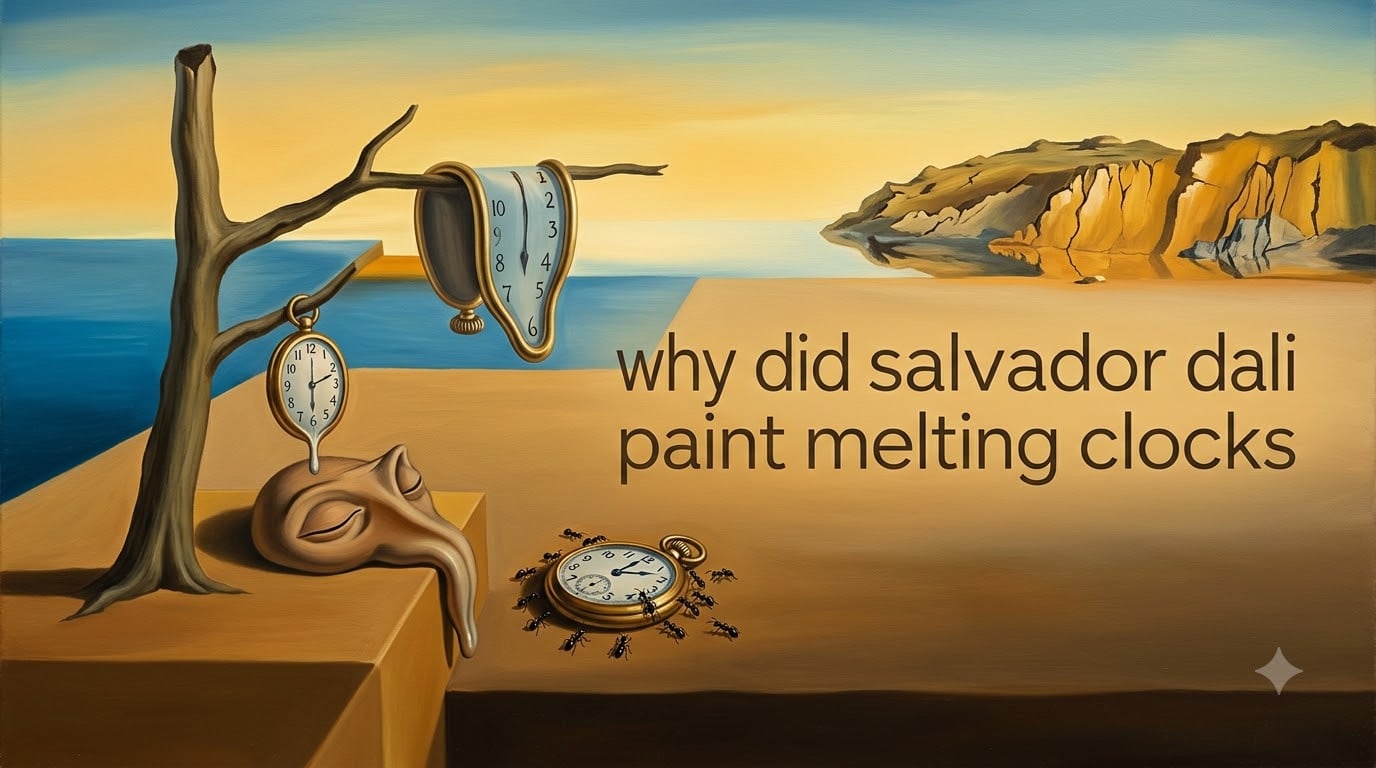
Salvador Dalí painted melting clocks in The Persistence of Memory (1931) because he wanted to capture the way time feels in a dream: soft, unreliable, and slowly running off a table like Camembert cheese left in the sun. The painting fuses a hyper-real Catalan landscape with four drooping pocket watches, a closed-eye self-portrait, and a swarm of ants to suggest that time, memory, and the unconscious are not the rigid, mechanical things we pretend they are.
In this guide, I’ll walk you through the story behind the painting, what each melting clock really means, and why Dalí later denied the most famous explanation people give for it. We start with the basics, then go deep on the symbolism.
Table of Contents
Quick Facts: The Persistence of Memory at a Glance
- Title: The Persistence of Memory (also called The Melting Clocks, The Soft Watches, or The Melting Watches)
- Artist: Salvador Dalí
- Year: 1931
- Medium: Oil on canvas
- Dimensions: Roughly 9 1/2 by 13 inches (24 by 33 cm) – small enough to feel intimate
- Style: Surrealism, painted in Dalí’s paranoid-critical method
- Current location: Museum of Modern Art (MoMA), New York City
- Accession number: 162.1934 (donated to MoMA in 1934)
- Where to see it: MoMA Floor 5, Gallery 517
The painting is smaller than most people expect. Standing in front of it at MoMA, you notice details you’d miss in a textbook – the eyelashes on the sleeping creature, the cracked cliff face, the flies casting human shadows.
The Camembert Cheese Story: How the Melting Clocks Were Born
Dalí’s own account of how the melting clocks were born is one of the most quoted anecdotes in modern art. He said the idea came to him while watching a wheel of Camembert cheese soften and collapse on a table after dinner.
In a recorded conversation with the Nobel-winning chemist Ilya Prigogine, Dalí described watching the soft cheese sag in the warm evening air and seeing, in that everyday moment, the entire landscape of his new painting. He later wrote that the image was a “soft, extravagant, solitary, paranoiac-critical Camembert cheese of space and time.”
That single phrase – Camembert of time – does more than any other Dalí quote to explain the mood of the painting. It is funny, domestic, slightly absurd, and it tells you the artist was not illustrating a physics textbook. He was painting the feeling of watching a dinner outlast its welcome.
What the Melting Clocks Actually Mean
The melting clocks symbolize the collapse of fixed, mechanical time. In waking life, we treat time as a rigid thing measured by watches and clocks. In dreams, in memory, and in the unconscious, that rigidity dissolves.
Dalí used the soft watches to suggest that our experience of time is closer to a flowing, unstable material than to a ticking mechanism. The clocks melt over a branch, drape across a face, droop over a block, and pool on the ground – four different ways time can lose its shape.
One clock sits closed, covered in ants. Another is warped but still recognizable as a pocket watch. A third drapes across a strange fleshy shape. A fourth is the face of the sleeping creature in the center of the painting. None of them are working in any normal sense, and that is the point.
Not every clock melts. The orange clock face-down on the block is rigid, and the closed watch draped over the edge of the platform is still mostly solid. This is not an oversight – it is a contrast. Dalí uses both soft and hard clocks to show that even within a dream, time is not uniformly fluid; some moments hold their shape, others dissolve.
Did Einstein’s Theory of Relativity Inspire the Clocks?
The most persistent myth about the painting is that the melting clocks are a direct illustration of Einstein’s theory of relativity. Dalí himself denied this repeatedly.
When interviewers and critics pushed the Einstein connection, Dalí insisted the clocks were a product of his subconscious, not a diagram of spacetime. He called the relativity reading “literary” and pointed out that the painting was finished in 1931, the same year most readers were first learning about Einstein’s work in popular press, and that his real inspiration was a piece of cheese.
What is true is that Dalí was aware of relativity and read Einstein in the late 1920s. He later made relativity a much more explicit theme in works like Galatea of the Spheres (1952). But in The Persistence of Memory, the soft watches are about subjective time, dream time, and the unconscious – not the curvature of spacetime.
The Soft Self-Portrait at the Center of the Painting
The strange, soft creature lying in the center of the painting, with its closed eyes and long lashes, is a self-portrait of Dalí. The closed eyes reference sleep, dreams, and the unconscious – the surrealist territory the painting explores.
The creature’s shape has been compared to a distorted face, a melting animal, and a piece of dough. Some art historians see in it an infant’s profile, which fits Dalí’s lifelong interest in birth, memory, and primal experience.
A less obvious influence is Hieronymus Bosch’s Garden of Earthly Delights. Dalí admired Bosch and openly cited the triptych as inspiration for several of his dream figures. The fleshy, ambiguous creature in the foreground of The Persistence of Memory echoes the strange hybrid beings Bosch painted centuries earlier.
The Ants, the Olive Tree, and the Theme of Decay
The cluster of ants on the closed orange watch is one of the painting’s most disturbing details. Dalí used ants throughout his career as symbols of decay, death, and the way the body breaks down after death.
His obsession with ants came from a childhood trauma. In his book The Secret of Life, Dalí recalled finding a wounded bat on the ground as a boy and watching ants swarm over the small dying animal. The image stayed with him for life and reappears across his work, including a famous later painting called Dream Caused by the Flight of a Bee Around a Pomegranate a Second Before Awakening (1944).
The dead, withered olive tree on the left side of the painting and the cracked, sun-baked platform both reinforce the same theme. Dalí is not painting a peaceful dream. He is painting a landscape of slow collapse, where even time itself has gone soft and started to rot.
The Catalan Landscape: Cap de Creus, Cadaqués, and Home
The cliffs and shoreline in The Persistence of Memory are not invented. They are based on the Cap de Creus peninsula, the rocky headland near Dalí’s hometown of Cadaqués on the Catalan coast of Spain.
Cadaqués was Dalí’s anchor. He returned there throughout his life, and the strange, lunar rock formations of Cap de Creus show up in many of his paintings. The flat, golden platform in the foreground of The Persistence of Memory echoes the bleached, sun-drenched rocks Dalí played on as a child.
By setting his dream on this specific, recognizable piece of home ground, Dalí did something the Surrealists had not done before. He made the unconscious feel local, geological, and personal. The dream is not somewhere strange. The dream is his own backyard.
Dalí, Surrealism, and the Paranoid-Critical Method
The Persistence of Memory is one of the defining images of the Surrealist movement, the early-twentieth-century art movement that tried to unleash the creative power of the unconscious mind. Surrealism was founded in 1924 by the poet André Breton, and by the late 1920s Dalí had become one of its most visual painters.
What set Dalí apart was a technique he called the paranoid-critical method. The idea was simple and strange: Dalí would deliberately induce a self-hypnotic, paranoid state, then sit down and paint with the most precise, classical realism he could manage. The result is what you see in The Persistence of Memory – impossible subjects rendered with the discipline of an old master.
Dalí called this approach painting with “the most imperialist fury of precision.” The wildness is in the dream. The control is in the brush.
The Disintegration of the Persistence of Memory and the Painting’s Legacy
In 1952 to 1954, Dalí returned to the same composition and painted a sequel: The Disintegration of the Persistence of Memory. In it, the landscape of Cap de Creus is broken into floating blocks, the watches dissolve into particles, and the sea floods the scene.
That later painting shows Dalí re-reading his own 1931 work through the lens of nuclear physics and atomic theory. What was once a soft, melancholic dream becomes a scene of atomic disintegration, as if the clocks have finally finished melting into nothing.
The provenance of the original tells its own story. Dalí sold the painting in 1931 through his Paris gallery. It moved through Pierre Colle, then to the Julien Levy Gallery in New York. In 1934, an anonymous donor gave it to MoMA, where it has hung almost continuously ever since.
Why the Melting Clocks Still Matter Today
Almost a century after The Persistence of Memory was painted, the melting clock has escaped the museum wall and become a permanent piece of visual shorthand for time running out, time going soft, or time being unreliable.
You can see the influence in the title sequence of The Third Man (1949), in Dr. Who references, in Looney Tunes gags, in The Simpsons couch gags, and in countless album covers and movie posters. The image travels because it works – it compresses a whole philosophy of time into a single, instantly readable picture.
If you want to see the original, head to MoMA in New York. It hangs on Floor 5 in Gallery 517. The painting is small, so step close. Look at the eyelashes. Look at the ants. Look at the single hard orange watch that refuses to melt.
Frequently Asked Questions
What do Dalí melting clocks symbolize?
The melting clocks symbolize the collapse of fixed, mechanical time. Dalí used them to suggest that time, in dreams and in the unconscious, is not rigid but soft, unstable, and unreliable, like Camembert cheese melting in the sun.
What inspired Salvador Dalí to paint melting clocks?
Dalí said the image came from watching a wheel of Camembert cheese soften and collapse on the table after dinner. He described the painting as a soft, extravagant, paranoiac-critical Camembert cheese of space and time.
Are the melting clocks inspired by Einstein’s theory of relativity?
Dalí explicitly denied the Einstein connection. While he read relativity in the late 1920s, he insisted the soft watches were a product of his subconscious and the everyday image of melting cheese, not a diagram of spacetime.
What do the ants in The Persistence of Memory represent?
The ants represent decay, death, and the breakdown of the body. Dalí returned to ants across his career, an obsession that began with a childhood trauma of finding a wounded bat being swarmed by ants, which he later described in his book The Secret of Life.
Why is the central figure in Persistence of Memory a self-portrait?
The closed-eye creature in the center of the painting is a soft self-portrait of Dalí. The closed eyes reference sleep, dreams, and the unconscious mind, which was the core subject of the Surrealist movement.
Where is the original Persistence of Memory painting?
The original The Persistence of Memory has been at the Museum of Modern Art (MoMA) in New York since 1934. It hangs on Floor 5, Gallery 517, and is free to view with museum admission.
Conclusion
So why did Salvador Dalí paint melting clocks? He painted them because he wanted to put the feeling of a strange dinner – cheese sagging in the warm air, a long afternoon fading into evening – onto a canvas and call it a dream.
More than ninety years later, the soft watches still say something true about how time feels inside the mind. Mechanical time keeps marching, but the time of memory, dream, and decay always softens, droops, and finally goes still. If you find yourself in New York, stop by MoMA Floor 5, Gallery 517, and stand in front of the small canvas where Dalí caught all of that in a single 9 1/2 by 13 inch frame.