
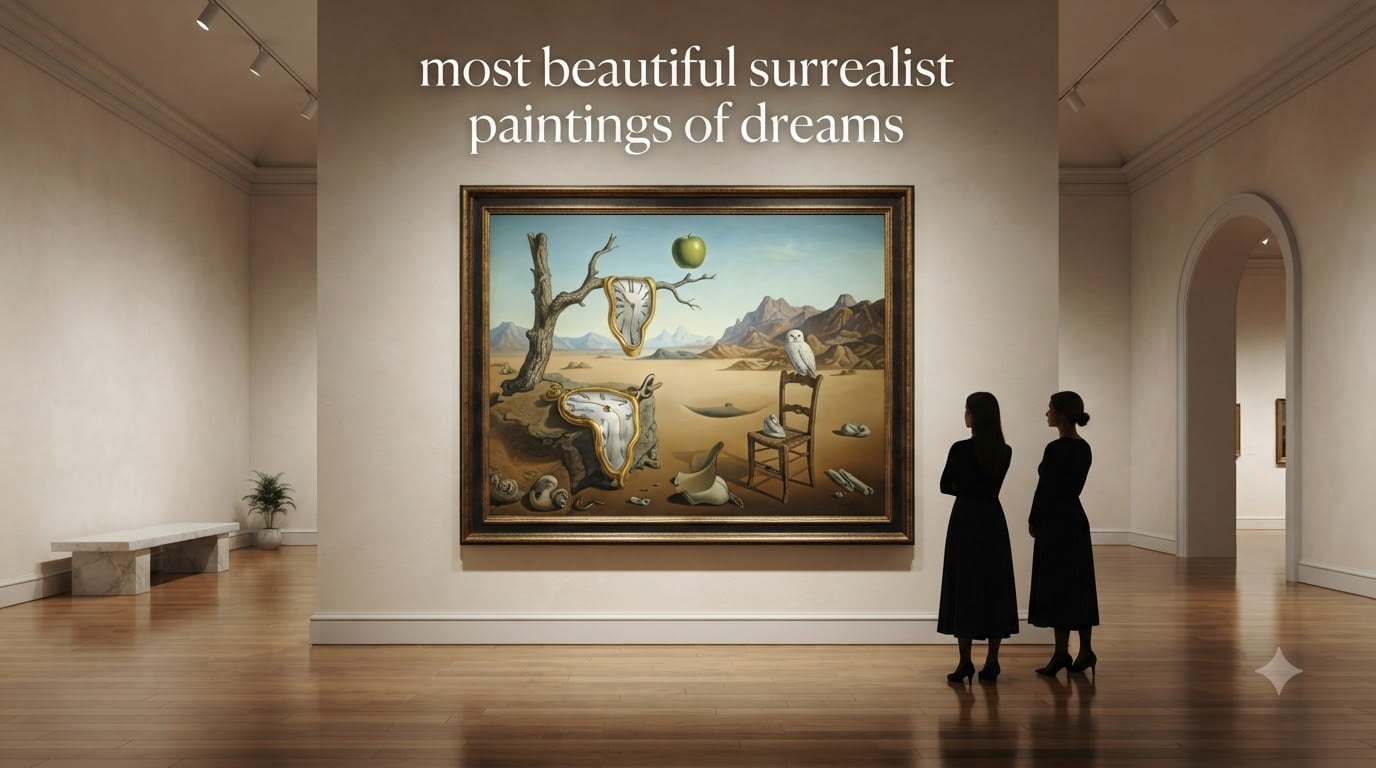
The most beautiful surrealist paintings of dreams are works that translate dream logic onto canvas – impossible juxtapositions, melting or floating objects, distorted scale, and uncanny figures – made famous by Salvador Dalí, René Magritte, Joan Miró, Leonora Carrington, and their peers in the twentieth-century Surrealist movement. I have spent the last year walking through galleries and staring at catalog reproductions of these works, and I keep returning to the same twelve. They are the ones that made me stop breathing in front of the canvas.
Below, I have ranked twelve paintings by sheer visual beauty – not chronology, not movement politics, just the dream feeling they leave in your chest. Each entry includes the artist, year, medium, current museum, and a short reading of why it works on a dreamlike register. If you have ever wanted to know which Surrealist dream paintings actually feel like dreams – and why – this guide is for you.
Table of Contents
What Makes a Surrealist Dream Painting Feel Like a Dream?
Surrealist dream paintings feel like dreams because they use a handful of visual tricks our sleeping brain already knows. Scale shifts – an apple the size of a building, an ant crawling on a thimble. Melting or solidifying objects – soft clocks, floating stones, dissolving horses. Impossible juxtapositions – a man in a bowler hat standing inside an egg, a door opening onto a different sky than the one outside it. Uncanny light that comes from nowhere. Distorted perspective where the floor becomes a wall and the ceiling becomes a sea.
This visual language is called oneiric – from the Greek oneiros, meaning dream. Oneiric art is art that behaves the way the unconscious mind behaves when we sleep. Salvador Dalí described his own method as “hand-painted dream photographs.” René Magritte called his paintings “poems of the visible.” The point is not to illustrate a specific dream but to trigger the same unstable, hyper-real sensation that any remembered dream triggers.
Behind the visuals sits a deliberate technique called automatism – letting the hand move across the canvas without the conscious mind directing it. André Breton codified automatism in his 1924 Surrealist Manifesto as a way to bypass reason and reach the unconscious. Many of the works on this list were made with at least some element of automatism: Tanguy’s biomorphic shapes, Miró’s floating stars, Ernst’s rubbings and scrapes.
That combination – Freudian theory, automatist mark-making, and a refusal of rational space – is what separates a true Surrealist dream painting from a “weird” picture. Strangeness alone is not enough. The painting has to feel inevitable, the way a remembered dream always feels inevitable, even when it makes no sense.
Where the Dream Logic Came From: Surrealism, Freud and the 1924 Manifesto
Surrealism was officially born in Paris in 1924, when the French poet André Breton published the first Surrealist Manifesto. He defined Surrealism as “psychic automatism in its pure state” – a way of expressing “the actual functioning of thought” without reason, morality, or aesthetic concern. The movement grew out of Dada but turned its chaos inward, toward the dream, the hallucination, and the unconscious mind.
The intellectual fuel was Sigmund Freud. Freud’s Interpretation of Dreams (1900) had argued that dreams are the disguised fulfilment of repressed wishes, and that they reveal the inner architecture of the psyche. For Breton and his circle, Freud’s book was a revelation: the dream was no longer nonsense, it was a coded message worth reading. Surrealists called themselves “les éveilleurs” – the awakeners – because they wanted to bring the logic of dreams into waking life.
The visual language followed quickly. In 1924, the same year as the Manifesto, Joan Miró painted Harlequin’s Carnival, a tabletop of half-formed dreams. By 1925, Magritte was painting floating pipes and silent bowler hats. By 1929, Dalí had joined the group and was already perfecting his precise, hallucinatory dream-paranoia method. Between 1924 and the outbreak of the Second World War, almost every canvas on this list was painted.
Breton’s group was not a quiet art circle. Members were expelled for refusing to align with communism, for backsliding into religion, or – in Dalí’s case in 1934 – for what Breton called “the exalting of Hitlerian fascism.” That political and psychic pressure is part of why the dream paintings of the late 1930s feel more like nightmares than fairy tales. History leaked into the unconscious.
The movement also produced a sister practice called exquisite corpse – a collaborative drawing game where each artist folds the paper and adds to a hidden section. The result, like a shared dream, is a single body no single person could have invented. That collective dream logic runs underneath everything on this list.
The 12 Most Beautiful Surrealist Paintings of Dreams
I have ordered these twelve from what I find most arresting to most quietly powerful. Each one is currently held by a museum or major collection you can visit, and each one earned its place on this list by giving me the specific, physical sensation of remembering a dream.
1. The Persistence of Memory – Salvador Dalí (1931)
Oil on canvas, 24 × 33 cm. Museum of Modern Art (MoMA), New York.
The painting everyone pictures when they hear the word “Surrealist.” Soft clocks droop over the edge of a brown platform in a rocky Catalan landscape; a fly buzzes on the face of an orange watch; a melting face sleeps against the stone. Dalí called this work “the first Surrealist painting made by the paranoiac-critical method,” a method he invented to deliberately induce dreamlike hallucinations while awake. It is small – postcard-sized – and that is part of its power. The dream is intimate. I have stood in front of it at MoMA and felt my own pulse slow down to the speed of those clocks.
Why it feels like a dream: the soft clocks are a direct image of how time behaves in a remembered dream – elastic, sticky, indifferent to waking logic. The empty plain stretches like an unrecalled memory. The viewer is invited to lie down inside the picture the way the central figure does.
2. The Son of Man – René Magritte (1964)
Oil on canvas, 116 × 89 cm. Private collection, Brussels.
A man in a dark overcoat and bowler hat stands against a grey sea wall. A green apple floats in front of his face, occluding everything but the rim of his hat, his dark hair, and one wide eye staring straight at us. Magritte painted this self-portrait near the end of his life, and the title is a deliberate pun – the son of man is everyman, but also the literal son, the human one. I find this painting more dreamlike than Magritte’s more famous Treachery of Images (“this is not a pipe”), because here the dream is not a clever argument but a feeling. The face is hidden. We all look like this inside.
Why it feels like a dream: the apple in front of the face is a direct metaphor for the screen our own unconscious puts between us and other people. We recognise the man – or think we do – but cannot see him. That is exactly how dream-encounters feel.
3. Harlequin’s Carnival – Joan Miró (1924-25)
Oil on canvas, 66 × 90.5 cm. Buffalo AKG Art Museum (formerly Albright-Knox), New York.
Painted in the same year as the Surrealist Manifesto itself, this canvas is a tabletop of half-formed creatures, music notes, ladders, stars, and a single enormous blackbird. The composition looks like a child’s memory of a circus seen through a kaleidoscope. Miró is one of the few Surrealists whose paintings feel like pleasant dreams – joyful, almost musical. I have a postcard of this on my studio wall, and I find myself staring at it when I need to remember that not every dream is a nightmare.
Why it feels like a dream: the colours are primary, the shapes are simple, and the entire picture refuses to settle into a single readable scene. Like a remembered dream, it rewards looking without ever resolving.
4. The Elephant Celebes – Max Ernst (1921)
Oil on canvas, 125.4 × 107.9 cm. Tate Modern, London.
Made just before the Manifesto but already a fully Surrealist picture, this canvas shows a headless, mechanical elephant standing in a desert, surrounded by a headless mannequin, a fish swimming in mid-air, a vacuum tube on stilts, and a faceless bust of Beethoven. The “Celebes” of the title comes from a German children’s rhyme about a papier-mâché elephant. Ernst was reading Freud at the time, and the canvas has the unmistakable feeling of a dream you wake from and cannot quite explain. It is the first true nightmare painting of the twentieth century.
Why it feels like a dream: the scale shifts between the giant elephant and the tiny vacuum tube reproduce the way objects in dreams change importance without warning. A thing that mattered a moment ago becomes a thing that does not exist.
5. Self-Portrait (Inn of the Dawn Horse) – Leonora Carrington (1937-38)
Oil on canvas, 65 × 81 cm. Museum of Modern Art (MoMA), New York.
A young woman sits cross-legged on a green armchair in a bare white room. A horse and a hyena sit beside her, a white owl perches on the chair back, a candle floats above her head, and a strange rocking horse-shaped figure balances on her knees. Carrington painted this after her lover Max Ernst was arrested by the Gestapo and her own breakdown forced her into a psychiatric hospital. The painting is a self-portrait from the inside of that breakdown – a dream of safety inside a stable that is also a cage. It is one of the most quietly disturbing dream paintings ever made.
Why it feels like a dream: the animals are her familiars in the way dream animals always are – knowing, silent, patient. The room is both safe and inescapable. The candle floats the way a wish floats inside a remembered dream.
6. Indefinite Divisibility – Yves Tanguy (1942)
Oil on canvas, 100.5 × 81 cm. Museum of Modern Art (MoMA), New York.
A bleached desert landscape stretches to a flat horizon. On it stand a series of bone-white, biomorphic shapes – some pointed like fangs, some soft like pillows, some curving like question marks. There is no sky and no shadow, only a featureless cream atmosphere that makes scale impossible to judge. Tanguy spent the late 1930s walking through Breton’s Paris group, then fled to America with his wife, the Surrealist Kay Sage, in 1941. This is the painting of exile – a literal nowhere painted in the middle of the Second World War.
Why it feels like a dream: the shapes have no referents in waking life. They are the kind of thing the mind invents when it is processing a difficult feeling and has run out of real-world vocabulary. I always feel like I am reading someone’s anxious dream about something they cannot say.
7. Celestial Pablum – Remedios Varo (1958)
Oil on canvas, 60 × 80 cm. Museo de Arte Moderno, Mexico City.
Three hooded figures stand on a tower, scooping a pale porridge of light and stars into vessels that feed the heavens. The tower floats in an empty purple void. Varo, a Spanish painter who fled to Mexico during the war, used the iconography of medieval alchemy to build an entire cosmos in miniature. Her paintings feel like the dreams of an old abbess – patient, ceremonial, and mysteriously tender. Of all the works on this list, this is the one I find most consistently calming to live with.
Why it feels like a dream: the rhythm of the figures at work feels ritualistic, the way a recurring dream-job feels – you keep showing up to do the same impossible task and the task never ends.
8. Eine Kleine Nachtmusik – Dorothea Tanning (1943)
Oil on canvas, 40.6 × 61 cm. Tate Modern, London.
The title is Mozart’s serenade, but the painting is a stone corridor of arched doorways opening onto a railway track and a single sunflower. A small girl in a tight blue dress crouches on the platform; a giant battered glove hangs from the ceiling. Tanning, who would later become one of the great Surrealist novelists, painted this in her New York studio during the war. It reads like the dream-image a child might have of being sent on a train to somewhere unknown. I find it unbearably sad and unbearably beautiful in equal measure.
Why it feels like a dream: the corridor that goes on forever, the impossible doorways, the giant glove that could be either parent or threat – these are exact replicas of the architecture of childhood anxiety dreams. Tanning knew the genre well.
9. The Sleeping Venus – Paul Delvaux (1944)
Oil on canvas, 174.5 × 199 cm. Tate Modern, London.
A marble goddess lies asleep on a slab in front of a Greek temple. Behind her, in soft focus, a skeleton in a black robe stands at the foot of a bed. Beside her, two businessmen in dark suits and bowler hats stand stiffly like wooden sentries. Delvaux, a Belgian painter, constructed this painting out of every classical Surrealist prop – the bowler hats, the sleeping nude, the architectural void – and made them sing. I think of it as the painting of the dream you keep having about being watched.
Why it feels like a dream: the calm of the sleeping figure contrasts with the unease of the men watching her. That is exactly the ethical ambiguity that runs underneath almost every remembered dream about another body.
10. The Two Fridas – Frida Kahlo (1939)
Oil on canvas, 173 × 173 cm. Museo de Arte Moderno, Mexico City.
Two versions of Frida Kahlo sit on a green bench under a stormy sky, holding hands. One wears a white Victorian dress and bleeds from a cut artery in her lap; the other wears a traditional Tehuana skirt and holds a tiny portrait of Diego Rivera. Kahlo painted this in the months after her divorce from Rivera. It is not strictly a Surrealist picture – Kahlo resisted the label – but it is hard to imagine a more dreamlike image of a divided self. The bleeding vein loops across the canvas like a second nervous system.
Why it feels like a dream: we all dream, at some point, of meeting another version of ourselves. Kahlo turned that dream into a portrait of a real marriage ending. The dream does not have to be impossible to be true.
11. Tomorrow is Never – Kay Sage (1955)
Oil on canvas, 91.8 × 117 cm. Private collection (formerly on loan to MoMA).
A pale architectural structure – part curtain, part sail, part gallows – stands in the middle of a long, shadowless plain. A tiny figure of a man in a black coat clings to a rope at its base. The sky is a flat muted blue. Sage, Tanguy’s wife and the only American-born painter in Breton’s inner circle, painted this after Tanguy’s death, though he was still alive at the time – she was painting the grief in advance. The title says it all. Of all the works on this list, this is the one that has stayed with me longest.
Why it feels like a dream: the structure is incomprehensible but inevitable, the way the architecture of a recurring anxiety dream is incomprehensible but inevitable. You keep trying to climb it. You never reach the top.
12. The Song of Love – Giorgio de Chirico (1914)
Oil on canvas, 73 × 59.1 cm. Museum of Modern Art (MoMA), New York.
Painted a full decade before the Manifesto, this is the painting Breton later called the first true Surrealist work. A mannequin’s head floats in front of a stone wall. Behind it, a classical building with a green ball on its roof and a rubber glove on the right. A red steam engine puffs across an empty square. De Chirico, the Italian founder of metaphysical painting, supplied almost every Surrealist with their visual vocabulary – the empty piazza, the long shadows, the mannequin, the incongruous classical fragments.
Why it feels like a dream: this is the dream before Surrealism learned its name. The empty Italian piazza, the silent statues, the shadows falling in the wrong direction – it is the visual root system of every dream painting on this list.
The Dreamy Surrealists Worth Knowing: A Spotlight on Female Voices
If you only know Surrealism through Dalí, you are missing half the dream. The movement was, in its founding years, conspicuously female-friendly – Breton’s first wife Simone was in the group, and women made up roughly a third of the Paris surrealists in the late 1920s. Their work, however, has been historically under-collected, under-exhibited, and under-priced on the auction market. I want to spotlight four of them here.
Leonora Carrington (British-Mexican, 1917-2011) escaped an Irish society upbringing and a relationship with Max Ernst by being institutionalised in Spain, where she discovered that her breakdowns had been a kind of initiation. Her paintings – Self-Portrait (Inn of the Dawn Horse), The Giantess, El Mundo Mágico – read like lucid dreams you might have if you grew up reading Celtic folklore and Alice in Wonderland at the same time.
Dorothea Tanning (American, 1910-1992) painted for seventy years. Her early dream paintings – Birthday, Eine Kleine Nachtmusik – are unsettling rooms you cannot leave. Her later work loosened into folded fabric sculptures and rooms made of doors. She was also a novelist whose book Chasm is a genuine dream of a book.
Remedios Varo (Spanish-Mexican, 1908-1963) trained as a commercial illustrator in Barcelona, joined the Surrealists in Paris in the 1930s, and spent the rest of her short life in Mexico City. Her alchemical paintings – Celestial Pablum, Creation of the Birds, Ascending to the Source – are meticulous, slow, ceremonial dreams. They feel like illuminated manuscripts for an order of monks that never existed.
Kay Sage (American, 1898-1963) was the only American woman in Breton’s inner circle and the only one who painted in a fully abstract metaphysical idiom. Her paintings – Tomorrow is Never, Margin of Silence, I Saw Three Cities – are dreams of architecture in which the architecture itself is the dreamer.
Frida Kahlo (Mexican, 1907-1954) refused the Surrealist label in life, telling Breton that they had painted dreams while she had painted her own reality. But The Two Fridas, The Wounded Deer, Without Hope are among the most exact dream-paintings of the twentieth century. The surreal was simply how her life felt.
Where to See the Most Beautiful Surrealist Dream Paintings
If you want to see these works in person – and you should, because photographs flatten the dream – here is a curator’s short list of the museums that hold them.
Museum of Modern Art, New York. The single best Surrealist collection in the world. Dalí’s The Persistence of Memory, Ernst’s The Attirement of the Bride, Magritte’s The Lovers, Tanguy’s Indefinite Divisibility, de Chirico’s The Song of Love, and Carrington’s Self-Portrait (Inn of the Dawn Horse) are all on view in the upper floors.
Tate Modern, London. Holds Ernst’s The Elephant Celebes, Tanning’s Eine Kleine Nachtmusik, and Delvaux’s The Sleeping Venus. The Surrealist rooms are on level 3 and reward slow looking.
Museo del Prado, Madrid. Holds the canonical Hieronymus Bosch triptychs (not on this list, but the dream-tradition’s earlier cousin), plus some of Goya’s darkest late work. Pair a Prado visit with the Reina Sofía next door for Picasso and Dalí.
Museo Reina Sofía, Madrid. Spanish Civil War-era Surrealism and the early work of Dalí live here, in the same building that houses Picasso’s Guernica.
Kröller-Müller Museum, Otterlo, Netherlands. A small park-museum with one of the largest collections of Surrealist drawings outside Paris, plus a sculpture garden that already feels like a dream.
Dalí Theatre-Museum, Figueres, Spain. Built around Dalí’s hometown church, this is the only museum designed by a Surrealist for his own work. The Mae West room and the rain-taxi’s ceiling of bread are essential.
Museo de Arte Moderno, Mexico City. Houses Frida Kahlo’s The Two Fridas and most of Remedios Varo’s major paintings. Go for the Varo alone – she is hard to see anywhere else in this concentration.
Buffalo AKG Art Museum, New York. Recently reopened after a major expansion, with a dedicated Miró gallery that includes Harlequin’s Carnival.
If you can only visit one, go to MoMA. If you can visit two, add either the Dalí Theatre-Museum or the Museo de Arte Moderno in Mexico City – both reward the trip.
Frequently Asked Questions
What are some famous paintings that depict dreams?
The most famous paintings that depict dreams are Salvador Dali’s The Persistence of Memory (1931), Rene Magritte’s The Son of Man (1964), Joan Miro’s Harlequin’s Carnival (1924-25), Max Ernst’s The Elephant Celebes (1921), Leonora Carrington’s Self-Portrait Inn of the Dawn Horse (1937-38), Yves Tanguy’s Indefinite Divisibility (1942), Remedios Varo’s Celestial Pablum (1958), and Dorothea Tanning’s Eine Kleine Nachtmusik (1943). Most are held by MoMA, Tate Modern or the Museo de Arte Moderno in Mexico City.
What are the top 10 Surrealist paintings?
A frequently cited top 10 of Surrealist dream paintings includes The Persistence of Memory (Dali), The Son of Man (Magritte), Harlequin’s Carnival (Miro), The Elephant Celebes (Ernst), Self-Portrait Inn of the Dawn Horse (Carrington), Indefinite Divisibility (Tanguy), Celestial Pablum (Varo), Eine Kleine Nachtmusik (Tanning), The Sleeping Venus (Delvaux), and The Two Fridas (Kahlo).
Is Surrealism inspired by dreams?
Yes. Surrealism was explicitly built on Freudian dream theory. Andre Breton’s 1924 Surrealist Manifesto defined Surrealism as psychic automatism in its pure state, and the movement took Freud’s The Interpretation of Dreams (1900) as its founding text. Surrealist painters used techniques like automatism, free association and the exquisite corpse game to translate the visual logic of dreams onto canvas.
Which artist is known for surreal dream-like paintings?
Salvador Dali is the most widely known Surrealist dream-painter, especially for The Persistence of Memory with its soft clocks. Other artists equally associated with the dream register include Rene Magritte, Joan Miro, Leonora Carrington, Remedios Varo, Yves Tanguy, Dorothea Tanning, Max Ernst and Paul Delvaux.
What is dreamy Surrealism?
Dreamy Surrealism – sometimes called oneiric Surrealism – is the branch of the movement focused on translating dream logic onto canvas. It uses visual tricks like scale distortion, melting or floating objects, impossible juxtapositions and uncanny light, often combined with Freudian themes. Joan Miro and Henri Rousseau are the clearest examples of the pleasant-dream branch; Max Ernst, Dorothea Tanning and Leonora Carrington lean toward the nightmare branch.
Did Dali paint his dream?
Dali claimed his paintings were hand-painted dream photographs. He developed a method he called the paranoiac-critical method, in which he would deliberately induce a state of hallucinatory self-observation while awake and then paint the resulting image. The Persistence of Memory (1931) is the most famous example – Dali said it was built from a Camembert cheese melting in the sun.
What are the 7 characteristics of Surrealist art?
The seven most cited characteristics of Surrealist art are: visual juxtaposition of unrelated objects, dreams and the unconscious as subject matter, automatism and free-association mark-making, distortion of scale or perspective, symbolic use of the body, irrational or impossible space, and an interest in the marvellous, uncanny or erotic. Not every Surrealist painting has all seven – Leonora Carrington’s animal familiars, for example, emphasise the body and the uncanny rather than automatist mark-making.
What is considered the most beautiful painting of all time?
There is no agreed answer – beauty is famously in the eye of the beholder. Among Surrealist dream paintings, the works most often called the most beautiful include Dali’s The Persistence of Memory, Magritte’s The Son of Man, Miro’s Harlequin’s Carnival and Carrington’s Self-Portrait Inn of the Dawn Horse. Across all painting traditions, perennial candidates include Vermeer’s Girl with a Pearl Earring, Botticelli’s Birth of Venus and Klimt’s The Kiss.
Why These Paintings Still Feel Like Dreams Today
A century after Breton wrote the Surrealist Manifesto, these twelve works still hold their dream charge. They do so because they were made by painters who understood a simple fact about dreams: a dream is not a strange picture, it is a strange feeling – the feeling that the present moment has a hidden order you cannot quite name, that the people you love are not quite the people in the room, that your kitchen is also a forest. The best Surrealist dream paintings reproduce that feeling without naming it. They leave the order hidden.
I have kept a postcard of Carrington’s self-portrait above my desk for years. It still teaches me something every time I forget to look at it. If you only make one pilgrimage from this list, make it to MoMA for The Persistence of Memory and Carrington’s self-portrait on the same floor. Then walk slowly out into New York. The dream continues.
The most beautiful surrealist paintings of dreams are not pretty pictures. They are doors. Once you walk through them, the room you came back to does not look quite the same.