
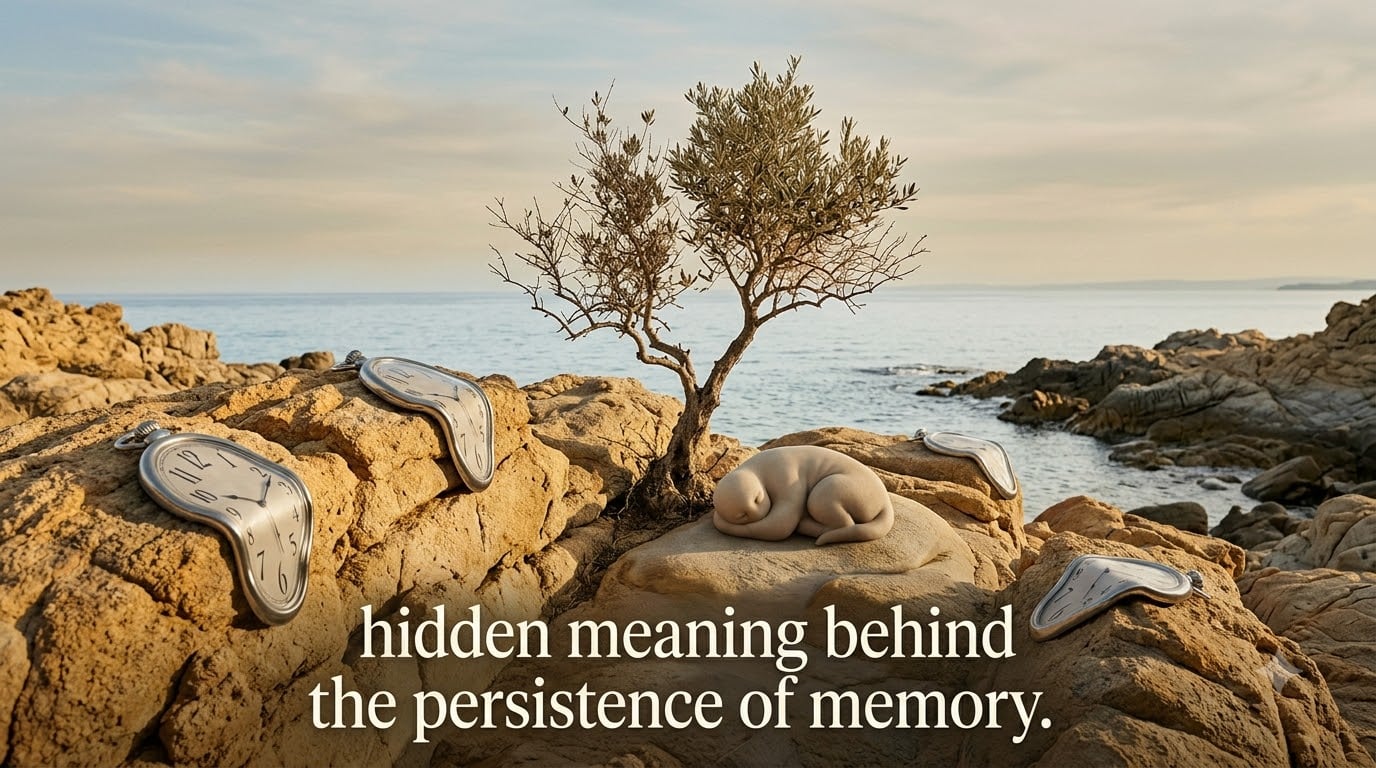
Salvador Dalí’s The Persistence of Memory (1931) is a surrealist meditation on the fluidity, decay, and unreliability of time. Its melting pocket watches draped across a barren Catalan landscape have become the single most iconic image in 20th-century art. But what is the hidden meaning behind The Persistence of Memory? Scholars and Dalí himself have offered competing answers — involving Einstein’s relativity, melting Camembert cheese, childhood trauma, and the logic of dreams — and understanding all of them is the key to unlocking the painting’s true depth.
I’ve spent years studying surrealist art, visiting MoMA to stand in front of this small canvas, and reading every major scholarly interpretation. What follows is a complete walkthrough of every symbolic element in the painting, the historical context that shaped it, and the details almost everyone misses.
Table of Contents
Quick Facts: The Persistence of Memory at a Glance
| Artist | Salvador Dalí (1904–1989) |
| Year | 1931 |
| Medium | Oil on canvas |
| Dimensions | 24 cm × 33 cm (9.5 in × 13 in) |
| Location | Museum of Modern Art (MoMA), New York City |
| Accession Number | 162.1934 |
| Style | Surrealism |
| Also Known As | The Soft Watches or The Melting Watches |
The painting arrived at MoMA in 1934 as an anonymous gift and has hung there ever since. Despite its outsized fame, the canvas is barely larger than a sheet of notebook paper — a fact that surprises nearly every first-time viewer.
Why Are the Clocks Melting in The Persistence of Memory?
The three melting watches are the painting’s most recognizable element and its central enigma. Their limp, drooping forms suggest that time itself has become soft, unreliable, and perhaps irrelevant in the dreamscape Dalí depicts.
Two competing origin stories dominate the scholarship. The popular interpretation links the soft watches to Albert Einstein’s theory of special relativity, which showed that time is not absolute but relative to the observer. Art historian Dawn Adès and others have argued that the melting clocks visualize this revolutionary idea — time bending and warping rather than ticking uniformly.
Dalí himself rejected the Einstein connection. In a letter to physicist Ilya Prigogine, he claimed the melting watches were inspired by the sight of Camembert cheese melting in the sun after dinner. “The fact that I painted soft watches,” Dalí wrote, “was nothing more than the surprise of Camembert cheese melting in the sun.” Whether this was genuine or another of his famous provocations remains debated.
The most satisfying reading may be both at once. Dalí was aware of relativity — it was part of the intellectual air he breathed in 1930s Europe — but his creative trigger was the mundane image of melting cheese. The painting holds both ideas in tension: scientific revolution and kitchen-table absurdity.
The Sleeping Creature: Self-Portrait or Dream Figure?
In the center of the composition lies a fleshy, amorphous form with closed eyelids and long eyelashes. Most viewers assume it is a sleeping animal or a melting face. Art historians identify it as a distorted self-portrait of Dalí himself — specifically, his profile in repose, with the closed eye, prominent nose, and curled lashes recognizable once you know to look.
The creature’s form also echoes a figure from Hieronymus Bosch’s The Garden of Earthly Delights (c. 1500). Dalí admired Bosch’s nightmarish imagery, and the soft, organic quality of the central figure directly references the fantastical creatures that populate Bosch’s triptych. Art historians including Dawn Adès have traced this connection explicitly.
The closed eye is significant. Every other element in the painting — the watches, the ants, the dead tree — exists in the waking world. But the creature sleeps. This positions the entire scene as a dream, with the sleeping figure as both the dreamer and the landscape’s only inhabitant. Time melts because the dreamer is unconscious, and the rigid categories of waking life have dissolved.
The Ants, the Orange Watch, and the Symbolism of Decay
On the left edge of the canvas, a pocket watch — the only one that has not melted — is covered with black ants. The ants have appeared in Dalí’s work since his earliest paintings and consistently symbolize decay, mortality, and anxiety.
Dalí traced the ants to a childhood memory he recounted in his autobiography The Secret Life of Salvador Dalí (1942). As a boy, he found a wounded bat swarming with ants. He picked it up, was bitten, and flung it into a well — then felt overwhelming guilt. The ants became, for him, a recurring emblem of rot, guilt, and the inevitability of death.
The orange watch’s refusal to melt is equally telling. While the other three watches droop and dissolve — time collapsing in the dream — this one remains rigid, its surface invaded by ants. It may represent waking reality intruding into the dream: time that still functions but is already decaying. The contrast between the melting watches and the ant-covered firm one creates a visual argument about the dual nature of time — fluid in dreams, but devouring in life.
A Fly Casting a Human Shadow: The Detail Almost Everyone Misses
On the face of the orange watch, a single dead fly rests. Its shadow, cast across the watch’s golden surface, takes the unmistakable shape of a human figure — arms slightly raised, standing upright. This detail is present in the original canvas but rarely discussed outside specialized scholarship.
The fly is another Dalí motif tied to decomposition. Flies lay eggs in dead matter; they are agents of biological decay. But the human shadow transforms the fly into something more unsettling: a small death that casts a human silhouette, as though mortality itself is shaped like us. It is one of the painting’s most haunting details and one that rewards close, slow looking.
The Catalan Coastline: Cap de Creus and Port Lligat
The craggy golden rocks in the background are not invented. They are the cliffs of Cap de Creus on the northeastern tip of Catalonia, near the fishing village of Cadaqués where Dalí spent every summer of his childhood. The specific promontory visible in the painting is Puig Pení, a headland that casts a long, distinctive shadow across the scene.
Dalí and his lifelong companion Gala lived in a small house in Port Lligat, a tiny bay adjacent to Cadaqués. The landscape of The Persistence of Memory is essentially the view from his doorstep — rendered in precise, classical detail while the objects draped across it dissolve into surrealist impossibility.
This grounding in a real place is essential to the painting’s power. The rocks, the dead olive tree, the calm sea — all are observed with photographic accuracy. The dream elements (melting clocks, sleeping creature) do not float in an abstract void. They inhabit a specific, recognizable location, which makes the surrealism feel intimate rather than fantastical. You are not looking at a dream in general. You are looking at Dalí’s dream on the Catalan coast.
Dalí’s Paranoiac-Critical Method and the Dream That Started It All
Dalí developed what he called the “paranoiac-critical method” — a technique for inducing hallucinatory, irrational imagery while remaining fully conscious. He would fixate on an object or an image until it transformed into something else, then paint the hallucination with precise realism.
The Persistence of Memory was painted after Dalí experienced a vision while staring at a piece of melting Camembert cheese. The soft watches emerged from this paranoiac-critical exercise — the cheese became time, and the time became landscape. Dalí described the process as “a hand-painted dream photograph,” emphasizing that he did not paint while sleeping. He painted waking visions with the precision of a Renaissance master.
This method is what separates Dalí from other Surrealists like André Masson or Max Ernst, who relied on automatism (spontaneous, uncontrolled mark-making). Dalí’s Surrealism is controlled, deliberate, and technically virtuosic. Every element in The Persistence of Memory is rendered with careful observation, even as the subject matter defies logic.
Persistence vs. Disintegration: Dalí’s 1954 Reimagining
In 1954, more than two decades after the original, Dalí painted The Disintegration of the Persistence of Memory. It reimagines the same composition — the melting watches, the creature, the Catalan landscape — but broken into rectangular, pixel-like fragments suspended above water.
The 1954 version reflects Dalí’s interest in nuclear physics and quantum mechanics, which he had absorbed in the postwar years. Where the 1931 painting shows time melting into fluidity, the 1954 version shows matter itself disintegrating into particles. It is both a sequel and a commentary: the earlier painting dissolved time; the later one dissolves the physical world.
Comparing the two side by side reveals how Dalí’s intellectual preoccupations shifted from Freudian psychology and relativity to atomic theory. The first painting is a dream of softness; the second is a vision of fragmentation. Both hang in the same museum — the second at the Salvador Dalí Museum in St. Petersburg, Florida.
Why a Tiny Canvas Produces a Giant Icon
One fact consistently surprises museum visitors: The Persistence of Memory measures only 24 by 33 centimeters — roughly the size of a standard sheet of paper. You can hold it at arm’s length and still feel it is smaller than you expected.
This small scale is not incidental. The painting’s intimacy depends on it. You have to step close to see the fly, the ants, the lashes on the sleeping creature’s closed eye. The small canvas forces a private, almost secret encounter — the way dreams are small and private even when they feel vast. Reproductions in books and online strip away this physical intimacy, which is one reason the original at MoMA still surprises visitors.
Dalí’s classical technique — smooth, invisible brushstrokes, precise rendering of light and shadow — also reads differently at this scale. It looks like a miniature Renaissance painting with surrealist subject matter, and the tension between Old Master craft and dreamlike content is part of what makes it unforgettable.
The Painting’s Cultural Afterlife: From The Simpsons to Fashion Ads
Few artworks have been parodied or referenced as often as The Persistence of Memory. The Simpsons recreated it in a couch gag. Looney Tunes referenced the melting clocks. The image appears in Doctor Who, fashion advertising, album covers, and countless memes. It has become visual shorthand for “weird, dreamlike, and intellectual.”
This ubiquity raises an interesting question: has overexposure dulled the painting’s impact? Most scholars argue no. Seeing the original at MoMA — tiny, quiet, with its muted ochre and blue palette — restores the strangeness that reproductions flatten. The painting rewards slow looking in a way that its endless reproductions do not.
Frequently Asked Questions
What is the hidden meaning behind The Persistence of Memory?
The hidden meaning behind The Persistence of Memory is a meditation on the fluidity and unreliability of time. Dalí’s melting clocks suggest that time is not rigid — it bends in dreams, decays in memory, and dissolves under pressure. Scholars have connected the imagery to Einstein’s relativity, Dalí’s own Camembert-cheese inspiration, and Freudian dream theory.
What does the melting clock in The Persistence of Memory symbolize?
The melting clock symbolizes the subjective, relative nature of time. In dreams, time stretches and compresses; in memory, it warps. Dalí said he was inspired by Camembert cheese melting in the sun, but scholars widely interpret the soft watches as a visual metaphor for relativity and the unconscious mind’s disregard for clock-time.
Is The Persistence of Memory about Einstein’s theory of relativity?
Many art historians have linked the melting clocks to Einstein’s theory of special relativity, which demonstrated that time is not absolute. However, Dalí himself denied the connection, claiming the watches were inspired by melting Camembert cheese. The painting likely holds both ideas in tension — scientific revolution and surreal absurdity.
What do the ants represent in The Persistence of Memory?
The ants represent decay, mortality, and anxiety. Dalí associated them with a childhood memory of a wounded bat covered in ants, which he described in his autobiography The Secret Life of Salvador Dalí. In the painting, they swarm the only watch that has not melted, suggesting that even rigid time is subject to decomposition.
What does the creature in the center of The Persistence of Memory mean?
The creature is widely identified as a distorted self-portrait of Salvador Dalí — his profile in sleep, with recognizable eyelashes and a closed eye. It also references the fantastical creatures in Hieronymus Bosch’s The Garden of Earthly Delights. The creature’s sleep positions the entire scene as a dream.
What does the dead fly on the watch mean in The Persistence of Memory?
The dead fly on the orange watch symbolizes decomposition and biological decay. Its most striking detail is its shadow, which casts a human-shaped silhouette across the watch face — a small death shaped like a person, suggesting that mortality itself takes our form.
Why did Salvador Dalí paint The Persistence of Memory?
Dalí painted The Persistence of Memory after a vision triggered by watching Camembert cheese melt in the sun. Using his paranoiac-critical method — a technique for inducing waking hallucinations — he transformed the melting cheese into soft watches draped across a dreamlike version of the Catalan coastline near his home.
Where is The Persistence of Memory displayed?
The Persistence of Memory has been housed at the Museum of Modern Art (MoMA) in New York City since 1934. It arrived as an anonymous donation and bears the accession number 162.1934. It is one of the most visited paintings in MoMA’s permanent collection.
How big is The Persistence of Memory?
The painting measures just 24 cm × 33 cm (9.5 inches × 13 inches) — roughly the size of a standard sheet of paper. Its small scale is part of its power: viewers must step close to see details like the ants, the fly, and the sleeping creature’s lashes, creating an intimate, almost private encounter.
What is the difference between The Persistence of Memory and The Disintegration of the Persistence of Memory?
The Persistence of Memory (1931) shows melting clocks on a dreamlike Catalan landscape, while The Disintegration of the Persistence of Memory (1954) reimagines the same scene broken into rectangular, pixel-like fragments suspended above water. The 1954 version reflects Dalí’s postwar interest in nuclear physics and quantum mechanics, disintegrating matter itself rather than just time.
Final Thoughts
The hidden meaning behind The Persistence of Memory is not a single secret waiting to be decoded. It is a layered work that holds multiple truths at once: relativity and cheese, science and childhood guilt, dream logic and Renaissance craft. Dalí gave us melting clocks that refuse a single explanation, and that irreducibility is precisely what makes the painting endure.
If you want to understand the painting fully, start with the direct answer: time is fluid, memory is unreliable, and the dreamer at the center of it all is Dalí himself. Then look closer — at the ants, the fly’s human shadow, the real Catalan rocks — and let each detail pull you deeper. The painting rewards the slow looker more than any reproduction can suggest.