
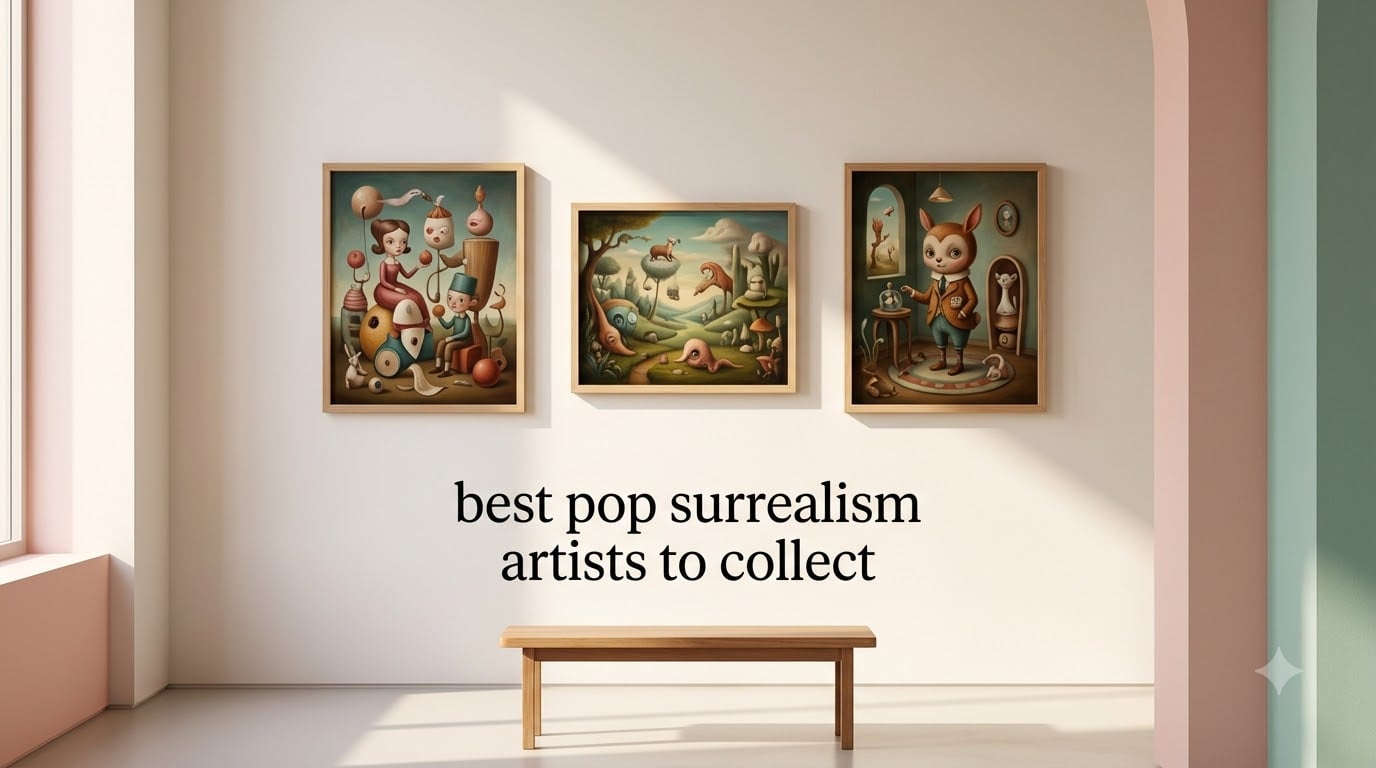
Walking into a room and seeing a Mark Ryden painting on the wall feels different. The colors are familiar, almost commercial, but the figures twisted between them carry a quiet dread that stays with you. That tension, between childhood sweetness and adult unease, is exactly what made our team fall for pop surrealism years ago, and it’s the reason collectors keep paying attention.
The best pop surrealism artists to collect today sit at the meeting point of underground illustration, classical painting, and pop culture criticism. Some have six-figure auction records. Others are mid-career painters whose limited edition prints still sit in a friendly range. Both ends of that spectrum deserve a closer look, and this guide is built to help you find your way through it.
I’ve spent months talking to gallerists, scrolling through Juxtapoz archives, and watching collectors share their walls on social channels to put this list together. What follows is the most useful roadmap I’ve found for anyone who wants to start collecting pop surrealism artists with confidence, whether your budget is modest or ambitious.
Pop surrealism, also called lowbrow art, is a contemporary movement that blends underground comic book imagery, classical painting technique, and pop culture references into dreamlike, often macabre compositions. The best pop surrealism artists to collect, including Mark Ryden, Robert Williams, Camille Rose Garcia, Todd Schorr, and contemporary talents like Jeff Soto and Amy Sol, work across oil, acrylic, digital, and mixed media.
Table of Contents
What Is Pop Surrealism and Why Collectors Love It
Pop surrealism is a contemporary figurative movement that fuses classical painting technique with cartoon, comic, and pop culture imagery to create something both familiar and unsettling. You’ll often hear it called lowbrow art, and the two terms describe the same broad scene of artists who came up through skateboards, zines, hot rods, and underground comics rather than through MFA programs.
The reason collectors love it is the same reason the work keeps growing as a category: every piece carries a narrative. A Mark Ryden canvas isn’t decoration, it’s a small allegory about consumer culture. A Camille Rose Garcia painting doubles as a quiet political cartoon. You don’t just hang these pieces, you read them.
There are a few qualities that recur across the best work in the movement:
- Highly finished figurative painting with old-master craft.
- Pop iconography, branding, mascots, and toys twisted into new roles.
- Dreamlike, sometimes nightmarish, atmosphere.
- Hand-drawn draftsmanship that borrows from comics and illustration.
- Layered symbolism that rewards long looking.
For a new collector, that density of meaning is part of the value. A print from a strong pop surrealism artist can hold a wall for decades, because the imagery keeps unfolding.
The Origins of Pop Surrealism: From Lowbrow Beginnings to Mainstream Recognition
The founding myth of pop surrealism starts in late-1990s Los Angeles, but the soil had been turned for nearly thirty years by then. In the 1970s, a generation of artists in the California car, comic, and skateboard scenes felt shut out of the gallery world. They had technical chops, often trained by Disney or by commercial illustration studios, but their imagery came from hot rods, monster movies, and pulp magazines rather than from abstract expressionism or conceptual art.
Robert Williams was the loudest voice in that generation. He called the work lowbrow as an act of defiance, and in 1994 he co-founded Juxtapoz magazine with the publisher Vicki Wells. Juxtapoz gave the scene a venue, a critical language, and crucially, a community of artists who could see each other’s work in print every month. By the late 1990s, galleries like La Luz de Jesus in Los Angeles and the Shooting Gallery in San Francisco had built loyal followings around the same artists.
Around the same window, Mark Ryden, who had studied illustration at Pasadena’s Art Center and worked with Williams, began painting the polished, candy-palette images that would carry the movement into the mainstream. His 1998 Whitney Biennial invitation was, in our reading, the moment that pop surrealism stopped being underground. Major museums had started to pay attention, and the collectors followed.
Today the same artists teach, exhibit, and sell through blue-chip galleries, while the Juxtapoz archive remains the richest single source for tracing how the movement matured from hot-rod pinstripers into something an art curator could hang next to a Matthew Barney.
The Founding Pop Surrealism Artists Every Collector Should Know
These are the foundational names. If you’re building any kind of serious pop surrealism collection, you’ll end up encountering their work, either directly or through the artists they’ve influenced. I’ll list each with a short profile of why they matter and what kind of piece they make.
Mark Ryden is, for many collectors, the entry point. His oil paintings often put a child, an animal, or a religious symbol inside a frame of consumer products, and the result feels both reverent and satirical. Ryden trained under Robert Williams at Juxtapoz and went on to show at the Whitney, the Musée de la Halle Saint-Pierre in Paris, and a long list of commercial galleries. Original Ryden canvases sit at the top of the market, but his limited edition prints are widely available and still a sound starting point.
Robert Williams is the godfather. He started in the 1960s underground comics scene, co-founded Zap Comix alongside R. Crumb, and built the kind of painting vocabulary that mixed Burne Hogarth anatomy with hot-rod chrome. If you see a Williams canvas with a stretched, rubbery figure floating in front of a sci-fi skyline, you’ve found a classic. His work commands serious auction results, but his out-of-print monograph The Lowbrow Art of Robert Williams is itself a collector’s item.
Todd Schorr is the second-generation leader most associated with the late golden age of lowbrow. His paintings are dense, exuberant allegories about American consumerism, full of greasy mascots, eyeballs, and melting iconography. Schorr trained at the Philadelphia College of Art and brought a chunkier, more comic-book-influenced style to the movement. Original Schorrs are scarce, but his print editions remain a strong secondary buy.
Camille Rose Garcia is the painter most associated with the darker, more politically charged side of pop surrealism. Her work has the muted, slightly decayed palette of a vintage storybook, and her imagery leans into fairy tale grotesques and ecological allegory. Garcia was born in Los Angeles, studied at the Otis College of Art and Design, and has shown widely at galleries on both coasts. Her numbered screenprints are a solid place to start a Garcia sub-collection.
Kenny Scharf came out of the East Village art scene alongside Jean-Michel Basquiat and Keith Haring in the early 1980s. He joined the pop surrealism orbit through a friendship with Williams and Juxtapoz, and his paintings of cartoon faces, gooey cosmic blobs, and lurid color fields are some of the most joyful in the movement. Scharf has been prolific, which is helpful for collectors trying to find affordable originals.
Ron English has spent decades reshaping the border between pop surrealism and street art. His “Abraham Obama” image, the grinning McSupersized characters, and his moonwalker series have entered the wider visual vocabulary of contemporary culture. English still sells prints, original paintings, and small sculptures, and his work is a smart pick for collectors who like art with a sharper social edge.
Contemporary Pop Surrealism Artists Worth Collecting
The second wave of pop surrealism artists is in a sweet spot for collectors. They’re established enough to have auction records and gallery representation, but their prints are still realistically priced for someone building a first collection. These are the names I’d watch most closely going into 2026.
Jeff Soto is the painter most often cited as Ryden’s heir apparent. His work has that polished illustrative finish but trades Ryden’s quiet unease for a louder, almost narrative-poster sensibility, with robots, kites, and overgrown forests turning into character-driven worlds. Soto has been a Juxtapoz cover artist and shows at Corey Helford Gallery in Los Angeles. His limited edition screenprints are an accessible entry point and hold their value well.
Amy Sol paints something gentler than most of her peers, dreamy figurative women, swans, deer, and abstract floral settings done in soft cool palettes. Sol is Korean-American and was born in Mongolia, an unusual background that informs the quiet, slightly orientalist fantasy feeling of her paintings. If you want a pop surrealism artist whose work feels calm and meditative, Sol is the clearest answer.
Esao Andrews works at the darker, more psychedelic end of the movement. His paintings often look like graffiti rendered with a Surrealist’s patience, dripping, warped figures in thick oil and acrylic on wood panel. Andrews has shown at Jonathan Levine Gallery and is a Juxtapoz favorite. His hand-embellished prints are a good starting point, but small original works on panel show up at reasonable levels.
Greg Simkins, often called “the Creep” for his recurring character, builds paintings that look like the inside of a comic-book dream. Skeletons, animals, and strange mechanical figures crowd into dreamlike landscapes. Simkins had a long career as a graphic designer before committing to fine art, and that graphic discipline shows in every panel he composes.
Naoto Hattori is the digital painter in this group. He works primarily in colored pencil and digital tools, and his portrait heads look like melting, candy-bright psychedelia layered over very precise drawing. Hattori is one of the few pop surrealism artists who can be approached almost entirely through his original drawings, which keeps pricing relatively friendly.
Ray Caesar is a Canadian-British artist whose digital prints and sculptures have become a quiet phenomenon in pop surrealism collecting. His figures, androgynous, doll-like, slightly off in a way you can’t quite name, came out of a personal artistic practice built in Toronto. Caesar has shown at the Museum of Sex in New York and abroad, and his limited editions typically hold their value as his gallery career has grown.
Additional contemporary names our team would add if your budget allows: Aaron Horkey, Nicolosi, Adam Caldwell, and the Australian painter Doopie Draser, who represents a strong next-wave voice out of Melbourne.
How to Recognize Pop Surrealism and Lowbrow Art
Recognizing pop surrealism and lowbrow art in the wild comes down to a handful of consistent visual cues. If a piece hits several of these qualities at once, you’re probably looking at the real thing:
- A figure rendered with strong classical or illustrative draftsmanship, not photorealism and not pure abstraction.
- Pop iconography, mascots, branded packaging, or cartoon characters as the central subject.
- An atmosphere that is dreamlike, eerie, or slightly nightmarish, even when the palette is bright.
- Layered symbolism that rewards a second or third look.
- An unmistakably hand-drawn quality, even if digital tools were used somewhere in the process.
- Themes of consumer culture, childhood memory, religion, sexuality, or transformation.
The two terms, pop surrealism and lowbrow, are mostly interchangeable today. Some artists, like Robert Williams, prefer “lowbrow” because it honors the scene’s working-class and outsider roots. Others, like Mark Ryden, lean toward “pop surrealism” because it describes the finished image more accurately. Galleries and auction houses tend to use them as synonyms.
What separates pop surrealism from traditional surrealism is the absence of automatism and the heavy presence of commercial iconography. Salvador Dali’s melting clocks were about the unconscious. A Ryden painting of a child holding a McDonald’s fries box is about the conscious memory of growing up inside a brand.
Techniques and Mediums Used by Pop Surrealism Artists
The craft standard across the best pop surrealism artists is high, and most of them draw with traditional tools even when finishing digitally. Three mediums dominate:
- Oil and acrylic on canvas or wood panel, used by Mark Ryden, Todd Schorr, Esao Andrews, and Camille Rose Garcia.
- Airbrush, a classic lowbrow tool borrowed from hot-rod sign painters, used heavily by Williams and his generation.
- Graphite and colored pencil on paper, used by Laurie Lipton and Naoto Hattori for very tightly rendered drawings.
Most contemporary artists in the movement also work digitally, either for layout or for finished pieces. Ray Caesar builds his figures in 3D software before treating them as prints. Many of the younger painters, including Doopie Draser, sketch in Procreate and then transfer the drawing to canvas.
Printmaking is a parallel craft tradition. The best work in pop surrealism shows up as limited edition screenprints, giclées, and giclograph editions, often hand-pulled, hand-finished, and signed in pencil by the artist. A signed, numbered screenprint from a name like Jeff Soto or Amy Sol holds its value because of this craft layer.
How to Start Collecting Pop Surrealism Art
Starting a collection is less about budget and more about patience. Here is the workflow that has worked for me and for collectors I trust.
Step 1: Pick a focus artist. Resist the temptation to buy one print from each of twelve artists. Pick one living artist whose work you can live with for years. Buy a small edition print from them, frame it, and live with it for a season. If it still thrills you, that artist is your foundation.
Step 2: Begin with prints, move toward originals. Limited edition screenprints in editions of under 200 are the natural first step. They are signed, numbered, and considerably lower priced than originals. Once you know what you like, start hunting small original works on paper or on wood panel.
Step 3: Build provenance into every purchase. Provenance is the documented chain of ownership for a piece of art. Buy from the artist’s studio, from a gallery that represents them, or from a documented secondary-market sale. Ask for a signed certificate of authenticity and keep the invoice with the certificate forever.
Step 4: Learn the difference between print types. The hierarchy, in rough order of value, runs something like this: first, a hand-pulled, signed, and numbered original screenprint on archival paper; then a giclée on cotton rag paper with the artist’s signature and numbering; then open edition giclée prints, which are decorative and should not be confused with collectible art.
Once you understand the hierarchy, confirm every edition size in writing before you commit to a purchase.
Step 5: Watch for forgeries. Pop surrealism has had problems with edition size inflation and unauthorized reproductions. Always ask for the published edition size and a clear image of the certificate of authenticity. If a “limited edition” of 50 has 400 numbered prints floating around the secondary market, walk away.
Step 6: Set a real budget and a real wall. Decide a yearly amount, even a modest one, and commit to it. Measure the wall you want to fill. A focused three-print collection on a single wall reads stronger than twelve scattered pieces.
The single most common mistake new collectors make is buying too many things from too many artists. A small, focused Ryden-and-Soto wall is a coherent collection. A wandering one-print-from-everyone wall is decoration.
Where to Buy Pop Surrealism Art: Galleries, Fairs, and Online Platforms
There is no shortage of legitimate places to buy pop surrealism art, but the channel you choose changes both the price you pay and the level of authenticity you can expect.
- Specialty brick-and-mortar galleries remain the safest first stop. La Luz de Jesus in Los Angeles, Corey Helford Gallery in Los Angeles, and the Jonathan Levine Gallery in New York have built reputations specifically around this scene.
- Art fairs like Superfine, the Seattle Art Fair, and various Juxtapoz-sponsored events offer the chance to meet artists and see work in person.
- Online artist-run shops sell first-run editions directly, often at the lowest price you’ll see for a given piece.
- Limited-edition platforms like Beautiful Bizarre Magazine’s artist directory connect collectors with vetted pop surrealism artists across multiple regions.
- Major auction houses, Christie’s, Sotheby’s, Phillips, Heritage, sell important original works at the top of the market when they surface.
For collectors in Europe, Beinart Gallery in Melbourne and Copro Gallery in Los Angeles serve international clients with shipping infrastructure. None of these channels is universally cheaper than the others, but buying at the artist’s studio almost always wins on price.
Is Pop Surrealism Art a Good Investment?
Honest answer: yes, in the sense that original works by top pop surrealism artists have appreciated consistently over the last decade, and no, in the sense that you should never buy a piece expecting to flip it for profit. Art is a slow, illiquid asset.
Mark Ryden’s auction record sits comfortably above seven figures for his largest originals. Original Camille Rose Garcia paintings have moved from five figures into low six figures on the secondary market. Todd Schorr originals are tracked seriously by Heritage Auctions. These are real, repeatable results from a transparent market.
The collectors who do best treat their purchases as long-term holdings of work they genuinely want to live with. Resale is a future bonus, not a short-term plan. Buy the artist whose work you trust, hold the work for at least five years, and only sell through a major auction house or a vetted secondary dealer when you do.
Budget-conscious collectors have one practical advantage: a well-chosen limited edition print from an emerging pop surrealism artist today can become a meaningful asset a decade from now, and the entry barrier is far lower than for blue-chip contemporary art.
Frequently Asked Questions
What is pop surrealism art?
Pop surrealism, also called lowbrow art, is a contemporary figurative movement that fuses classical painting technique with cartoon, comic, and pop culture imagery. The work is often dreamlike, symbolic, and slightly macabre, drawing on underground comics, skate and car culture, and old-master craft to create pieces that feel both familiar and unsettling.
Who is considered the father of pop surrealism?
Robert Williams is widely regarded as the founding father of pop surrealism. He gave the movement its name, co-founded Juxtapoz magazine in 1994, and trained a generation of artists including Mark Ryden at his LA studio. Williams himself describes the work as lowbrow, in homage to the underground illustration and car culture roots of the scene.
What is the significance of pop surrealism in art?
Pop surrealism democratized contemporary art by absorbing techniques and imagery from illustration, comics, skateboarding, and tattoo culture into a fine-art context. It also challenged the boundary between low and high art, opening the door for figurative painters who did not emerge from traditional MFA programs to show alongside the most established names in the contemporary art world.
What makes a painting pop surrealism or lowbrow art?
A painting usually reads as pop surrealism if it combines highly finished figurative technique with pop iconography, dreamlike or eerie atmosphere, layered symbolism, and a hand-drawn quality. Common motifs include childhood mascots, branded packaging, cartoon characters in unfamiliar roles, and themes of consumer culture or transformation. The work sits between the polished look of illustration and the emotional charge of surrealism.
How do I start collecting pop surrealism art?
The easiest path is to pick one artist you trust, begin with a small signed and numbered limited edition print, frame it well, and live with it for a season. Buy from the artist’s studio, a specialty gallery, or another documented primary channel, and keep the certificate of authenticity with the invoice forever. Once you know what you like, expand to small originals, ideally with documented provenance.
Where can I buy pop surrealism art?
Trusted channels include specialty galleries like La Luz de Jesus in Los Angeles, Corey Helford Gallery, and Jonathan Levine Gallery in New York, art fairs where the artists exhibit directly, online artist-run stores that sell first-run editions, and limited-edition platforms like the Beautiful Bizarre artist directory. For blue-chip originals, major auction houses such as Christie’s, Sotheby’s, and Heritage Auctions will occasionally offer important pieces.
Is pop surrealism art a good investment?
Original works by top pop surrealism artists have appreciated steadily over the last decade, and limited edition prints can be a smart long-term holding for a patient collector. You should not buy art expecting short-term flips, since art is a slow and illiquid asset. The strongest returns usually come from buying work you genuinely want to live with, then holding it through multiple years.
Final Thoughts on Collecting Pop Surrealism Artists
If you remember one thing from this guide, let it be this. The best pop surrealism artists to collect are the ones whose work pulls you back to the wall after the room is quiet. Start with one, build provenance into every purchase, treat prints as serious art, and let originals follow when they appear. The scene built by Robert Williams and Juxtapoz has matured into one of the most collector-friendly corners of contemporary art, and there has never been a better moment to start.