
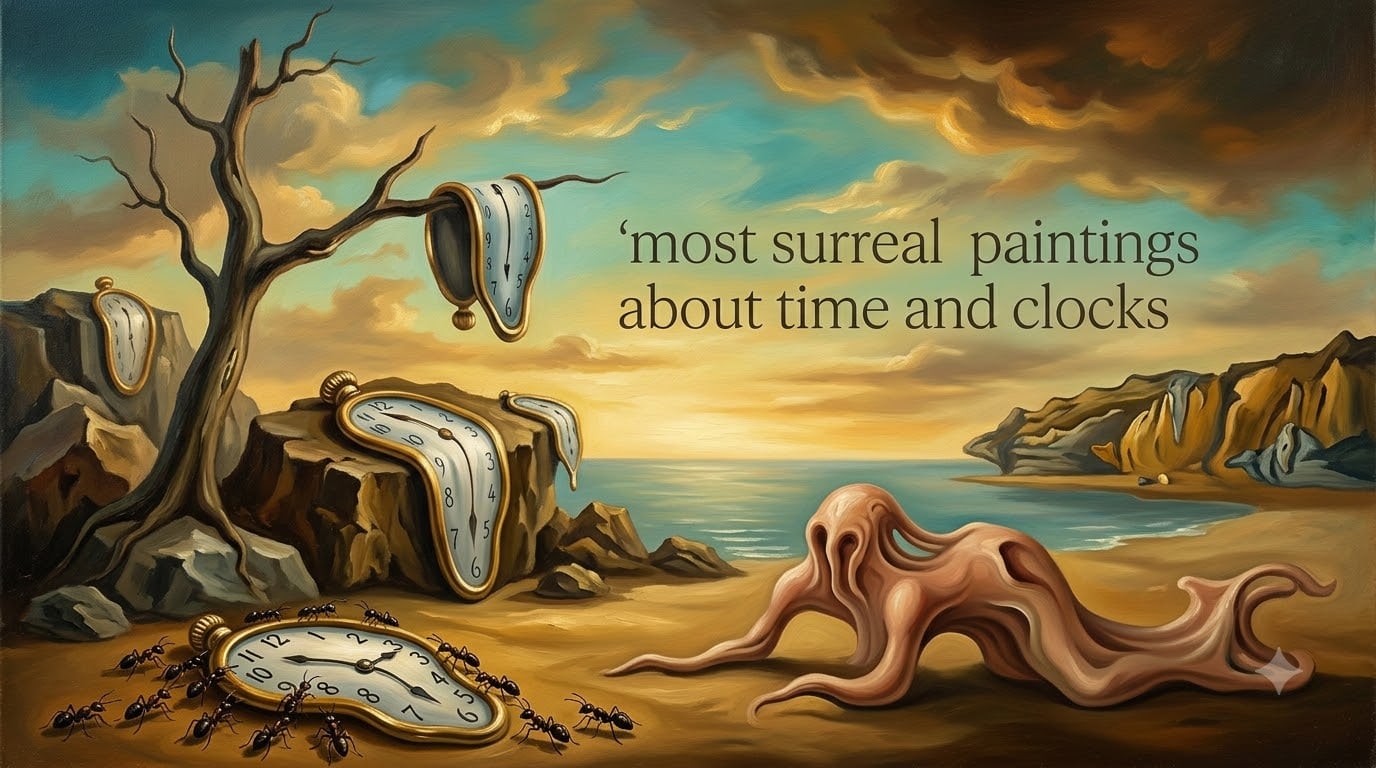
The most surreal painting about time and clocks is Salvador Dalí’s The Persistence of Memory (1931), an oil on canvas that shows soft, melting watches draped across a barren Catalan landscape. Also known as Soft Watches or Melting Clocks, the work hangs in the Museum of Modern Art (MoMA) in New York and remains the single most recognizable image in 20th-century art.
But it is far from the only one. When readers search for the most surreal paintings about time and clocks, they want a list, not a 700-word essay on a single canvas. In this guide, I walk through ten surrealist works that bend, melt, dissolve, and weaponise the clock, from Dalí’s 1931 masterwork to Vladimir Kush’s contemporary “metaphorical realism.” You will find the artist, year, medium, current location, and the meaning behind each one.
Table of Contents
What Is the Most Surreal Painting About Time and Clocks?
The Persistence of Memory is a 1931 surrealist painting by Salvador Dalí that depicts four soft, drooping watches in a sun-bleached Catalan landscape. Also called Soft Watches or Melting Clocks, the 9.5 by 13 inch oil on canvas hangs in the Museum of Modern Art (MoMA) in New York. It is widely considered the most iconic surrealist image ever painted.
Dalí painted it in his late twenties, after returning to his family home in Port Lligat and reading Sigmund Freud on the relativity of time and dreams. The result is a small, deceptively simple canvas where clocks lose their function as instruments and become objects of memory, decay, and reverie.
10 Most Surreal Paintings About Time and Clocks
This is the list you came for. I have grouped the works by artist so you can see how Dalí, Magritte, Kush, and others returned to the clock motif again and again, each in their own surrealist dialect.
1. The Persistence of Memory (1931) — Salvador Dalí
Oil on canvas, 24.1 x 33 cm. Given anonymously to MoMA in 1934 (accession 162.1934). The four melting watches, the orange clock draped over a melting creature, the dead olive tree, and the ants are now the visual shorthand for “surrealism” worldwide. Visitors to MoMA often tell me they are surprised by how small the canvas is in person.
2. The Disintegration of the Persistence of Memory (1952–54) — Salvador Dalí
Oil on canvas, 25.4 x 33 cm. Salvador Dalí Museum, St. Petersburg, Florida. Twenty years after his first meditation on soft watches, Dalí returned to the same scene, now fractured into floating geometric blocks, with the clocks atomised and the landscape suspended in mid-air. It is his nuclear-age sequel to the 1931 canvas and proof that the melting-clock motif was a lifelong obsession, not a one-off trick.
3. Time Transfixed (1938) — René Magritte
Oil on canvas, 79 x 139 cm. Art Institute of Chicago. A working mantle clock sits in a stone fireplace, its face replaced by the nose cone of a steam locomotive that is barrelling through the hearth. Magritte was indeed a Surrealist and a member of the Belgian surrealist circle around André Breton. The painting turns a household timepiece into a small theatre of the absurd.
4. The Melting Watch — Vladimir Kush (2001)
Oil on canvas, signed. Kush Fine Art. The Russian-born, American-trained artist Vladimir Kush is the founder of a contemporary movement he calls “Metaphorical Realism,” and clocks are among his signature props. In this work, a soft pocket watch sags over the edge of a wooden table the same way Dalí’s 1931 watches sag over rocks, but Kush adds his own signature: airborne fish, draping fabric, and a calm, luminous Mediterranean palette.
5. Webmaster (1999) — Vladimir Kush
Oil on canvas, signed. Private collection. A figure stands at the centre of an enormous web made of stretched, woven watch faces. The webs are held up by tree branches that double as clock hands. It is Kush’s clearest statement that time itself is a trap the mind weaves, a contemporary echo of de Chirico’s metaphysical clocks.
6. Kill Time (2006) — Vladimir Kush
Oil on canvas, signed. Kush Fine Art. A woman sits at a café table beside a pool of water in which a clock face is slowly drowning. The title is the verb: she is killing it, slowly, deliberately, while the rest of the scene goes on with the cool objectivity of a Dalí background.
7. Gare Montparnasse (The Melting Clock), 1952 — Salvador Dalí
Colour lithograph. Private collections. Dalí returned to the melted watch as a print motif in the 1950s and 1960s. This lithograph shows a single pocket watch drooping over the edge of a tile roof, with a Parisian skyline reading more dream than memory behind it. It is the most reproduced Dalí print after The Sacrament of the Last Supper.
8. The Soft Watch at the Moment of Its First Explosion (1979) — Salvador Dalí
Colour lithograph from the Les Horloges Molles suite. Private collections. In this late print, Dalí finally detonates the soft watch. It is no longer melting; it is breaking open like an egg, seed-pods spilling out of the case. Read it as the artist’s farewell to the symbol he had been refining for nearly half a century.
9. The Garden of Earthly Delights (1490–1500) — Hieronymus Bosch (Surrealist Forerunner)
Oil on oak panel, 220 x 389 cm (central panel). Museo del Prado, Madrid. Bosch is not a surrealist. André Breton himself, however, claimed him as a patron saint of the movement in 1924, and Dalí cited the Garden as a direct ancestor of The Persistence of Memory. The central and right panels are full of translucent eggs, glass vessels, oversized fruit, and clock-like instruments of time and torment that prefigure Dalí’s melting watches by more than four centuries.
10. The Dream (Le Rêve, 1932) — Pablo Picasso
Oil on canvas, 130 x 97 cm. Private collection (sold May 2013). Although Picasso never joined the surrealist movement, his 1932 portrait of Marie-Thérèse Walter is unmistakably dreamlike: a face split into profile and frontal view, hands folded in sleep. It does not show a clock, but it is the clearest example of how time stops inside a surrealist image: nothing moves, nothing ages, the figure is suspended.
| # | Painting | Artist | Year | Medium | Location |
|---|---|---|---|---|---|
| 1 | The Persistence of Memory | Salvador Dalí | 1931 | Oil on canvas | MoMA, New York |
| 2 | The Disintegration of the Persistence of Memory | Salvador Dalí | 1952–54 | Oil on canvas | Dalí Museum, St. Petersburg FL |
| 3 | Time Transfixed | René Magritte | 1938 | Oil on canvas | Art Institute of Chicago |
| 4 | The Melting Watch | Vladimir Kush | 2001 | Oil on canvas | Kush Fine Art |
| 5 | Webmaster | Vladimir Kush | 1999 | Oil on canvas | Private collection |
| 6 | Kill Time | Vladimir Kush | 2006 | Oil on canvas | Kush Fine Art |
| 7 | Gare Montparnasse (The Melting Clock) | Salvador Dalí | 1952 | Lithograph | Private collections |
| 8 | The Soft Watch at the Moment of Its First Explosion | Salvador Dalí | 1979 | Lithograph | Private collections |
| 9 | The Garden of Earthly Delights | Hieronymus Bosch (forerunner) | 1490–1500 | Oil on oak panel | Museo del Prado, Madrid |
| 10 | The Dream (Le Rêve) | Pablo Picasso | 1932 | Oil on canvas | Private collection |
Why Surrealists Fixated on Time and Clocks
Time and clocks became central surrealist symbols because they represent memory, decay, relativity, and the irrational nature of subjective experience. Breton’s first Surrealist Manifesto (1924) named Freud, dream, and the unconscious as the movement’s founding territory, and clocks were the most universal symbol of the rational, mechanical world the surrealists wanted to overturn.
Three forces pulled the surrealists toward time. First, Freudian psychoanalysis taught that the unconscious has no clock, so memories surface out of order and trauma compresses years into seconds. Second, Einstein’s theory of relativity was in the air; clocks were no longer absolute, and a melting watch was the perfect emblem. Third, the trauma of the First World War made a generation suspicious of progress, industry, and the mechanical timepiece as a weapon of discipline.
Dalí called his technique the paranoiac-critical method: a self-induced paranoid state in which the artist interprets reality with equal weight given to every option, until the irrational becomes as plausible as the rational. Soft watches are the visual proof that the method works. When you look at The Persistence of Memory, the melting clock is the natural state, and the orange clock on the creature is the strange one.
Reading the Symbols: Melting Clocks, Ants, and Dead Trees
The clocks in The Persistence of Memory represent the relativity and fluidity of time as experienced in dreams, memory, and the unconscious mind. They are not broken; they are liberated from the obligation to be rigid. Dalí later described them as “the camembert of time,” because he supposedly saw runny Camembert cheese on a napkin and realised a soft clock would disturb the viewer just enough to make them look twice.
Other symbols carry the same weight. The ants on the small orange clock represent decay and the discomfort of watching a precious thing rot in real time. The dead olive tree in the foreground symbolises the barrenness of memory when nothing new is allowed to grow. The single golden pocket watch in the centre, closed and invaded by ants, is the mechanical clock, the world of industry and routine that the surrealists were trying to sabotage. The fleshy, melting creature in the centre of the canvas is often read as a self-portrait of Dalí asleep on the rocks at Cap de Creus, dreaming the whole scene.
Frequently Asked Questions
What is the name of the surrealist painting featuring clocks?
The most famous surrealist painting featuring clocks is The Persistence of Memory (1931) by Salvador Dalí, also known as Soft Watches or Melting Clocks. It hangs in the Museum of Modern Art (MoMA) in New York.
What are some famous paintings with clocks in them?
Beyond Dalí’s The Persistence of Memory (1931) and The Disintegration of the Persistence of Memory (1952–54), famous surrealist clock paintings include Magritte’s Time Transfixed (1938), Vladimir Kush’s The Melting Watch, Webmaster, and Kill Time, and Bosch’s The Garden of Earthly Delights, which Dalí himself cited as a forerunner.
Who is the artist known for painting clocks?
Salvador Dalí is the artist most associated with painting clocks. He returned to the soft watch motif across his entire career, from The Persistence of Memory (1931) through lithograph suites in the 1970s. Vladimir Kush is the leading contemporary successor with his Metaphorical Realism.
What do the melting clocks represent in The Persistence of Memory?
The melting clocks in The Persistence of Memory represent the relativity and fluidity of time as experienced in dreams, memory, and the unconscious mind. They are not broken; they are freed from the obligation to be rigid. Dalí described them as the camembert of time.
How much is Salvador Dalí’s Melting Clocks painting worth?
The Persistence of Memory is held by MoMA as a gift, not a sale. Dalí originals and authorised lithographs continue to set records at major auction houses, with high-quality prints regularly achieving strong results at specialised sales of 20th-century surrealist works.
What is the meaning behind Vladimir Kush’s art?
Vladimir Kush is the founder of Metaphorical Realism, a contemporary branch of surrealism. His paintings use classical technique to render impossible scenes in which clocks, fish, draping fabric, and architectural fragments stand in for memory, longing, and the passage of time.
Was Magritte a Surrealist?
Yes. René Magritte was a Belgian Surrealist and a member of the international surrealist circle around André Breton. His 1938 painting Time Transfixed, which shows a steam locomotive bursting through a working mantle clock, is one of the canonical time-themed surrealist works.
Final Thoughts
The most surreal paintings about time and clocks all do the same thing in different keys: they take the most rigid object in our daily life and make it behave like a dream. Dalí did it first and most famously with The Persistence of Memory in 1931. Magritte answered with a locomotive in a fireplace. Vladimir Kush is the contemporary heir, building whole Metaphorical Realism scenes around soft watches, drowning clocks, and webs of faces.
If you are visiting New York, the small MoMA canvas is the anchor of the surrealist canon. If you would rather chase the clock motif through the rest of the 20th century, the Dalí Theatre-Museum in Figueres, the Art Institute of Chicago, and the Kush Fine Art gallery in California are the three stops I would make. Time, as these painters keep insisting, was never the straight line we thought it was.