
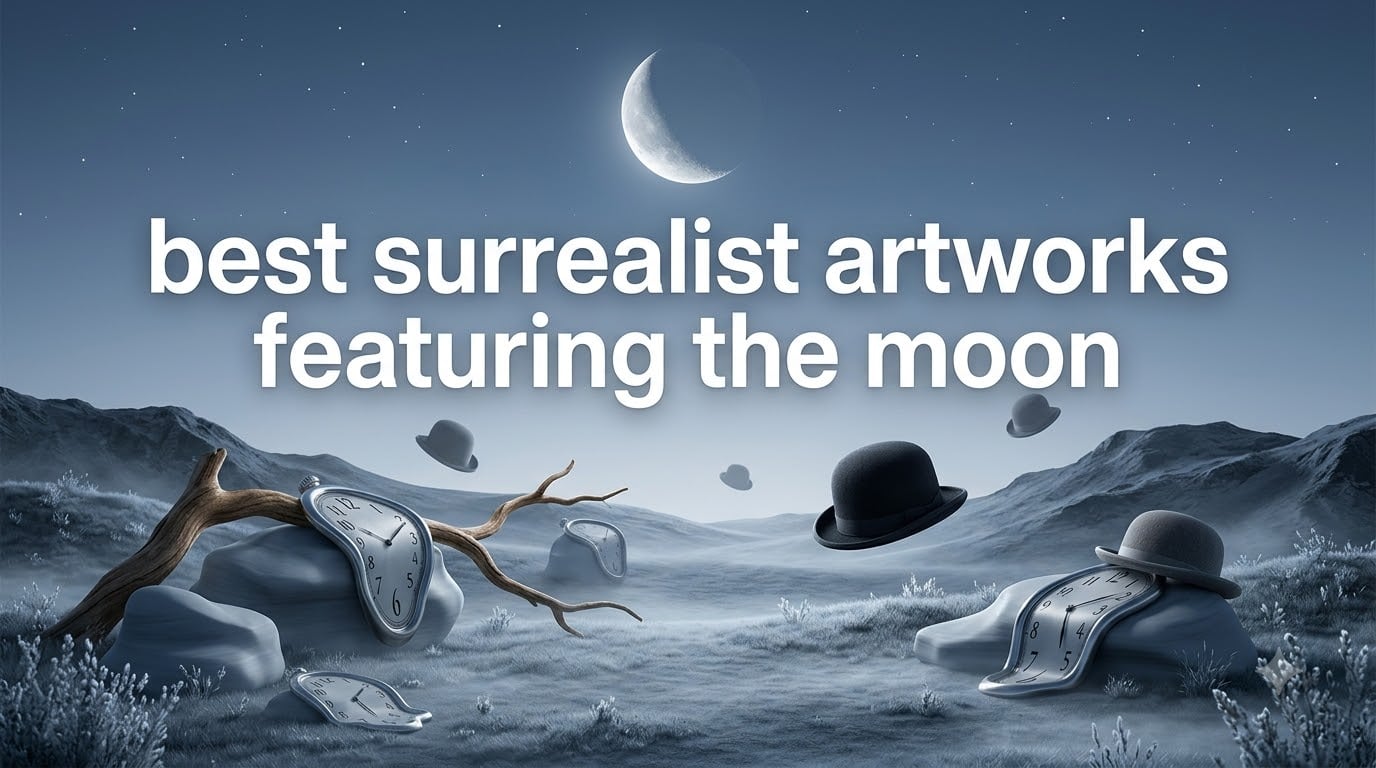
The moon has haunted Western art for centuries, but no movement embraced it more fiercely than Surrealism. When you explore the best surrealist artworks featuring the moon, you uncover a constellation of dreamlike paintings where lunar imagery becomes a portal to the unconscious mind. From Magritte’s bowler-hatted men gazing at crescent moons to Varo’s moon trapped in a birdcage, these works reveal why Surrealist painters returned to the moon again and again.
Table of Contents
What Makes an Artwork Surrealist?
Surrealism emerged in 1924 when André Breton published his Surrealist Manifesto in Paris. The movement sought to unlock the creative power of the unconscious mind by blending dreamlike imagery with unexpected, often irrational juxtapositions.
At its core, Surrealist art draws heavily on Sigmund Freud’s theories of the unconscious. Artists like Salvador Dalí and René Magritte deliberately painted scenes that defied rational logic, aiming to reveal truths hidden beneath the surface of everyday reality.
Two distinct approaches defined the movement. Veristic surrealists like Dalí rendered dreams with photographic precision, while paradigmatic surrealists like Max Ernst and Joan Miró used automatism and abstraction to channel the unconscious directly onto the canvas.
Why Did Surrealists Love the Moon?
The moon held special meaning for Surrealist artists because it embodied one of the movement’s central ideas: that hidden realities exist beneath the visible world. Just as the moon shows only one face to Earth while concealing the other, surrealists believed everyday reality masked a deeper, dreamlike truth.
Breton himself saw the moon as a symbol of the feminine, the mysterious, and the irrational. In Freudian terms, the moon’s cyclical phases mirrored the rhythms of the unconscious—waxing and waning like repressed desires surfacing in dreams.
The concept of the moon’s “hidden face” became one of Surrealism’s most powerful visual metaphors. Because we only ever see one side of the moon from Earth, surrealists read this as proof that reality itself has a concealed dimension. Magritte captured this idea explicitly in Le Chef-d’œuvre ou les mystères de l’horizon, where three crescent moons appear in different positions around identical bowler-hatted figures, each suggesting a different perspective on the same hidden truth.
There was also an aesthetic appeal. Moonlight cast the world in silvery, otherworldly tones that perfectly matched the surrealists’ goal of defamiliarizing the ordinary. A landscape bathed in moonlight already looked like a dream, making it the ideal setting for Surrealist visions.
The 10 Best Surrealist Artworks Featuring the Moon
Each of the following works uses the moon as a key motif, whether as a symbol of the unconscious, a marker of dreamlike space, or an element that transforms the familiar into the uncanny.
1. René Magritte — Le Chef-d’œuvre ou les mystères de l’horizon (1955)
Three men in identical bowler hats stand in twilight, each with a small crescent moon floating above or beside their heads. The painting is Magritte’s most iconic lunar image and one of the most recognizable surrealist artworks of the twentieth century.
The crescent moons serve as a visual enigma. They exist in three different positions, suggesting that reality—like the moon—presents a different face depending on the observer’s perspective. The bowler hats, Magritte’s signature motif of anonymous conformity, become strangely poetic when paired with the celestial bodies above them.
This work resides in a private collection but has been widely exhibited at institutions including the Magritte Museum in Brussels. Art historians consider it a masterclass in Magritte’s ability to make the ordinary appear mysterious through subtle visual displacement.
2. Salvador Dalí — Big Thumb. Beach. Moon and Decaying Bird (1928)
Painted during Dalí’s early Surrealist period, this work features a fragmented landscape of the Catalan coast with a pale moon dominating the upper portion of the canvas. Organic forms—flesh-like shapes and decaying imagery—crowd the foreground in what Dalí called a “paranoiac-critical” composition.
The moon here is not a peaceful celestial object but an unsettling presence that illuminates decay and transformation. Dalí’s technique during this period was deliberately crude and raw, channeling Freudian automatic drawing to bypass rational thought.
The painting belongs to the Museo Nacional Centro de Arte Reina Sofía in Madrid. It represents a critical moment when Dalí was developing the visual vocabulary that would define his career, before his later shift toward hyper-realistic rendering.
3. Remedios Varo — Celestial Pablum (1958)
This is one of the most extraordinary surrealist moon paintings ever created, and it remains underappreciated in mainstream art history. A woman—often interpreted as a personification of the moon—sits in a tower, feeding the actual crescent moon from a spoon through a window.
Varo, a Spanish-Mexican painter, used this image to explore themes of feminine creativity and nourishment. The moon is literally being fed, sustained by a female figure who controls celestial forces from her domestic space. It is a radical reimagining of the moon as something dependent on feminine energy rather than passively illuminating the night sky.
The painting is housed in the Museum of Modern Art in Mexico City. Varo’s work has experienced a significant reappraisal in recent decades, with Celestial Pablum now recognized as one of the defining works of female Surrealism.
4. Dorothea Tanning — Eine Kleine Nachtmusik (1943)
The title references Mozart’s famous serenade, but the painting depicts a nightmarish hotel corridor bathed in an eerie, moonlit glow. A giant sunflower with humanoid features blocks the hallway while a young girl stands at the threshold, her nightgown blown by an unseen wind.
Tanning’s use of moonlight transforms the domestic setting of a hotel into something deeply unsettling. The corridor stretches into darkness, suggesting that the rational world is merely a thin veneer over a chaotic, dreamlike reality.
This painting belongs to the Tate collection in London. Tanning, who lived to be 101, was one of the most important American Surrealists and used moonlit interiors as a recurring setting to explore themes of adolescence, awakening, and the uncanny.
5. Max Ernst — Naissance d’une galaxie (Birth of a Galaxy, 1969)
Created late in Ernst’s career, this cosmic painting shows celestial bodies emerging from primordial matter in a swirling, biomorphic composition. The moon appears as a luminous orb at the center of a new galaxy being born, connecting lunar imagery to themes of creation and universal origin.
Ernst was deeply interested in the cosmos throughout his life, and this painting represents the culmination of decades of experimentation with cosmic imagery. The technique combines his signature grattage method—scraping paint across textured surfaces—with a visionary sense of scale.
The work is part of the Peggy Guggenheim Collection in Venice. Ernst’s late cosmic paintings are among the most ambitious works in the Surrealist canon, expanding the moon motif from a personal symbol into a universal one.
6. Leonora Carrington — The Old Maids (1947)
Carrington, a British-born Mexican Surrealist, paints a bizarre dinner scene where elderly women sit around a table under a massive, otherworldly moon. The figures are grotesque and theatrical, their ritual meal taking on cosmic significance under the lunar glow.
The moon in this painting serves as a witness to feminine ritual and transformation. Carrington frequently used nocturnal settings to explore themes of aging, female community, and the boundary between the domestic and the supernatural.
This work is held in a private collection. Carrington’s art has gained enormous critical attention in the twenty-first century, with major retrospectives at institutions including the Museo de Arte Moderno in Mexico City and Tate Modern in London.
7. Yves Tanguy — Multiplication of the Arcs (1954)
Tanguy’s signature biomorphic forms populate a vast, moonlit desert landscape in this late masterpiece. Bone-like structures stretch across a flat plane beneath a luminous sky where the moon casts long, impossible shadows across the barren terrain.
Tanguy was entirely self-taught and claimed his paintings were inspired by visions he experienced as a child. The moon in his work transforms familiar landscapes into alien geographies, reinforcing the Surrealist belief that another world exists just beyond ordinary perception.
The painting is in the collection of the Museum of Modern Art in New York. Tanguy’s precision and his ability to create entirely convincing unreal spaces made him one of the most admired painters among his Surrealist peers.
8. Kay Sage — I Saw Three Cities (1944)
An American Surrealist who spent much of her career in France, Sage painted haunting architectural landscapes under vast, empty skies. In this work, three abstracted cities rise from a desolate plain beneath a pale, overbearing moon that dominates the composition.
Sage’s moon is not romantic but oppressive—a cold, indifferent presence hovering over human constructions. The painting captures the wartime anxiety of the 1940s, when European cities were being destroyed and rebuilt under the same ancient moon.
The work belongs to the Smithsonian American Art Museum in Washington, D.C. Sage was married to Yves Tanguy, and the couple’s parallel explorations of lunar landscapes represent one of the most productive artistic partnerships in Surrealist history.
9. Man Ray — Observatory Time: The Lovers (1932)
This photographic work combines multiple exposures to create an impossible image: a pair of red lips floats in the sky above a cityscape, with the moon visible in the background. The lips belonged to Lee Miller, Man Ray’s muse and collaborator, transformed into a celestial object.
Man Ray’s lunar photography challenged the boundary between photography and Surrealist art. By combining real celestial bodies with manipulated imagery, he proved that the Surrealist moon could exist even in the supposedly objective medium of photography.
Prints of this work are held in major collections worldwide, including the Metropolitan Museum of Art in New York and the Centre Pompidou in Paris. It remains one of the most reproduced Surrealist images of the twentieth century.
10. Giorgio de Chirico — The Song of Love (1914)
Though painted before the official founding of Surrealism, de Chirico’s proto-Surrealist masterpiece profoundly influenced the movement. A classical head sculpture, a rubber glove, and a green ball are set against a deep blue sky with a crescent moon on the horizon.
De Chirico’s moon presides over a metaphysical landscape where familiar objects become strange and menacing. Breton and the Surrealists claimed de Chirico as a direct precursor, recognizing in his work the same destabilization of rational space that they sought to achieve.
The painting is held at the Museum of Modern Art in New York. It is widely considered the single most influential proto-Surrealist work, and its moonlit atmosphere set the template for decades of Surrealist painting that followed.
Romantic Moon vs. Surrealist Moon: A Key Difference
Before Surrealism, the moon in Western art belonged primarily to the Romantics. Caspar David Friedrich’s Two Men Contemplating the Moon (1819) shows figures gazing at a serene crescent in a peaceful landscape. The moon invites quiet reflection and spiritual communion with nature.
The Surrealist moon is fundamentally different. In Magritte, Dalí, and Varo, the moon does not comfort—it disorients. It transforms familiar objects into strange, often threatening presences. Where the Romantic moon connects humans to the natural world, the Surrealist moon disconnects them from rational reality entirely.
This shift reflects the broader change in Western thought between the nineteenth and twentieth centuries. The Romantics believed nature revealed spiritual truths. The Surrealists, influenced by Freud and the trauma of two world wars, believed truth lay hidden in the unconscious—and the moon was the perfect symbol for that hidden realm.
Where to See These Works Today
Several of the paintings on this list are in major museums open to the public year-round. Magritte’s works are concentrated at the Magritte Museum in Brussels, while Dalí’s early Surrealist paintings can be found at the Museo Reina Sofía in Madrid and the Dalí Theatre-Museum in Figueres, Spain.
Remedios Varo’s paintings are primarily held in Mexican institutions, with the Museo de Arte Moderno in Mexico City housing Celestial Pablum and several other major works. Dorothea Tanning’s Eine Kleine Nachtmusik is in the Tate collection in London.
For American Surrealists, the Smithsonian American Art Museum in Washington, D.C. holds Kay Sage’s work, while the Museum of Modern Art in New York has paintings by Tanguy and de Chirico. The Peggy Guggenheim Collection in Venice is the best place to see Ernst’s late cosmic paintings.
For those interested in Man Ray’s photographic work, prints are available at the Metropolitan Museum of Art in New York and the Centre Pompidou in Paris. De Chirico’s proto-Surrealist masterpieces can be found at MoMA alongside works by Tanguy and Ernst.
If you are planning a museum visit, check each institution’s website for current exhibitions, as Surrealist moon paintings are frequently loaned to temporary shows and thematic exhibitions around the world. Major Surrealist retrospectives tend to group these lunar works together, offering a rare chance to compare them side by side in a single visit.
Frequently Asked Questions
What does the Moon symbolize in surrealist paintings?
In surrealist art, the moon symbolizes the hidden unconscious mind, feminine energy, mystery, and the irrational. Surrealists believed that just as the moon reveals only one face to Earth, reality conceals a deeper, dreamlike truth beneath its surface.
Who are the most famous surrealist painters who used the Moon?
The most famous surrealist painters who used the moon as a recurring motif are René Magritte, Salvador Dalí, Remedios Varo, Dorothea Tanning, Max Ernst, Leonora Carrington, Yves Tanguy, and Kay Sage. Magritte and Dalí are the best known, but female surrealists like Varo and Tanning produced some of the most original moon imagery.
Did Salvador Dalí paint the Moon?
Yes, Salvador Dalí painted the moon in several works, most notably Big Thumb. Beach. Moon and Decaying Bird (1928) and in fragments throughout his paranoiac-critical period. The moon in Dalí’s paintings usually represents unconscious revelation and dreamlike transformation.
Are there famous female surrealist moon paintings?
Yes, several of the most original surrealist moon paintings were created by women. Remedios Varo’s Celestial Pablum (1958) depicts a woman feeding the moon from a tower. Dorothea Tanning’s Eine Kleine Nachtmusik (1943) uses moonlit interiors to explore feminine awakening. Leonora Carrington and Kay Sage also created significant moon-themed works.
Where can I see surrealist moon paintings in person?
Major collections include the Magritte Museum in Brussels, the Dalí Theatre-Museum in Figueres, the Museo de Arte Moderno in Mexico City (for Varo), the Tate in London (for Tanning), the Museum of Modern Art in New York (for Tanguy and de Chirico), and the Peggy Guggenheim Collection in Venice (for Ernst).
Conclusion
The best surrealist artworks featuring the moon reveal why this celestial body captivated an entire artistic movement. From Magritte’s enigmatic crescents floating above bowler hats to Varo’s moon being nourished by a feminine figure in a tower, these works demonstrate that the moon was never just a backdrop in Surrealist art—it was a symbol of everything hidden, unconscious, and irrational that the surrealists wanted to bring into the light.
Whether you are a student of twentieth-century art or simply drawn to dreamlike imagery, these ten paintings offer a complete introduction to the Surrealist moon. The inclusion of four female surrealists—Varo, Tanning, Carrington, and Sage—is deliberate. These artists produced some of the movement’s most original lunar imagery, yet they have historically been overshadowed by their male counterparts. Their reappraisal in recent decades has enriched our understanding of why the moon mattered so deeply to Surrealism.
Visit the museums listed above to experience these works in person, where their scale, texture, and luminous moonlit atmospheres can be fully appreciated. A reproduction on a screen cannot capture the way moonlight seems to glow from within Varo’s canvas or the unsettling depth of Tanguy’s endless lunar deserts.